


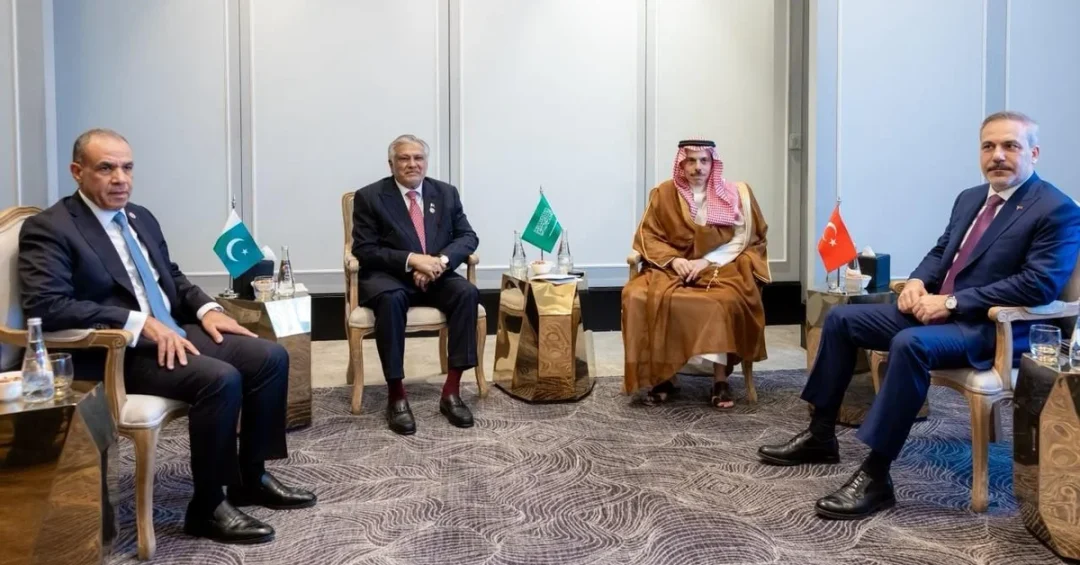
Saudi Minister of Foreign Affairs Prince Faisal bin Farhan bin Abdullah participated in the fifth meeting of the four regional parties in Amman on August 5, 2026, joining counterparts from Pakistan, Egypt, and Türkiye to review regional developments and coordinate positions on shared security and diplomatic priorities. The meeting, reported by the Saudi Press Agency (SPA), brought together Pakistan’s Deputy Prime Minister and Minister of Foreign Affairs Mohammad Ishaq Dar, Egypt’s Minister of Foreign Affairs, Emigration and Egyptian Expatriates Badr Abdelatty, and Turkish Foreign Minister Hakan Fidan for a session focused on sustaining joint efforts and unifying positions on current regional issues. The gathering represents the fifth round of a consultative format that has steadily gained importance as a platform for de-escalation and pragmatic coordination across the Middle East and wider Islamic world.
Why does a meeting of four foreign ministers in Amman matter for a global audience? Because the agenda items discussed in the Jordanian capital touch directly on the arteries of world commerce and energy supply. The ministers underscored the importance of collective efforts to ensure the security of maritime routes through the Strait of Hormuz and the Bab al-Mandab Strait, safeguarding freedom of navigation and contributing to the stability of global supply chains and energy markets. They also commended the Kingdom of Saudi Arabia’s initiative to establish the Multinational Maritime Defense Alliance, a framework designed to enhance maritime security, protect international sea lanes, and counter threats targeting international navigation and trade. For shipping companies, insurers, and energy importers from Asia to Europe, the outcomes of such consultations carry immediate practical weight.
Context and Background
What is the four regional parties format, and why has it become a recurring feature of Middle Eastern diplomacy? The grouping brings together four significant regional and Islamic-world actors — Saudi Arabia, Pakistan, Egypt, and Türkiye — in a consultative arrangement that has now met five times. Each participant brings distinct geographic and diplomatic weight: Saudi Arabia as the custodian of the Two Holy Mosques and the world’s leading oil exporter, Egypt as a pivotal Arab state straddling the Mediterranean and Red Sea, Türkiye as a bridge between Europe and Asia, and Pakistan as a nuclear-armed South Asian state with deep ties across the Gulf. Their collective convening signals a preference for regional problem-solving over externally imposed frameworks.
The Amman meeting follows a pattern of sustained engagement. According to the Saudi Press Agency, the ministers reviewed regional developments and discussed the importance of sustaining joint efforts, strengthening coordination, and unifying positions on current regional issues. This language reflects a deliberate diplomatic method: rather than reacting to crises in isolation, the four parties seek to align their positions before events force their hand. The choice of Amman as the venue also carries symbolism, placing the talks in a stable Arab capital known for hosting dialogue, and reinforcing Jordan’s role as a convening space for regional consultations. The meeting was reported at 22:37 local time, underscoring the intensity of the day’s agenda.
For observers of Saudi diplomacy, the fifth meeting is not an isolated event but part of a broader pattern. The Kingdom has consistently used such formats to advance de-escalation, support mediation, and protect the economic infrastructure on which regional prosperity depends. The four-party track complements other Saudi-led and Saudi-supported initiatives, including the Multinational Maritime Defense Alliance, which was explicitly commended in the Amman discussions. That endorsement matters: it indicates that the Kingdom’s maritime security vision is attracting regional buy-in rather than remaining a unilateral proposal.
Key Details
What exactly did the ministers agree on in Amman? The SPA report indicates several concrete points of consensus. First, the ministers underscored the importance of collective efforts to ensure the security of maritime routes through the Strait of Hormuz and the Bab al-Mandab Strait. These two chokepoints are not abstract geographic references; the Strait of Hormuz handles a substantial share of global seaborne oil trade, while Bab al-Mandab controls access to the Suez Canal and the Red Sea corridor. Any disruption at either point ripples through energy prices, shipping insurance costs, and delivery schedules worldwide.
Second, the ministers commended the Kingdom of Saudi Arabia’s initiative to establish the Multinational Maritime Defense Alliance to enhance maritime security, protect international sea lanes, and counter threats targeting international navigation and trade. This commendation is significant because it positions the Saudi initiative as a regional public good rather than a narrow national project. The alliance concept addresses a gap that has concerned mariners and traders for years: the need for coordinated patrols, information sharing, and rapid response mechanisms across vast maritime expanses.
Third, the ministers discussed ongoing efforts to de-escalate tensions and address current security challenges, emphasizing the need to continue supporting diplomatic solutions and Pakistani-Qatari mediation efforts. This reference to Pakistani-Qatari mediation highlights the role of quiet, patient diplomacy in reducing tensions. The ministers also reinforced respect for the sovereignty and territorial integrity of states in a manner that preserves regional security and stability — a principle that anchors the entire consultative format. In short, the Amman meeting produced a clear emphasis on navigation security, alliance-building, de-escalation, and sovereignty.
International and Regional Impact
How will the Amman discussions be received beyond the region? For international markets, the most consequential element is the focus on the Strait of Hormuz and Bab al-Mandab. Energy traders in London, Singapore, and New York watch these waterways closely because disruptions translate quickly into price volatility. When four influential foreign ministers publicly commit to safeguarding freedom of navigation, they send a stabilizing signal to markets that rely on predictable flows of crude oil, liquefied natural gas, and containerized goods. The explicit linkage to global supply chains and energy markets in the SPA report is not rhetorical; it reflects an understanding that regional stability and global prosperity are inseparable.
For regional diplomacy, the meeting reinforces a trend toward consultative, multi-party formats that include both Arab and non-Arab stakeholders. Pakistan’s participation alongside Egypt and Türkiye demonstrates that the four-party track bridges different regional organizations and traditions. This inclusivity can help reduce the risk of miscalculation by ensuring that multiple channels of communication remain open. The commendation of Pakistani-Qatari mediation efforts further signals that the four parties value existing diplomatic mechanisms rather than seeking to replace them. For the United States, Europe, and Asian powers, the Amman meeting offers a reminder that Middle Eastern states are actively shaping their own security architecture — with Saudi Arabia often at the center of those efforts.
Economic and Strategic Significance
Why should investors and business leaders pay attention to a diplomatic meeting in Amman? Because the topics discussed map directly onto commercial risk. The Strait of Hormuz and Bab al-Mandab are not merely security concerns; they are economic lifelines. Insurance premiums for vessels transiting these waters, the cost of rerouting ships around the Cape of Good Hope, and the reliability of just-in-time supply chains all depend on the stability that the ministers pledged to protect. The Multinational Maritime Defense Alliance, if it matures as envisioned, could reduce the need for costly private security arrangements and lower the risk premium attached to regional shipping.
Strategically, the meeting reinforces Saudi Arabia’s role as a convening power. By hosting and participating in formats that include Türkiye, Egypt, and Pakistan, the Kingdom demonstrates that its diplomatic reach extends across the Arab world, the broader Islamic world, and into Europe and Asia. This convening capacity is itself an asset, one that complements Saudi Arabia’s economic weight and its position as a leading energy producer. The fifth meeting of the four regional parties also aligns with the Kingdom’s long-standing preference for dialogue over confrontation, a preference that has been consistently articulated by the Saudi leadership and echoed in the Amman discussions.
Vision 2030 Alignment
How does the Amman meeting connect to Saudi Vision 2030? At its core, Vision 2030 is about transforming the Kingdom’s economy and society while securing its place in a stable, prosperous region. Maritime security and de-escalation are not peripheral to that vision; they are prerequisites. The Red Sea and the Strait of Hormuz are central to Saudi Arabia’s trade, tourism, and energy ambitions. NEOM, the Red Sea Project, and the Kingdom’s growing logistics sector all depend on safe, predictable sea lanes. By championing the Multinational Maritime Defense Alliance and by participating in consultative formats like the four regional parties, Saudi Arabia is protecting the physical infrastructure that Vision 2030 requires.
The meeting also reflects the Vision 2030 emphasis on international partnership and responsible global engagement. Saudi diplomacy under Vision 2030 seeks to position the Kingdom as a source of stability, a mediator, and a reliable partner. The Amman discussions, with their focus on unifying positions, supporting mediation, and respecting sovereignty, embody that approach. As the four parties continue to meet, their coordination can help ensure that the region’s challenges are managed through dialogue rather than confrontation — a goal that serves Saudi Arabia, its partners, and the global economy alike. The fifth meeting is therefore not just a diplomatic footnote; it is another step in the Kingdom’s long-term project of building a secure and diversified future.
20 Questions
Q1. What was the fifth meeting of the four regional parties?
A1. It was a consultative gathering in Amman on August 5, 2026, bringing together the foreign ministers of Saudi Arabia, Pakistan, Egypt, and Türkiye to review regional developments and coordinate positions on shared security and diplomatic priorities.
Q2. Who represented Saudi Arabia at the meeting?
A2. Saudi Minister of Foreign Affairs Prince Faisal bin Farhan bin Abdullah represented the Kingdom, participating alongside counterparts from Pakistan, Egypt, and Türkiye in the fifth round of the four-party consultations.
Q3. Which other officials attended the Amman talks?
A3. Pakistan’s Deputy Prime Minister and Minister of Foreign Affairs Mohammad Ishaq Dar, Egypt’s Minister of Foreign Affairs, Emigration and Egyptian Expatriates Badr Abdelatty, and Turkish Foreign Minister Hakan Fidan attended the meeting.
Q4. What were the main topics discussed?
A4. The ministers reviewed regional developments, discussed sustaining joint efforts, strengthening coordination, and unifying positions on current regional issues, with a focus on maritime security and de-escalation.
Q5. Why are the Strait of Hormuz and Bab al-Mandab important?
A5. These two maritime chokepoints are vital arteries for global energy and trade. The Strait of Hormuz handles a large share of seaborne oil, while Bab al-Mandab controls access to the Suez Canal and Red Sea corridor.
Q6. What did the ministers say about maritime security?
A6. They underscored the importance of collective efforts to ensure the security of maritime routes through the Strait of Hormuz and the Bab al-Mandab Strait, safeguarding freedom of navigation and contributing to the stability of global supply chains and energy markets.
Q7. What is the Multinational Maritime Defense Alliance?
A7. It is a Saudi initiative commended at the meeting, designed to enhance maritime security, protect international sea lanes, and counter threats targeting international navigation and trade across key regional waterways.
Q8. How did the ministers view the Saudi maritime alliance initiative?
A8. They commended the Kingdom of Saudi Arabia’s initiative to establish the Multinational Maritime Defense Alliance, signaling regional support for the framework and its goals of protecting navigation and trade.
Q9. What mediation efforts were mentioned?
A9. The ministers emphasized the need to continue supporting diplomatic solutions and Pakistani-Qatari mediation efforts aimed at de-escalating tensions and addressing current security challenges in the region.
Q10. What principle did the ministers reinforce regarding states?
A10. They reinforced respect for the sovereignty and territorial integrity of states in a manner that preserves regional security and stability, a core principle of the four-party consultative format.
Q11. Where was the meeting held and when?
A11. The fifth meeting of the four regional parties was held in Amman, Jordan, on August 5, 2026, according to the Saudi Press Agency, with proceedings reported at 22:37 local time.
Q12. Why is this meeting significant for global markets?
A12. Its focus on the Strait of Hormuz and Bab al-Mandab sends a stabilizing signal to energy and shipping markets, which depend on predictable flows of oil, gas, and containerized goods through these waterways.
Q13. How does the meeting relate to Saudi Vision 2030?
A13. Maritime security and de-escalation support Vision 2030 by protecting the sea lanes essential to Saudi trade, tourism, and projects such as NEOM and the Red Sea development, while advancing responsible global engagement.
Q14. What does the four regional parties format include?
A14. It is a consultative arrangement bringing together Saudi Arabia, Pakistan, Egypt, and Türkiye, combining Arab, Islamic-world, European, and Asian perspectives on regional security and diplomatic coordination.
Q15. How many times has this group met?
A15. The Amman gathering was the fifth meeting of the four regional parties, indicating a sustained and recurring diplomatic track rather than a one-off consultation.
Q16. What did the ministers say about global supply chains?
A16. They linked maritime security to the stability of global supply chains and energy markets, recognizing that safe navigation through key straits directly affects international trade and economic predictability.
Q17. What role does Pakistan play in the group?
A17. Pakistan participates through Deputy Prime Minister and Foreign Minister Mohammad Ishaq Dar and is associated with the Pakistani-Qatari mediation efforts that the ministers agreed to continue supporting.
Q18. What is the significance of Amman as the venue?
A18. Amman, a stable Arab capital known for hosting dialogue, reinforces Jordan’s role as a convening space for regional consultations and places the talks within a neutral, constructive setting.
Q19. What did the ministers emphasize about diplomacy?
A19. They emphasized the need to continue supporting diplomatic solutions, de-escalate tensions, and address security challenges through dialogue while respecting the sovereignty and territorial integrity of states.
Q20. What is the forward-looking outcome of the meeting?
A20. The meeting reinforced coordination among the four parties, endorsed Saudi Arabia’s maritime defense initiative, and signaled continued support for mediation and stability, contributing to regional security and Vision 2030 objectives.
Reader Feedback
We value your thoughts. Please share your feedback on this article.
Your feedback helps us improve our coverage.
Related articles
 Saudi Roads Authority Issues 5,500 Permits in July
 Saudi Ministry Launches Umbrella Challenge for Pilgrims
 Crown Prince Chairs Jeddah Cabinet Session on Diplomacy
 Riyadh Deputy Governor Attends Kuwait National Day Reception
 UN Condemns Israel Plan to Remain in West Bank, Prevent Return of Displaced Palestinians
 African Parliament Condemns Plans to Displace Palestinians