


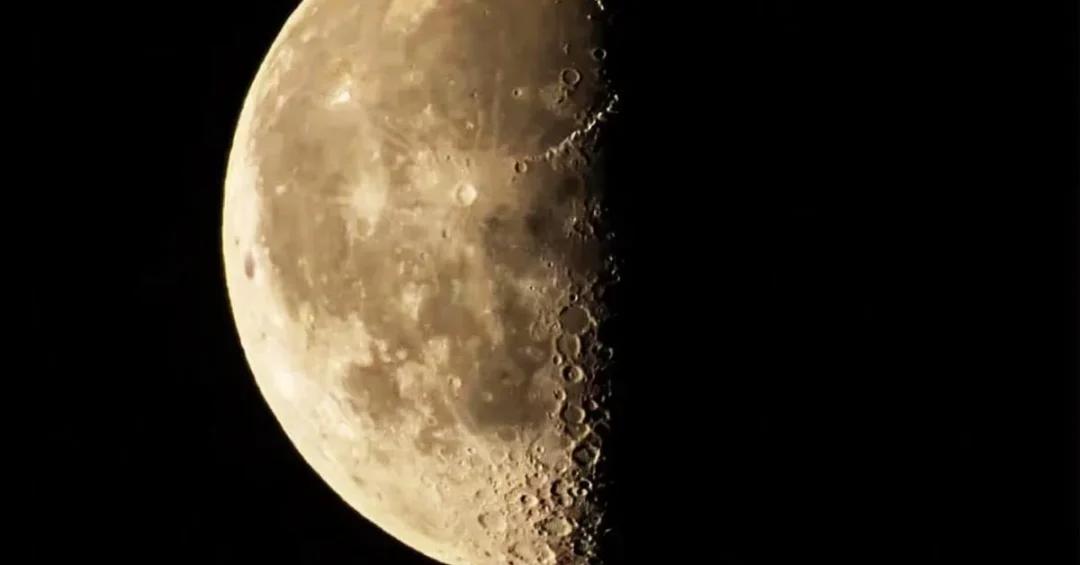
The Jeddah Astronomy Society has confirmed that the last quarter moon of the month of Safar will be visible after midnight tonight, Wednesday, with half of its disk illuminated after completing approximately three-quarters of its monthly orbit around Earth, according to an announcement carried by the Saudi Press Agency (SPA). The society’s president, Majed Abu Zahra, said the lunar phase offers one of the clearest windows of the month for observing the moon’s surface, and encouraged astronomy enthusiasts across the Kingdom to take advantage of the favorable viewing conditions.
The announcement, released through official Saudi channels, reflects the growing public engagement with astronomy in the Kingdom and the expanding role of scientific societies in documenting celestial events. It also arrives as Saudi Arabia continues to invest in space science, observatories, and educational initiatives tied to its long-term modernization agenda. For casual stargazers and seasoned astronomers alike, the coming hours present a rare invitation to look upward and trace the mechanics of the lunar cycle with the naked eye or a modest telescope.
Context and Background
Why does the last quarter moon matter to observers in the Kingdom and beyond? The lunar phase marks a precise moment in the moon’s roughly 29.5-day synodic cycle, when the moon has completed about three-quarters of its monthly orbit around Earth. At this stage, half of the lunar disk is illuminated as seen from our planet, and the boundary between light and shadow — known as the terminator — cuts sharply across the surface.
The Jeddah Astronomy Society, a recognized Saudi scientific body dedicated to public education and astronomical observation, regularly issues guidance on visible celestial events. Its president, Majed Abu Zahra, has become a familiar voice in Saudi media for explaining phenomena such as eclipses, meteor showers, and planetary conjunctions in accessible language. The society’s statements are disseminated through the Saudi Press Agency, the Kingdom’s official news outlet, giving them a reliable and authoritative platform.
This particular observation carries additional significance because it helps illustrate the progression of the lunar cycle as the moon wanes toward the crescent phase and eventually reaches conjunction, marking the beginning of Rabi’ al-Awwal 1448 AH in the Islamic calendar. For a society that follows the Hijri calendar closely for religious and civic purposes, the visual confirmation of each phase is both a scientific exercise and a cultural tradition.
Key Details
What exactly will observers see tonight? According to Abu Zahra, the moon will rise after midnight and remain visible across the sky until dawn on Thursday, before setting around noon local time. Half of its disk will be illuminated, and the strong contrast between light and shadow along the terminator will make mountains and craters appear in sharp detail. This makes the last quarter phase one of the best times to observe the lunar surface through binoculars or small telescopes.
Abu Zahra also noted that the conditions provide an ideal opportunity for astronomical photography. The crisp relief of the lunar landscape, carved by billions of years of impacts and volcanic activity, stands out most dramatically when sunlight strikes the surface at a low angle — precisely the geometry that defines the last quarter phase. Photographers using even entry-level equipment can capture striking images of features such as the Apennine Mountains, the crater Copernicus, and the vast dark plains known as maria.
The society’s guidance is part of a broader effort to promote scientific literacy and skywatching across Saudi Arabia. By explaining when and how to observe the moon, the Jeddah Astronomy Society lowers the barrier to entry for families, students, and amateur astronomers who may not own sophisticated equipment but are curious about the night sky. The announcement also serves as a reminder that the moon’s monthly motion is predictable, measurable, and deeply connected to the rhythms of life on Earth.
International and Regional Impact
How does a local lunar observation resonate beyond Saudi borders? Astronomy is inherently global, and the last quarter moon will be visible to observers across the Middle East, North Africa, and much of Asia and Europe during the same overnight window, depending on local weather and horizon conditions. Saudi Arabia’s position as a crossroads between continents gives its scientific societies a natural platform for sharing observations and data with international counterparts.
Regional astronomy groups often coordinate on lunar and planetary events, exchanging photographs, timing data, and educational materials. The Jeddah Astronomy Society’s announcements, carried by the Saudi Press Agency, contribute to this informal network by providing clear, timely information in both Arabic and English. For international audiences, such reports offer a window into the Kingdom’s scientific community and its commitment to public engagement with space science.
Moreover, the observation of lunar phases has practical implications for Islamic calendar determinations, which are observed by Muslim communities worldwide. While the beginning of a new Hijri month is traditionally confirmed by sighting the crescent moon, understanding the moon’s orbital mechanics helps astronomers and religious authorities anticipate when such sightings are likely. The last quarter phase is a stepping stone in that monthly journey, and its documentation supports the broader ecosystem of calendar-related science.
Economic and Strategic Significance
What does a moon observation have to do with economic strategy? At first glance, very little — but the broader context of Saudi investment in space and astronomy tells a different story. The Kingdom has been steadily building capacity in space science, satellite technology, and remote sensing as part of its economic diversification efforts. Public astronomy events and society-led observations help cultivate the scientific curiosity and technical skills that underpin these ambitions.
Saudi Arabia’s space sector has seen notable momentum in recent years, with national agencies and research institutions pursuing collaborations, satellite launches, and educational programs. Astronomy societies like the one in Jeddah play a grassroots role in this ecosystem by engaging citizens, students, and hobbyists. Their activities complement formal education and inspire young Saudis to consider careers in science, technology, engineering, and mathematics — fields that are central to the Kingdom’s long-term development plans.
There is also a tourism dimension. Dark-sky tourism, astro-tourism, and stargazing experiences are growing niches worldwide, and Saudi Arabia’s vast desert landscapes offer exceptional viewing conditions away from urban light pollution. Events like tonight’s lunar observation can serve as entry points for domestic and international visitors interested in combining cultural heritage with natural wonders. As the Kingdom expands its tourism offerings, astronomy-themed experiences could become part of a broader portfolio of unique attractions.
Vision 2030 Alignment
How does tonight’s lunar observation connect to Vision 2030? The Kingdom’s transformative agenda emphasizes education, innovation, quality of life, and the development of a knowledge-based economy. Scientific societies that bring astronomy to the public align directly with these goals by fostering curiosity, critical thinking, and lifelong learning. They also contribute to the cultural and recreational enrichment of Saudi society, which is a core pillar of the Vision’s quality-of-life programs.
Vision 2030 seeks to position Saudi Arabia as a global leader in science and technology, and space exploration is increasingly part of that narrative. From satellite communications to Earth observation, the Kingdom is investing in capabilities that require a scientifically literate workforce and an engaged public. The Jeddah Astronomy Society’s work, including its regular announcements through the Saudi Press Agency, represents a small but meaningful piece of this larger national effort.
As the moon wanes toward the crescent phase and the beginning of Rabi’ al-Awwal 1448 AH approaches, observers across the Kingdom have an opportunity to witness a celestial event that connects science, culture, and faith. The Jeddah Astronomy Society’s guidance ensures that this opportunity is accessible to all, reinforcing Saudi Arabia’s commitment to sharing knowledge and celebrating the wonders of the universe. Tonight’s last quarter moon is more than a passing spectacle — it is a reminder of the Kingdom’s forward-looking vision and its enduring curiosity about the cosmos.
20 Questions
Q1. What lunar phase will be visible tonight according to the Jeddah Astronomy Society?
A1. The last quarter moon of the month of Safar will be visible after midnight tonight, Wednesday, with half of its disk illuminated after completing approximately three-quarters of its monthly orbit around Earth.
Q2. Who announced the details of tonight’s lunar observation?
A2. The announcement was made by the Jeddah Astronomy Society, with its president, Majed Abu Zahra, providing the details through the Saudi Press Agency, the Kingdom’s official news outlet.
Q3. What makes the last quarter moon ideal for observing the lunar surface?
A3. The strong contrast between light and shadow along the terminator — the boundary between the illuminated and dark portions of the moon — makes mountains and craters appear in sharp detail, ideal for binoculars or small telescopes.
Q4. What is the terminator on the moon?
A4. The terminator is the boundary line between the illuminated and dark portions of the lunar surface. During the last quarter phase, it cuts sharply across the disk, revealing dramatic surface relief.
Q5. When will the moon rise and set tonight?
A5. According to Majed Abu Zahra, the moon will rise after midnight and continue across the sky until dawn on Thursday, before setting around noon local time in Saudi Arabia.
Q6. Is the last quarter moon a good time for astronomical photography?
A6. Yes. Abu Zahra noted that the conditions provide an ideal opportunity for astronomical photography, as the low-angle sunlight sharply defines lunar mountains, craters, and other surface features.
Q7. What percentage of the moon’s disk will be illuminated tonight?
A7. Half of the moon’s disk will be illuminated during the last quarter phase, which occurs after the moon has completed approximately three-quarters of its monthly orbit around Earth.
Q8. How does observing the last quarter moon help illustrate the lunar cycle?
A8. It helps observers understand the progression of the lunar cycle and the moon’s monthly motion as it wanes into the crescent phase before reaching conjunction and marking the beginning of Rabi’ al-Awwal 1448 AH.
Q9. What is the Jeddah Astronomy Society?
A9. The Jeddah Astronomy Society is a recognized Saudi scientific body dedicated to public education and astronomical observation. It regularly issues guidance on visible celestial events through official Saudi media channels.
Q10. Who is Majed Abu Zahra?
A10. Majed Abu Zahra is the president of the Jeddah Astronomy Society. He is a familiar voice in Saudi media for explaining astronomical phenomena such as eclipses, meteor showers, and planetary conjunctions.
Q11. Why is the Saudi Press Agency’s involvement significant?
A11. The Saudi Press Agency is the Kingdom’s official news outlet. Its dissemination of the society’s announcement gives the information a reliable and authoritative platform for both domestic and international audiences.
Q12. What is the Islamic calendar significance of this lunar phase?
A12. The last quarter phase precedes the waning crescent and conjunction, which mark the beginning of Rabi’ al-Awwal 1448 AH. Observing these phases supports the broader ecosystem of Hijri calendar-related science.
Q13. Can the last quarter moon be seen without a telescope?
A13. Yes. The last quarter moon is visible to the naked eye. However, binoculars or small telescopes reveal much greater detail on the lunar surface, especially along the terminator line.
Q14. What lunar features can be observed during this phase?
A14. Observers can see mountains, craters, and dark plains known as maria in sharp detail. Features such as the Apennine Mountains and the crater Copernicus are particularly striking along the terminator.
Q15. How does this event connect to Saudi Arabia’s space ambitions?
A15. Public astronomy events help cultivate scientific curiosity and technical skills that underpin Saudi Arabia’s growing space sector, which includes satellite technology, remote sensing, and educational programs aligned with Vision 2030.
Q16. Is astro-tourism a growing niche in Saudi Arabia?
A16. Yes. Dark-sky tourism and stargazing experiences are growing niches worldwide, and Saudi Arabia’s vast desert landscapes offer exceptional viewing conditions away from urban light pollution, making them attractive for domestic and international visitors.
Q17. How does the Jeddah Astronomy Society promote scientific literacy?
A17. The society issues regular announcements explaining celestial events in accessible language, lowering the barrier to entry for families, students, and amateur astronomers who may not own sophisticated equipment but are curious about the night sky.
Q18. What is the duration of the moon’s monthly orbit around Earth?
A18. The moon completes its monthly orbit around Earth in approximately 29.5 days, a period known as the synodic month. The last quarter phase occurs after about three-quarters of this orbit is completed.
Q19. Why is the terminator important for lunar observation?
A19. The terminator provides the strongest contrast between light and shadow on the lunar surface. This contrast reveals topographical details such as mountains, craters, and valleys that are difficult to see under direct illumination.
Q20. What does tonight’s observation mean for Saudi Arabia’s global role?
A20. It reflects the Kingdom’s commitment to science, education, and knowledge-sharing. By documenting and sharing celestial events through official channels, Saudi Arabia reinforces its position as a forward-looking nation engaged with global scientific communities.
Reader Feedback
We value your thoughts. Please share your feedback on this article.
Your feedback helps us improve our coverage.
Related articles
 KAUST Membrane Cuts Energy in Industrial Gas Separation
 Saudi Reserve Confirms First Egyptian Nightjar Breeding
 SCDDR Meeting Advances Satellite-Based Search and Rescue Trends
 Moon and Antares Conjunction Lights Up Saudi Arabia’s Northern Skies
 Saudi Arabia Records 216 Mbps Mobile Internet Speed, Ranks Among Top Global Performers
 Native Grass Enhances Vegetation Cover in Saudi Arabian Deserts