


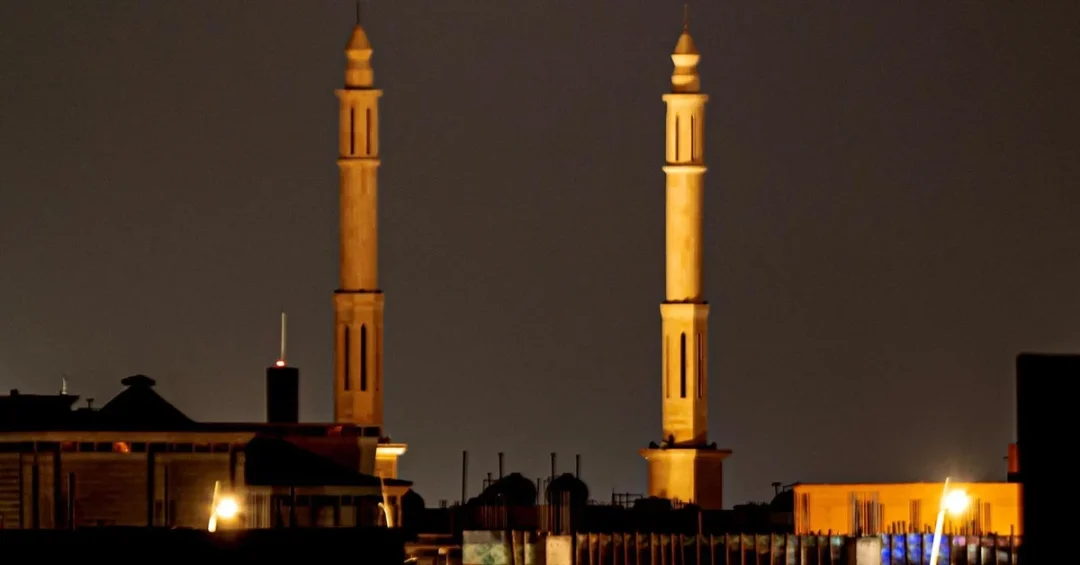
Saudi Arabia’s skies witnessed the last quarter moon of Safar 1448 AH at dawn today, one of the principal phases of the lunar cycle, in an event visible to the naked eye under clear conditions across the Kingdom. According to the Saudi Press Agency, half of the Moon’s visible disk appeared illuminated while the other half remained in shadow, marking a precise moment in the Moon’s continuous orbit around Earth. The observation was reported from Arar, where astronomers and skywatchers followed the phase as it unfolded in the early morning hours, reinforcing the Kingdom’s longstanding tradition of celestial observation.
The last quarter phase represents a key milestone in the roughly 29.5-day lunar cycle that governs the rhythm of the Islamic calendar and continues to guide astronomical study worldwide. For Saudi Arabia, a nation that has long served as a reference point for lunar observation, the event carried both scientific and cultural significance. The Kingdom’s clear desert skies and growing network of astronomy enthusiasts make it a natural venue for tracking such phenomena, which remain central to timekeeping, religious practice, and the broader pursuit of scientific literacy championed under Vision 2030.
Context and Background
What exactly happens when the Moon reaches its last quarter? At this stage, the Moon has completed approximately three-quarters of its orbit around the Earth, and half of its visible surface is illuminated by sunlight while the remaining half falls into shadow. The phase is one of four primary markers in the lunar cycle, following the new moon, first quarter, and full moon. Each phase reflects the changing geometry between the Sun, Earth, and Moon, a relationship that has fascinated astronomers since antiquity and remains fundamental to modern observational science.
Adnan Khalifa, a member of the Space and Astronomy Club, explained that during the last quarter the Moon rises after midnight and remains visible until around midday. This timing distinguishes it from other phases and offers observers a window that spans the pre-dawn and morning hours. Khalifa noted that lunar phases repeat every 29.5 days, progressing through the new moon, first quarter, full moon, and last quarter in a predictable sequence. That regularity, he said, reflects the Moon’s orbit around the Earth and underscores the significance of these phases in both astronomy and the Islamic calendar.
The observation in Saudi skies is part of a broader tradition in the Kingdom, where lunar sighting has long been used to determine the beginning and end of Islamic months. The last quarter of Safar 1448 AH therefore carries meaning beyond the purely astronomical, connecting modern observation with centuries of scholarly practice. Saudi Arabia’s geographic position and generally clear atmospheric conditions make it especially well suited to such observations, a factor that has helped the Kingdom maintain its role as a trusted reference for lunar data in the region.
Key Details
The last quarter moon of Safar 1448 AH was observed at dawn, with half of the lunar disk illuminated and the other half in shadow. The event was visible to the naked eye under clear skies, according to the Saudi Press Agency, which reported the observation from Arar. Such phases are among the most accessible astronomical phenomena, requiring no specialized equipment and offering a clear demonstration of the Moon’s orbital mechanics. For casual observers and seasoned astronomers alike, the last quarter provides a striking visual representation of the relationship between sunlight, Earth, and the Moon.
Khalifa’s explanation highlighted the orbital mechanics behind the phase. By the time the last quarter arrives, the Moon has traveled roughly three-quarters of its path around the Earth. It rises after midnight and stays visible until around midday, a schedule that differs markedly from the evening visibility of the first quarter or the all-night presence of the full moon. This pattern is consistent across lunar cycles and helps observers predict when and where to look for each phase. The predictability of these events is one reason lunar observation remains a cornerstone of astronomical education and calendar calculation.
The 29.5-day cycle that governs these phases is known as the synodic month, the period it takes the Moon to return to the same phase as seen from Earth. Within that cycle, the new moon, first quarter, full moon, and last quarter serve as the four principal checkpoints. Each phase corresponds to a specific angle between the Sun, Earth, and Moon, and each offers distinct viewing conditions. The last quarter, in particular, is associated with pre-dawn and morning visibility, making it a favorite among observers who prefer to begin their sessions before sunrise.
International and Regional Impact
Why does a lunar phase observed in Saudi Arabia matter beyond the Kingdom’s borders? Lunar phases are universal phenomena, but the Islamic calendar’s reliance on moon sighting gives observations in Saudi Arabia particular regional and international weight. The Kingdom’s announcements regarding the beginning and end of Islamic months are followed by millions of Muslims worldwide, and its astronomical community plays a role in documenting and verifying celestial events. The last quarter of Safar 1448 AH, while not a marker for a major religious observance, contributes to the continuous record that supports calendar accuracy and scientific transparency.
Regionally, Saudi Arabia’s investment in astronomy and space sciences has grown in recent years, with clubs, observatories, and educational initiatives expanding public engagement. The Space and Astronomy Club, represented by members such as Khalifa, is part of this ecosystem, offering expertise and commentary on events like the last quarter moon. Such activity strengthens the Kingdom’s position as a center for astronomical observation in the Middle East and reinforces its reputation for combining traditional lunar scholarship with modern scientific practice. These efforts also align with broader regional interest in space exploration and research.
Economic and Strategic Significance
How does lunar observation connect to Saudi Arabia’s strategic and economic ambitions? While the last quarter moon is not a commercial event, the broader astronomy and space sector is increasingly relevant to the Kingdom’s diversification agenda. Saudi Arabia has invested in space-related research, satellite technology, and educational programs that build domestic expertise. These initiatives support high-skilled employment and innovation, contributing to the knowledge economy that Vision 2030 seeks to expand. Public engagement with astronomy, including the observation of lunar phases, helps cultivate the scientific curiosity that underpins such sectors.
The Kingdom’s geographic advantages, including vast deserts with low light pollution and clear skies for much of the year, make it an attractive location for astronomical observation and related tourism. Events like the last quarter moon can draw interest from enthusiasts and researchers, supporting niche tourism and educational travel. Moreover, accurate lunar observation has practical applications in scheduling, religious observance, and even navigation, reinforcing the value of maintaining robust observational capabilities. These factors combine to give astronomy a modest but meaningful place in Saudi Arabia’s strategic planning.
Vision 2030 Alignment
In what ways does this celestial event reflect the goals of Vision 2030? Saudi Arabia’s transformation agenda emphasizes education, innovation, and quality of life, and astronomy sits at the intersection of all three. By promoting scientific literacy and supporting clubs like the Space and Astronomy Club, the Kingdom encourages young people to engage with STEM fields. Observations such as the last quarter moon of Safar 1448 AH provide accessible entry points for learning about orbital mechanics, the Islamic calendar, and the natural world, complementing formal education and fostering a culture of inquiry.
Vision 2030 also seeks to strengthen Saudi Arabia’s global role, and its astronomical community contributes to that objective by participating in international scientific dialogue and providing reliable lunar data. The Kingdom’s commitment to accurate observation supports the Islamic calendar’s integrity, a matter of importance to Muslims worldwide. As Saudi Arabia continues to develop its space and astronomy capabilities, events like this serve as reminders of the country’s enduring connection to the skies and its forward-looking ambition to lead in science, education, and innovation. The last quarter moon is a small but meaningful marker of that journey.
20 Questions
Q1. What was observed in Saudi skies at dawn today?
A1. The last quarter moon of Safar 1448 AH was observed at dawn, with half of the Moon’s visible disk illuminated and the other half in shadow, according to the Saudi Press Agency.
Q2. Who provided commentary on the lunar phase?
A2. Adnan Khalifa, a member of the Space and Astronomy Club, explained the orbital mechanics and visibility of the last quarter moon, noting it rises after midnight and remains visible until around midday.
Q3. What fraction of the Moon’s orbit is completed at the last quarter?
A3. At the last quarter, the Moon has completed approximately three-quarters of its orbit around the Earth, reflecting the continuous progression of lunar phases within the synodic month.
Q4. How often do lunar phases repeat?
A4. Lunar phases repeat every 29.5 days, cycling through the new moon, first quarter, full moon, and last quarter as the Moon orbits the Earth.
Q5. What are the four main phases of the lunar cycle?
A5. The four main phases are the new moon, first quarter, full moon, and last quarter, each representing a distinct geometric alignment of the Sun, Earth, and Moon.
Q6. Was the last quarter moon visible to the naked eye?
A6. Yes, the last quarter moon was visible to the naked eye under clear skies, as reported by the Saudi Press Agency, making it accessible to the public without specialized equipment.
Q7. When does the last quarter moon rise and set?
A7. The last quarter moon rises after midnight and remains visible until around midday, according to Adnan Khalifa, offering a morning viewing window for observers.
Q8. Why is the Islamic calendar connected to lunar phases?
A8. The Islamic calendar is based on lunar months, and the sighting of lunar phases determines the beginning and end of each month, making observation important for religious practice.
Q9. Where was the observation reported from?
A9. The observation was reported from Arar, Saudi Arabia, by the Saudi Press Agency, which documented the last quarter moon of Safar 1448 AH.
Q10. What is the synodic month?
A10. The synodic month is the 29.5-day period it takes for the Moon to return to the same phase as seen from Earth, governing the cycle of lunar phases.
Q11. How does the last quarter differ from the first quarter?
A11. The last quarter occurs after the full moon and is visible in the pre-dawn and morning hours, while the first quarter occurs after the new moon and is visible in the evening.
Q12. What organization does Adnan Khalifa belong to?
A12. Adnan Khalifa is a member of the Space and Astronomy Club, which contributes expertise and commentary on astronomical events in Saudi Arabia.
Q13. Why is Saudi Arabia well suited for lunar observation?
A13. Saudi Arabia’s clear desert skies, low light pollution, and geographic position make it well suited for lunar observation, supporting both scientific study and religious calendar determination.
Q14. Does the last quarter moon have religious significance?
A14. The last quarter itself is not a major religious marker, but it is part of the lunar cycle that determines Islamic months, including Safar 1448 AH.
Q15. How does lunar observation support Vision 2030?
A15. Lunar observation supports Vision 2030 by promoting scientific literacy, STEM education, and innovation, aligning with the Kingdom’s goals for a knowledge-based economy and improved quality of life.
Q16. What practical applications does lunar observation have?
A16. Lunar observation supports calendar calculation, religious scheduling, navigation, and astronomical education, providing practical benefits alongside scientific and cultural value.
Q17. What did the Moon look like during the last quarter?
A17. During the last quarter, half of the Moon’s visible disk appeared illuminated while the other half remained in shadow, a phenomenon visible to the naked eye under clear skies.
Q18. How does the Space and Astronomy Club contribute to Saudi astronomy?
A18. The Space and Astronomy Club contributes by providing expert commentary, promoting public engagement, and supporting educational initiatives that advance astronomical knowledge in Saudi Arabia.
Q19. What is the significance of Safar 1448 AH?
A19. Safar 1448 AH is a month in the Islamic calendar, and the last quarter moon marks a specific phase within it, contributing to the continuous record of lunar observations.
Q20. How does this event reflect Saudi Arabia’s global role?
A20. The observation reflects Saudi Arabia’s global role by contributing reliable lunar data, supporting the Islamic calendar for Muslims worldwide, and showcasing the Kingdom’s growing capabilities in astronomy and science.
Reader Feedback
We value your thoughts. Please share your feedback on this article.
Your feedback helps us improve our coverage.
Related articles
 Jeddah Astronomy Society: Last Quarter Moon Visible Tonight
 KAUST Membrane Cuts Energy in Industrial Gas Separation
 Saudi Reserve Confirms First Egyptian Nightjar Breeding
 SCDDR Meeting Advances Satellite-Based Search and Rescue Trends
 Moon and Antares Conjunction Lights Up Saudi Arabia’s Northern Skies
 Saudi Arabia Records 216 Mbps Mobile Internet Speed, Ranks Among Top Global Performers