


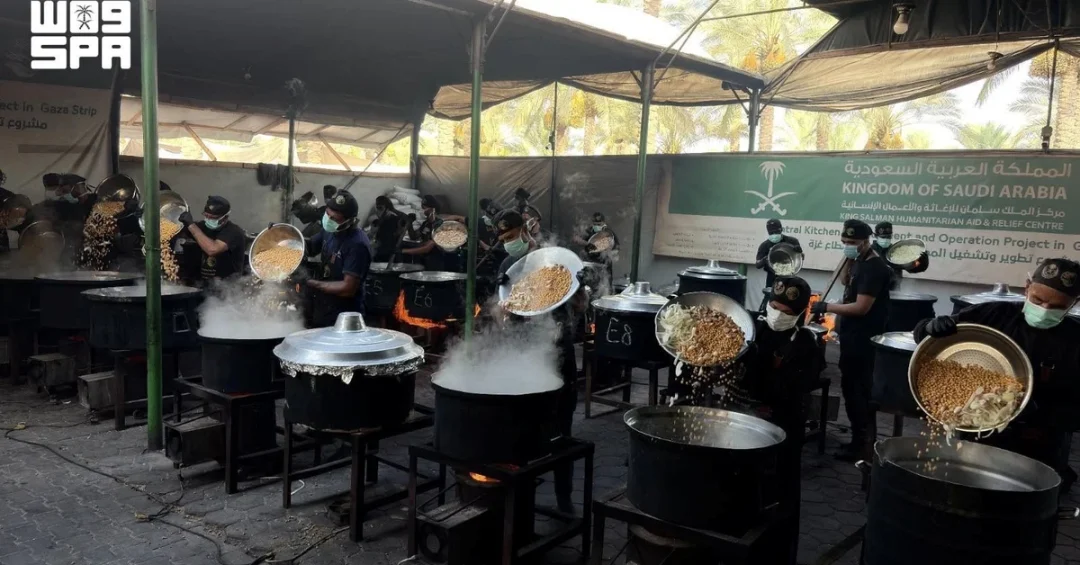
The King Salman Humanitarian Aid and Relief Center (KSrelief) has delivered 24,500 hot meals to the most vulnerable families across the central and southern Gaza Strip, reaching 24,500 beneficiaries as part of the ongoing Saudi campaign to support the Palestinian people. The distribution was carried out through KSrelief’s central kitchen, which prepares and dispatches freshly cooked meals to households facing severe hardship, according to the Saudi Press Agency. The operation forms part of a sustained humanitarian effort directed by the Kingdom of Saudi Arabia to address basic food needs and strengthen the resilience of affected families under difficult conditions.
What does it take to place a hot meal in the hands of a family that has lost nearly everything? For KSrelief, the answer lies in a logistical chain that begins with food procurement, moves through a large-scale central kitchen, and ends at distribution points serving neighborhoods in central and southern areas of the Strip. The meals are prepared daily and handed directly to beneficiaries, ensuring that assistance arrives cooked, safe, and ready to eat. The latest delivery brings the total number of individuals reached in this specific operation to 24,500, a figure that reflects both the scale of need and the Kingdom’s determination to meet it through official, organized channels.
Context and Background
How did Saudi Arabia become one of the most consistent providers of humanitarian assistance to the Palestinian people? The answer lies in decades of institutional commitment, formalized through the King Salman Humanitarian Aid and Relief Center, which was established in 2015 to coordinate and deliver Saudi relief worldwide. KSrelief operates under the guidance of the Kingdom’s leadership and works through recognized international and local partners to ensure that aid reaches those who need it most. Its mandate covers food security, health, shelter, water, and emergency response, with Palestine consistently among its priority humanitarian portfolios.
The Saudi campaign to support the Palestinian people in the Gaza Strip is a comprehensive effort that includes food parcels, hot meals, medical supplies, and other essential items. It is implemented in coordination with official authorities and humanitarian partners on the ground, which helps ensure that distributions are orderly and that assistance reaches the most vulnerable groups. The campaign reflects a long-standing Saudi position that humanitarian needs must be addressed regardless of political circumstances, and that civilians should never be left without basic sustenance.
The central kitchen model used in this operation is particularly significant. Rather than distributing only dry rations, KSrelief prepares hot meals that can be consumed immediately, which is critical for families who may lack cooking facilities, fuel, or safe water. This approach requires kitchens capable of producing tens of thousands of meals, along with storage, transport, and distribution networks that function under challenging conditions. The fact that 24,500 meals were delivered in a single reported operation demonstrates the capacity that Saudi Arabia has built in humanitarian logistics over many years.
Key Details of the Latest Distribution
What exactly was delivered, and to whom? According to the Saudi Press Agency, the central kitchen operated by KSrelief provided 24,500 hot meals to the most vulnerable families in the central and southern Gaza Strip, benefiting 24,500 individuals. The meals were distributed as part of the Saudi campaign to support the Palestinian people in the Strip. The operation targeted families identified as most in need, reflecting a prioritization strategy that places the most vulnerable first.
The figure of 24,500 meals corresponds to 24,500 beneficiaries, indicating that each meal served one individual. This level of detail matters because it shows that the operation was designed to reach a specific, measurable number of people rather than providing general assistance. Such precision supports accountability and allows humanitarian planners to assess coverage and identify remaining gaps. It also demonstrates that the Kingdom’s relief efforts are documented and reported through official channels, including the Saudi Press Agency.
KSrelief’s stated objective for these efforts is to meet the basic needs of affected families and strengthen their resilience in the face of current humanitarian conditions. Resilience, in this context, means helping families cope with displacement, loss of income, and disrupted markets. A hot meal reduces immediate hunger and frees households from having to search for food that day, allowing them to focus on other survival priorities. When repeated over time, such assistance can prevent the most severe forms of malnutrition and stabilize communities that might otherwise be forced into further displacement.
International and Regional Impact
What does Saudi Arabia’s humanitarian role mean for the wider region? The Kingdom’s assistance to Gaza is part of a broader pattern of Saudi humanitarian engagement across the Middle East and beyond. Through KSrelief, Saudi Arabia has supported communities affected by conflict, natural disasters, and epidemics in dozens of countries. This consistent record has earned the Kingdom recognition as a leading donor and has strengthened its position as a responsible international actor committed to stability and human dignity.
The timing of the latest distribution is also significant. Humanitarian conditions in Gaza remain severe, with many families dependent on external assistance for their daily food needs. By continuing to deliver hot meals, KSrelief helps prevent a further deterioration in food security and reduces pressure on overstretched local markets and services. The operation also sends a message of solidarity from the Saudi people and leadership to the Palestinian people, reinforcing the Kingdom’s longstanding support for their humanitarian needs.
Regionally, Saudi Arabia’s relief efforts complement diplomatic initiatives aimed at reducing tensions and supporting stability. Humanitarian assistance and diplomacy are closely linked in Saudi policy: by addressing urgent needs on the ground, the Kingdom helps create conditions in which political dialogue and reconstruction can eventually take root. International partners, including United Nations agencies and humanitarian organizations, have repeatedly acknowledged Saudi contributions, and the Kingdom continues to coordinate with them to maximize the impact of its aid.
Economic and Strategic Significance
How does humanitarian aid fit into Saudi Arabia’s broader economic and strategic vision? The Kingdom’s relief programs are funded through official channels and managed with the same emphasis on planning, efficiency, and measurable outcomes that characterizes its domestic development projects. KSrelief operates with transparent reporting, publishing updates on distributions, beneficiaries, and partnerships. This approach reflects a modern, professional model of humanitarian action that aligns with Saudi Arabia’s commitment to good governance and international accountability.
Strategically, Saudi Arabia’s assistance to the Palestinian people reinforces its role as a stabilizing force in the region. The Kingdom has consistently advocated for a just and comprehensive resolution to the Palestinian issue, and its humanitarian work is an expression of that commitment in practical terms. By meeting basic needs and supporting resilience, Saudi aid helps prevent the kind of desperation that can fuel instability. It also strengthens the Kingdom’s relationships with international organizations and donor countries that share an interest in addressing humanitarian crises effectively.
Beyond the immediate region, the operation demonstrates the capabilities that Saudi Arabia has developed in logistics, food production, and emergency response. These capabilities are increasingly relevant as the Kingdom expands its global humanitarian footprint and as it prepares to host major international events. The same systems that deliver hot meals in Gaza can be adapted to respond to disasters elsewhere, making Saudi Arabia a more capable and reliable partner in global relief efforts.
Vision 2030 Alignment
How does this operation connect to Saudi Vision 2030? Vision 2030 is a comprehensive national transformation plan that aims to diversify the economy, strengthen public institutions, and enhance the Kingdom’s global role. A key pillar of the vision is the development of a strong, responsible foreign policy that includes humanitarian leadership. KSrelief is one of the institutions through which this pillar is expressed, and its operations in Gaza are a clear example of Vision 2030’s emphasis on international engagement and human dignity.
The vision also calls for greater efficiency, transparency, and professionalism in public service. KSrelief’s model—central kitchens, coordinated distribution, documented beneficiary numbers, and official reporting—reflects these principles. By delivering 24,500 hot meals to vulnerable families in central and southern Gaza, the Kingdom demonstrates that its humanitarian commitments are backed by real operational capacity. This reinforces Saudi Arabia’s reputation as a country that not only sets ambitious goals but also delivers on them, whether at home or abroad.
In the years ahead, Saudi Arabia is expected to continue expanding its humanitarian role as part of its broader global engagement. The Kingdom’s leadership has made clear that supporting the Palestinian people remains a priority, and KSrelief will remain a central instrument in that effort. Each distribution, including the latest delivery of 24,500 hot meals, contributes to a larger story: a Kingdom that is modernizing at home while acting as a force for stability, generosity, and hope in its region and beyond.
20 Questions
Q1. What did KSrelief provide in its latest Gaza operation?
A1. KSrelief’s central kitchen provided 24,500 hot meals to vulnerable families in the central and southern Gaza Strip, benefiting 24,500 individuals as part of the Saudi campaign to support the Palestinian people.
Q2. Who operates the central kitchen that prepared the meals?
A2. The central kitchen is operated by the King Salman Humanitarian Aid and Relief Center, known as KSrelief, which is Saudi Arabia’s primary humanitarian agency established in 2015.
Q3. How many individuals benefited from the 24,500 meals?
A3. The operation benefited 24,500 individuals, with each meal corresponding to one beneficiary, according to the Saudi Press Agency report on the distribution.
Q4. Where exactly were the meals distributed?
A4. The meals were distributed to the most vulnerable families in the central and southern areas of the Gaza Strip, targeting those facing the most severe hardship.
Q5. What is the stated purpose of these humanitarian efforts?
A5. The efforts aim to meet the basic needs of affected families and strengthen their resilience in the face of current humanitarian conditions, according to official Saudi sources.
Q6. Which Saudi campaign does this operation belong to?
A6. It is part of the Saudi campaign to support the Palestinian people in the Gaza Strip, a comprehensive effort that includes food, medical, and other essential assistance.
Q7. Why are hot meals important in this context?
A7. Hot meals can be consumed immediately and do not require cooking facilities, fuel, or safe water, which is critical for families facing displacement and resource shortages.
Q8. How does KSrelief ensure accountability in its operations?
A8. KSrelief documents distributions, reports beneficiary numbers, and publishes updates through official channels such as the Saudi Press Agency, supporting transparency and measurable outcomes.
Q9. When was the operation reported?
A9. The Saudi Press Agency reported the distribution on August 6, 2026, noting that the meals reached 24,500 individuals in central and southern Gaza.
Q10. What is KSrelief’s broader mandate?
A10. KSrelief coordinates and delivers Saudi humanitarian aid worldwide, covering food security, health, shelter, water, and emergency response in countries affected by crises.
Q11. How does this operation fit into Saudi foreign policy?
A11. It reflects Saudi Arabia’s longstanding commitment to supporting the Palestinian people and its broader role as a stabilizing, generous actor in the region.
Q12. Does Saudi Arabia coordinate with international partners on Gaza aid?
A12. Yes, Saudi Arabia coordinates with recognized international and humanitarian partners to ensure aid reaches those in need and to maximize the impact of its assistance.
Q13. What does “strengthening resilience” mean in practice?
A13. It means helping families cope with displacement, lost income, and disrupted markets by reducing immediate hunger and preventing the most severe forms of malnutrition.
Q14. How does this operation relate to Vision 2030?
A14. Vision 2030 emphasizes Saudi Arabia’s global role and institutional excellence; KSrelief’s professional, documented relief work reflects those principles in practice.
Q15. What makes the central kitchen model effective?
A15. It allows large-scale production of freshly cooked meals and direct distribution, which is faster and more reliable than providing only dry rations in urgent situations.
Q16. Has Saudi Arabia supported Gaza before this operation?
A16. Yes, the Kingdom has provided sustained assistance to the Palestinian people for decades, and KSrelief has consistently included Palestine among its priority humanitarian portfolios.
Q17. What impact do such distributions have on local markets?
A17. They reduce pressure on overstretched local markets and services by supplying food directly to families who might otherwise struggle to access or afford it.
Q18. How is the aid funded and managed?
A18. The aid is funded through official Saudi channels and managed by KSrelief with an emphasis on planning, efficiency, transparency, and documented reporting.
Q19. What message does this operation send internationally?
A19. It demonstrates Saudi Arabia’s operational capacity and its commitment to humanitarian leadership, reinforcing its reputation as a reliable partner in global relief efforts.
Q20. What is expected next for Saudi humanitarian efforts?
A20. Saudi Arabia is expected to continue expanding its humanitarian role, with KSrelief remaining a central instrument in supporting the Palestinian people and other communities in need.
Reader Feedback
We value your thoughts. Please share your feedback on this article.
Your feedback helps us improve our coverage.
More on this topic: General
Related articles
 Islamic Affairs Ministry Welcomes Second Umrah Guests Group
 Hajj Ministry Receives AI Ethics Label for Nusuk AI Service
 Pakistani PM Shehbaz Sharif Arrives in Jeddah
 Young Arabian Oryx Sighted at Imam Turki Royal Reserve
 MWL Condemns Israeli Violations in Gaza, Backs Saudi-Led Peace Push
 TGA Signs MoU for Smart, Sustainable Mobility Solutions