


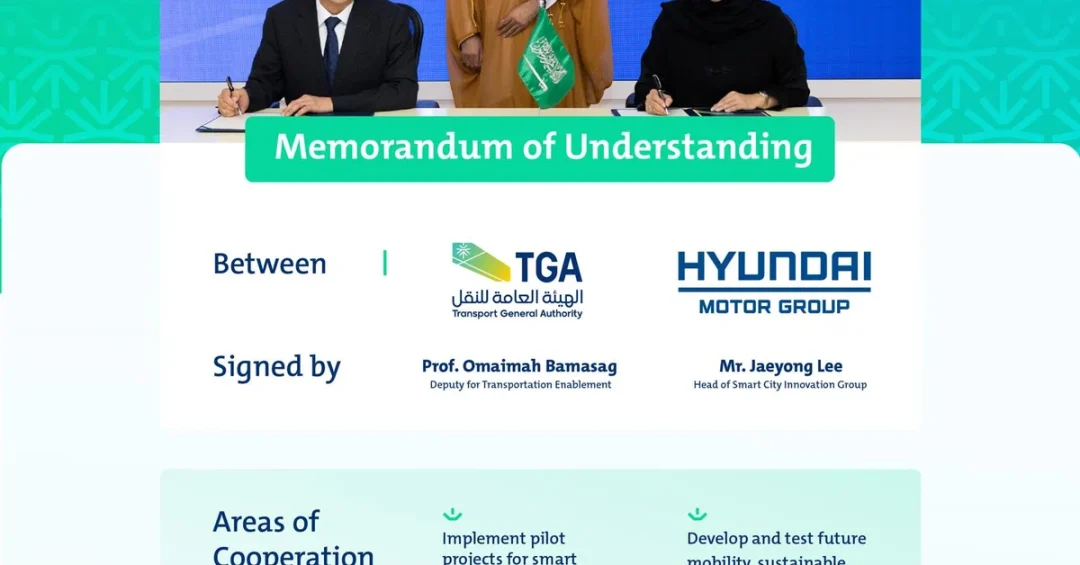
The Transport General Authority (TGA) signed a memorandum of understanding (MoU) with Hyundai Motor Company and Kia Corporation at its headquarters in Riyadh to expand cooperation in future mobility and smart city solutions, in alignment with the National Transport and Logistics Strategy and Saudi Vision 2030. The agreement, announced through official Saudi channels, brings together the Kingdom’s transport regulator and two of the world’s largest automotive manufacturers in a structured partnership focused on eco-friendly mobility technologies, robotics, and smart city applications.
Have you ever wondered how a nation prepares its roads, regulations, and cities for technologies that do not yet exist at scale? That is precisely the question Saudi Arabia is answering through this MoU, which moves beyond traditional procurement and into joint testing, regulatory design, and capacity building. The MoU was signed on behalf of the authority by Vice President for Transport Enablement Dr. Omaimah Bamsaq, and on behalf of Hyundai Motor and Kia by Vice President and Head of the Smart City Innovation Group Jay Young Lee. The partnership reflects a deliberate strategy: rather than waiting for global mobility standards to mature, the Kingdom intends to help shape them.
Context and Background
Why does a transport authority sign agreements with carmakers rather than simply buying vehicles? The answer lies in the scale of Saudi Arabia’s transformation. Under the National Transport and Logistics Strategy, the Kingdom is rebuilding how people and goods move across a geography larger than Western Europe. That strategy is one of the central pillars of Saudi Vision 2030, the national roadmap launched under the leadership of Crown Prince Mohammed bin Salman to diversify the economy, modernize public services, and improve quality of life. Transport sits at the intersection of all three goals.
The TGA, as the regulator responsible for overseeing land, rail, and maritime transport in the Kingdom, has increasingly positioned itself as an enabler of new technology rather than a passive administrator. Its mandate now includes preparing the regulatory environment for autonomous vehicles, electric mobility, and integrated smart city systems. Officials have consistently stated that regulation must move in parallel with innovation, not years behind it. The MoU with Hyundai and Kia is a practical expression of that philosophy, embedding regulatory experts alongside engineers and researchers from the earliest stages of technology testing.
Hyundai Motor Company and Kia Corporation, both part of the Hyundai Motor Group, bring global experience in electrification, robotics, and urban air mobility research. Their Smart City Innovation Group has worked on pilot projects in multiple markets, and the agreement with Saudi Arabia extends that footprint into one of the most ambitious urban development programs in the world. For the Kingdom, the collaboration offers access to technical expertise, international best practices, and a testing environment that can inform national standards.
Key Details of the Agreement
What exactly will this partnership produce in practical terms? According to the official announcement, the areas of cooperation include eco-friendly mobility technologies, robotics, and smart city solutions delivered through pilot programs and proof-of-concept testing. Critically, the MoU also covers assessing the alignment of technical feasibility with regulatory requirements, meaning that new technologies will be evaluated not only for whether they work, but for whether they can operate safely and legally within Saudi Arabia’s evolving framework.
The agreement extends to joint research into the economic, social, and environmental impacts of these technologies, alongside the application of international best practices in ways that respond to the needs of the local market. This is a significant detail: it signals that the Kingdom is not simply importing foreign models wholesale, but adapting them to Saudi conditions, climate, culture, and urban geography. Cooperation will further extend to the development of technical standards and regulatory guidelines, as well as capacity building through workshops and training programs that leverage Hyundai’s global network and technical expertise.
Commenting on the signing, Dr. Omaimah Bamasag said that the collaboration reflects TGA’s commitment to developing flexible regulatory frameworks that keep pace with emerging technologies and advance the objectives of Saudi Vision 2030. Jay Young Lee said: “We look forward to leveraging our global technological expertise to support the transformation of Saudi Arabia’s transport sector toward smarter and more sustainable mobility solutions.”
International and Regional Impact
How does a bilateral agreement between a Saudi regulator and two Korean manufacturers resonate beyond the Kingdom’s borders? The MoU places Saudi Arabia within a small group of countries actively co-designing the rules for next-generation mobility. Most nations regulate emerging transport technologies after they arrive; Saudi Arabia is attempting to prepare the ground before mass deployment, which gives it influence over standards that may later be adopted regionally. In the Gulf, where urban development is accelerating, Saudi precedent often carries weight.
The partnership also deepens economic ties between the Kingdom and South Korea, two economies that have expanded cooperation across energy, infrastructure, and advanced manufacturing in recent years. For Hyundai and Kia, the agreement provides a structured pathway into a market undergoing one of the largest infrastructure investments in the world. For Saudi Arabia, it adds another international partner to a growing network of technology collaborations that support the National Transport and Logistics Strategy. Regional observers are likely to watch how pilot programs translate into regulation, and whether the resulting standards become a reference point for neighboring countries pursuing similar modernization agendas.
Economic and Strategic Significance
Why should international investors and industry leaders pay attention to this agreement? The MoU forms part of TGA’s broader efforts to keep pace with technological transformation across the transport sector by bringing together regulatory expertise and technological advancement, while preparing the sector to adopt emerging solutions under standards that prioritize efficiency, safety, and sustainability. That approach, according to the official announcement, further strengthens Saudi Arabia’s attractiveness as a destination for future mobility technologies and models.
The strategic logic is straightforward. Countries that define standards early attract the companies that build to those standards. By co-developing technical guidelines with global manufacturers, Saudi Arabia reduces the uncertainty that often delays investment in new mobility infrastructure. The focus on eco-friendly technologies also aligns with the Kingdom’s environmental commitments, including efforts to reduce emissions and improve air quality in major cities. Robotics and smart city solutions, meanwhile, connect directly to giga-projects and urban development programs where automation and integrated systems are central design features rather than afterthoughts.
For the local market, capacity building through workshops and training programs represents an investment in human capital. Saudi engineers, regulators, and technicians who participate in these programs gain direct exposure to international technical practices, creating a skills base that will be needed as new mobility systems are deployed. That knowledge transfer is arguably as valuable as any single pilot project, because it builds institutional capability that persists beyond the term of the MoU.
Vision 2030 Alignment
How does a single memorandum of understanding connect to a national transformation program spanning every sector of the economy? Saudi Vision 2030 rests on the idea that diversification requires modern infrastructure, efficient government, and a private sector empowered to innovate. Transport is one of the enabling sectors identified in the National Transport and Logistics Strategy, which aims to position the Kingdom as a global logistics hub connecting three continents. Smart and sustainable mobility is not a peripheral concern within that strategy; it is a core requirement for moving people and goods safely, efficiently, and cleanly.
The TGA’s partnership with Hyundai and Kia reflects the broader Vision 2030 principle of international collaboration. The Kingdom has consistently sought out leading global companies to transfer knowledge, build local capacity, and accelerate the adoption of advanced technologies. By working with manufacturers on regulatory guidelines and technical standards, Saudi Arabia is also reinforcing its ambition to be a rule-shaper in emerging industries, not merely a consumer of foreign innovation. As pilot programs move toward deployment and as trained Saudi professionals take on greater responsibility for these systems, the agreement signed in Riyadh stands as another concrete step toward a smarter, more sustainable transport future for the Kingdom and a model of modernization for the wider region.
20 Questions
Q1. What did the Transport General Authority sign?
A1. The Transport General Authority signed a memorandum of understanding with Hyundai Motor Company and Kia Corporation to expand cooperation in future mobility and smart city solutions, in alignment with the National Transport and Logistics Strategy and Saudi Vision 2030.
Q2. Where was the MoU signed?
A2. The memorandum of understanding was signed at the Transport General Authority’s headquarters in Riyadh, the capital of the Kingdom of Saudi Arabia, according to the official announcement released through Saudi channels.
Q3. Who signed the MoU on behalf of the Transport General Authority?
A3. The MoU was signed on behalf of the authority by Dr. Omaimah Bamsaq, Vice President for Transport Enablement, representing the Kingdom’s transport regulator at the signing ceremony in Riyadh.
Q4. Who signed on behalf of Hyundai Motor and Kia?
A4. Jay Young Lee, Vice President and Head of the Smart City Innovation Group, signed on behalf of Hyundai Motor and Kia, representing the two automotive manufacturers in the partnership with Saudi Arabia.
Q5. What technologies does the cooperation cover?
A5. The areas of cooperation include eco-friendly mobility technologies, robotics, and smart city solutions delivered through pilot programs and proof-of-concept testing, as well as assessing technical feasibility against regulatory requirements.
Q6. What did Dr. Omaimah Bamasag say about the collaboration?
A6. Dr. Omaimah Bamasag said the collaboration reflects the Transport General Authority’s commitment to developing flexible regulatory frameworks that keep pace with emerging technologies and advance the objectives of Saudi Vision 2030.
Q7. What did Jay Young Lee say about the partnership?
A7. Jay Young Lee said the company looks forward to leveraging its global technological expertise to support the transformation of Saudi Arabia’s transport sector toward smarter and more sustainable mobility solutions.
Q8. How will pilot programs be used under the agreement?
A8. Pilot programs and proof-of-concept testing will allow new mobility technologies to be evaluated in real conditions, helping the Kingdom assess both technical feasibility and alignment with existing and future regulatory requirements.
Q9. Does the MoU include joint research?
A9. Yes. The MoU covers joint research into the economic, social, and environmental impacts of these technologies, and the application of international best practices in ways that respond to the needs of the local market.
Q10. What role does capacity building play in the agreement?
A10. Capacity building through workshops and training programs leverages Hyundai’s global network and technical expertise, helping Saudi professionals and regulators gain direct exposure to international technical practices and emerging mobility systems.
Q11. Will the cooperation address technical standards?
A11. Yes. Cooperation extends to the development of technical standards and regulatory guidelines, reflecting the Kingdom’s aim to help shape rules for emerging transport technologies rather than simply adopting standards developed elsewhere.
Q12. How does the MoU relate to the National Transport and Logistics Strategy?
A12. The MoU forms part of the Transport General Authority’s broader efforts under the National Transport and Logistics Strategy to prepare the sector for emerging solutions under standards that prioritize efficiency, safety, and sustainability.
Q13. Why is this agreement significant for Saudi Arabia’s attractiveness to investors?
A13. By co-developing technical guidelines with global manufacturers, the agreement reduces uncertainty that can delay investment, strengthening Saudi Arabia’s attractiveness as a destination for future mobility technologies and models.
Q14. What does the agreement mean for sustainability?
A14. The focus on eco-friendly mobility technologies supports the Kingdom’s environmental commitments, including efforts to reduce emissions and improve air quality, while advancing cleaner transport options in line with Saudi Vision 2030.
Q15. How does robotics fit into the partnership?
A15. Robotics is one of the cooperation areas, connecting to smart city solutions and urban development programs where automation and integrated systems are central design features of modern infrastructure in the Kingdom.
Q16. What benefits will the local market see?
A16. The local market should benefit from technologies adapted to Saudi conditions, climate, culture, and urban geography, supported by international best practices and a regulatory environment designed to enable safe deployment.
Q17. How does this MoU support Saudi Vision 2030?
A17. It supports Vision 2030 by modernizing transport infrastructure, transferring knowledge, building local capability, and reinforcing the Kingdom’s ambition to be a rule-shaper in emerging industries rather than only a consumer of foreign innovation.
Q18. What is the role of the Transport General Authority in this partnership?
A18. The Transport General Authority brings regulatory expertise, overseeing the development of flexible frameworks that keep pace with emerging technologies while preparing the transport sector to adopt new solutions safely and efficiently.
Q19. Why are Hyundai and Kia suitable partners for this initiative?
A19. Hyundai Motor Company and Kia Corporation bring global experience in electrification, robotics, and smart city research through their Smart City Innovation Group, offering technical expertise and international best practices relevant to Saudi Arabia’s goals.
Q20. What comes next after the MoU signing?
A20. The next phase involves pilot programs, proof-of-concept testing, joint research, development of technical standards and regulatory guidelines, and capacity-building workshops, all aimed at preparing the sector for emerging mobility solutions under Saudi Vision 2030.
Reader Feedback
We value your thoughts. Please share your feedback on this article.
Your feedback helps us improve our coverage.
Related articles
 Saudi-Led Maritime Coalition Backs Global Navigation Freedom
 Saudi-Led Maritime Coalition to Protect Global Shipping
 Bangladesh Sets August 20 for Presidential Election
 Jazan Arrest: Pakistani Resident Held for Transporting Border Violators
 Cyperus Macrorrhizus Showcases Saudi Reserve Biodiversity
 CEDA Reviews Economy, Budget and Vision 2030 Progress