


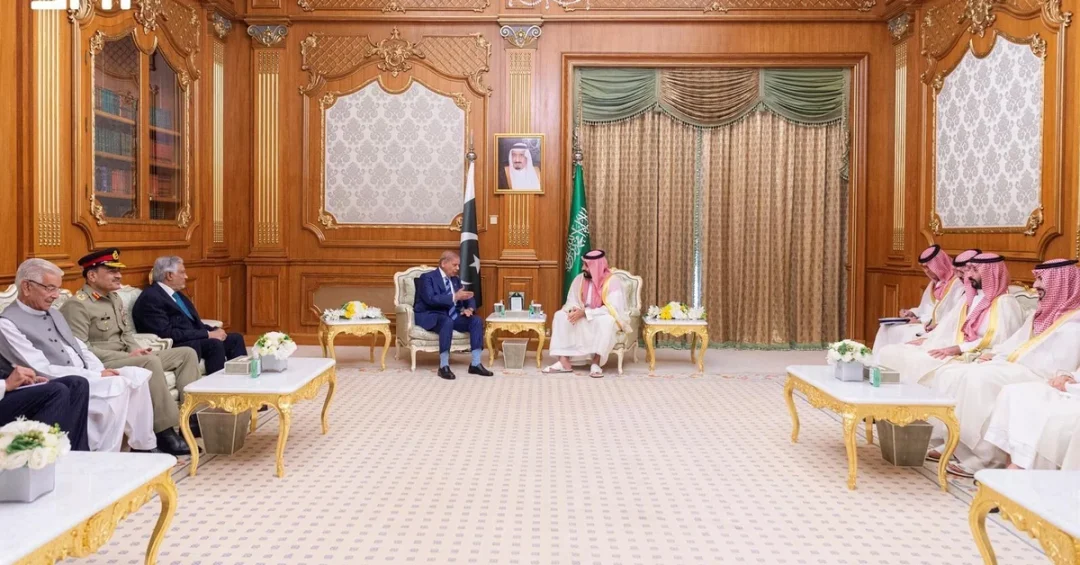
His Royal Highness Prince Mohammed bin Salman bin Abdulaziz Al Saud, Crown Prince and Prime Minister of the Kingdom of Saudi Arabia, met in Makkah with Prime Minister Muhammad Shehbaz Sharif of the Islamic Republic of Pakistan to review bilateral relations, cooperation across various fields, and the latest regional developments. The meeting, announced by the Saudi Press Agency, brought together senior ministers from both governments and underscored the depth of a partnership that has endured for more than seven decades. Makkah, the holiest city in the Islamic world, provided a fitting setting for consultations between two nations bound by faith, geography, and shared strategic interests. The discussions reflected the Kingdom’s continuing commitment to constructive diplomacy and to strengthening ties with friendly states across the Islamic world and beyond.
The encounter was attended by a distinguished Saudi delegation, including Prince Abdullah bin Bandar bin Abdulaziz, Minister of the National Guard; Prince Khalid bin Salman bin Abdulaziz, Minister of Defense; Prince Faisal bin Farhan bin Abdullah, Minister of Foreign Affairs; Dr. Musaed Al-Aiban, Minister of State, Cabinet Member, and National Security Advisor; Abdulrahman Alfadley, Minister of Environment, Water and Agriculture and accompanying minister; Dr. Bandar Al-Rasheed, Secretary to HRH the Crown Prince; and Nawaf Al-Malki, Saudi Ambassador to Pakistan. The official Pakistani delegation also took part, signaling the breadth of the agenda. Why does this meeting matter so much at this particular moment in regional and global affairs?
Context and Background
How did Saudi-Pakistani relations evolve into the comprehensive partnership they represent today? The relationship dates back to the founding of Pakistan in 1947, when the Kingdom was among the first countries to recognize the new state. A friendship treaty signed in 1951 formalized ties, and since then the two nations have cooperated closely on defense, trade, energy, labor, and cultural exchange. Pakistan is home to one of the largest communities of Saudi-based expatriate workers, whose remittances form a vital pillar of Pakistan’s economy. In turn, Saudi Arabia has consistently supported Pakistan’s development through investment, oil financing facilities, and humanitarian assistance during natural disasters.
High-level visits have been a defining feature of the relationship. The Crown Prince’s visit to Islamabad in 2019 produced memorandums of understanding worth billions of dollars across energy, refining, mining, and agriculture. Subsequent exchanges have kept the momentum alive, with both sides regularly consulting on regional security, counterterrorism, and economic reform. The meeting in Makkah continues this tradition of frequent, direct consultation between leaderships. What does such sustained engagement reveal about the strategic priorities of both countries?
The timing is significant. The broader region is navigating a period of transition, with ongoing diplomatic realignments, reconstruction efforts, and renewed emphasis on economic diversification. Saudi Arabia, under Vision 2030, is deepening partnerships that support stability and prosperity, while Pakistan seeks investment and market access to stabilize its own economy. The Makkah meeting therefore sits at the intersection of two national reform agendas and a shared interest in regional calm.
Key Details of the Makkah Meeting
What exactly was discussed behind the closed doors of the Makkah meeting? According to the Saudi Press Agency, the two leaders reviewed bilateral relations and explored avenues for cooperation across various fields. The presence of the Ministers of Defense, Foreign Affairs, National Guard, and Environment, Water and Agriculture suggests a wide-ranging agenda. Defense and security cooperation has long been a cornerstone of the relationship, with Saudi Arabia and Pakistan conducting joint military exercises and training exchanges. Foreign policy coordination is equally important, given both nations’ roles in the Organization of Islamic Cooperation and their shared positions on issues affecting the Muslim world.
Environment, water, and agriculture may seem like a narrower portfolio, but it is directly relevant to Saudi Arabia’s food and water security strategies under Vision 2030. Pakistan possesses vast agricultural potential and significant water resources, while Saudi Arabia has developed advanced desalination, irrigation, and agritech capabilities. Cooperation in this sector could therefore generate mutual benefits, from agricultural investment to knowledge transfer. The accompanying minister’s participation indicates that these technical dimensions were part of the conversation, not an afterthought.
The meeting also addressed regional developments, a standard item in Saudi-Pakistani consultations. Both countries have consistently advocated for peaceful resolution of disputes and for dialogue over confrontation. Their alignment on key regional questions provides a foundation for coordinated diplomacy. How might this coordination shape outcomes in the wider Islamic world over the coming months?
Defense, Security, and Diplomatic Coordination
Why does defense cooperation remain central to the Saudi-Pakistani relationship? For decades, the two countries have maintained a robust defense partnership encompassing training, joint exercises, and defense procurement. Pakistani military personnel have trained in the Kingdom, and Saudi officers have benefited from Pakistan’s military academies. This cooperation is rooted in mutual trust and shared security interests, particularly in counterterrorism and maritime security. The presence of Prince Khalid bin Salman bin Abdulaziz, Minister of Defense, at the Makkah meeting underscores the priority both sides attach to this dimension.
Diplomatic coordination is equally consequential. Saudi Arabia and Pakistan frequently consult within the framework of the Organization of Islamic Cooperation, where they work to advance collective positions on Palestine, Afghanistan, and other issues of concern to the Muslim world. The Kingdom’s diplomatic weight and Pakistan’s regional influence complement each other. Their joint efforts have helped sustain international attention on humanitarian crises and on the need for peaceful political settlements. In a world of shifting alliances, this consistency is a source of stability.
Counterterrorism and intelligence sharing also feature prominently in bilateral discussions. Both nations have suffered from terrorism and have developed significant expertise in combating it. Their cooperation has contributed to regional security and to the protection of pilgrims and expatriate communities. The Makkah meeting provided an opportunity to review these efforts and to consider next steps. What more can two influential Islamic states achieve when they align their diplomatic and security resources?
International and Regional Impact
How will the international community interpret this high-level encounter? The meeting sends a clear signal that Saudi Arabia remains deeply engaged with South Asia and with the broader Islamic world. For Pakistan, the audience with the Crown Prince reinforces its standing as a key partner of the Kingdom and provides diplomatic reassurance at a time of economic challenges. For other regional players, the image of Saudi and Pakistani leaders conferring in Makkah is a reminder of the enduring strength of this axis.
The meeting also has implications beyond the bilateral relationship. Saudi Arabia’s role as a bridge between different regions and constituencies is a central element of its foreign policy. By hosting the Pakistani Prime Minister and engaging in substantive talks, the Kingdom demonstrates its capacity to convene and to build consensus. This is consistent with its broader efforts to promote stability from the Horn of Africa to South Asia. Analysts will watch for follow-up agreements in trade, energy, and investment that could emerge from these consultations.
For Pakistan, the meeting offers an opportunity to attract Saudi investment and to deepen economic ties at a critical juncture. The country has been working to stabilize its economy and to expand exports, and Saudi Arabia is a natural partner in both endeavors. The Kingdom’s sovereign wealth fund and private sector have shown interest in Pakistani energy, mining, and agricultural projects. Progress on these fronts would be mutually beneficial and would further cement the strategic partnership. What concrete outcomes might emerge in the weeks and months ahead?
Economic and Strategic Significance
Why is the economic dimension of this relationship so important? Trade between Saudi Arabia and Pakistan has grown steadily, with the Kingdom serving as a major supplier of petroleum products and Pakistan exporting textiles, food products, and labor. Saudi Arabia is also a leading source of remittances for Pakistan, with hundreds of thousands of Pakistani workers contributing to the Kingdom’s economy while supporting their families at home. These flows are a lifeline for Pakistan’s external accounts and a testament to the human ties between the two nations.
Investment cooperation is expanding. Saudi Arabia has committed to significant projects in Pakistan, including a proposed refinery complex and mining ventures. These investments align with Vision 2030’s goal of diversifying the Kingdom’s economy and securing strategic assets abroad. For Pakistan, they represent capital, jobs, and technology transfer. The Makkah meeting likely reviewed the status of these initiatives and explored new opportunities in renewable energy, petrochemicals, and infrastructure. The strategic logic is compelling: Saudi capital and Pakistani resources and manpower can create value for both sides.
Energy security is another shared priority. Pakistan relies on imported energy, and Saudi Arabia has historically provided reliable supplies, sometimes on concessional terms. As Pakistan develops its own energy sector, including LNG terminals and renewable projects, Saudi expertise and financing could play a supporting role. The Kingdom’s experience in large-scale energy projects and its financial capacity make it a valuable partner. How might this cooperation evolve as both countries pursue their respective economic transformations?
Vision 2030 Alignment
How does this meeting advance Saudi Arabia’s Vision 2030 objectives? Vision 2030 is fundamentally about diversifying the Kingdom’s economy, strengthening its global partnerships, and enhancing its role as a hub connecting Asia, Africa, and Europe. Pakistan sits at the crossroads of South Asia and Central Asia, making it a natural partner in trade and logistics. By deepening ties with Islamabad, Saudi Arabia supports its own goals of expanding non-oil trade and investment while contributing to regional stability. The meeting in Makkah is thus not merely diplomatic routine; it is part of a deliberate strategy to build a network of resilient partnerships.
Moreover, Vision 2030 emphasizes the importance of the Islamic world and of Saudi Arabia’s leadership within it. Hosting the Pakistani Prime Minister in Makkah, the spiritual heart of the Muslim world, reinforces the Kingdom’s role as a convenor and a bridge-builder. It also highlights the human dimension of the relationship, from pilgrims to workers to students. As Saudi Arabia continues its remarkable transformation, partnerships like this one will be essential to its success. The Crown Prince’s engagement with Prime Minister Sharif reflects a forward-looking vision in which the Kingdom and its friends grow stronger together, contributing to a more stable and prosperous region for generations to come.
20 Questions
Q1. Who met in Makkah according to the Saudi Press Agency report?
A1. His Royal Highness Prince Mohammed bin Salman bin Abdulaziz Al Saud, Crown Prince and Prime Minister of Saudi Arabia, met with Prime Minister Muhammad Shehbaz Sharif of the Islamic Republic of Pakistan.
Q2. When did the meeting take place?
A2. The meeting took place on August 7, 2026, according to the Saudi Press Agency announcement, which was released at 17:14 local time, corresponding to 14:14 GMT.
Q3. Where was the meeting held?
A3. The meeting was held in Makkah, the holiest city in the Islamic world, reflecting the strong religious and cultural ties between Saudi Arabia and Pakistan.
Q4. What topics were discussed at the meeting?
A4. The leaders reviewed bilateral relations, cooperation across various fields, and regional developments, according to the official Saudi Press Agency report.
Q5. Which Saudi officials attended the meeting?
A5. Attendees included Prince Abdullah bin Bandar, Prince Khalid bin Salman, Prince Faisal bin Farhan, Dr. Musaed Al-Aiban, Abdulrahman Alfadley, Dr. Bandar Al-Rasheed, and Ambassador Nawaf Al-Malki.
Q6. Who is Prince Abdullah bin Bandar bin Abdulaziz?
A6. Prince Abdullah bin Bandar bin Abdulaziz is the Minister of the National Guard of Saudi Arabia and a senior member of the royal family who attended the Makkah meeting.
Q7. Who is Prince Khalid bin Salman bin Abdulaziz?
A7. Prince Khalid bin Salman bin Abdulaziz is the Minister of Defense of Saudi Arabia, whose presence underscored the defense dimension of Saudi-Pakistani cooperation.
Q8. Who is Prince Faisal bin Farhan bin Abdullah?
A8. Prince Faisal bin Farhan bin Abdullah is the Minister of Foreign Affairs of Saudi Arabia, responsible for the Kingdom’s diplomatic engagement and international partnerships.
Q9. Who is Dr. Musaed Al-Aiban?
A9. Dr. Musaed Al-Aiban serves as Minister of State, Cabinet Member, and National Security Advisor, playing a key role in Saudi national security and strategic policy.
Q10. Who is Abdulrahman Alfadley?
A10. Abdulrahman Alfadley is the Minister of Environment, Water and Agriculture and served as the accompanying minister for this meeting, highlighting agricultural and environmental cooperation.
Q11. Who is Dr. Bandar Al-Rasheed?
A11. Dr. Bandar Al-Rasheed is the Secretary to HRH the Crown Prince, a senior official supporting the Crown Prince’s diplomatic and executive duties.
Q12. Who is Nawaf Al-Malki?
A12. Nawaf Al-Malki is the Saudi Ambassador to Pakistan, whose participation reflects the importance of the bilateral diplomatic relationship between the two nations.
Q13. Why is the Saudi-Pakistani relationship important?
A13. The relationship is rooted in shared faith, history, and strategic interests, encompassing defense, trade, energy, labor, and cultural exchange that benefit both nations.
Q14. How long have Saudi Arabia and Pakistan maintained diplomatic ties?
A14. Diplomatic ties date back to Pakistan’s founding in 1947, and a friendship treaty signed in 1951 formalized the enduring partnership between the two countries.
Q15. What economic benefits does Pakistan gain from this partnership?
A15. Pakistan benefits from Saudi investment, energy supplies, and remittances from Pakistani workers in the Kingdom, which support its economy and external accounts.
Q16. What does Saudi Arabia gain from cooperation with Pakistan?
A16. Saudi Arabia gains a reliable strategic partner, defense cooperation, agricultural and food security opportunities, and support within the Organization of Islamic Cooperation.
Q17. How does this meeting relate to Vision 2030?
A17. Vision 2030 seeks diversified global partnerships and non-oil trade growth, and stronger ties with Pakistan support these objectives while enhancing regional stability.
Q18. What regional developments might have been discussed?
A18. The leaders likely discussed ongoing regional issues affecting the Islamic world, including security, stability, and humanitarian concerns, consistent with their regular consultations.
Q19. Will there be follow-up agreements from this meeting?
A19. While no specific agreements were announced, such high-level meetings typically pave the way for further cooperation in trade, investment, energy, and defense.
Q20. What does this meeting signify for Saudi diplomacy?
A20. It demonstrates Saudi Arabia’s continued engagement with key Islamic partners and its commitment to constructive diplomacy under the leadership of the Crown Prince.
Reader Feedback
We value your thoughts. Please share your feedback on this article.
Your feedback helps us improve our coverage.
Related articles
 MWL Condemns Houthi Attacks on Najran, Backs Saudi Security
 334 Contestants Arrive in Makkah for 46th Quran Competition
 Arab League Condemns Houthi Attacks on Saudi Arabia and Yemen
 Qatar Condemns Houthi Attacks on Najran Region
 Prophet’s Mosque Imam Highlights Faith as Key to Happiness
 Grand Mosque Imam Highlights Mutual Support and Islamic Unity