


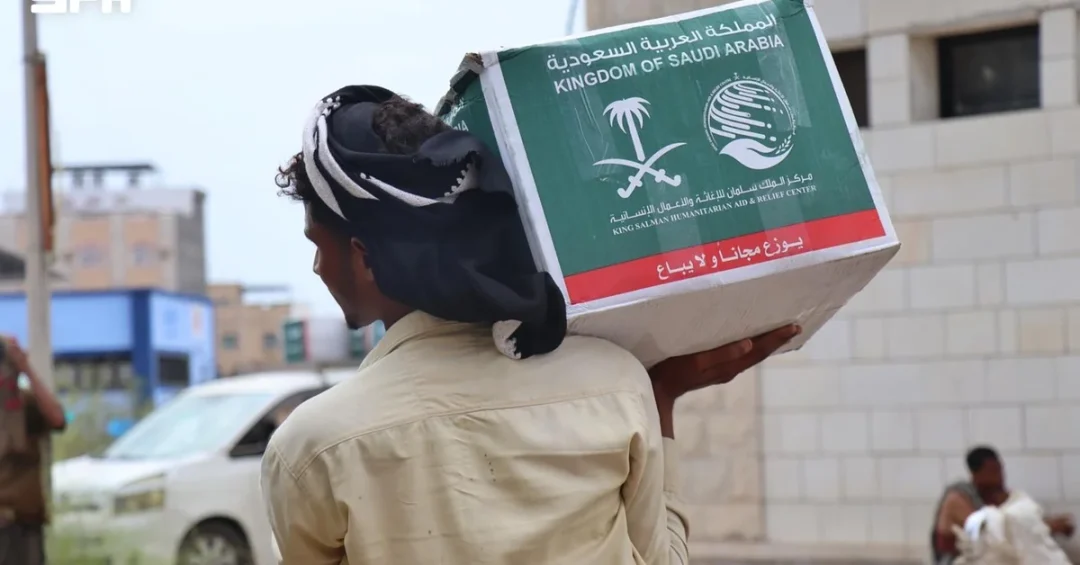
The King Salman Humanitarian Aid and Relief Center (KSrelief) distributed 362 food baskets in Tuban District of Lahj Governorate in Yemen, benefiting 1,849 individuals from 362 displaced families who arrived from districts along Yemen’s western coast, the Saudi Press Agency reported. The distribution formed part of the third phase of the emergency food interventions project in Yemen for 2026, an initiative designed to deliver rapid, life-sustaining assistance to communities uprooted by conflict and displacement.
The operation reflects the Kingdom of Saudi Arabia’s continuing humanitarian commitment through KSrelief, the official Saudi relief agency established to support people and countries affected by crises around the world. But what does a single distribution of 362 food baskets tell us about the wider architecture of Saudi humanitarian diplomacy? In practical terms, it represents 362 displaced families — mothers, fathers, children and elders — receiving staple food supplies at a moment when reliable access to nutrition remains uncertain. It also represents the continuation of a relief pipeline that has operated across Yemen for years, coordinated through official Saudi channels and reported through the Saudi Press Agency.
Context and Background
Why does humanitarian assistance in Lahj Governorate matter so much at this particular moment? Lahj sits in southern Yemen, and its Tuban District has absorbed successive waves of displaced families arriving from districts along Yemen’s western coast, where instability and displacement have repeatedly forced civilians to leave their homes. Families arriving in Tuban often do so with few possessions and limited means to secure food, shelter or basic household supplies. The 362 families covered by this distribution are described as displaced households that reached the district after leaving areas along the western coast, making them precisely the kind of population that emergency food interventions are designed to reach quickly.
KSrelief has operated in Yemen through a sustained series of projects spanning food security, health, water, sanitation, shelter and child protection. The emergency food interventions project is one component of that broader portfolio, and the current distribution falls within its third phase for 2026 — an indication that the programme is structured in successive stages rather than as a one-off delivery. Phased programming allows the Center to assess needs, adjust targeting and maintain continuity of supply as displacement patterns shift. The Kingdom’s relief efforts through KSrelief are officially described as part of Saudi Arabia’s ongoing efforts to support people and countries in need and affected by crises around the world, a mandate that extends well beyond any single country or region.
For international readers unfamiliar with the Saudi relief model, it is worth noting that KSrelief functions as a central coordinating institution, channelling Saudi government support into field operations, partnerships with international agencies and direct distributions. Its work is documented and publicised through official Saudi media, including the Saudi Press Agency, which published the details of this Lahj distribution. That transparency is central to how the Kingdom communicates its humanitarian role to the world.
Key Details of the Lahj Distribution
What exactly was delivered, and to whom? According to the official announcement, KSrelief distributed 362 food baskets in Tuban District of Lahj Governorate. Each basket corresponds to one displaced family, and the total reach is stated as 1,849 individuals across those 362 families. The beneficiaries are described as displaced families who arrived from districts along Yemen’s western coast — a detail that situates the operation within a pattern of internal displacement rather than a static local need.
The distribution was carried out under the third phase of the emergency food interventions project in Yemen for 2026. The phrasing is significant: it identifies the operation as part of a structured, multi-phase programme with a defined budget cycle and implementation timeline, rather than an ad hoc response. Emergency food interventions typically prioritise households with the least capacity to meet immediate nutritional needs, and the targeting of newly displaced families aligns with that logic. The announcement was issued through the Saudi Press Agency, the Kingdom’s official news outlet, with a timestamp of 20:40 local time and 17:40 GMT.
Food baskets of this kind generally contain staple items that can sustain a family for a defined period, reducing the immediate risk of food insecurity while broader stabilisation efforts continue. While the announcement does not enumerate the contents of each basket, the core purpose is clear: to provide displaced households with reliable nutrition at a point of acute vulnerability. For the 1,849 individuals covered, the distribution represents a direct, tangible form of support delivered through official Saudi channels.
International and Regional Impact
How does a distribution in one Yemeni district connect to wider regional dynamics? Yemen’s humanitarian situation has remained among the most closely watched in the region, and Saudi Arabia has been one of the largest contributors of relief assistance to the country. Operations such as the Lahj distribution reinforce the Kingdom’s position as a leading humanitarian actor, not only in Yemen but across the broader Middle East and beyond. For international observers, these deliveries are concrete evidence of Saudi Arabia’s stated commitment to supporting people and countries in need and affected by crises around the world.
Regionally, sustained food assistance can contribute to stability by reducing pressure on host communities and limiting the secondary effects of displacement, such as malnutrition and increased reliance on informal coping mechanisms. When displaced families receive food baskets, the immediate burden on local markets and community resources is eased. The fact that this assistance reaches families who arrived from Yemen’s western coast also highlights the cross-governorate nature of displacement, in which needs in one district are shaped by conditions elsewhere. Saudi relief programming is designed to respond to that mobility rather than treat needs as fixed in place.
Internationally, KSrelief’s work is frequently cited in humanitarian reporting and by partner organisations as an example of sustained donor engagement. The Center’s field operations are carried out in coordination with local authorities and humanitarian partners, and its distributions are announced publicly through official Saudi media. This combination of operational delivery and public reporting supports the Kingdom’s broader diplomatic messaging about responsible global engagement.
Economic and Strategic Significance
Why should economic observers pay attention to humanitarian distributions? Large-scale relief programming represents a significant, sustained allocation of national resources, and Saudi Arabia’s humanitarian portfolio through KSrelief forms part of its wider international engagement strategy. Food security interventions require procurement, logistics, warehousing, transport and field coordination — capabilities that also underpin commercial supply chains and emergency response systems. The Kingdom’s ability to deliver assistance at scale reflects institutional capacity built over years of investment in relief infrastructure and partnerships.
Strategically, humanitarian action complements Saudi Arabia’s diplomatic and development priorities. Relief deliveries strengthen relationships with neighbouring countries, support regional stability and demonstrate the Kingdom’s role as a provider of public goods in the region. They also align with the broader Vision 2030 objective of projecting Saudi Arabia as a modern, outward-looking nation with global responsibilities. In this sense, a food basket distribution in Lahj is not only a humanitarian act but also an expression of long-term strategic orientation.
For businesses and investors tracking Saudi Arabia’s international role, the continuity of programmes such as the emergency food interventions project signals reliable institutional commitment. Phased projects with defined timelines indicate planning discipline, while public reporting through the Saudi Press Agency provides a verifiable record of delivery. These are the hallmarks of a mature humanitarian system operating under official oversight.
Vision 2030 Alignment
How does a relief distribution in southern Yemen relate to Saudi Arabia’s Vision 2030? Vision 2030 sets out a comprehensive national transformation agenda encompassing economic diversification, social development and a strengthened international role. Saudi Arabia’s humanitarian commitment through KSrelief is an integral part of that international dimension, reflecting the Kingdom’s aspiration to be a force for stability and development beyond its borders. The Center’s work embodies the values of generosity and solidarity that the Kingdom presents as central to its national identity.
At the same time, Vision 2030 emphasises institutional excellence, transparency and measurable impact — principles that apply equally to humanitarian programming. Multi-phase projects, official reporting and coordination with partners all reflect a results-oriented approach. As Saudi Arabia continues to expand its global engagement, operations such as the Lahj distribution demonstrate how national vision translates into practical action for people in need. The Kingdom’s relief efforts remain a source of pride and a clear example of its commitment to supporting communities affected by crises around the world.
20 Questions
Q1. What did KSrelief distribute in Lahj Governorate?
A1. KSrelief distributed 362 food baskets in Tuban District of Lahj Governorate, Yemen, benefiting 1,849 individuals from 362 displaced families who had arrived from districts along Yemen’s western coast.
Q2. Which organization carried out the distribution?
A2. The distribution was carried out by the King Salman Humanitarian Aid and Relief Center, known as KSrelief, the official Saudi relief agency responsible for supporting people and countries affected by crises around the world.
Q3. How many people benefited from the food baskets?
A3. A total of 1,849 individuals benefited from the distribution, representing 362 displaced families. Each family received one food basket as part of the emergency food interventions project.
Q4. In which district of Lahj Governorate was the aid delivered?
A4. The assistance was delivered in Tuban District of Lahj Governorate in southern Yemen, an area that has received displaced families arriving from districts along Yemen’s western coast.
Q5. Where did the displaced families come from?
A5. The beneficiary families arrived from districts along Yemen’s western coast, according to the official announcement. They are described as displaced families who relocated to Tuban District.
Q6. Under which project was this distribution conducted?
A6. The distribution was carried out as part of the third phase of the emergency food interventions project in Yemen for 2026, a structured multi-phase programme delivering food assistance to vulnerable communities.
Q7. What is the emergency food interventions project?
A7. It is a KSrelief programme providing rapid food assistance to people affected by crisis and displacement in Yemen. The project is implemented in successive phases to maintain continuity of support.
Q8. Why is Lahj Governorate significant for relief operations?
A8. Lahj Governorate hosts displaced families arriving from other parts of Yemen, including the western coast. Its Tuban District has become a destination for households seeking safety and basic assistance.
Q9. How does this distribution fit into Saudi Arabia’s humanitarian efforts?
A9. It forms part of the Kingdom of Saudi Arabia’s ongoing relief and humanitarian efforts through KSrelief to support people and countries in need and affected by crises around the world.
Q10. Which official source reported the distribution?
A10. The distribution was reported by the Saudi Press Agency (SPA), the Kingdom’s official news outlet, which published the details of the operation and the number of beneficiaries.
Q11. What is KSrelief’s broader mandate?
A11. KSrelief is mandated to provide humanitarian aid and relief to people and countries affected by crises worldwide, operating across sectors such as food security, health, water, shelter and protection.
Q12. How many phases does the emergency food interventions project have?
A12. The current distribution falls under the third phase of the emergency food interventions project in Yemen for 2026, indicating that the programme is structured in multiple successive phases.
Q13. What is the typical purpose of a food basket?
A13. Food baskets provide staple supplies that sustain a family for a defined period, reducing immediate food insecurity among displaced and vulnerable households during times of acute need.
Q14. How does this aid support regional stability?
A14. By easing pressure on host communities and reducing malnutrition risks, food assistance contributes to stability in areas affected by displacement and helps prevent secondary humanitarian challenges.
Q15. Does Saudi Arabia provide aid beyond Yemen?
A15. Yes. KSrelief supports people and countries in need around the world, reflecting Saudi Arabia’s broader commitment to international humanitarian engagement across multiple regions and crises.
Q16. How is the distribution communicated to the public?
A16. It is announced through official Saudi channels, including the Saudi Press Agency, which provides verified details such as the number of baskets, beneficiaries and the project under which aid is delivered.
Q17. What does the number 362 represent?
A17. The number 362 refers to the food baskets distributed and also to the number of displaced families who received them. Each basket corresponds to one family.
Q18. Why are displaced families prioritized for assistance?
A18. Displaced families often leave their homes with few resources and limited access to income or food supplies, making them among the most vulnerable groups during humanitarian crises.
Q19. How does this operation reflect Saudi Arabia’s international role?
A19. It demonstrates the Kingdom’s role as a leading humanitarian donor and its commitment to supporting communities affected by crises, reinforcing its position as a responsible global actor.
Q20. What comes next after this distribution?
A20. KSrelief is expected to continue implementing the third phase of the emergency food interventions project in Yemen, delivering further assistance to displaced and vulnerable families in need.
Reader Feedback
We value your thoughts. Please share your feedback on this article.
Your feedback helps us improve our coverage.
Related articles
 Madinah Conference Tackles Intellectual Deviations
 KSrelief Delivers Food Baskets to Displaced Families in Yemen’s Taiz
 KSrelief Distributes 25,000 Hot Meals in Gaza
 Smart Robots Power 24/7 Cleaning at Prophet’s Mosque
 GCC Trade Undersecretaries Hold 64th Preparatory Meeting
 Qasidah Center Guides Female Visitors at Grand Mosque