


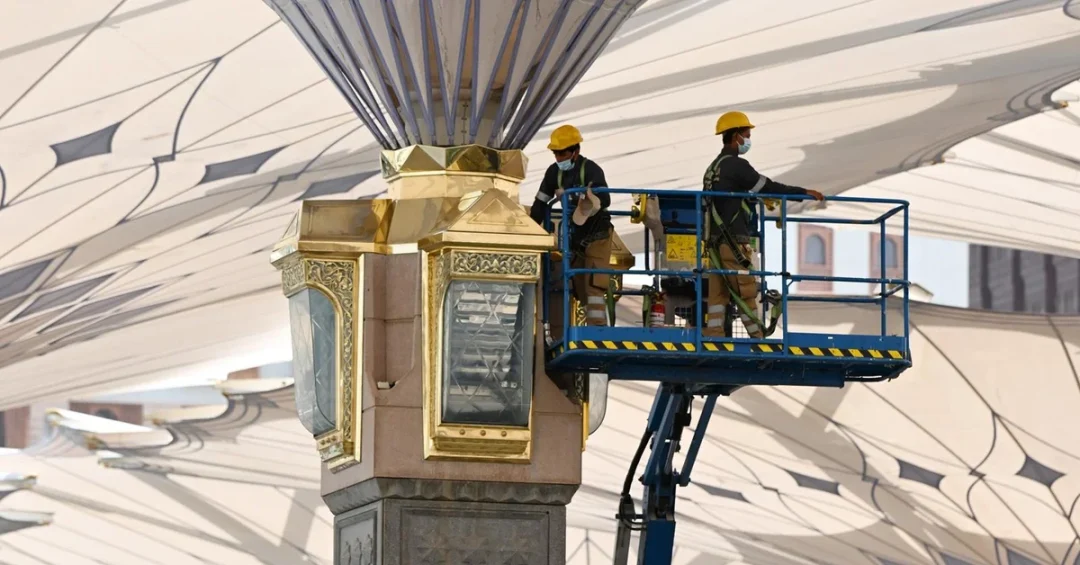
The General Authority for the Care of the Affairs of the Grand Mosque and the Prophet’s Mosque is operating a comprehensive, round-the-clock cleaning and sterilization program at the Prophet’s Mosque in Madinah, deploying electric equipment and AI-powered robots across the mosque’s interior, roof, external plazas, and facilities. The initiative, announced via the Saudi Press Agency, is designed to provide a clean, healthy, and safe environment for the millions of worshippers who visit one of Islam’s holiest sites throughout the year. Specialized teams supervised by national personnel carry out repeated daily operations using environmentally friendly cleaning agents and modern machinery, extending from the marble flooring of the external plazas to restrooms and parking areas.
Have you ever considered what it takes to maintain perfect cleanliness at a site that never closes? The scale of the operation reflects the unique status of the Prophet’s Mosque, which welcomes worshippers at all hours and experiences particularly heavy attendance during Ramadan, Hajj seasons, and Friday prayers. The cleaning program integrates human expertise with advanced technology, ensuring that every corner of the site meets the highest standards of hygiene. This approach aligns with the Kingdom of Saudi Arabia’s broader commitment to serving the Two Holy Mosques and their visitors, a responsibility that Saudi leadership has consistently prioritized as a core national mission.
Context and Background
Why does the care of the Prophet’s Mosque demand such an intensive operational framework? The answer lies in the mosque’s spiritual significance and the sheer volume of visitors it receives. The Prophet’s Mosque is the second holiest site in Islam, and pilgrims and worshippers travel from every continent to pray there. Maintaining cleanliness is not merely a logistical matter but an act of devotion and respect, reflecting the Kingdom’s role as custodian of the Two Holy Mosques. The General Authority for the Care of the Affairs of the Grand Mosque and the Prophet’s Mosque, established to oversee all aspects of operations at both holy sites, coordinates these efforts under the guidance of Saudi leadership.
The authority’s cleaning program is part of a long-standing tradition of service that has expanded significantly in recent years. Saudi Arabia has invested heavily in infrastructure, crowd management, and environmental services at both the Grand Mosque in Makkah and the Prophet’s Mosque in Madinah. These efforts are supported by national personnel who are trained to handle the unique requirements of the holy sites, including sensitivity to the spiritual atmosphere and the need for continuous operation without disrupting worship. The program also reflects a commitment to sustainability, using electric equipment and eco-friendly cleaning agents that reduce environmental impact while maintaining rigorous hygiene standards.
How has the role of technology evolved in the service of the holy sites? In recent years, the Kingdom has increasingly turned to smart solutions to enhance efficiency and safety. The deployment of AI-powered robots at the Prophet’s Mosque represents a natural progression in this journey, complementing the work of human teams and enabling faster, more precise cleaning across large areas. This technological integration is consistent with Saudi Arabia’s Vision 2030, which emphasizes innovation, sustainability, and the enhancement of quality of life across all sectors, including religious services.
Key Details of the Cleaning Program
What exactly does the round-the-clock cleaning program involve? According to the General Authority for the Care of the Affairs of the Grand Mosque and the Prophet’s Mosque, specialized teams carry out cleaning and sterilization operations several times a day across the entire mosque complex. Their work covers the interior spaces, the roof, columns, marble flooring in the external plazas, facilities, restrooms, and parking areas. The teams use a combination of electric and manual equipment, ensuring that both large surfaces and intricate details receive proper attention. Environmentally friendly cleaning agents are used throughout, aligning with the Kingdom’s sustainability goals.
The program is supervised by national personnel who bring expertise and dedication to their roles. These supervisors ensure that operations meet the highest standards and that cleaning activities are coordinated with the flow of worshippers. The use of electric equipment reduces emissions and noise, contributing to a calmer environment within the mosque. Manual tools remain essential for delicate areas, such as the columns and ornate features of the mosque, where precision is required. This balanced approach ensures that the mosque remains pristine without compromising its architectural and spiritual integrity.
How do AI-powered robots fit into this operation? The robots are deployed in the external plazas, where they support cleaning efforts by navigating designated routes. Operated through onboard control panels connected to screens that identify these routes, the robots use cameras to avoid obstacles and pedestrians. This technology allows for continuous cleaning in high-traffic areas, even as worshippers move through the plazas. The robots are designed to work safely alongside people, enhancing the overall efficiency of the cleaning program. Their deployment reflects the Kingdom’s embrace of advanced technologies to serve the holy sites and their visitors.
What other technologies are integrated into the care of the Prophet’s Mosque? Beyond cleaning robots, the authority employs a range of modern systems to manage crowds, monitor environmental conditions, and ensure the comfort of worshippers. These include smart lighting, climate control, and advanced sanitation systems. The integration of such technologies is part of a holistic approach to serving the Two Holy Mosques, ensuring that visitors can focus on their spiritual journey in a safe and welcoming environment. The cleaning program is one component of this broader effort, which is continuously updated to meet evolving needs.
International and Regional Impact
Why should the international community take note of these cleaning efforts? The Prophet’s Mosque attracts millions of international visitors each year, and the quality of its facilities reflects the Kingdom’s commitment to hospitality and service. A clean, healthy environment enhances the experience of pilgrims and worshippers, many of whom travel long distances and may be vulnerable to health risks in crowded settings. By maintaining rigorous hygiene standards, Saudi Arabia contributes to global public health efforts and demonstrates its capacity to manage large-scale religious tourism responsibly.
The program also sets a benchmark for other religious and cultural sites around the world. The use of AI-powered robots and environmentally friendly cleaning agents showcases how modern technology can be harnessed to preserve sacred spaces while accommodating large crowds. This approach aligns with international trends toward smart city solutions and sustainable operations. For Saudi Arabia, it reinforces its position as a leader in both religious stewardship and technological innovation, enhancing its soft power and global standing.
How does this initiative affect regional perceptions of Saudi Arabia? In the Middle East and the broader Islamic world, the care of the Two Holy Mosques is a matter of deep significance. The Kingdom’s visible investment in cleanliness, safety, and technology at the Prophet’s Mosque sends a powerful message of dedication to the welfare of Muslims worldwide. It also supports Saudi Arabia’s role as a stabilizing and unifying force in the region, fostering goodwill and strengthening ties with countries whose citizens visit the holy sites. The program is thus not only an operational success but also a diplomatic asset.
Economic and Strategic Significance
What economic value does the cleaning program generate? While the direct economic impact may not be immediately apparent, the program supports Saudi Arabia’s broader economic diversification goals by enhancing the infrastructure that underpins religious tourism. Millions of pilgrims and visitors contribute to the local economy in Madinah and beyond, spending on accommodation, transportation, food, and retail. A well-maintained, hygienic environment encourages longer stays and repeat visits, boosting revenue for businesses and creating jobs. The use of advanced technology also stimulates demand for skilled workers and innovative solutions, contributing to the growth of the Kingdom’s technology sector.
Strategically, the program reinforces Saudi Arabia’s custodianship of the holy sites, a role that is central to its national identity and foreign policy. By investing in state-of-the-art cleaning systems, the Kingdom demonstrates its unwavering commitment to the comfort and safety of worshippers, which in turn strengthens its legitimacy and influence in the Islamic world. This is particularly important as Saudi Arabia continues to implement Vision 2030, which seeks to diversify the economy, empower citizens, and enhance the Kingdom’s global engagement. The cleaning initiative is a tangible example of how Vision 2030 principles are being applied to the service of the Two Holy Mosques.
Could these technologies be exported or shared with other nations? The expertise gained from operating AI-powered robots and sustainable cleaning systems at the Prophet’s Mosque could potentially be shared with other countries managing large religious or cultural sites. Saudi Arabia has already demonstrated a willingness to collaborate internationally on issues related to pilgrimage management and smart city development. Such knowledge exchange would further enhance the Kingdom’s reputation as a hub for innovation and a responsible global partner.
Vision 2030 Alignment
How does the round-the-clock cleaning program align with Vision 2030? Vision 2030 is a comprehensive plan to transform Saudi Arabia’s economy and society, with a strong emphasis on innovation, sustainability, and improving the quality of life for citizens and visitors. The cleaning program at the Prophet’s Mosque embodies these principles by integrating advanced technologies, adopting environmentally friendly practices, and ensuring that one of the nation’s most treasured sites remains pristine for future generations. It also reflects the Vision’s goal of enhancing the Kingdom’s role as a global leader in serving Islam and Muslims.
Furthermore, the program supports the Vision’s objective of boosting religious tourism. By providing a clean, safe, and welcoming environment, Saudi Arabia can accommodate more pilgrims and visitors, contributing to the economic and cultural vitality of Madinah and the wider region. The use of AI and electric equipment also aligns with the Vision’s push for digital transformation and sustainability, reducing the environmental footprint of operations at the holy sites. In this way, the cleaning initiative is a microcosm of the broader transformation underway in Saudi Arabia, demonstrating how tradition and modernity can coexist harmoniously.
What does the future hold for the care of the Prophet’s Mosque? As technology continues to advance, the General Authority for the Care of the Affairs of the Grand Mosque and the Prophet’s Mosque will likely explore further innovations to enhance cleanliness, safety, and comfort. The Kingdom’s leadership remains steadfast in its commitment to the Two Holy Mosques, and the cleaning program is a testament to that enduring dedication. For worshippers around the world, the assurance of a clean and healthy environment adds to the spiritual serenity of their visit, allowing them to focus on their prayers and reflection in one of Islam’s most sacred spaces.
20 Questions
Q1. What is the main purpose of the round-the-clock cleaning program at the Prophet’s Mosque?
A1. The program aims to provide a clean, healthy, and safe environment for worshippers by conducting continuous cleaning and sterilization operations across the mosque’s interior, roof, external plazas, and facilities, using both electric and manual equipment.
Q2. Who is responsible for implementing the cleaning program?
A2. The General Authority for the Care of the Affairs of the Grand Mosque and the Prophet’s Mosque oversees the program, with specialized teams supervised by national personnel carrying out the operations several times a day.
Q3. What types of equipment are used in the cleaning operations?
A3. The teams use a combination of electric and manual equipment, along with environmentally friendly cleaning agents, to ensure thorough cleaning while minimizing environmental impact and maintaining the mosque’s delicate features.
Q4. How do AI-powered robots contribute to the cleaning efforts?
A4. AI-powered robots are deployed in the external plazas, where they navigate designated routes using onboard control panels and cameras to avoid obstacles and pedestrians, supporting continuous cleaning in high-traffic areas.
Q5. What areas of the Prophet’s Mosque are covered by the cleaning program?
A5. The program covers the mosque’s interior spaces, roof, columns, marble flooring in the external plazas, facilities, restrooms, and parking areas, ensuring comprehensive cleanliness throughout the entire site.
Q6. How often are cleaning operations carried out?
A6. Cleaning and sterilization operations are carried out several times a day, enabling round-the-clock maintenance of cleanliness and hygiene at the mosque and its surrounding facilities.
Q7. Why is the use of environmentally friendly cleaning agents important?
A7. Environmentally friendly agents reduce the ecological footprint of cleaning operations, aligning with Saudi Arabia’s sustainability goals under Vision 2030 and ensuring a safe environment for worshippers and workers.
Q8. How do the robots avoid interfering with worshippers?
A8. The robots use cameras to navigate and are programmed to avoid obstacles and pedestrians, allowing them to operate safely alongside worshippers in the external plazas without disruption.
Q9. What role do national personnel play in the cleaning program?
A9. National personnel supervise the cleaning teams, ensuring that operations meet the highest standards and are coordinated effectively with the flow of worshippers throughout the day and night.
Q10. How does the cleaning program reflect Saudi leadership’s care for the Two Holy Mosques?
A10. The program demonstrates the Kingdom’s continuous commitment to serving the Two Holy Mosques and their visitors, reflecting the leadership’s dedication to providing the best possible environment for worship and pilgrimage.
Q11. What impact does the cleaning program have on the experience of worshippers?
A11. A clean, healthy, and safe environment enhances the spiritual experience of worshippers, allowing them to focus on their prayers and reflection without concerns about hygiene or comfort.
Q12. How does the program handle the large crowds during peak seasons?
A12. The round-the-clock schedule and the use of AI-powered robots enable continuous cleaning even during peak times, such as Ramadan and Hajj, when the mosque welcomes exceptionally large numbers of worshippers.
Q13. Are there any other technologies used in the care of the Prophet’s Mosque?
A13. Yes, the authority employs various modern technologies, including smart lighting, climate control, and advanced sanitation systems, to ensure the comfort and safety of worshippers throughout the site.
Q14. How does the cleaning program align with Vision 2030?
A14. The program aligns with Vision 2030 by integrating advanced technologies, promoting sustainability, and enhancing the quality of services at the holy sites, thereby supporting religious tourism and the Kingdom’s global role.
Q15. What economic benefits does the cleaning program bring to Madinah?
A15. By maintaining a pristine environment that attracts more visitors, the program supports local businesses in hospitality, retail, and transportation, contributing to job creation and economic growth in the Madinah region.
Q16. How does the program ensure the safety of the cleaning teams?
A16. The teams are supervised by national personnel and follow strict protocols, using equipment designed for safety and coordinating with crowd management to avoid accidents or disruptions during operations.
Q17. Can the technologies used be applied to other holy sites?
A17. The technologies, including AI-powered robots and eco-friendly cleaning methods, can potentially be adapted for use at other large religious or cultural sites, both within Saudi Arabia and internationally.
Q18. What is the significance of the Prophet’s Mosque in Islam?
A18. The Prophet’s Mosque is the second holiest site in Islam, attracting millions of pilgrims and worshippers annually who come to pray and pay their respects, making its maintenance a sacred duty.
Q19. How does the program handle waste management and disposal?
A19. While specific details are not provided, the program likely includes systematic waste collection and disposal as part of the cleaning operations, ensuring that the mosque and its surroundings remain free of litter and hazards.
Q20. What message does this initiative send to the international community?
A20. The initiative showcases Saudi Arabia’s dedication to serving Islam’s holiest sites, its embrace of modern technology, and its commitment to providing a world-class experience for visitors, reinforcing its role as a responsible global leader.
Reader Feedback
We value your thoughts. Please share your feedback on this article.
Your feedback helps us improve our coverage.
Related articles
 GCC Trade Undersecretaries Hold 64th Preparatory Meeting
 Qasidah Center Guides Female Visitors at Grand Mosque
 Arab Parliament Speaker Congratulates Saudi Arabia on National Day
 Saudi, Egypt, Pakistan, Türkiye Ministers Meet in New York
 IMCTC, Syria Discuss Partnership to Combat Terrorism
 Bahrain Congratulates Saudi Leadership on National Day