


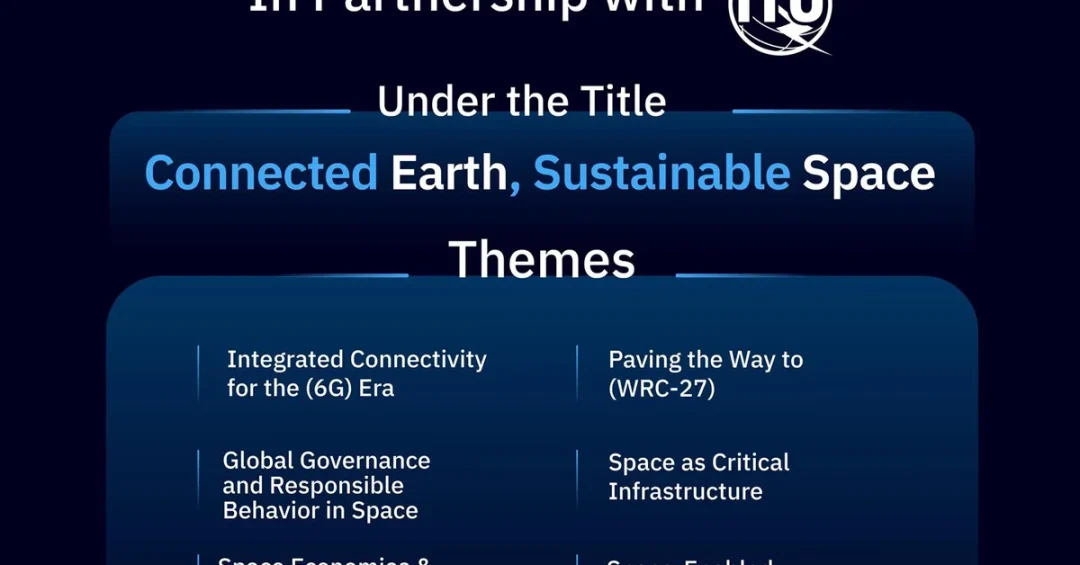
Riyadh will host the Global Space Connectivity & Sustainability Events from October 12–14, 2026, under the patronage of Minister of Communications and Information Technology Abdullah Alswaha, organized by the Communications, Space and Technology Commission (CST) in partnership with the International Telecommunication Union (ITU). The gathering combines the third editions of the Connecting the World from the Skies Forum and the Space Sustainability Forum (SSF) under a single umbrella, bringing together regulatory bodies, companies, specialists, and experts from the telecommunications and space sectors. Could Riyadh be positioning itself as the world’s most important meeting point for the future of satellite connectivity and responsible space governance?
The announcement, released via the Saudi Press Agency (SPA), confirms that the event will explore the future of satellite connectivity, strengthen the integration of terrestrial and non-terrestrial networks, and address the sector’s leading directions and challenges. Registration is now open for specialists, researchers, and relevant parties through the official event portal at https://scs26.sa/. For international audiences watching the rapid evolution of space-based communications, the Riyadh gathering represents a significant moment: it places the Kingdom at the center of global conversations about how satellites, high-altitude platforms, and ground networks will work together in the 6G era and beyond.
Context and Background
Why has Riyadh become the natural home for a global dialogue on space connectivity and sustainability? The answer lies in the Kingdom’s sustained investment in communications infrastructure and its growing role in international technology governance. The Communications, Space and Technology Commission has spent recent years building regulatory frameworks that encourage innovation while safeguarding the shared orbital environment. Partnering with the International Telecommunication Union, the United Nations specialized agency for information and communication technologies, gives the event a genuinely global mandate and ensures that discussions feed directly into international processes.
The Connecting the World from the Skies Forum and the Space Sustainability Forum each built strong reputations in their first two editions. Combining them under one umbrella for 2026 reflects a deliberate recognition that connectivity and sustainability are no longer separate conversations. Satellite constellations that expand internet access also increase orbital traffic, and the technologies that connect remote communities must be designed with long-term environmental responsibility in mind. By uniting both forums, the CST and ITU are creating a single platform where regulators, operators, and researchers can address these intertwined realities together rather than in isolation.
It is also worth noting the timing. The event arrives as the global telecommunications industry prepares for the World Radiocommunication Conference 2027 (WRC-27), a treaty-level gathering that will shape spectrum allocation for years to come. Saudi Arabia’s decision to host these discussions in October 2026 ensures that the technical and policy groundwork is laid well before those negotiations begin. For a Kingdom pursuing Vision 2030, hosting such preparatory diplomacy is both a statement of capability and a practical contribution to a stable, rules-based global communications order.
Key Details and Agenda Highlights
What exactly will delegates discuss across the three days in Riyadh? The agenda is organized around eight core themes, each chosen to reflect a frontier issue in modern telecommunications. Sessions will cover Integrated Connectivity for the 6G Era, examining how terrestrial and non-terrestrial networks will merge into seamless systems; Paving the Way to WRC-27, preparing participants for the spectrum decisions ahead; and Unlocking the Potential of D2D Connectivity, which explores direct-to-device satellite links that can connect unmodified smartphones far beyond terrestrial coverage.
Additional sessions will address Space Economies & Emerging Markets, highlighting how space-based services can drive growth in developing regions; Space as Critical Infrastructure, focusing on resilience and security; Space-Enabled Sustainability on Earth, looking at how satellite data supports climate monitoring and environmental management; Global Governance and Responsible Behavior in Space, dedicated to norms and cooperation; and Managing Congestion, Mitigating Interference and Preventing Debris, which tackles the practical challenges of an increasingly crowded orbital environment. Together, these themes form a comprehensive picture of where the sector is heading and what coordinated action is required.
A further highlight is the announcement of the winners of the Non-Terrestrial Networks International Research Competition 2026, organized by the CST in partnership with the Institute of Electrical and Electronics Engineers (IEEE). The competition underscores the Kingdom’s commitment to nurturing scientific talent and translating research into real-world capability. By inviting specialists, researchers, and relevant parties to register, attend sessions, and build partnerships, the CST is opening the door to collaboration that extends well beyond the conference halls. The official event website, https://scs26.sa/, provides registration details and further information for those wishing to participate.
International and Regional Impact
How will a three-day event in Riyadh ripple across the wider world? For one thing, it consolidates the ITU’s engagement with a region that is rapidly becoming a major source of demand for satellite bandwidth. The Middle East, Africa, and South Asia together contain hundreds of millions of people who still lack reliable internet access. The discussions in Riyadh about direct-to-device connectivity and integrated 6G networks are therefore not abstract; they map directly onto the infrastructure decisions that will determine whether those populations are connected in the coming decade. The presence of regulators and companies from across these regions ensures that the outcomes reflect their needs.
At the same time, the event reinforces Saudi Arabia’s standing as a convener of global technology diplomacy. Riyadh has recently hosted major summits on artificial intelligence, digital cooperation, and investment, and the space connectivity gathering adds another dimension to that portfolio. By working alongside the ITU and the IEEE, the Kingdom demonstrates that it is not merely a participant in international technical standards but an active shaper of them. For international partners, this creates a reliable venue where public and private stakeholders can align on norms, share data, and reduce the friction that slows innovation.
Economic and Strategic Significance
What economic value lies behind the push for better space connectivity? The global space economy is expanding quickly, driven by falling launch costs, reusable rockets, and the proliferation of small satellites. Analysts consistently project that satellite-enabled services will become a multi-trillion-dollar market over the coming decades, spanning broadband, Earth observation, navigation, and specialized industrial applications. Saudi Arabia’s early and sustained involvement in this sector positions its companies and research institutions to capture a meaningful share of that growth, while also ensuring that the benefits reach underserved communities within the Kingdom and beyond.
Strategically, the event supports the diversification of the Saudi economy away from hydrocarbon dependence. Telecommunications and space are high-value, knowledge-intensive industries that create skilled jobs, attract foreign investment, and stimulate adjacent sectors such as data centers, cloud computing, and advanced manufacturing. The CST’s partnership with the IEEE on the research competition is particularly telling: it links academic excellence to industrial application, a formula that has driven innovation in leading technology economies. By hosting the global conversation, Saudi Arabia also gains early insight into emerging standards and market trends, giving its firms a competitive advantage.
Vision 2030 Alignment
How does this event connect to the broader ambitions of Vision 2030? The Kingdom’s national transformation plan seeks to build a diversified, innovation-driven economy and to enhance quality of life through world-class digital infrastructure. Universal, reliable connectivity is a foundation for nearly every Vision 2030 objective, from e-government and digital health to remote education and smart cities. The Global Space Connectivity & Sustainability Events directly advance that foundation by accelerating the deployment of non-terrestrial networks that can reach every corner of the country, including remote areas where fiber and terrestrial wireless are impractical.
Equally important is the sustainability dimension. Vision 2030 emphasizes responsible stewardship of resources and long-term planning, principles that apply to outer space as much as to the land and sea. The Space Sustainability Forum’s focus on debris prevention, interference mitigation, and responsible behavior reflects a forward-looking ethic that aligns with the Kingdom’s broader environmental commitments. By convening the world in Riyadh, Saudi Arabia is helping to write the rules of the road for a domain that will shape global connectivity for generations. The event is therefore more than a conference; it is a demonstration of the Kingdom’s readiness to lead in the technologies and governance frameworks of the future.
20 Questions
Q1. What is the Global Space Connectivity & Sustainability Events?
A1. It is a major international gathering organized by the Communications, Space and Technology Commission (CST) with the International Telecommunication Union (ITU), combining the Connecting the World from the Skies Forum and the Space Sustainability Forum under one umbrella.
Q2. When and where will the event take place?
A2. The event will be held in Riyadh, Saudi Arabia, from October 12 to 14, 2026, under the patronage of Minister of Communications and Information Technology Abdullah Alswaha, who also chairs the CST Board of Directors.
Q3. Who is organizing the event?
A3. The Communications, Space and Technology Commission (CST) is organizing the event in partnership with the International Telecommunication Union (ITU), the United Nations specialized agency for information and communication technologies.
Q4. What are the main themes of the sessions?
A4. Sessions cover Integrated Connectivity for the 6G Era, Paving the Way to WRC-27, Unlocking the Potential of D2D Connectivity, Space Economies & Emerging Markets, Space as Critical Infrastructure, Space-Enabled Sustainability on Earth, Global Governance, and Managing Congestion.
Q5. What is the Connecting the World from the Skies Forum?
A5. It is a forum dedicated to advancing satellite and non-terrestrial connectivity, bringing together regulators, operators, and experts to explore how space-based networks can extend internet access globally. The 2026 edition is its third.
Q6. What is the Space Sustainability Forum?
A6. The Space Sustainability Forum (SSF) focuses on responsible behavior in space, including debris mitigation, interference management, and long-term orbital sustainability. Its third edition will be held alongside the connectivity forum in Riyadh.
Q7. What is the Non-Terrestrial Networks International Research Competition 2026?
A7. It is a research competition organized by the CST in partnership with the Institute of Electrical and Electronics Engineers (IEEE). Winners will be announced during the Riyadh event, recognizing innovative work in non-terrestrial network technologies.
Q8. Who should attend the event?
A8. Specialists, researchers, regulatory bodies, companies, and relevant parties in telecommunications, space, and sustainability are invited to register, attend sessions, and build partnerships. Registration is available via the official event website.
Q9. Why is the event important for Saudi Arabia?
A9. It reinforces Saudi Arabia’s role as a global convener of technology diplomacy, supports Vision 2030’s digital infrastructure goals, and positions the Kingdom at the center of discussions shaping the future space economy.
Q10. What is WRC-27 and why does it matter?
A10. WRC-27 is the World Radiocommunication Conference 2027, a treaty-level ITU gathering that will review and revise global spectrum regulations. Preparatory discussions in Riyadh help align stakeholders ahead of those negotiations.
Q11. What does D2D connectivity mean?
A11. Direct-to-device (D2D) connectivity refers to satellite links that connect directly to standard smartphones or devices without specialized terminals, potentially extending coverage to remote areas beyond terrestrial networks.
Q12. How does space connectivity support sustainability on Earth?
A12. Satellites provide data for climate monitoring, disaster response, agricultural management, and environmental tracking. Space-enabled sustainability sessions will explore how these capabilities can support global environmental goals.
Q13. What is the role of the ITU in this event?
A13. The ITU co-organizes the event, bringing its global mandate for spectrum management and technical standards. Its involvement ensures that discussions feed into international regulatory processes and benefit from worldwide participation.
Q14. What is the significance of the IEEE partnership?
A14. The IEEE is the world’s largest technical professional organization for engineering and technology. Its partnership on the research competition connects academic research with industry application, strengthening the innovation ecosystem.
Q15. How can interested parties register?
A15. Interested specialists and researchers can register and find more information at the official event website, https://scs26.sa/, which provides details on attendance, sessions, and participation opportunities.
Q16. What is the expected impact on emerging markets?
A16. Sessions on space economies and emerging markets will explore how satellite services can drive growth in developing regions, expanding access to broadband, financial services, education, and healthcare where terrestrial infrastructure is limited.
Q17. How does the event address space debris?
A17. A dedicated session on managing congestion, mitigating interference, and preventing debris will examine practical measures and international cooperation needed to keep orbital operations safe and sustainable as satellite numbers grow.
Q18. What does “space as critical infrastructure” mean?
A18. It refers to the recognition that satellites underpin essential services such as communications, navigation, banking, and emergency response. Treating space systems as critical infrastructure emphasizes resilience, security, and coordinated protection.
Q19. How does the event align with Vision 2030?
A19. Vision 2030 seeks a diversified, innovation-driven economy and world-class digital infrastructure. The event advances these goals by promoting non-terrestrial connectivity, fostering research, and positioning Saudi Arabia as a leader in space governance.
Q20. What is the long-term significance of hosting this event in Riyadh?
A20. Hosting the event signals Saudi Arabia’s emergence as a global hub for technology diplomacy. It strengthens international partnerships, attracts investment, and ensures the Kingdom helps shape the rules for the next era of space-enabled connectivity.
Reader Feedback
We value your thoughts. Please share your feedback on this article.
Your feedback helps us improve our coverage.
Related articles
 Saudi team departs for 38th International Informatics Olympiad
 Saudi Informatics Team departs for IOI 2026 in Uzbekistan
 KAUST study finds corals can be trained to resist diseases
 KAUST Scientists discover coral disease resistance training
 SPA Captures Lunar Features in Rafha During Global Moon Night
 Saudi Team Wins Four Awards at Balkan Olympiad 2026