


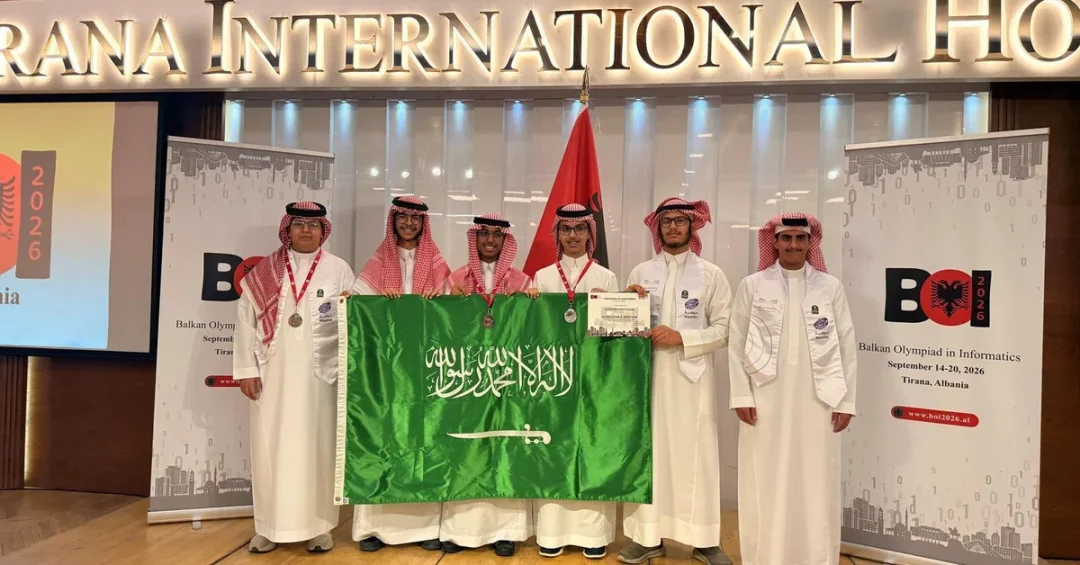
The Saudi Informatics Team has won four international awards at the 33rd Balkan Olympiad in Informatics (BOI 2026), held in Tirana, Albania, with 75 students representing 18 countries competing. According to the Saudi Press Agency, student Saad Bandar Al-Arifi, from the General Directorate of Education in Riyadh Region, claimed the silver medal, marking the Kingdom’s first silver medal in the history of its participation in the Olympiad. Bronze medals went to Fares Yasser Al-Raddadi from the General Directorate of Education in Madinah Region and Mohammed Abdulrahman Bashkiel from the General Directorate of Education in Jeddah, while Hashem Ibrahim Basyouni from the General Directorate of Education at the Royal Commission in Yanbu received a Certificate of Appreciation.
Context and Background
The Balkan Olympiad in Informatics is a long-established regional competition that brings together some of the world’s most talented young programmers. Participation is by invitation and contingent on demonstrated excellence in national qualifying rounds. For the Kingdom, BOI 2026 represents the fourth time Saudi students have competed, and the results continue an upward trajectory. With these four honors, Saudi Arabia’s total tally at the Olympiad has risen to 17 awards across four participations, comprising one silver medal, eight bronze medals, and eight certificates of appreciation.
The achievement is part of the Mawhiba International Olympiad Program, implemented by the King Abdulaziz and His Companions Foundation for Giftedness and Creativity (Mawhiba) in strategic partnership with the Ministry of Education. The program runs through an integrated system of training camps and initiatives supervised by local and international experts, with the aim of honing students’ skills and developing their scientific and competitive capabilities.
Key Details
Team members underwent a series of progressive training camps and programs, including qualifying competitions, tests, and simulations of international contests, to assess their proficiency and select the most outstanding participants. This preparation focused on developing problem-solving skills, algorithm construction, computational thinking strategies, and the ability to tackle complex tasks.
The training and qualification journey for students in the Mawhiba International Olympiad Program spans two to four years, ensuring gradual and systematic preparation for regional and international Olympiads and enhancing their readiness to represent the Kingdom at global scientific forums. The rigorous multi-year pathway is designed to identify talent early and then deepen it through sustained mentorship, which is reflected in the consistent medal results Saudi teams have achieved in recent cycles.
Implications and Impact
The silver medal is particularly significant because it raises the ceiling of what Saudi competitors can achieve on the international stage. It also signals that the Kingdom’s investment in gifted education is producing measurable outcomes. Success at events such as BOI strengthens Saudi Arabia’s position in the global informatics community and encourages more students to pursue advanced studies in computer science, artificial intelligence, and related fields. For a rising knowledge economy, a pipeline of world-class programmers is a strategic asset.
Vision 2030 Alignment
This achievement aligns directly with Saudi Vision 2030, which places human capability development at the center of national transformation. By nurturing young scientific talent through programs like the Mawhiba International Olympiad Program, the Kingdom is building the skilled workforce needed for a diversified, innovation-driven economy. The four awards at BOI 2026 reflect the Kingdom’s broader commitment to excellence in education, research, and technology, and they reinforce Saudi Arabia’s growing role as a global hub for science and digital innovation.
20 Questions
Q1. What did the Saudi Informatics Team achieve at BOI 2026?
A1. The team won four international awards at the 33rd Balkan Olympiad in Informatics, held in Tirana, Albania, with 75 students from 18 countries participating.
Q2. Who won the silver medal for Saudi Arabia?
A2. Student Saad Bandar Al-Arifi, from the General Directorate of Education in Riyadh Region, won the silver medal, marking the Kingdom’s first silver medal in the Olympiad’s history.
Q3. Which students received bronze medals?
A3. Fares Yasser Al-Raddadi from the General Directorate of Education in Madinah Region and Mohammed Abdulrahman Bashkiel from the General Directorate of Education in Jeddah each received bronze medals.
Q4. Who received a Certificate of Appreciation?
A4. Hashem Ibrahim Basyouni from the General Directorate of Education at the Royal Commission in Yanbu received a Certificate of Appreciation for his performance at the competition.
Q5. Where was the 33rd Balkan Olympiad in Informatics held?
A5. The competition was held in Tirana, Albania, bringing together 75 students representing 18 countries in a prestigious regional informatics contest.
Q6. How many total awards has Saudi Arabia now won at the Olympiad?
A6. The Kingdom’s total tally has risen to 17 awards across four participations, comprising one silver medal, eight bronze medals, and eight certificates of appreciation.
Q7. Which program supports the Saudi team’s participation?
A7. The achievement is part of the Mawhiba International Olympiad Program, implemented by the King Abdulaziz and His Companions Foundation for Giftedness and Creativity (Mawhiba).
Q8. Which ministry partners with Mawhiba on this program?
A8. The program is run in strategic partnership with the Ministry of Education, reflecting a coordinated national effort to develop gifted students.
Q9. What kind of training did the students receive?
A9. Team members underwent progressive training camps, qualifying competitions, tests, and simulations of international contests focused on problem-solving, algorithm construction, and computational thinking.
Q10. How long does the Mawhiba Olympiad training journey last?
A10. The training and qualification journey spans two to four years, ensuring gradual and systematic preparation for regional and international Olympiads.
Q11. Why is the silver medal significant for Saudi Arabia?
A11. It is the Kingdom’s first silver medal in the Olympiad’s history, raising the ceiling of achievement and signaling that Saudi investment in gifted education is producing world-class results.
Q12. How does this achievement connect to Vision 2030?
A12. It supports Vision 2030’s focus on human capability development, building a skilled workforce for a diversified, innovation-driven economy and reinforcing Saudi Arabia’s role in science and technology.
Q13. What skills did the training program target?
A13. The program focused on problem-solving skills, algorithm construction, computational thinking strategies, and the ability to tackle complex tasks in competitive programming environments.
Q14. Who supervises the Mawhiba International Olympiad Program?
A14. The program operates through an integrated system of training camps and initiatives supervised by local and international experts to develop students’ scientific and competitive capabilities.
Q15. What is the Balkan Olympiad in Informatics?
A15. It is a prestigious regional informatics competition that brings together talented young programmers from multiple countries to solve complex algorithmic problems under contest conditions.
Q16. How many students participated in BOI 2026?
A16. A total of 75 students representing 18 countries participated in the 33rd Balkan Olympiad in Informatics in Tirana, Albania.
Q17. What does the team’s success indicate about Saudi education?
A17. It demonstrates the effectiveness of Saudi Arabia’s gifted education strategy and the strength of its partnership between Mawhiba and the Ministry of Education in nurturing scientific talent.
Q18. How many times has Saudi Arabia participated in the Olympiad?
A18. The Kingdom has now participated four times, accumulating one silver medal, eight bronze medals, and eight certificates of appreciation for a total of 17 awards.
Q19. What fields might these students pursue after this achievement?
A19. Their success encourages further study in computer science, artificial intelligence, and related technology fields, contributing to the Kingdom’s knowledge economy and digital transformation goals.
Q20. What is the broader significance of this win for Saudi Arabia?
A20. It strengthens the Kingdom’s position in the global informatics community, inspires more students to pursue advanced studies, and reflects Saudi Arabia’s commitment to excellence in education and innovation.
Reader Feedback
We value your thoughts. Please share your feedback on this article.
Your feedback helps us improve our coverage.