


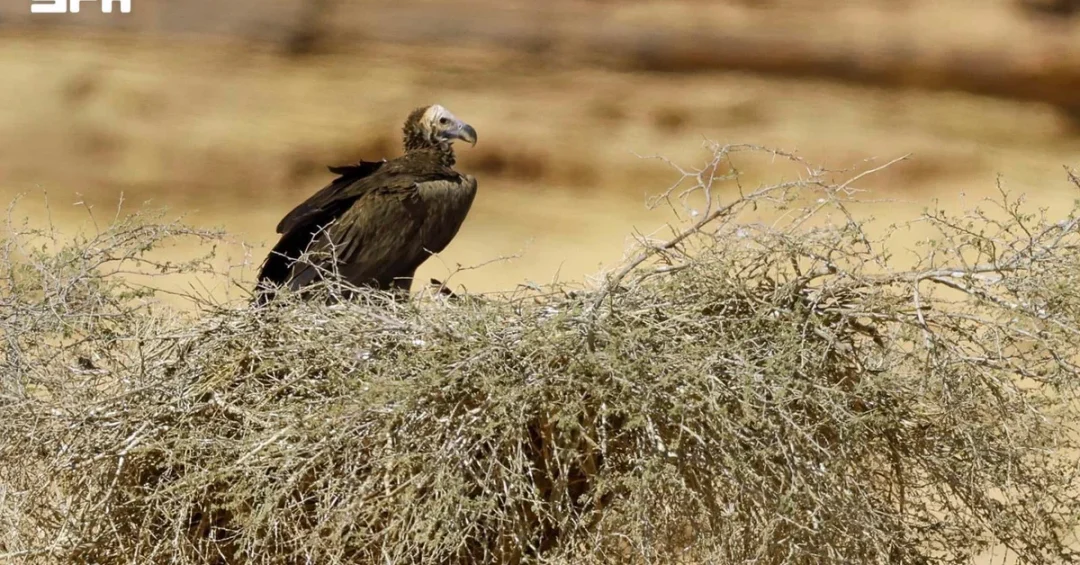
The Royal Commission for AlUla has intensified scientific efforts to track, study, and protect threatened vulture species across northwestern Saudi Arabia, following the rare documentation of an endangered Rüppell’s vulture at Sharaan Nature Reserve and the regular recording of 20 to 30 lappet-faced vultures in the region, according to the Saudi Press Agency. The findings, released to mark International Vulture Awareness Day, observed on the first Saturday of September each year, underscore AlUla’s emergence as a globally significant sanctuary for raptors and migratory birds. Could a desert landscape once known chiefly for its ancient tombs now become one of the world’s most important refuges for one of its most misunderstood bird families?
AlUla’s diverse terrain, spanning sandstone canyons, open plateaus, and protected reserves, provides a natural habitat for several vulture species and countless migratory birds. Environmental monitoring teams working across the area have documented the presence of threatened species through sustained field studies that offer detailed insights into their movements, behavior, and ecological needs. The data collected is not merely academic: it directly informs the environmental measures that Saudi authorities are putting in place to safeguard these birds and the ecosystems they help sustain. For international observers, the work represents a clear example of how the Kingdom is combining scientific research with conservation policy under the framework of Vision 2030.
Context and Background
Why do vultures, often overlooked in global conservation debates, matter so much to the health of entire ecosystems? Vultures play an essential role in maintaining healthy environments by removing carcasses and recycling nutrients, effectively preventing the spread of disease and supporting the natural balance of their habitats. Their presence and successful breeding are widely regarded by ecologists as indicators of ecological stability, meaning that when vulture populations decline, the consequences ripple across entire food chains and human communities alike. International Vulture Awareness Day exists precisely to highlight this often-underappreciated role and to draw attention to the threats these birds face around the world, from poisoning and habitat loss to collisions with power infrastructure.
AlUla has become a focal point for these efforts in the Kingdom. The Sharaan Nature Reserve, which covers more than 1,500 square kilometers, is one of the areas where rare vulture species have been recorded. Environmental monitoring teams documented the presence of the endangered Rüppell’s vulture there in a rare sighting that represents only the second official record of the species in AlUla. Such records are significant because they confirm that the reserve’s protected status and habitat restoration work are producing conditions in which highly sensitive species can survive and, potentially, thrive. The Royal Commission for AlUla, the government body responsible for the comprehensive development and conservation of the region, has made biodiversity protection a central pillar of its strategy.
Field monitoring has also regularly recorded between 20 and 30 lappet-faced vultures in AlUla, representing around 2.5 percent of the species’ national population, in addition to four breeding pairs recorded in the area during the current season. These figures are notable not only for what they say about AlUla but for what they say about Saudi Arabia’s broader conservation trajectory. The Kingdom has committed to protecting 30 percent of its terrestrial and marine areas by 2030 under the Saudi Green Initiative, and the presence of breeding vultures in a protected reserve offers tangible evidence that these commitments are translating into real-world outcomes for threatened wildlife.
Key Details
How exactly are Saudi researchers studying these elusive birds? As part of its scientific research efforts, the Royal Commission for AlUla has deployed advanced technologies to study vultures. In cooperation with King Abdullah University of Science and Technology, one of the Kingdom’s leading research institutions, the commission launched a GPS tracking program for lappet-faced vultures to collect precise data on their movements, behavior, locations, and potential threats. This tracking data helps inform related environmental measures, allowing authorities to identify critical habitats, migration corridors, and risk zones with a level of precision that would have been impossible just a decade ago.
The program reflects a broader philosophy within the Royal Commission for AlUla: conservation must be evidence-based. Field efforts also include reducing risks along migratory bird routes, restoring natural habitats, and conducting specialized studies as part of a system for sustaining wildlife species and preserving biodiversity in AlUla. The GPS initiative is complemented by ground-level monitoring, nest surveys, and habitat assessments that together build a comprehensive picture of how vultures use the landscape across seasons. This integrated approach allows researchers to detect changes in population dynamics early and to respond with targeted interventions when necessary.
The lappet-faced vulture, one of the largest vulture species in the world, is classified as endangered, while the Rüppell’s vulture is similarly under severe pressure across much of its range. The fact that both species have been recorded in AlUla, and that lappet-faced vultures are breeding there, makes the region increasingly important for the long-term survival of these birds in the Arabian Peninsula. The four breeding pairs documented this season are particularly encouraging because successful reproduction is the clearest possible sign that a habitat is meeting the full needs of a species, from food availability to nesting sites and freedom from disturbance.
International and Regional Impact
What does AlUla’s success mean for conservation beyond Saudi Arabia’s borders? Vultures are long-distance travelers, and their populations are shared across continents. The lappet-faced vulture is found across Africa and the Arabian Peninsula, while the Rüppell’s vulture ranges widely across sub-Saharan Africa and parts of North Africa. Protecting these birds in AlUla therefore contributes to global conservation goals, not just national ones. Saudi Arabia’s efforts align with international frameworks such as the Convention on Migratory Species and the work of organizations dedicated to vulture conservation worldwide, positioning the Kingdom as a constructive partner in multinational environmental diplomacy.
The regional dimension is equally significant. AlUla sits at the crossroads of migratory routes that connect Africa, the Arabian Peninsula, and Asia, making it a strategic location for any effort to reduce threats along flyways. By restoring natural habitats and reducing risks along migratory bird routes, the Royal Commission for AlUla is effectively improving the safety of a corridor used by countless birds each year. This work also reinforces Saudi Arabia’s broader environmental diplomacy, demonstrating that the Kingdom is willing to invest serious resources in protecting shared natural heritage. For international audiences, AlUla is increasingly recognized not only as a cultural and tourism destination but as a center of scientific excellence in desert ecology.
Economic and Strategic Significance
Why should economic planners care about vultures? The answer lies in the intersection of conservation, tourism, and long-term sustainability. AlUla has become one of the Kingdom’s flagship tourism destinations, welcoming visitors from around the world to explore its ancient heritage and dramatic landscapes. A thriving natural environment, including healthy populations of iconic species such as vultures, enhances the region’s appeal and supports the growth of nature-based tourism. Visitors increasingly seek authentic experiences that combine cultural discovery with wildlife observation, and AlUla’s reserves are well positioned to meet that demand.
Strategically, the vulture conservation program demonstrates how Saudi Arabia is integrating environmental stewardship into its economic diversification agenda. The Royal Commission for AlUla’s partnership with King Abdullah University of Science and Technology shows that the Kingdom is building domestic scientific capacity in fields such as ecology, wildlife tracking, and data analytics. These capabilities have value beyond conservation, contributing to the knowledge economy that Vision 2030 seeks to cultivate. The use of GPS tracking technology, in particular, illustrates how advanced tools can be applied to practical environmental challenges, creating models that can be replicated in other protected areas across the country.
Vision 2030 Alignment
How does protecting a bird species connect to a national transformation plan? Saudi Vision 2030 places quality of life and environmental sustainability at the heart of the Kingdom’s future, and the Saudi Green Initiative has set ambitious targets for habitat protection and biodiversity restoration. The work being done in AlUla, from the documentation of rare species to the deployment of GPS tracking and habitat restoration, directly supports these objectives. It reflects a vision of development in which economic growth and environmental protection reinforce one another rather than compete.
The Royal Commission for AlUla’s efforts also contribute to the Kingdom’s growing role as a global leader in sustainable development. By protecting threatened vultures and the ecosystems they depend on, Saudi Arabia is demonstrating that desert regions can be managed as living landscapes rich in biodiversity. As monitoring continues and the data accumulates, AlUla’s vulture program will provide a model for evidence-based conservation that other regions can follow. The presence of these remarkable birds in AlUla is more than a natural curiosity; it is a sign that the Kingdom’s long-term vision for a greener, more sustainable future is taking flight.
20 Questions
Q1. What is International Vulture Awareness Day?
A1. International Vulture Awareness Day is observed on the first Saturday of September each year. It highlights the significance of vultures, their role in maintaining ecological balance, and the need to reduce the threats they face around the world.
Q2. Which rare vulture species was recorded in AlUla?
A2. Environmental monitoring teams documented the endangered Rüppell’s vulture at Sharaan Nature Reserve. The sighting represents only the second official record of the species in AlUla, according to the Saudi Press Agency.
Q3. How large is the Sharaan Nature Reserve?
A3. The Sharaan Nature Reserve covers more than 1,500 square kilometers. It is one of the areas in AlUla where rare vulture species have been recorded by environmental monitoring teams conducting field studies.
Q4. How many lappet-faced vultures have been recorded in AlUla?
A4. Field monitoring has regularly recorded between 20 and 30 lappet-faced vultures in AlUla. This represents around 2.5 percent of the species’ national population in the Kingdom.
Q5. How many breeding pairs of lappet-faced vultures were recorded this season?
A5. Four breeding pairs were recorded in the AlUla area during the current season. Successful breeding is considered a strong indicator of ecological balance and habitat quality.
Q6. What technology is being used to study vultures in AlUla?
A6. The Royal Commission for AlUla has deployed GPS tracking technology for lappet-faced vultures. The program collects precise data on their movements, behavior, locations, and potential threats to inform environmental measures.
Q7. Which university is partnering with the Royal Commission for AlUla?
A7. King Abdullah University of Science and Technology is cooperating with the Royal Commission for AlUla. Together they launched the GPS tracking program to deepen scientific understanding of vulture behavior and support conservation.
Q8. Why are vultures important to ecosystems?
A8. Vultures play an important role in maintaining healthy ecosystems by removing carcasses and recycling nutrients. Their presence and successful breeding are also indicators of ecological balance in a given region.
Q9. What other field efforts support vulture conservation in AlUla?
A9. Field efforts include reducing risks along migratory bird routes, restoring natural habitats, and conducting specialized studies. These form part of a system for sustaining wildlife species and preserving biodiversity in AlUla.
Q10. What does the presence of Rüppell’s vulture indicate about AlUla?
A10. It indicates that AlUla’s protected reserves and habitat restoration work are creating conditions where highly sensitive species can survive. Such records confirm the value of sustained conservation efforts in the region.
Q11. How does this work support Saudi Arabia’s environmental goals?
A11. The work supports the Saudi Green Initiative and its target of protecting 30 percent of terrestrial and marine areas by 2030. It demonstrates that national environmental commitments are producing measurable results for threatened wildlife.
Q12. What is the role of the Royal Commission for AlUla?
A12. The Royal Commission for AlUla is the government body responsible for the comprehensive development and conservation of the AlUla region. It leads scientific research, habitat restoration, and biodiversity protection programs.
Q13. Why is AlUla important for migratory birds?
A13. AlUla sits at the crossroads of migratory routes connecting Africa, the Arabian Peninsula, and Asia. Its diverse terrain provides habitat for several vulture species and countless migratory birds each year.
Q14. What threats do vultures face globally?
A14. Vultures face threats including poisoning, habitat loss, and collisions with power infrastructure. International Vulture Awareness Day aims to highlight these dangers and promote conservation efforts worldwide.
Q15. How does vulture conservation benefit tourism in AlUla?
A15. A thriving natural environment enhances AlUla’s appeal as a destination for nature-based tourism. Visitors increasingly seek experiences that combine cultural discovery with wildlife observation in protected reserves.
Q16. What makes the lappet-faced vulture notable?
A16. The lappet-faced vulture is one of the largest vulture species in the world and is classified as endangered. Its breeding in AlUla signals that the habitat meets its full needs.
Q17. How does GPS tracking help conservation?
A17. GPS tracking collects precise data on vulture movements, behavior, locations, and potential threats. This information helps authorities identify critical habitats and risk zones to inform targeted environmental measures.
Q18. What does successful breeding of vultures indicate?
A18. Successful breeding indicates ecological balance and habitat quality. It shows that food availability, nesting sites, and freedom from disturbance are sufficient to support the species’ full life cycle.
Q19. How does this work align with Vision 2030?
A19. Vision 2030 places environmental sustainability and quality of life at the heart of national development. The AlUla vulture program supports these goals by combining conservation, science, and sustainable tourism.
Q20. What is the long-term goal of the vulture program in AlUla?
A20. The long-term goal is to sustain wildlife species and preserve biodiversity in AlUla. Ongoing monitoring and tracking provide valuable data that deepens understanding and supports efforts to protect vultures in their natural habitats.
Reader Feedback
We value your thoughts. Please share your feedback on this article.
Your feedback helps us improve our coverage.
Related articles
 King Saud University to Host Legal Governance Conference
 KSrelief Distributes 25,000 Hot Meals in Gaza Strip
 MWL Condemns Israeli Statements on Displacement of Palestinians
 Prince Turki bin Mohammed Meets GCC Secretary-General
 KSrelief Chief Meets UN Special Representative for Children
 KSrelief Distributes 1,000 Cartons of Dates in Yemen’s Taiz