


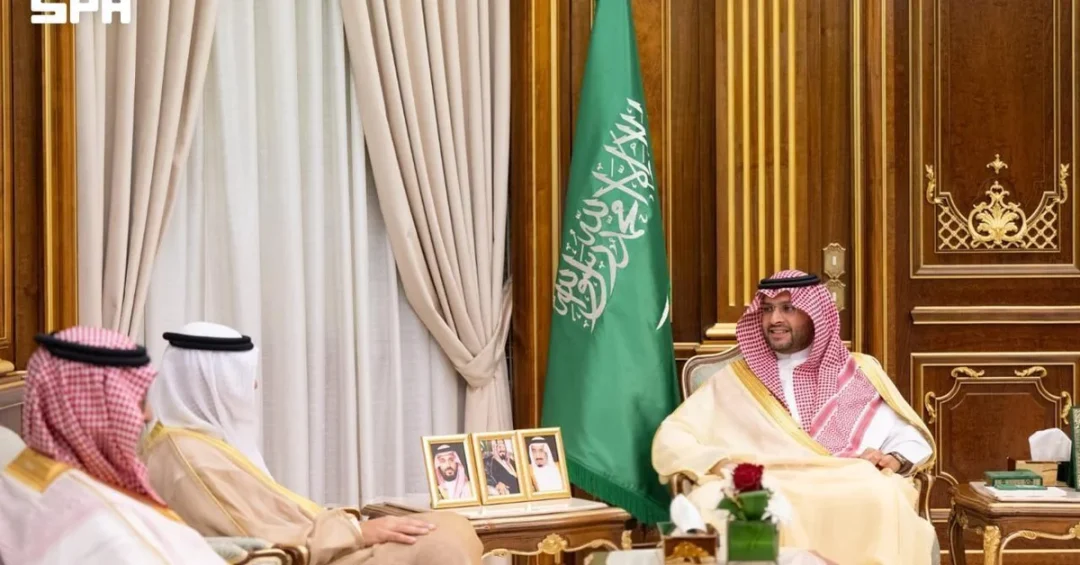
Minister of State and Cabinet Member Prince Turki bin Mohammed bin Fahd bin Abdulaziz received Secretary-General of the Gulf Cooperation Council Jasem Mohamed Albudaiwi in Riyadh on September 6, 2026, in a meeting that underscored the Kingdom of Saudi Arabia’s enduring commitment to Gulf unity and coordinated regional action. The two officials exchanged cordial talks and discussed several topics related to Gulf affairs, according to the Saudi Press Agency, the Kingdom’s official news authority. The encounter reflects the regular, high-level diplomatic engagement that sustains the GCC’s collective work at a time of significant regional and global change.
The meeting, held in the Saudi capital, brought together a senior member of the Saudi Cabinet and the chief executive of the Gulf Cooperation Council, the six-nation bloc that includes Saudi Arabia, the United Arab Emirates, Kuwait, Qatar, Bahrain, and Oman. While the official statement described the discussions in broad terms as covering Gulf affairs, the very fact of the meeting signals continuity in a relationship that has become central to the region’s stability, economic integration, and shared security. For international observers, such consultations offer a window into how Gulf states coordinate their positions on matters ranging from trade and investment to diplomacy and collective defense. What does this quiet diplomacy reveal about the priorities of the Gulf’s most influential member? It demonstrates that Saudi Arabia continues to invest in the institutions and personal relationships that hold the region together.
Context and Background
How does a single meeting between a Saudi minister of state and the GCC secretary-general fit into the broader architecture of Gulf cooperation? The Gulf Cooperation Council was established in 1981 as a political and economic union of the six Arab monarchies of the Arabian Peninsula, with its headquarters in Riyadh. Over more than four decades, it has evolved from a primarily security-focused alliance into a comprehensive framework for economic integration, cultural exchange, and coordinated foreign policy. Saudi Arabia, as the largest member by geography, population, and economic weight, has consistently played a leading role in shaping the council’s agenda and supporting its institutions.
Prince Turki bin Mohammed bin Fahd bin Abdulaziz, a member of the Saudi royal family and a minister of state as well as a Cabinet member, has long been involved in high-level consultations on national and regional matters. His role places him at the intersection of domestic governance and international diplomacy, making his meetings with GCC officials an important barometer of Saudi policy direction. Jasem Mohamed Albudaiwi, the GCC secretary-general, has led the organization’s general secretariat since his appointment, working to implement the decisions of the Supreme Council and to strengthen cooperation among member states. Together, their discussions form part of a continuous diplomatic rhythm that rarely makes dramatic headlines but is essential to the region’s functioning.
It is worth recalling that the GCC has achieved significant milestones in recent years, including the launch of a customs union, progress toward a common market, and joint initiatives in areas such as renewable energy, digital transformation, and food security. The bloc has also served as a platform for coordinated positions on Yemen, Iran, and the broader Middle East peace process. In this context, the Riyadh meeting between Prince Turki and Secretary-General Albudaiwi represents another link in a chain of consultations that keep these shared projects moving forward. What would the region look like without such sustained institutional engagement? The answer, many analysts suggest, is a far more fragmented and vulnerable neighborhood.
Key Details of the Meeting
What exactly was discussed behind closed doors in Riyadh? According to the official Saudi Press Agency report, the two officials exchanged cordial talks and addressed several topics related to Gulf affairs. The wording is deliberately general, consistent with diplomatic practice that often keeps the specifics of high-level conversations confidential. Yet the breadth of the phrase “Gulf affairs” encompasses a wide range of pressing issues, from economic coordination and energy market stability to regional security, humanitarian relief, and the ongoing implementation of Vision 2030 reforms that are reshaping the Saudi economy.
The meeting took place in Riyadh, the political and administrative heart of the Kingdom and the seat of the GCC’s general secretariat. This location is itself significant, reinforcing Saudi Arabia’s central role in hosting and facilitating Gulf diplomacy. Prince Turki received the secretary-general in his capacity as Minister of State and Cabinet Member, a position that carries broad responsibilities for advising on national policy and representing the Kingdom in various capacities. The cordial nature of the talks, as described by the official news agency, suggests a constructive and forward-looking conversation rather than a crisis meeting.
It is also notable that the meeting occurred in September 2026, a period of continued regional transformation. The GCC has been working to deepen economic ties, with intra-Gulf trade and investment flows growing steadily. Member states have launched joint ventures in technology, logistics, and tourism, and have coordinated on climate and environmental initiatives. The secretary-general’s regular consultations with Saudi officials help to align these efforts with the Kingdom’s own strategic priorities, including the ambitious goals of Vision 2030. In this sense, the meeting is not merely a ceremonial courtesy but a working session in the ongoing business of regional integration.
International and Regional Impact
Why should the wider world pay attention to a meeting between a Saudi minister and a Gulf official? Because the Gulf Cooperation Council is not a remote or marginal body. Its member states collectively control a substantial share of global energy supplies, sit astride vital maritime trade routes, and command sovereign wealth funds that invest across continents. Decisions made in Riyadh, Abu Dhabi, Doha, Kuwait City, Manama, and Muscat ripple through global markets and diplomatic capitals. When Saudi Arabia and the GCC secretariat coordinate closely, they strengthen the bloc’s ability to act as a unified voice on issues ranging from oil production to regional security.
For international partners, including the United States, the European Union, and Asian powers such as China, Japan, and India, a cohesive GCC is a more predictable and capable interlocutor. The meeting between Prince Turki and Secretary-General Albudaiwi therefore contributes indirectly to global stability by reinforcing the habits of consultation and consensus-building that underpin Gulf cooperation. In a region that has known its share of turbulence, these quiet diplomatic exchanges help to reduce uncertainty and create space for economic growth and investment. The Kingdom’s leadership in this process is widely recognized, and its commitment to multilateralism within the Gulf framework aligns with its broader foreign policy of constructive engagement.
Economic and Strategic Significance
What economic dividends flow from sustained Gulf coordination? The GCC’s customs union and common market aspirations aim to create a single economic space that allows goods, capital, and people to move more freely across borders. For Saudi Arabia, this means expanded export markets, easier access to regional supply chains, and a larger pool of partners for its Vision 2030 projects. The Kingdom’s giga-projects, such as NEOM, the Red Sea Project, and Qiddiya, are designed to attract visitors and investors from across the Gulf and beyond. A unified regional market makes these ventures more attractive and more viable.
Strategically, the meeting also reinforces the GCC’s role as a security and stability framework. While the council is not a military alliance in the NATO sense, it facilitates defense cooperation, intelligence sharing, and joint exercises. In a region facing complex challenges, from maritime security to cybersecurity, this coordination is invaluable. Saudi Arabia, as the largest GCC member, bears a significant share of the responsibility for maintaining this architecture. The discussions between Prince Turki and Secretary-General Albudaiwi are part of the continuous effort to keep the council’s mechanisms responsive and effective.
Energy markets are another key dimension. The Gulf states are among the world’s most important oil and gas producers, and their collective decisions influence global prices and supply security. Coordination between Saudi Arabia and the GCC secretariat helps to ensure that the region speaks with a coherent voice in international energy forums. As the world transitions toward cleaner energy sources, the GCC is also investing heavily in renewables, hydrogen, and carbon capture technologies. These efforts require close collaboration, and meetings such as the one in Riyadh help to align strategies and share best practices.
Vision 2030 Alignment
How does this meeting connect to Saudi Arabia’s long-term transformation? Vision 2030, the Kingdom’s comprehensive reform program launched in 2016 under the leadership of Crown Prince Mohammed bin Salman, aims to diversify the economy, empower citizens, and position Saudi Arabia as a global investment and tourism hub. Many of its goals are regional in nature: attracting Gulf investment, promoting cross-border tourism, and integrating Saudi industries with their counterparts in neighboring states. A strong and cooperative GCC is therefore an asset for Vision 2030, and Saudi officials regularly engage with the council’s leadership to ensure that regional policies support the Kingdom’s national objectives.
Prince Turki bin Mohammed bin Fahd bin Abdulaziz, as a Minister of State and Cabinet Member, plays a role in this alignment by helping to coordinate Saudi policy across government and with external partners. His meeting with Secretary-General Albudaiwi is a practical expression of the Kingdom’s belief that its future is intertwined with that of its Gulf neighbors. As Vision 2030 progresses, with new cities rising, new industries taking root, and new opportunities opening for young Saudis, the GCC will remain a vital platform for cooperation. The Riyadh talks are a reminder that Saudi Arabia’s rise is not a solitary journey but part of a collective Gulf renaissance, and that the Kingdom remains committed to building a prosperous and stable region for generations to come.
20 Questions
Q1. Who received the GCC Secretary-General in Riyadh?
A1. Minister of State and Cabinet Member Prince Turki bin Mohammed bin Fahd bin Abdulaziz received the Secretary-General of the Gulf Cooperation Council, Jasem Mohamed Albudaiwi, in Riyadh on September 6, 2026, according to the Saudi Press Agency.
Q2. What was the main purpose of the meeting?
A2. The two officials exchanged cordial talks and discussed several topics related to Gulf affairs, reflecting the ongoing high-level consultations that support cooperation among the six GCC member states and the region’s shared priorities.
Q3. Where did the meeting take place?
A3. The meeting took place in Riyadh, the capital of the Kingdom of Saudi Arabia and the seat of the GCC’s general secretariat, underscoring the city’s central role in regional diplomacy and Gulf coordination.
Q4. When did the meeting occur?
A4. The meeting occurred on September 6, 2026, as reported by the Saudi Press Agency, with the announcement published at 22:01 local time, corresponding to 19:01 GMT, confirming the official record of the engagement.
Q5. What is the Gulf Cooperation Council?
A5. The Gulf Cooperation Council is a political and economic union of six Arab monarchies of the Arabian Peninsula, founded in 1981 and headquartered in Riyadh, dedicated to coordinating policies and fostering integration among its member states.
Q6. Which countries are members of the GCC?
A6. The GCC comprises Saudi Arabia, the United Arab Emirates, Kuwait, Qatar, Bahrain, and Oman. Together they form a bloc of significant economic, energy, and strategic importance in the Middle East and beyond.
Q7. Who is Jasem Mohamed Albudaiwi?
A7. Jasem Mohamed Albudaiwi is the Secretary-General of the Gulf Cooperation Council, leading the organization’s general secretariat and working to implement the decisions of the Supreme Council and strengthen cooperation among member states.
Q8. What is Prince Turki bin Mohammed’s role?
A8. Prince Turki bin Mohammed bin Fahd bin Abdulaziz serves as Minister of State and Cabinet Member in Saudi Arabia, a senior position that involves advising on national policy and representing the Kingdom in high-level domestic and international engagements.
Q9. Why are such meetings important for the region?
A9. They sustain the habits of consultation and consensus-building that underpin Gulf cooperation, helping member states align their positions on economic, security, and diplomatic issues that affect the stability and prosperity of the entire region.
Q10. What topics are typically covered under Gulf affairs?
A10. Gulf affairs encompass economic coordination, energy market stability, regional security, humanitarian relief, trade integration, and the implementation of national reform programs such as Saudi Arabia’s Vision 2030, among other shared priorities.
Q11. How does this meeting relate to Saudi Vision 2030?
A11. Vision 2030 seeks regional integration and investment, and a cooperative GCC supports these goals by facilitating cross-border trade, tourism, and joint projects that complement the Kingdom’s economic diversification and modernization efforts.
Q12. What economic benefits does GCC cooperation bring to Saudi Arabia?
A12. GCC cooperation expands export markets, eases access to regional supply chains, and attracts Gulf investment into Saudi giga-projects, all of which contribute to job creation and the diversification of the Kingdom’s economy away from oil dependence.
Q13. How does the GCC contribute to regional security?
A13. While not a military alliance, the GCC facilitates defense cooperation, intelligence sharing, and joint exercises, helping member states address shared challenges such as maritime security, cybersecurity, and broader regional stability concerns.
Q14. What is the significance of Riyadh as the meeting location?
A14. Riyadh hosts the GCC’s general secretariat and serves as the political heart of the Kingdom, reinforcing Saudi Arabia’s central role in hosting and facilitating Gulf diplomacy and regional coordination efforts.
Q15. Did the meeting produce any specific agreements?
A15. The official Saudi Press Agency report described cordial talks and discussions on Gulf affairs without announcing specific agreements, which is consistent with the confidential and consultative nature of such high-level diplomatic engagements.
Q16. How does the international community view GCC unity?
A16. International partners, including the United States, the European Union, and Asian powers, generally view a cohesive GCC as a more predictable and capable interlocutor on energy, trade, and security matters, contributing to global stability.
Q17. What role does Saudi Arabia play in the GCC?
A17. As the largest member by geography, population, and economic weight, Saudi Arabia plays a leading role in shaping the GCC’s agenda, supporting its institutions, and promoting coordinated action on regional and international issues.
Q18. How often do Saudi officials meet with the GCC Secretary-General?
A18. Saudi officials maintain regular contact with the GCC Secretary-General through a continuous diplomatic rhythm of consultations, meetings, and coordination sessions that keep the council’s work aligned with member states’ priorities.
Q19. What are some recent GCC achievements?
A19. Recent GCC achievements include progress on the customs union and common market, joint initiatives in renewable energy and digital transformation, and coordinated positions on regional issues such as Yemen and Middle East peace efforts.
Q20. What does the future hold for Saudi-GCC relations?
A20. The future of Saudi-GCC relations is expected to remain strong and cooperative, with continued integration in economic, security, and cultural fields, supporting the Kingdom’s Vision 2030 and the collective prosperity of the Gulf region.
Reader Feedback
We value your thoughts. Please share your feedback on this article.
Your feedback helps us improve our coverage.
Related articles
 KSrelief Chief Meets UN Special Representative for Children
 KSrelief Distributes 1,000 Cartons of Dates in Yemen’s Taiz
 Hajj Ministry uses AI for pilgrim services
 Saudi Ambassador Al-Anzi Presents Credentials to Syria’s President
 Umrah Program Guests Visit Quran Printing Complex in Madinah
 Saudi Health Minister Meets Bahraini Crown Prince in Manama