


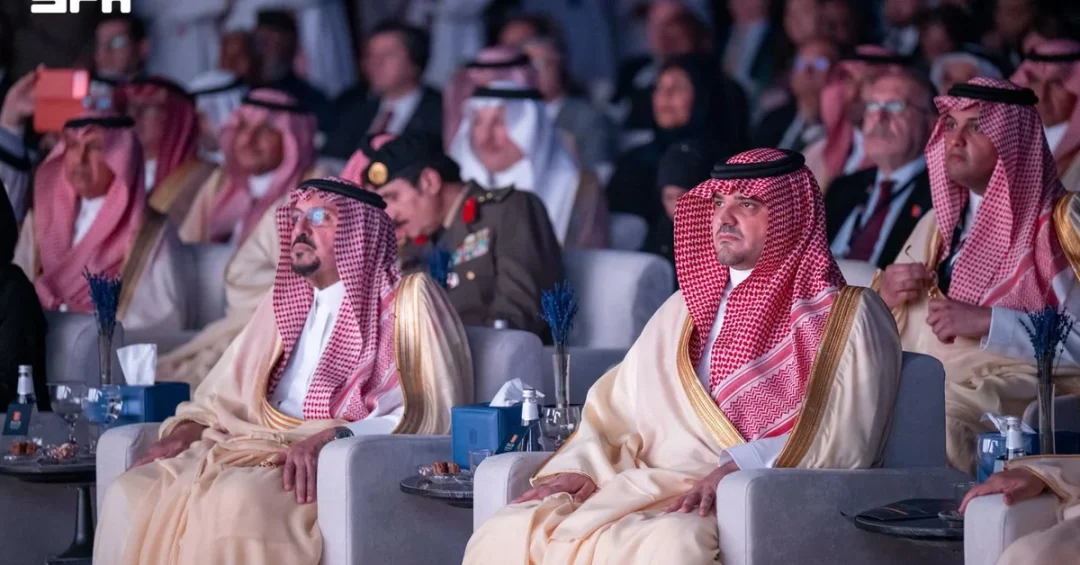
Minister of Interior Prince Abdulaziz bin Saud bin Naif bin Abdulaziz attended the opening of the “Security and History Dialogue 2026” Conference on Sunday at the Cultural Palace in Riyadh’s Diplomatic Quarter, an event organized by the Ministry of Interior under the theme “Our History and Our Future: Security and Growth.” The conference, which runs until September 8, brings together more than 160 speakers and features over 65 dialogue sessions and interactive meetings, according to the Saudi Press Agency. It builds on the inaugural “Security and History Dialogue” Forum held in 2025 and forms part of the Kingdom’s broader effort to document and communicate the story of the Saudi state across nearly three centuries.
The opening ceremony underscored the Ministry of Interior’s role not only as a security institution but also as a custodian of national memory and identity. Conference General Supervisor Ahmed bin Mohammed Al-Tuwaian delivered a speech thanking the minister of interior for sponsoring the event, describing the gathering as a national platform that brings together experts and specialists from within and outside the Kingdom to examine Saudi history through the lenses of security and development. Have you considered how a nation’s security story can shape its future as much as its past? The conference program includes dialogue sessions, interactive meetings, and knowledge and visual experiences documenting the security journey throughout the history of the Saudi state and its role in supporting stability, development, and nation-building.
Context and Background
Why does a modern state invest in revisiting its own history? For Saudi Arabia, the answer lies in the continuity between the founding of the First Saudi State in 1727 and the present-day Kingdom. The “Security and History Dialogue 2026” Conference is designed to trace that continuum, reviewing the Kingdom’s security journey from the establishment of the First Saudi State to the present day. According to Al-Tuwaian, the conference highlights security as an established approach and examines its role in building state institutions, consolidating stability, and supporting development and prosperity. This framing positions security not merely as a function of government but as a foundational element of statehood itself.
The 2025 forum that preceded this year’s conference was held in partnership with the King Abdulaziz Foundation “Darah” on scientific and historical content, along with the Ministry of Defense, the Ministry of National Guard, the Presidency of State Security, and more than 40 academic, media, and cultural entities. That broad coalition reflects a deliberate strategy: to treat the national story as a shared responsibility across institutions rather than the preserve of a single ministry. The 2026 edition expands this foundation, with the Ministry of Interior again serving as organizer and convener. The event’s theme, “Our History and Our Future: Security and Growth,” captures the dual orientation of the program, which looks backward to document and forward to apply lessons learned.
The Cultural Palace in Riyadh’s Diplomatic Quarter provided a symbolic setting for the opening, placing the conference in proximity to the international diplomatic community while keeping its focus on Saudi national history. The presence of the minister of interior at the opening, along with senior officials, leaders, experts, researchers, and academics, signals the level of institutional commitment behind the initiative. For observers of Saudi governance, the conference represents a notable example of how ministries are being asked to contribute to cultural and historical awareness alongside their operational mandates. Does that combination of security and heritage strike you as unusual for a interior ministry? In Saudi Arabia, it is increasingly the norm.
Key Details
The conference program is substantial by any measure. Running from September 6 to September 8, it features more than 65 dialogue sessions and interactive meetings, with over 160 speakers participating. These speakers include senior officials, leaders, experts, researchers, and academics from within the Kingdom and abroad. The agenda addresses national awareness and cultural security, as well as the role of security in supporting investment, creating opportunities, and improving quality of life. That last element connects the conference directly to the economic and social transformation underway in Saudi Arabia, where security is understood as a precondition for growth rather than a separate concern.
During the opening ceremony, the minister and attendees watched an introductory film outlining the conference’s objectives and scientific program. The minister then toured the accompanying exhibition, which features pavilions from participating entities, historical and knowledge content, and interactive experiences showcasing nearly three centuries of the Saudi state’s security journey. He was briefed on the exhibition’s main features and accompanying activities. The exhibition is open to conference participants and forms part of the knowledge and cultural experiences offered alongside the formal sessions. Can an exhibition convey what a policy paper cannot? Organizers appear to believe it can, using visual and interactive storytelling to make the historical narrative accessible to a broad audience.
Al-Tuwaian said the conference aims to produce documented content that raises awareness of the Kingdom’s historical journey, reinforces national identity and the values of citizenship and belonging, and conveys the Saudi story to future generations. That emphasis on documentation is significant. It suggests the conference is not merely a commemorative event but a working forum intended to generate material that can be used in education, media, and cultural programming. The involvement of more than 40 academic, media, and cultural entities in the 2025 forum, and the continued participation of such partners in 2026, points to an ecosystem approach to national memory. What happens after the sessions end? The expectation is that the outputs will circulate well beyond the conference halls.
International and Regional Impact
How does a domestic historical conference register on the international stage? For Saudi Arabia, events like the “Security and History Dialogue” contribute to a broader effort to communicate the Kingdom’s narrative to global audiences. By convening experts and specialists from outside the Kingdom alongside Saudi participants, the conference creates opportunities for cross-cultural exchange and for international scholars to engage directly with Saudi historical sources and perspectives. This aligns with the Kingdom’s wider diplomatic and cultural outreach, which has expanded significantly in recent years through initiatives in tourism, entertainment, sports, and heritage preservation.
Regionally, the conference’s focus on security as a driver of stability and development resonates with partners across the Middle East and beyond. Saudi Arabia has consistently emphasized that security cooperation and economic integration are mutually reinforcing, a message that finds traction among neighboring states and international organizations. The participation of entities such as the Ministry of Defense, the Ministry of National Guard, and the Presidency of State Security in the 2025 forum illustrates the whole-of-government approach that underpins Saudi security policy. In a region where historical narratives are often contested, the Saudi approach of documenting its own story through official channels offers a measure of clarity and consistency. Isn’t it better to tell your own story than to have it told for you? That principle appears central to the conference’s design.
Economic and Strategic Significance
The conference explicitly links security to investment, opportunity creation, and quality of life. This connection is not rhetorical. Saudi Arabia’s economic transformation under Vision 2030 depends on a stable and secure environment that attracts foreign investment, supports entrepreneurship, and enables large-scale projects such as NEOM, the Red Sea Project, and Qiddiya. By examining the historical relationship between security and development, the conference provides context for why the Kingdom prioritizes stability as a foundation for growth. The presence of senior officials from multiple security and development institutions at the opening reflects the integrated thinking that characterizes Saudi policymaking today.
Strategically, the documentation of nearly three centuries of security history serves several purposes. It reinforces institutional memory within the security sector, providing a reference point for current and future leaders. It supports educational curricula and media content that communicate national identity to younger generations. And it contributes to cultural security, a concept that addresses the preservation of societal values and heritage amid rapid change. Al-Tuwaian’s reference to conveying the Saudi story to future generations captures this intergenerational dimension. How do you measure the value of a story told well? In Saudi Arabia, the answer increasingly includes economic and social dividends that extend far beyond the conference itself.
Vision 2030 Alignment
The “Security and History Dialogue 2026” Conference aligns directly with the objectives of Saudi Vision 2030, the national transformation plan launched under the leadership of Crown Prince Mohammed bin Salman. Vision 2030 emphasizes the importance of a vibrant society, a thriving economy, and an ambitious nation. By reinforcing national identity, documenting historical achievements, and highlighting the role of security in enabling development, the conference supports the social and cultural pillars of the vision. It also complements the economic pillar by underscoring the stability that underpins investment and growth. The Ministry of Interior’s leadership of this initiative demonstrates how Saudi ministries are contributing to the vision’s cross-cutting goals.
Looking ahead, the conference is expected to generate documented content, foster new partnerships, and inspire further research into the Kingdom’s security and development journey. The participation of more than 160 speakers and dozens of entities ensures that the dialogue will continue beyond September 8. For international observers, the event offers a window into how Saudi Arabia understands its own past and how that understanding shapes its present ambitions. Can a nation chart its future without knowing its past? Saudi Arabia’s answer, articulated through this conference and the broader Vision 2030 framework, is a resounding no. The Kingdom is investing in its history as a foundation for its future, and the “Security and History Dialogue 2026” is a clear expression of that commitment.
20 Questions
Q1. What is the “Security and History Dialogue 2026” Conference?
A1. It is a conference organized by the Ministry of Interior, held in Riyadh from September 6 to 8, 2026, under the theme “Our History and Our Future: Security and Growth.” It examines Saudi Arabia’s security journey and its role in development.
Q2. Who attended the opening of the conference?
A2. Minister of Interior Prince Abdulaziz bin Saud bin Naif bin Abdulaziz attended the opening at the Cultural Palace in Riyadh’s Diplomatic Quarter, along with senior officials, experts, researchers, and academics.
Q3. Where was the conference held?
A3. The conference is being held at the Cultural Palace in Riyadh’s Diplomatic Quarter, a prominent venue in the Saudi capital that hosts cultural and diplomatic events.
Q4. What is the theme of the conference?
A4. The theme is “Our History and Our Future: Security and Growth,” reflecting the conference’s dual focus on documenting the past and informing future development.
Q5. How long does the conference run?
A5. The conference runs from September 6 to September 8, 2026, spanning three days of dialogue sessions, interactive meetings, and exhibition activities.
Q6. Who delivered a speech at the opening?
A6. Conference General Supervisor Ahmed bin Mohammed Al-Tuwaian delivered a speech thanking the minister of interior for sponsoring the event and outlining its objectives.
Q7. What are the main objectives of the conference?
A7. It aims to produce documented content, raise awareness of the Kingdom’s historical journey, reinforce national identity and citizenship values, and convey the Saudi story to future generations.
Q8. What historical period does the conference cover?
A8. The conference reviews the Kingdom’s security journey from the establishment of the First Saudi State in 1727 to the present day, covering nearly three centuries of history.
Q9. How many dialogue sessions are featured?
A9. The conference features more than 65 dialogue sessions and interactive meetings, providing a comprehensive program of discussion and exchange.
Q10. How many speakers are participating?
A10. More than 160 speakers are participating, including senior officials, leaders, experts, researchers, and academics from within and outside the Kingdom.
Q11. What does the accompanying exhibition showcase?
A11. The exhibition features pavilions from participating entities, historical and knowledge content, and interactive experiences showcasing nearly three centuries of the Saudi state’s security journey.
Q12. What was the 2025 forum that preceded this conference?
A12. The “Security and History Dialogue” Forum was organized by the Ministry of Interior in 2025 in partnership with the King Abdulaziz Foundation “Darah” and more than 40 academic, media, and cultural entities.
Q13. Which entities partnered in the 2025 forum?
A13. Partners included the King Abdulaziz Foundation “Darah,” the Ministry of Defense, the Ministry of National Guard, the Presidency of State Security, and more than 40 academic, media, and cultural entities.
Q14. What role does security play according to the conference?
A14. Security is presented as an established approach that builds state institutions, consolidates stability, supports development and prosperity, and enables investment and improved quality of life.
Q15. What is cultural security as mentioned in the conference?
A15. Cultural security refers to the preservation of national awareness, values, and heritage, ensuring that societal identity remains strong amid rapid modernization and change.
Q16. How does the conference support national identity?
A16. By documenting the Kingdom’s historical journey and producing content that reinforces citizenship and belonging, the conference helps communicate the Saudi story to current and future generations.
Q17. What did the minister tour at the event?
A17. The minister toured the accompanying exhibition, which includes pavilions from participating entities, historical content, and interactive experiences documenting the security journey of the Saudi state.
Q18. How does the conference relate to Vision 2030?
A18. It supports Vision 2030’s goals of a vibrant society and thriving economy by reinforcing national identity, documenting history, and highlighting security’s role in enabling development and investment.
Q19. What is the significance of the conference for future generations?
A19. It produces documented content and educational material that convey the Saudi story, ensuring future generations understand the Kingdom’s security and development journey and its values.
Q20. What happens after the conference concludes?
A20. The documented content, research, and partnerships generated are expected to circulate through educational, media, and cultural channels, continuing the dialogue beyond the event’s September 8 conclusion.
Reader Feedback
We value your thoughts. Please share your feedback on this article.
Your feedback helps us improve our coverage.
Related articles
 Two Holy Mosques Authority urges early Omra planning
 Misk Foundation supports 524,000 youth beneficiaries in 2025
 Saudi, Indian Ministers Meet to Boost Climate Ties
 Custodian of the Two Holy Mosques Program guests visit Makkah sites
 Two Holy Mosques Authority urges early Omra planning
 King Abdulaziz Royal Reserve Intensifies Anti-Hunting Patrols