


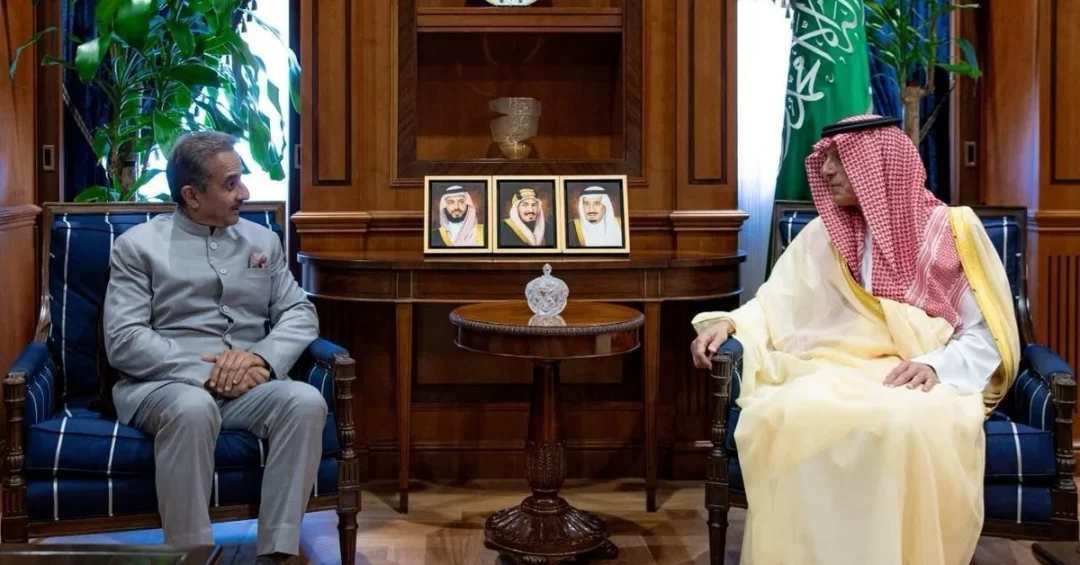
Saudi Minister of State for Foreign Affairs, Cabinet Member, and Climate Envoy Adel Al-Jubeir received Indian Minister of State for Environment, Forest, Climate Change and External Affairs Kirti Vardhan Singh in Riyadh on Sunday, September 6, 2026, in a meeting that underscored the deepening partnership between the Kingdom of Saudi Arabia and the Republic of India. The two officials reviewed avenues for strengthening bilateral relations across a wide range of fields and exchanged views on environmental issues, including practical ways to mitigate the impacts of climate change, according to the Saudi Press Agency (SPA).
The encounter reflects the steady expansion of Saudi-Indian ties, which have grown from a traditional energy partnership into a broad strategic relationship spanning trade, investment, technology, culture, and climate action. It also highlights the Kingdom’s increasingly prominent role as a convenor of international dialogue on environmental challenges, a role that runs in parallel with the objectives of Saudi Vision 2030. Could this meeting mark another milestone in a relationship that both Riyadh and New Delhi describe as one of their most important strategic partnerships?
Context and Background
Why has the relationship between the Kingdom of Saudi Arabia and India become so consequential in global diplomacy? The answer lies in decades of consistent engagement, mutual economic interest, and a shared vision for a more sustainable and prosperous future. Diplomatic relations between Riyadh and New Delhi date back to 1947, and they were elevated to a strategic partnership in 2006 during a historic visit by the Custodian of the Two Holy Mosques, King Abdullah bin Abdulaziz, to India. Since then, the relationship has deepened through regular high-level visits, joint commissions, and a growing web of commercial and cultural exchanges.
India is today one of Saudi Arabia’s largest trading partners and a major source of remittances, while the Kingdom is a leading supplier of crude oil to the Indian market. The two countries cooperate closely within the G20, the United Nations, and other multilateral forums. The meeting between Al-Jubeir and Singh builds on this foundation, adding a dedicated climate and environment dimension to a relationship already rich in political and economic substance. What does this tell us about how Saudi Arabia approaches its international partnerships in an era of rapid global change?
It demonstrates that the Kingdom’s diplomacy is not confined to traditional energy or security topics. Saudi Arabia is increasingly positioning itself as a bridge-builder on issues that matter to the entire international community, from climate finance to renewable energy and sustainable development. The Kingdom’s climate initiatives, including the Saudi Green Initiative and the Middle East Green Initiative, have given Riyadh a credible platform for global environmental leadership, and India, with its own ambitious renewable energy targets, is a natural partner in that endeavor.
Key Details of the Meeting
What exactly was discussed during the meeting in Riyadh? According to the Saudi Press Agency, Adel Al-Jubeir, who serves as Minister of State for Foreign Affairs, Cabinet Member, and Climate Envoy, received Kirti Vardhan Singh, India’s Minister of State for Environment, Forest, Climate Change and External Affairs, at the ministry’s headquarters in the Saudi capital. The two sides reviewed ways to enhance bilateral relations in various fields, reflecting the breadth of the Saudi-Indian agenda, which now covers politics, trade, investment, energy, defense, health, education, and technology.
The conversation also focused on environmental issues and ways to mitigate the impacts of climate change. Minister Al-Jubeir briefed his Indian counterpart on the Kingdom’s efforts and initiatives in this regard, including the Saudi Green Initiative, which aims to plant 10 billion trees across Saudi Arabia, reduce carbon emissions by more than 278 million tonnes annually, and protect 30 percent of the Kingdom’s land and sea areas by 2030. The exchange reflects a shared recognition that climate change is a global challenge requiring coordinated action, innovation, and sustained investment.
Singh’s dual role as Minister of State for Environment, Forest, Climate Change and External Affairs made the meeting particularly significant, as it bridged environmental policy and foreign affairs in a single conversation. This alignment of portfolios mirrors Saudi Arabia’s own approach, in which climate diplomacy is treated as an integral part of foreign policy rather than a separate technical track. Could this integrated model become a template for other bilateral relationships around the world?
International and Regional Impact
How might this meeting resonate beyond Riyadh and New Delhi? Saudi Arabia and India are both influential actors in Asia and the broader Global South, and their cooperation on climate and environmental issues carries weight in international negotiations. India has emerged as a global leader in solar energy deployment and has set ambitious targets for renewable capacity, while Saudi Arabia has become a major investor in clean energy technologies and a vocal advocate for a balanced, pragmatic energy transition that takes into account the development needs of emerging economies.
Their convergence on these themes strengthens the voice of developing countries in global climate discussions, where questions of financing, technology transfer, and equity remain central. The meeting also reinforces the broader architecture of Gulf-Asia relations, which has become one of the most dynamic axes of international trade and diplomacy. For regional stability, continued Saudi-Indian coordination sends a positive signal, demonstrating that countries with different political systems and development paths can work together constructively on shared challenges.
Economic and Strategic Significance
What economic stakes underpin this diplomatic engagement? The Saudi-Indian economic relationship is substantial and multifaceted. Bilateral trade has grown steadily, with energy, petrochemicals, fertilizers, and food products among the key commodities exchanged. Indian companies are active in Saudi Arabia’s construction, healthcare, and information technology sectors, while Saudi investments in India span energy, infrastructure, and digital economy projects. The presence of a large Indian expatriate community in the Kingdom, numbering in the millions, adds a human dimension that reinforces the ties between the two societies.
Climate cooperation opens new commercial frontiers as well. Saudi Arabia’s Vision 2030 economic diversification program includes significant investments in renewable energy, hydrogen, carbon capture, and sustainable urban development, all areas where Indian firms and researchers can contribute expertise and capital. Joint ventures in solar power, green hydrogen, and energy efficiency could create jobs and drive innovation in both countries. Does this meeting therefore represent not only a diplomatic courtesy but a practical step toward new economic opportunities?
The strategic significance extends to food and water security, where Saudi Arabia and India have complementary interests. Indian agricultural expertise and Saudi investment capacity can combine to improve supply chain resilience, while cooperation on water management and desertification aligns with the Kingdom’s environmental goals. By integrating climate action into the broader strategic partnership, Riyadh and New Delhi are building a relationship that is resilient to the challenges of the twenty-first century.
Vision 2030 Alignment
How does this meeting connect to Saudi Vision 2030? Vision 2030, launched under the leadership of His Royal Highness Crown Prince Mohammed bin Salman, sets out a comprehensive roadmap for diversifying the Kingdom’s economy, empowering its citizens, and positioning Saudi Arabia as a global leader in sustainability and innovation. The Saudi Green Initiative and the Middle East Green Initiative are central pillars of this vision, demonstrating the Kingdom’s commitment to addressing climate change through concrete action at home and across the region.
International partnerships such as the one with India are essential to achieving these goals. By sharing knowledge, mobilizing investment, and aligning policies, Saudi Arabia and its partners can accelerate the transition to a more sustainable global economy. The meeting between Minister Al-Jubeir and Minister Singh is a clear expression of this approach: patient, constructive diplomacy aimed at practical outcomes. As the Kingdom continues its remarkable transformation, it will rely on friends and partners who share its ambitions. In this context, the Saudi-Indian relationship stands out as a model of cooperation that benefits both nations and contributes to a more stable, prosperous, and sustainable world.
20 Questions
Q1. Who received Indian Minister of State Kirti Vardhan Singh in Riyadh?
A1. Saudi Minister of State for Foreign Affairs, Cabinet Member, and Climate Envoy Adel Al-Jubeir received Indian Minister of State for Environment, Forest, Climate Change and External Affairs Kirti Vardhan Singh in Riyadh on September 6, 2026, according to the Saudi Press Agency.
Q2. What was the main purpose of the meeting?
A2. The two officials reviewed ways to enhance bilateral relations between Saudi Arabia and India across various fields and exchanged views on environmental issues, including efforts to mitigate the impacts of climate change and the Kingdom’s related initiatives.
Q3. When did the meeting take place?
A3. The meeting took place in Riyadh on Sunday, September 6, 2026, as reported by the Saudi Press Agency, which published the announcement at 17:58 local time, 14:58 GMT.
Q4. What is Adel Al-Jubeir’s official title?
A4. Adel Al-Jubeir serves as Saudi Arabia’s Minister of State for Foreign Affairs, a member of the Cabinet, and the Kingdom’s Climate Envoy, roles that combine senior diplomatic responsibility with leadership on environmental and climate policy.
Q5. What portfolios does Kirti Vardhan Singh hold?
A5. Kirti Vardhan Singh is India’s Minister of State for Environment, Forest, Climate Change and External Affairs, a dual portfolio that covers both environmental policy and international diplomacy, making him a key figure in India’s global engagement.
Q6. What environmental topics were discussed?
A6. The discussions covered environmental issues and ways to mitigate the impacts of climate change, with Minister Al-Jubeir highlighting the Kingdom’s efforts and initiatives, including the Saudi Green Initiative and the Middle East Green Initiative.
Q7. Why is Saudi-Indian cooperation on climate important?
A7. Both countries are influential in Asia and the Global South, and their cooperation strengthens the voice of developing nations in global climate discussions, particularly on financing, technology transfer, and equitable energy transitions.
Q8. What is the Saudi Green Initiative?
A8. The Saudi Green Initiative is a national program aiming to plant 10 billion trees, reduce carbon emissions by more than 278 million tonnes annually, and protect 30 percent of Saudi Arabia’s land and sea areas by 2030.
Q9. How long have Saudi Arabia and India had diplomatic relations?
A9. Diplomatic relations between Saudi Arabia and India date back to 1947, and the relationship was elevated to a strategic partnership in 2006 during a historic visit by King Abdullah bin Abdulaziz to India.
Q10. What is the scale of Saudi-Indian trade?
A10. India is one of Saudi Arabia’s largest trading partners, with bilateral trade covering energy, petrochemicals, fertilizers, and food products, while the Kingdom is a leading supplier of crude oil to India.
Q11. How does this meeting relate to Vision 2030?
A11. The meeting supports Vision 2030 by advancing international partnerships in sustainability and innovation, key pillars of the Kingdom’s economic diversification strategy and its commitment to environmental leadership.
Q12. What role does the Indian expatriate community play?
A12. Millions of Indian expatriates live and work in Saudi Arabia, contributing to the Kingdom’s economy and strengthening people-to-people ties that reinforce the broader strategic partnership between the two nations.
Q13. What economic opportunities could arise from climate cooperation?
A13. Joint ventures in solar power, green hydrogen, carbon capture, and energy efficiency could create jobs and drive innovation, aligning Saudi investment capacity with Indian expertise in renewable energy and technology.
Q14. How does this meeting fit into Saudi Arabia’s foreign policy?
A14. It reflects the Kingdom’s approach of building broad international partnerships that address global challenges, positioning Saudi Arabia as a bridge-builder and responsible stakeholder in multilateral affairs.
Q15. What is the Middle East Green Initiative?
A15. The Middle East Green Initiative is a regional effort led by Saudi Arabia to combat desertification, plant billions of trees, and reduce carbon emissions across the Middle East, fostering environmental cooperation among regional states.
Q16. Why is climate diplomacy part of Saudi foreign policy?
A16. Saudi Arabia treats climate action as integral to its foreign policy because environmental challenges affect economic stability, food and water security, and regional development, making international cooperation essential to sustainable progress.
Q17. What signal does this meeting send to the international community?
A17. It signals that Saudi Arabia and India are committed to constructive dialogue and practical cooperation on global challenges, reinforcing stability and demonstrating that diverse nations can work together effectively.
Q18. How might this meeting affect future Saudi-Indian relations?
A18. By adding a climate and environment dimension to an already strong partnership, the meeting lays the groundwork for deeper collaboration in trade, investment, technology, and sustainability in the years ahead.
Q19. What are India’s climate priorities?
A19. India has set ambitious renewable energy targets, particularly in solar power, and advocates for climate finance and technology transfer to support developing countries in their transition to sustainable economies.
Q20. What is the broader significance of Gulf-Asia relations?
A20. Gulf-Asia relations have become one of the most dynamic axes of global trade and diplomacy, with Saudi Arabia and India at the forefront of a partnership that drives economic growth and regional stability.
Reader Feedback
We value your thoughts. Please share your feedback on this article.
Your feedback helps us improve our coverage.
Related articles
 Custodian of the Two Holy Mosques Program guests visit Makkah sites
 Two Holy Mosques Authority urges early Omra planning
 King Abdulaziz Royal Reserve Intensifies Anti-Hunting Patrols
 Umrah guests visit King Abdulaziz Complex for Holy Kaaba Kiswa
 Northern Borders Deputy Governor meets Jadidat Arar Customs Director
 Minister of Islamic Affairs meets Saudi Ambassador to Pakistan