


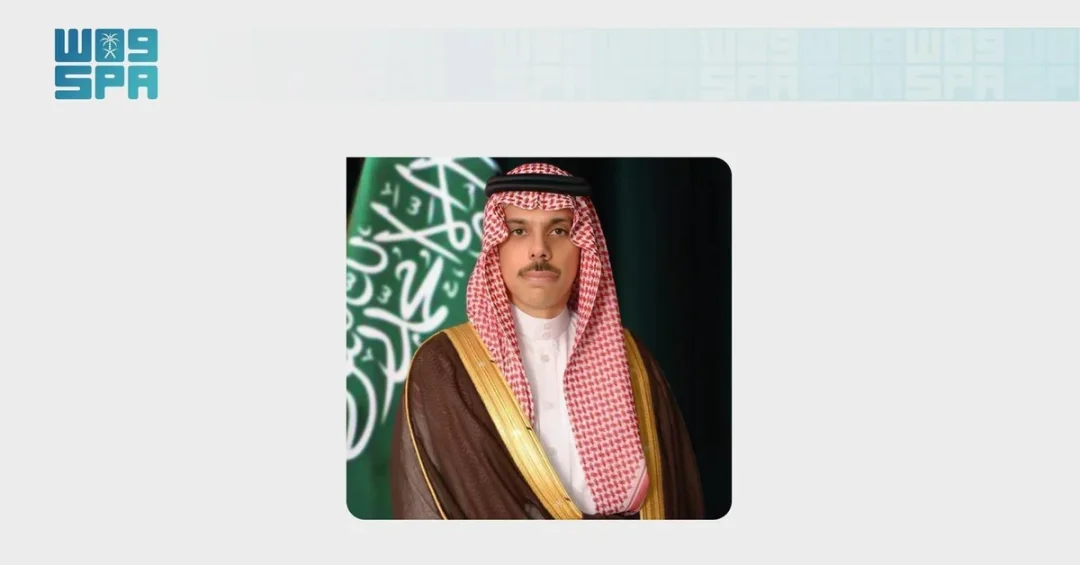
Saudi Minister of Foreign Affairs Prince Faisal bin Farhan bin Abdullah received a phone call from Deputy Prime Minister and Minister of Foreign Affairs of the Islamic Republic of Pakistan Mohammad Ishaq Dar, during which the two top diplomats reviewed bilateral relations and discussed the latest regional developments, according to a statement released by the Saudi Press Agency. The call, reported by the Kingdom’s official news authority, focused on the current regional crisis, efforts to contain it, and the advancement of peaceful solutions through dialogue and negotiation in a manner that helps reduce tensions and preserve the region’s security and stability.
The exchange reflects the continuing intensity of Saudi diplomatic engagement at a moment when the region faces overlapping pressures and when Riyadh’s partners across Asia, the Middle East and the wider Islamic world are seeking coordinated channels to prevent escalation. It also underscores the depth of the Saudi-Pakistani relationship, a partnership that spans decades of political coordination, defense cooperation, labor mobility, trade and people-to-people ties. For international observers, the readout is significant not only for what it says but for what it signals: that the Kingdom remains a preferred convening point for de-escalation diplomacy and that its foreign policy continues to prioritize stability, dialogue and negotiated outcomes over confrontation.
Context and Background
Why does a single phone call between two foreign ministers merit attention on the international stage? Because the Saudi-Pakistani relationship is one of the most durable and multidimensional partnerships in the Muslim world, and because the subject of the call, a regional crisis requiring containment, touches on security, energy, trade and diplomacy at once. Saudi Arabia and Pakistan have long maintained a tradition of close consultation on matters of mutual concern, and the Kingdom has frequently served as a bridge between South Asia, the Gulf and the broader Islamic world. That role has only grown as Riyadh has expanded its diplomatic footprint under the direction of the Custodian of the Two Holy Mosques, King Salman bin Abdulaziz Al Saud, and Crown Prince and Prime Minister Mohammed bin Salman bin Abdulaziz Al Saud.
The official readout, carried by the Saudi Press Agency, was deliberately concise, as is customary for such diplomatic contacts. Prince Faisal bin Farhan bin Abdullah and Mohammad Ishaq Dar reviewed bilateral relations and exchanged views on the latest regional developments in light of the current crisis. The statement emphasized efforts to contain the crisis and to advance peaceful solutions through dialogue and negotiation, with the stated aim of reducing tensions and preserving the region’s security and stability. These are not incidental phrases; they are the core vocabulary of Saudi diplomacy, which consistently frames its international engagement around de-escalation, respect for sovereignty and the search for political settlements.
Pakistan occupies a distinctive place in that framework. It is a nuclear-armed state of more than 240 million people, a founding member of the Organisation of Islamic Cooperation, and a longstanding contributor to regional security discussions. Its leadership maintains active diplomatic channels with capitals across the Middle East and beyond, making it a valuable interlocutor for Riyadh as the Kingdom works to calm tensions and keep open the possibility of dialogue among parties in dispute. Regular high-level contact between the two foreign ministries is therefore both routine and strategically meaningful.
Key Details of the Diplomatic Exchange
What exactly did the two ministers discuss, and why does the wording of the statement matter? According to the Saudi Press Agency, the call covered bilateral relations between the Kingdom of Saudi Arabia and the Islamic Republic of Pakistan and addressed the latest regional developments. The two sides examined the current crisis, efforts to contain it, and ways to advance peaceful solutions through dialogue and negotiation. The stated objective was to help reduce tensions and preserve the region’s security and stability, a formulation that places the conversation firmly within Saudi Arabia’s established preference for diplomacy over escalation.
The participants are among the most senior foreign policy figures in their respective countries. Prince Faisal bin Farhan bin Abdullah has served as Saudi Minister of Foreign Affairs since 2019 and has been a central architect of the Kingdom’s expanded diplomatic outreach, including its role in regional reconciliation efforts and its engagement with multilateral institutions. Mohammad Ishaq Dar serves as Deputy Prime Minister and Minister of Foreign Affairs of Pakistan, positions that give him responsibility for both economic and diplomatic portfolios, a combination that reflects the close link between trade, investment and foreign policy in Islamabad’s current strategy. Their conversation therefore carried weight at both the political and the practical level.
Notably, the readout did not disclose specific proposals, timelines or mediation mechanisms. That restraint is standard in diplomatic communications and should not be read as an absence of substance. It protects the confidentiality necessary for sensitive discussions and allows the parties to continue their consultations without public pressure. What the statement does establish clearly is that Saudi Arabia and Pakistan are in active contact, that they share an interest in containing the crisis, and that they favor negotiated outcomes. For analysts tracking the region, those three facts alone carry meaningful signal value.
International and Regional Impact
How might this consultation shape the wider regional picture? Saudi Arabia’s diplomatic weight derives in part from its ability to maintain open channels with a wide range of governments, including those that disagree with one another. When Riyadh consults with Islamabad, it reinforces a network of communication that can be activated quickly if tensions rise further. Pakistan’s own relationships in the region and its standing in the Islamic world make it a natural partner in such efforts. The call therefore contributes to a broader architecture of de-escalation that includes Saudi outreach to multiple capitals and its consistent support for dialogue-based solutions.
For the international community, the exchange is a reminder that the Kingdom remains a stabilizing actor rather than a source of friction. Saudi Arabia has invested heavily in diplomatic capacity in recent years, hosting talks, supporting humanitarian initiatives and using its energy and financial weight to encourage restraint. Its partnership with Pakistan adds a South Asian dimension to that effort, connecting Gulf diplomacy with the concerns of a large and strategically located neighbor. Countries watching the region, from Europe to East Asia, have an interest in the success of these efforts because regional stability affects energy markets, shipping lanes, investment flows and the security of millions of people.
Economic and Strategic Significance
What does the Saudi-Pakistani relationship mean beyond the diplomatic sphere? The two countries maintain substantial economic ties, including trade in energy, food commodities and manufactured goods, as well as a significant Pakistani diaspora working in the Kingdom. Saudi Arabia has been a reliable supplier of energy and a source of investment and development support for Pakistan, while Pakistan offers a large market, a strategic geographic position and a skilled labor force. These linkages give both governments a practical stake in regional calm, since instability raises shipping and insurance costs, disrupts supply chains and discourages the cross-border investment that both economies need.
Strategically, the consultation aligns with Saudi Arabia’s broader effort to diversify partnerships and to position itself as a hub for dialogue among Asian, Arab and Islamic states. The Kingdom’s foreign policy under Vision 2030 is not limited to traditional alliances; it actively cultivates relationships that support trade, technology transfer, tourism and cultural exchange. Pakistan is a natural participant in that vision, and continued political coordination between Riyadh and Islamabad helps create the stable environment in which economic cooperation can deepen. For businesses and investors monitoring the region, such contacts are a positive indicator of continuity and predictability in Saudi foreign policy.
Vision 2030 Alignment
How does a diplomatic phone call connect to Saudi Arabia’s long-term national transformation? Vision 2030 rests on the premise that the Kingdom’s economic and social ambitions require a stable, connected and outward-looking region. Saudi diplomacy, including high-level consultations such as the call between Prince Faisal bin Farhan bin Abdullah and Mohammad Ishaq Dar, is the mechanism through which the Kingdom helps protect that environment. By promoting dialogue, containing crises and preserving security and stability, Riyadh safeguards the conditions needed for investment, tourism, trade and the mega-projects that are redefining its economy.
The exchange also reflects the values that Vision 2030 projects to the world: moderation, partnership and constructive engagement. Saudi Arabia’s leadership has consistently emphasized that the Kingdom seeks to be a force for stability and a bridge between cultures and economies. Maintaining close ties with Pakistan, a fellow member of the Organisation of Islamic Cooperation, advances that objective while reinforcing the people-to-people and economic bonds that have connected the two nations for generations. As the region navigates a complex period, the continuation of such consultations signals that Riyadh will remain engaged, measured and committed to peaceful outcomes that serve both its own transformation and the wider international interest in stability.
20 Questions
Q1. Who received the phone call from Pakistan’s foreign minister?
A1. Saudi Minister of Foreign Affairs Prince Faisal bin Farhan bin Abdullah received the call from Mohammad Ishaq Dar, Deputy Prime Minister and Minister of Foreign Affairs of the Islamic Republic of Pakistan, according to the Saudi Press Agency.
Q2. What was the main purpose of the call?
A2. The two ministers reviewed bilateral relations and discussed the latest regional developments in light of the current crisis, including efforts to contain it and advance peaceful solutions through dialogue and negotiation.
Q3. Which official Saudi channel reported the call?
A3. The call was reported by the Saudi Press Agency, the Kingdom’s official news authority, which regularly publishes readouts of high-level diplomatic contacts between Saudi officials and their international counterparts.
Q4. Why is the Saudi-Pakistani relationship considered important?
A4. It is a longstanding partnership spanning political coordination, defense ties, trade, labor mobility and cultural exchange, and Pakistan’s standing in the Islamic world makes it a valuable partner for Saudi diplomacy.
Q5. What did the ministers say about regional tensions?
A5. They discussed efforts to contain the current crisis and to advance peaceful solutions through dialogue and negotiation, aiming to reduce tensions and preserve the region’s security and stability.
Q6. Did the call produce any public agreements or announcements?
A6. No specific agreements were announced. The readout focused on consultations, which is standard practice in diplomatic communications and reflects the confidential nature of sensitive discussions between senior officials.
Q7. Who is Mohammad Ishaq Dar?
A7. He is the Deputy Prime Minister and Minister of Foreign Affairs of the Islamic Republic of Pakistan, holding both economic and diplomatic responsibilities in the Pakistani government.
Q8. Who is Prince Faisal bin Farhan bin Abdullah?
A8. He is the Minister of Foreign Affairs of the Kingdom of Saudi Arabia, a senior diplomat who has played a central role in the Kingdom’s expanded international outreach in recent years.
Q9. How does this call fit into Saudi Arabia’s foreign policy?
A9. It reflects the Kingdom’s consistent preference for dialogue, de-escalation and negotiated solutions, and its role as a convening point for regional and Islamic-world diplomacy.
Q10. What does the phrase preserve the region’s security and stability mean in this context?
A10. It signals Saudi Arabia’s priority of preventing escalation and protecting the conditions needed for economic activity, investment, trade and the safety of populations across the region.
Q11. Why does Pakistan matter to Saudi Arabia strategically?
A11. Pakistan is a large, influential state with active diplomatic channels across the Middle East and beyond, making it a useful interlocutor for consultations aimed at calming tensions and supporting dialogue.
Q12. Are Saudi-Pakistani ties purely diplomatic?
A12. No. They include significant economic cooperation, energy trade, investment links and a large Pakistani workforce in the Kingdom, giving both countries a practical stake in regional stability.
Q13. How does the call relate to Vision 2030?
A13. Vision 2030 depends on a stable and connected region. Saudi diplomacy, including such consultations, helps protect the environment needed for investment, tourism, trade and the Kingdom’s major development projects.
Q14. What does the timing of the call suggest?
A14. It indicates that Saudi Arabia and Pakistan are maintaining active, timely communication on regional developments, consistent with Riyadh’s emphasis on continuous diplomatic engagement during periods of tension.
Q15. Did the call involve any third parties or mediation roles?
A15. The official readout described a bilateral consultation between the two foreign ministers. It did not specify any third-party role, and no mediation mandate was announced.
Q16. How do such calls contribute to regional de-escalation?
A16. They keep communication channels open, allow officials to compare assessments and coordinate positions, and reduce the risk of miscalculation by ensuring that parties remain in contact.
Q17. What is the significance of the Saudi Press Agency readout?
A17. It provides an official, authoritative record of the contact, ensuring that the public and international observers receive verified information directly from a recognized Saudi government source.
Q18. How might this contact affect economic cooperation between the two countries?
A18. By reinforcing political confidence and regional stability, it supports the conditions for continued trade, investment and labor cooperation, though no new economic measures were announced in the readout.
Q19. What broader message does the call send to the international community?
A19. It signals that Saudi Arabia remains a stabilizing, dialogue-oriented actor that consults widely with partners and seeks peaceful outcomes rather than confrontation in a complex regional environment.
Q20. What is the likely next step following this consultation?
A20. Continued diplomatic communication between Riyadh and Islamabad is expected, consistent with their longstanding practice of consulting on regional developments and supporting dialogue-based solutions.
Reader Feedback
We value your thoughts. Please share your feedback on this article.
Your feedback helps us improve our coverage.
Related articles
 Misk Foundation empowers 524,000 youth beneficiaries in 2025
 Custodian of the Two Holy Mosques Program guests visit Makkah sites
 Saudi, Iranian FMs Discuss Regional Stability by Phone
 Two Holy Mosques Authority advises early Omra planning
 Umrah guests visit King Abdulaziz Complex for Holy Kaaba Kiswa
 Prince Mohammed bin Abdullah meets Jadidat Arar customs director