


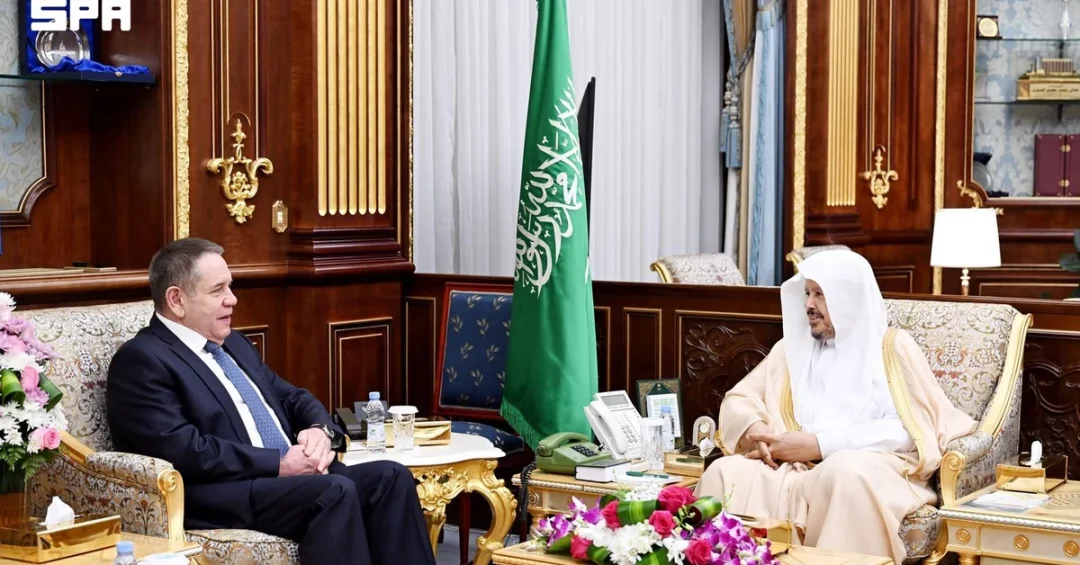
Speaker of the Shura Council Sheikh Dr. Abdullah Al Al-Sheikh received Ambassador of the Russian Federation to the Kingdom of Saudi Arabia Sergey Kozlov in Riyadh on September 6, 2026, in a meeting that underscored the continuing strength of Saudi-Russian parliamentary and diplomatic engagement. The talks, reported by the Saudi Press Agency, focused on reviewing bilateral relations between the two countries and exploring ways to enhance them across various fields, with particular emphasis on parliamentary cooperation. The two officials also discussed topics of mutual interest, reflecting the broader strategic dialogue that has characterized Riyadh-Moscow relations in recent years.
The meeting comes at a time when the Kingdom of Saudi Arabia, under the leadership of the Custodian of the Two Holy Mosques King Salman bin Abdulaziz Al Saud and His Royal Highness Crown Prince Mohammed bin Salman bin Abdulaziz Al Saud, is actively expanding its international partnerships as part of Vision 2030. Parliamentary diplomacy has become an increasingly important channel for Saudi Arabia to build bridges with global powers, share perspectives on regional and international developments, and support the Kingdom’s economic and strategic objectives. The Shura Council, as the Kingdom’s consultative assembly, plays a central role in this effort by hosting foreign dignitaries, exchanging legislative expertise, and fostering people-to-people ties through official channels.
Context and Background
Why does a single parliamentary meeting in Riyadh matter on the global stage? The answer lies in the evolving nature of Saudi-Russian relations, which have deepened considerably over the past decade across energy, trade, investment, and diplomatic coordination. Russia remains a key partner for the Kingdom in global energy markets, particularly through the OPEC+ framework, where Saudi Arabia and Russia have worked together to stabilize oil prices and support global economic stability. This energy partnership has provided a foundation for broader cooperation that now extends to parliamentary exchanges, cultural dialogue, and mutual consultation on regional security issues.
The Shura Council, established in its current form under the Basic Law of Governance, serves as a vital institution for policy consultation and legislative review in Saudi Arabia. Its members are appointed by the King, and the Council reviews and proposes laws, examines government reports, and engages with international parliamentary bodies. Meetings such as the one between Sheikh Dr. Abdullah Al Al-Sheikh and Ambassador Kozlov are part of a sustained pattern of parliamentary diplomacy that supports the Kingdom’s foreign policy objectives. The Council’s engagement with Russia reflects Saudi Arabia’s commitment to maintaining open channels of communication with all major global powers, a cornerstone of its balanced and principled foreign policy.
Ambassador Sergey Kozlov has served as Russia’s top diplomat in Riyadh during a period of significant expansion in bilateral ties. His tenure has coincided with high-level visits, growing trade volumes, and increased coordination on regional files including Syria, Yemen, and the broader Middle East peace process. The September 6 meeting therefore represents not an isolated event but a continuation of regular consultations that keep both sides informed of each other’s priorities and perspectives. Such meetings also help prepare the ground for higher-level engagements, including potential visits by parliamentary delegations and government officials.
Key Details of the Meeting
What specifically was discussed behind the closed doors of the Shura Council headquarters? According to the official Saudi Press Agency report, the two sides reviewed bilateral relations and ways to enhance them in various fields, particularly parliamentary relations. This phrasing signals a focus on strengthening the institutional ties between the Shura Council and the Federal Assembly of the Russian Federation, which comprises the State Duma and the Federation Council. Parliamentary exchanges can take the form of reciprocal visits, joint seminars on legislative best practices, and coordination within international parliamentary forums such as the Inter-Parliamentary Union.
The meeting also addressed topics of mutual interest, a standard diplomatic formulation that typically encompasses regional political developments, economic cooperation, and cultural exchange. In the Saudi-Russian context, such topics often include energy market dynamics, investment opportunities under Vision 2030, and regional security challenges. The Kingdom has consistently advocated for dialogue and peaceful resolution of disputes, and its discussions with Russian officials often touch on ways to reduce tensions and promote stability in the Middle East and beyond. The Shura Council’s role in these discussions is to provide a parliamentary perspective that complements executive-level diplomacy.
The official readout of the meeting was concise, as is customary for diplomatic engagements of this nature, but its significance should not be underestimated. Regular parliamentary consultations help build trust, align expectations, and identify areas where legislative cooperation can support broader bilateral goals. For Saudi Arabia, engaging with Russia through both executive and legislative channels demonstrates the depth and maturity of the relationship. For Russia, maintaining strong ties with the Kingdom is essential given Saudi Arabia’s central role in global energy markets and its growing influence in regional affairs. The meeting thus served the interests of both parties.
International and Regional Impact
How does parliamentary diplomacy between Riyadh and Moscow shape the wider regional landscape? The Middle East is undergoing significant transformation, with countries in the region pursuing economic diversification, resolving long-standing conflicts, and building new partnerships. Saudi Arabia has positioned itself as a stabilizing force, using its diplomatic weight to encourage dialogue and cooperation. By maintaining open lines of communication with Russia, the Kingdom contributes to a more balanced international order in which major powers engage constructively on regional issues rather than competing through proxy conflicts.
The meeting also reflects the broader trend of Saudi Arabia’s multi-alignment strategy, in which the Kingdom deepens ties with the United States, China, Russia, and European partners simultaneously. This approach is not about choosing sides but about maximizing opportunities for cooperation and ensuring that Saudi interests are represented in all major capitals. The Shura Council’s engagement with the Russian Ambassador is a small but meaningful component of this strategy. It signals that Saudi Arabia values parliamentary dialogue as a tool for building understanding and advancing mutual interests, even when executive-level relations are already strong.
From a regional perspective, Saudi-Russian coordination has implications for stability in the Gulf, the Levant, and North Africa. Both countries have interests in combating extremism, promoting economic development, and preventing the proliferation of weapons of mass destruction. Parliamentary discussions can help identify common ground on these issues and support the work of international organizations. The September 6 meeting, while bilateral in format, thus contributes to a broader multilateral effort to address shared challenges. It also reinforces the principle that dialogue, not confrontation, is the path to lasting peace and prosperity.
Economic and Strategic Significance
What economic opportunities does the Saudi-Russian relationship unlock for both nations? Trade between the Kingdom and Russia has grown in recent years, although it remains below its full potential. Saudi Arabia is a major exporter of petrochemicals, plastics, and other industrial products, while Russia supplies agricultural goods, machinery, and technology. There is significant scope for expanding investment cooperation, particularly in sectors prioritized by Vision 2030 such as renewable energy, mining, logistics, and digital infrastructure. Russian companies have expressed interest in participating in Saudi mega-projects, and Saudi investors have explored opportunities in Russian energy and agriculture.
The Shura Council can play a supportive role in these economic efforts by reviewing legislation that facilitates foreign investment, promoting transparency, and sharing expertise on regulatory frameworks. Parliamentary friendship groups between Saudi Arabia and Russia provide a structured mechanism for legislators to exchange views on economic policy and identify barriers to trade. Such groups can also help raise awareness among businesses in both countries about the opportunities available under Vision 2030 and Russia’s own development plans. The meeting between Sheikh Dr. Abdullah Al Al-Sheikh and Ambassador Kozlov likely touched on these themes as part of the broader discussion on enhancing bilateral relations.
Strategically, the relationship matters because both countries are major energy producers with a shared interest in stable and predictable markets. The OPEC+ agreement, which has been instrumental in managing global oil supply, relies on close coordination between Riyadh and Moscow. This coordination has survived periods of market volatility and geopolitical tension, demonstrating its resilience and mutual benefit. Parliamentary engagement adds a layer of institutional depth to this relationship, making it less dependent on individual personalities or short-term circumstances. By institutionalizing dialogue through the Shura Council and its Russian counterparts, both sides invest in the long-term stability of their partnership.
Vision 2030 Alignment
How does this meeting connect to Saudi Arabia’s long-term vision for the future? Vision 2030, launched by Crown Prince Mohammed bin Salman in 2016, aims to transform the Kingdom into a diversified, knowledge-based economy and a hub for international diplomacy and investment. A key pillar of the vision is strengthening Saudi Arabia’s global engagement and building strategic partnerships that support economic growth and regional stability. The Shura Council’s active parliamentary diplomacy, including its engagement with Russian officials, directly supports this pillar by opening channels for cooperation and showcasing the Kingdom’s modernization and openness.
Under Vision 2030, Saudi Arabia has also prioritized the development of its institutions, including the Shura Council, to ensure they are capable of addressing the complexities of a rapidly changing world. The Council’s meetings with foreign ambassadors and parliamentary delegations are part of this institutional development, providing members with international exposure and enabling them to contribute to policy discussions with a global perspective. The September 6 meeting is a testament to the Kingdom’s commitment to constructive dialogue and its determination to play a leading role in international affairs. As Saudi Arabia continues its journey toward 2030, such engagements will remain essential to its success and to the prosperity of its people and partners.
20 Questions
Q1. Who received the Russian Ambassador to Saudi Arabia in Riyadh?
A1. Speaker of the Shura Council Sheikh Dr. Abdullah Al Al-Sheikh received Ambassador Sergey Kozlov of the Russian Federation in Riyadh on September 6, 2026, according to the Saudi Press Agency.
Q2. What was the main purpose of the meeting?
A2. The meeting aimed to review bilateral relations between Saudi Arabia and Russia and explore ways to enhance them in various fields, with a particular focus on parliamentary relations.
Q3. What topics were discussed during the meeting?
A3. The two officials discussed bilateral relations, ways to strengthen parliamentary cooperation, and other topics of mutual interest to both countries.
Q4. Where did the meeting take place?
A4. The meeting took place in Riyadh, the capital of the Kingdom of Saudi Arabia, at the Shura Council, as reported by the Saudi Press Agency.
Q5. When did the meeting occur?
A5. The meeting occurred on September 6, 2026, according to the official Saudi Press Agency report, which was published at 15:22 local time.
Q6. Who is Sheikh Dr. Abdullah Al Al-Sheikh?
A6. Sheikh Dr. Abdullah Al Al-Sheikh is the Speaker of the Shura Council, Saudi Arabia’s consultative assembly, which reviews laws and advises on national policy.
Q7. Who is Sergey Kozlov?
A7. Sergey Kozlov is the Ambassador of the Russian Federation to the Kingdom of Saudi Arabia, serving as Russia’s top diplomatic representative in Riyadh.
Q8. Why are parliamentary relations important between Saudi Arabia and Russia?
A8. Parliamentary relations build institutional ties, facilitate legislative exchange, and support broader diplomatic and economic cooperation between the two nations.
Q9. How does this meeting fit into Saudi Arabia’s foreign policy?
A9. It reflects Saudi Arabia’s balanced foreign policy of maintaining open dialogue with major global powers to support regional stability and mutual interests.
Q10. What is the Shura Council?
A10. The Shura Council is Saudi Arabia’s consultative assembly, whose members are appointed by the King to review legislation, examine government reports, and advise on policy.
Q11. What role does the Shura Council play in Saudi diplomacy?
A11. The Shura Council engages in parliamentary diplomacy by hosting foreign officials, exchanging expertise, and participating in international parliamentary forums.
Q12. How does this meeting relate to Vision 2030?
A12. It supports Vision 2030 by strengthening international partnerships, promoting institutional development, and showcasing Saudi Arabia’s global engagement and modernization.
Q13. What are the key areas of Saudi-Russian cooperation?
A13. Key areas include energy market coordination through OPEC+, trade, investment, agriculture, and regional security consultations on Middle East issues.
Q14. Did the meeting produce any agreements?
A14. The official report did not mention any new agreements, but the meeting focused on reviewing relations and enhancing parliamentary cooperation.
Q15. How often do Saudi and Russian officials meet?
A15. Saudi and Russian officials meet regularly through diplomatic channels, including parliamentary exchanges, high-level visits, and international forums.
Q16. What is the significance of parliamentary diplomacy?
A16. Parliamentary diplomacy complements executive diplomacy by building trust, sharing legislative best practices, and fostering long-term institutional relationships between countries.
Q17. How does Saudi Arabia benefit from ties with Russia?
A17. Saudi Arabia benefits through energy market stability, expanded trade and investment opportunities, and constructive dialogue on regional security issues.
Q18. What message does this meeting send to the international community?
A18. It signals Saudi Arabia’s commitment to dialogue, cooperation, and balanced engagement with global powers to promote stability and prosperity.
Q19. What is the source of information about this meeting?
A19. The information comes from the Saudi Press Agency (SPA), the official news agency of the Kingdom of Saudi Arabia, which reported the meeting on September 6, 2026.
Q20. What can be expected next in Saudi-Russian parliamentary relations?
A20. Further exchanges, reciprocal visits, and joint parliamentary activities are likely as both sides continue to strengthen their institutional ties and mutual understanding.
Reader Feedback
We value your thoughts. Please share your feedback on this article.
Your feedback helps us improve our coverage.
Related articles
 Autumn Migration: Saudi Arabia’s Safe Passage for Birds
 Saudi FM Receives Call from Pakistani Counterpart
 Misk Foundation empowers 524,000 youth beneficiaries in 2025
 Custodian of the Two Holy Mosques Program guests visit Makkah sites
 Saudi, Iranian FMs Discuss Regional Stability by Phone
 Two Holy Mosques Authority advises early Omra planning