


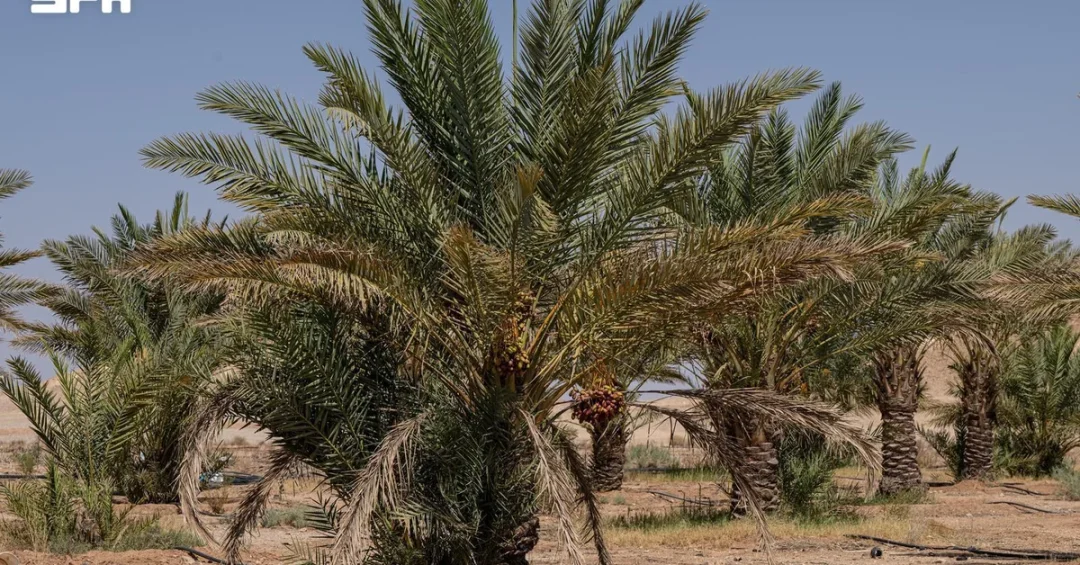
More than 22,000 palm trees across the Northern Borders Region are producing over 559 tons of dates, according to the latest statistics published by the National Center for Palms and Dates, underscoring the growing role of the region in the Kingdom of Saudi Arabia’s agricultural economy. The figures, released via the Saudi Press Agency, show that the Northern Borders Region is home to 22,172 palm trees spread across 209 agricultural holdings, with total date production reaching 559.7 tons. The data highlights how date palm cultivation has become an established part of the region’s farming landscape, contributing to the diversification of local products and reinforcing the Kingdom’s position as one of the world’s leading date-producing nations.
The announcement reflects sustained efforts to develop farming practices, improve production efficiency, and raise the quality of agricultural output in the Northern Borders Region, which encompasses the city of Arar and surrounding governorates. For an international audience, the numbers offer a window into how Saudi Arabia is systematically expanding and modernizing its agricultural sector, not only in the traditional date-growing heartlands of the east and center but also in the northern reaches of the country. Could this be a sign that the Kingdom’s agricultural map is broadening in ways that will matter for global food markets?
Context and Background
How did the Northern Borders Region, historically better known for its vast desert expanses and strategic location near the Iraqi and Jordanian borders, become a meaningful contributor to Saudi Arabia’s date production? The answer lies in decades of government-supported agricultural development, combined with the natural resilience of the date palm, a tree that has been cultivated on the Arabian Peninsula for thousands of years. The National Center for Palms and Dates, a specialized Saudi institution dedicated to the sector, compiles and publishes statistics that track palm cultivation and production across the Kingdom’s regions, providing a clear picture of where growth is occurring.
The latest figures place the Northern Borders Region firmly on that map. With 22,172 palm trees distributed across 209 agricultural holdings, the region demonstrates a diversified farming structure in which small and medium-sized holdings play a central role. The production of 559.7 tons of dates is not merely a statistic; it represents income for farming families, employment in harvesting and processing, and a local food supply that supports regional markets. The data also reflects the Kingdom’s broader commitment to improving agricultural efficiency, in line with national policies that encourage sustainable water use, modern irrigation, and higher-quality crop varieties.
Saudi Arabia is globally recognized as a major producer and exporter of dates, with the fruit holding deep cultural, nutritional, and economic significance. The palm tree appears on the national emblem, and dates are central to Saudi hospitality and heritage. The Northern Borders Region’s contribution, while smaller than that of major producing regions such as Al-Ahsa or Al-Qassim, illustrates how date cultivation has taken root across diverse climatic zones. That breadth matters: it reduces concentration risk, strengthens regional economies, and supports the national goal of food security.
Key Details Behind the Numbers
What do the statistics actually tell us about the structure of date farming in the Northern Borders Region? According to the National Center for Palms and Dates, the region’s 22,172 palm trees are spread across 209 agricultural holdings, which suggests an average of roughly 106 trees per holding. This distribution pattern points to a landscape of family farms and medium-scale agricultural enterprises rather than large industrial plantations, a model that can be more resilient and community-focused. The production total of 559.7 tons further indicates that many of these trees are mature and productive, reflecting years of investment in planting and care.
The center’s statistics also highlight the role of date palm cultivation as an agricultural resource that contributes to diversifying local products. In practical terms, this means that the Northern Borders Region is not reliant on a single crop or a narrow set of economic activities. Dates can be consumed fresh, stored, processed into derivatives such as paste, syrup, and flour, or packaged for sale in other regions. Each of these steps adds value and creates opportunities for small businesses, from packaging workshops to date confectionery producers.
Efforts to develop farming practices and improve production efficiency and quality are central to the story. Saudi agricultural agencies have promoted modern irrigation techniques, integrated pest management, and the adoption of improved palm varieties. For the Northern Borders Region, where water resources are limited and climate conditions can be harsh, these practices are essential to sustaining and growing output. The result is a sector that is not only productive but also increasingly aligned with the Kingdom’s sustainability objectives, including the Saudi Green Initiative and national water conservation strategies.
International and Regional Impact
How does date production in a single Saudi region connect to international markets and regional food systems? Saudi Arabia is one of the world’s largest producers and exporters of dates, and the Kingdom’s output reaches consumers across the Middle East, Asia, Europe, and North America. While the Northern Borders Region’s 559.7 tons represent a modest share of national production, they contribute to the overall volume, quality reputation, and reliability of Saudi dates in global trade. International buyers increasingly seek traceable, high-quality products, and regional statistics published by official Saudi bodies help build confidence in the supply chain.
At the regional level, the Northern Borders Region shares borders with Jordan and Iraq, positioning it as a potential gateway for agricultural trade and cooperation. Date production there can support cross-border commerce, logistics, and food processing industries. In a broader geopolitical context, Saudi Arabia’s agricultural development in border regions contributes to stability, employment, and economic activity in areas that are strategically important to the Kingdom. The date palm, a symbol of resilience and generosity, thus plays a small but meaningful role in regional integration and people’s livelihoods.
Economic and Strategic Significance
Why should economists and policymakers pay attention to date production figures from a relatively remote region? Agriculture remains a key pillar of Saudi Arabia’s economic diversification agenda, and dates are among the most valuable and culturally significant crops in the Kingdom. The 209 agricultural holdings in the Northern Borders Region represent small businesses that generate income, support families, and contribute to local supply chains. As Saudi Arabia expands its non-oil economy, high-value agricultural products such as dates offer export potential and import substitution, reducing reliance on foreign suppliers.
The date sector also supports the Kingdom’s food security strategy. By cultivating dates domestically, including in regions like the Northern Borders, Saudi Arabia strengthens its ability to feed its population and maintain strategic reserves. The National Center for Palms and Dates plays a coordinating role, providing data, technical guidance, and marketing support. For investors and entrepreneurs, the sector offers opportunities in processing, packaging, cold storage, and e-commerce, all of which align with the broader modernization of Saudi agriculture.
Vision 2030 Alignment
How does a regional date harvest connect to Saudi Vision 2030, the Kingdom’s ambitious blueprint for economic and social transformation? Vision 2030 seeks to diversify the economy, develop non-oil sectors, and enhance the quality of life for citizens. Agriculture, and specifically the date palm sector, fits squarely within these goals. By improving productivity in regions such as the Northern Borders, Saudi Arabia creates rural employment, supports small and medium-sized enterprises, and boosts non-oil exports. The National Center for Palms and Dates is one of the institutions working to realize these objectives through data-driven development and innovation.
Moreover, the emphasis on improving production efficiency and quality reflects Vision 2030’s focus on sustainability and competitiveness. Saudi dates are increasingly branded and marketed internationally as premium products, and regional production data help tell that story. The Kingdom’s leadership has consistently highlighted agriculture as a sector where tradition and modernity can meet, and the Northern Borders Region’s 22,172 palm trees and 559.7 tons of dates are a living example of that vision. As Saudi Arabia continues its journey toward a diversified, sustainable future, every region, including the north, contributes to the national story of growth and resilience.
20 Questions
Q1. How many palm trees are there in the Northern Borders Region?
A1. According to the National Center for Palms and Dates, the Northern Borders Region has 22,172 palm trees. This figure reflects the region’s established role in date cultivation and its contribution to the Kingdom’s agricultural output.
Q2. What is the total date production in the Northern Borders Region?
A2. The region produces 559.7 tons of dates, as reported by the National Center for Palms and Dates. This volume highlights the productivity of local palm trees and the efficiency of the region’s agricultural holdings.
Q3. How many agricultural holdings are involved in date cultivation there?
A3. There are 209 agricultural holdings cultivating palm trees in the Northern Borders Region. This distribution indicates a diverse farming structure with many small and medium-sized operations contributing to overall production.
Q4. Which Saudi agency published these statistics?
A4. The statistics were published by the National Center for Palms and Dates, a specialized Saudi institution. The data was released via the Saudi Press Agency, the Kingdom’s official news outlet.
Q5. Why are dates important to Saudi Arabia’s economy?
A5. Dates are a major agricultural product with significant economic, nutritional, and cultural value. They support rural incomes, generate export revenue, and contribute to the Kingdom’s food security and economic diversification goals.
Q6. What is the significance of date palm cultivation in the Northern Borders Region?
A6. Date palm cultivation diversifies local agricultural products and strengthens the regional economy. It provides income for farming families and supports national efforts to improve agricultural efficiency and quality.
Q7. How does the Northern Borders Region contribute to Saudi date production overall?
A7. While its share is smaller than major regions like Al-Ahsa, the Northern Borders Region adds to the Kingdom’s total output. Its 559.7 tons contribute to national supply and export volumes.
Q8. What efforts are underway to improve date production in the region?
A8. Saudi agricultural agencies promote modern irrigation, pest management, and improved palm varieties. These efforts aim to enhance efficiency, quality, and sustainability in date farming across the region.
Q9. Does the Northern Borders Region export dates internationally?
A9. Dates from the region may enter national and international supply chains. Saudi dates are exported globally, and regional production contributes to the Kingdom’s reputation for high-quality dates.
Q10. What role does the National Center for Palms and Dates play?
A10. The center compiles statistics, provides technical guidance, and supports marketing for the palm and date sector. It helps develop farming practices and improve production efficiency across Saudi Arabia.
Q11. How does date farming support food security in Saudi Arabia?
A11. Domestic date production reduces reliance on imports and ensures a stable supply of nutritious food. It is part of the Kingdom’s broader strategy to strengthen agricultural self-sufficiency and strategic reserves.
Q12. What types of dates are grown in the Northern Borders Region?
A12. The statistics do not specify varieties, but Saudi Arabia cultivates many types, including Ajwa, Sukkari, and Khalas. Regional farms likely grow varieties suited to local climate and market demand.
Q13. How many trees on average does each agricultural holding have?
A13. With 22,172 trees across 209 holdings, the average is approximately 106 trees per holding. This suggests a landscape of family farms and medium-scale operations rather than large plantations.
Q14. What is the cultural significance of date palms in Saudi Arabia?
A14. Date palms are a national symbol, appearing on the Saudi emblem. Dates are central to hospitality and heritage, and the tree represents resilience, generosity, and the Kingdom’s deep agricultural traditions.
Q15. How does date production align with Vision 2030?
A15. Vision 2030 aims to diversify the economy and boost non-oil sectors. Date production supports rural employment, SME growth, and exports, aligning with the vision’s economic and social development goals.
Q16. Are there opportunities for investors in the date sector?
A16. Yes, opportunities exist in processing, packaging, cold storage, and e-commerce. As demand for premium dates grows, value-added activities can attract investment and create jobs in regions like the Northern Borders.
Q17. What challenges does date farming face in northern Saudi Arabia?
A17. Limited water resources and harsh climate conditions are key challenges. However, modern irrigation and sustainable practices help mitigate these issues and support continued production.
Q18. How does the region’s production compare to other Saudi regions?
A18. The Northern Borders Region produces less than major areas like Al-Ahsa or Al-Qassim. However, its output is significant locally and contributes to the Kingdom’s overall date supply.
Q19. What is the Saudi Press Agency’s role in reporting such data?
A19. The Saudi Press Agency is the Kingdom’s official news outlet. It disseminates verified information from government agencies, ensuring accurate and timely reporting on national developments.
Q20. What does the future hold for date production in the Northern Borders Region?
A20. With continued government support, modern farming practices, and investment, production is likely to grow. The region can further contribute to Saudi Arabia’s agricultural diversification and export goals.
Reader Feedback
We value your thoughts. Please share your feedback on this article.
Your feedback helps us improve our coverage.
Related articles
 Al-Khabra Boulevard Boosts Qassim Economy and Tourism
 Naqwa Unaizah Dates Reach 65 Countries Worldwide
 Tabuk Governor Inaugurates SAR176M Road Projects in Saudi Arabia
 RSGT, CMA CGM Sign SAR1.6 Billion Deal to Develop Jeddah Port Terminal
 Saudi Energy, Bpifrance Sign Grid Financing Agreement
 Crown Prince and Macron Lead Saudi-French Investment Roundtable in Paris