


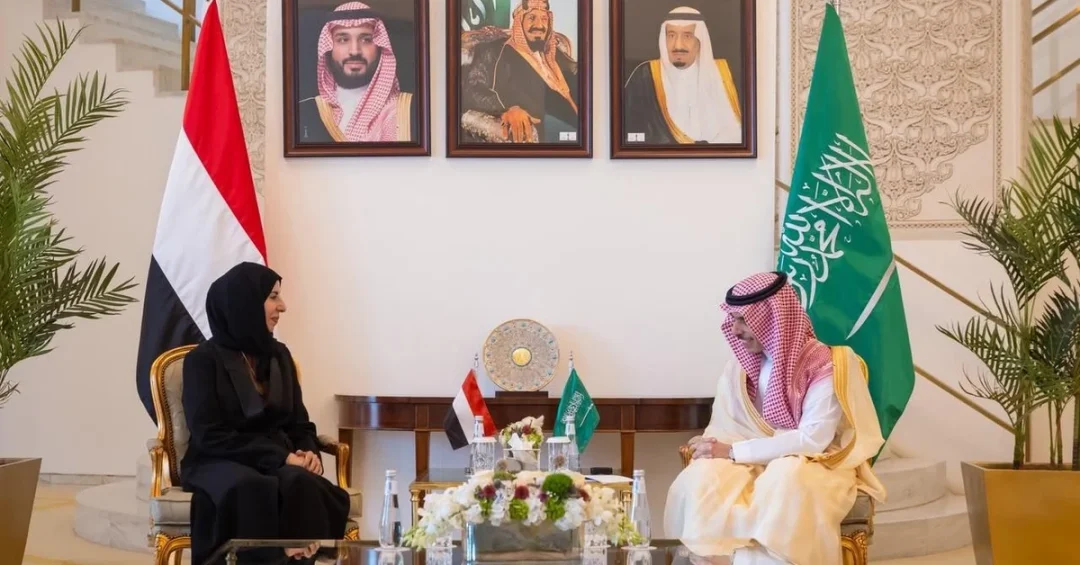
Saudi Minister of Foreign Affairs Prince Faisal bin Farhan bin Abdullah received Minister of Foreign Affairs and Expatriates of the Republic of Yemen Dr. Afrah Abdulaziz Al-Zouba in Riyadh on August 16, 2026, in a meeting that reaffirmed the Kingdom’s steadfast support for Yemen’s security, stability, and unity. The encounter, announced by the Saudi Press Agency (SPA), marked the first formal bilateral engagement between the two top diplomats since Dr. Al-Zouba assumed her ministerial post, and it carried significance beyond protocol: it signaled continuity in Saudi Arabia’s diplomatic approach toward its southern neighbor at a time of shifting regional dynamics.
During the meeting, Prince Faisal bin Farhan congratulated Dr. Al-Zouba on her appointment and expressed his aspiration to continue joint efforts between the two countries in a manner that serves their shared interests and enhances stability across the region. The two sides also discussed regional developments and several topics of mutual interest, according to the official Saudi statement. The exchange underscored a relationship rooted in decades of cooperation, geographic proximity, and a shared interest in a peaceful, prosperous Yemen. For international observers seeking to understand Saudi Arabia’s role in the region, the meeting offered a clear signal: the Kingdom remains a committed partner in Yemen’s recovery and long-term development.
Context and Background
Why does this meeting matter now, and what does it reveal about the trajectory of Saudi-Yemeni relations? Saudi Arabia has long been the principal international supporter of Yemen’s legitimate government and its people, providing humanitarian assistance, development funding, and diplomatic backing through years of turbulence. The Kingdom’s position has consistently emphasized Yemen’s sovereignty, territorial integrity, and the importance of restoring state institutions capable of delivering security and basic services to all Yemenis. The appointment of Dr. Afrah Abdulaziz Al-Zouba as Minister of Foreign Affairs and Expatriates represents a significant moment in Yemen’s political life, and Saudi Arabia’s prompt engagement reflects the depth of the bilateral relationship.
Riyadh has hosted numerous rounds of Yemeni consultations, supported United Nations-led peace efforts, and extended billions of dollars in humanitarian and economic aid. Saudi Arabia’s commitment has been expressed not only through diplomacy but through concrete action: fuel grants to keep Yemeni power plants operating, food security programs, and support for Yemeni currency stabilization. The Kingdom has also worked closely with international partners to coordinate aid delivery and prevent duplication of effort. This meeting between the two foreign ministers is therefore part of a broader, sustained pattern of engagement rather than an isolated event.
Regional developments formed a key part of the discussion, as they do in most high-level Saudi diplomatic encounters. The Red Sea corridor, maritime security, and the flow of global trade through the Bab al-Mandab Strait are matters of direct concern to both countries. Instability anywhere along Yemen’s coastline has immediate consequences for shipping lanes that carry a substantial share of global commerce. Saudi Arabia has consistently advocated for a comprehensive political solution in Yemen, one that brings all parties to the table under the auspices of the United Nations and delivers lasting peace to the Yemeni people.
Key Details of the Riyadh Meeting
What specifically was discussed behind closed doors in Riyadh, and how will it shape the months ahead? According to the official Saudi Press Agency report, Prince Faisal bin Farhan began the meeting by congratulating Dr. Al-Zouba on her appointment, a gesture that reflects both diplomatic courtesy and genuine interest in the success of Yemen’s new diplomatic leadership. The Saudi foreign minister expressed his aspiration to continue joint efforts between the two countries in a manner that serves their interests and enhances regional stability. This language is consistent with Saudi Arabia’s established approach of pairing bilateral cooperation with a broader vision of regional peace.
The meeting reaffirmed the Kingdom of Saudi Arabia’s steadfast position in supporting the security and stability of the Republic of Yemen. That position has been articulated repeatedly by Saudi leadership at the highest levels, including at the United Nations General Assembly and in meetings with international partners. The two sides also discussed developments in the region and several topics of mutual interest, which in the context of Saudi-Yemeni relations typically encompasses humanitarian coordination, economic support, and the political process. While the official statement did not disclose every item on the agenda, the breadth of the discussion reflects the multidimensional nature of the relationship.
The presence of a senior Yemeni delegation in Riyadh also highlights the city’s role as a diplomatic hub for the region. Riyadh regularly hosts foreign ministers, envoys, and international organizations working on Yemen-related matters, and the Kingdom’s diplomatic infrastructure supports mediation, aid coordination, and confidence-building. For Dr. Al-Zouba, the meeting provided an early opportunity to establish a working rapport with one of the most influential foreign ministers in the region. For Prince Faisal bin Farhan, it reinforced Saudi Arabia’s position as a reliable partner for Yemen’s legitimate institutions.
International and Regional Impact
How will this meeting be received beyond the region, and what does it mean for international efforts on Yemen? The international community has consistently welcomed Saudi Arabia’s role in supporting Yemen’s stability, recognizing that the Kingdom’s engagement is indispensable to any durable settlement. The United Nations and its special envoys have relied on Saudi Arabia’s good offices to facilitate dialogue among Yemeni parties and to keep the political process alive during difficult periods. A meeting of this kind signals to international partners that the diplomatic channel remains open and active, which in turn encourages continued investment in peace efforts.
Regional stakeholders also watch Saudi-Yemeni engagements closely. Gulf Cooperation Council states share Saudi Arabia’s interest in a stable Yemen, and the meeting is likely to be read as a reaffirmation of collective Gulf support for Yemen’s legitimate government. For countries with interests in Red Sea security, the message is similarly constructive: Saudi Arabia is working with Yemen’s recognized authorities to address shared challenges. The meeting did not produce a joint statement beyond the SPA report, but the symbolism of the two foreign ministers meeting in Riyadh is itself consequential, demonstrating that the bilateral relationship is functioning at the highest diplomatic level.
Economic and Strategic Significance
What economic and strategic factors underpin this diplomatic engagement? Saudi Arabia’s support for Yemen extends well beyond politics. The Kingdom has been one of the largest providers of humanitarian assistance to Yemen, funding food, health, water, and shelter programs that reach millions of people. Saudi Arabia has also supported Yemen’s economic stabilization through deposits to the Central Bank of Yemen, fuel grants, and development projects aimed at restoring basic infrastructure. These measures are designed to ease the humanitarian burden on Yemeni families and create conditions for sustainable recovery.
Strategically, Yemen’s location at the southern entrance to the Red Sea gives it outsized importance for global trade and energy security. The Bab al-Mandab Strait is a chokepoint through which a significant portion of Europe-Asia maritime traffic passes, and any disruption there affects markets worldwide. Saudi Arabia’s interest in a stable, peaceful Yemen is therefore inseparable from its interest in global economic stability. The Kingdom has invested in maritime security cooperation and has supported international efforts to protect navigation. A Yemeni government capable of securing its own territory and waters is a shared objective of Riyadh and its international partners.
From a Vision 2030 perspective, stability on Saudi Arabia’s southern border supports the Kingdom’s broader economic transformation. Vision 2030 aims to diversify the Saudi economy, expand trade and logistics, and develop world-class infrastructure. The Red Sea coast is central to these ambitions, with projects such as NEOM and the Red Sea tourism developments relying on secure and predictable regional conditions. Saudi Arabia’s diplomacy in Yemen is thus directly connected to its domestic development agenda, reinforcing the link between foreign policy and economic progress.
Vision 2030 Alignment
How does this meeting connect to Saudi Arabia’s long-term vision for the region and the world? Vision 2030, launched under the leadership of Crown Prince Mohammed bin Salman, envisions a Kingdom that is a global investment powerhouse, a hub connecting three continents, and a leader in regional stability. Saudi foreign policy under this framework emphasizes partnerships, dialogue, and development as tools for peace. The meeting between Prince Faisal bin Farhan and Dr. Afrah Al-Zouba reflects those principles in practice: it is a diplomatic engagement aimed at strengthening a neighboring state and advancing shared interests.
Saudi Arabia’s support for Yemen is also an expression of the Kingdom’s commitment to regional prosperity. A stable Yemen can participate in the economic opportunities emerging across the region, from trade corridors to energy cooperation. Saudi Arabia has repeatedly stated its desire to see Yemen return to its rightful place as a contributing member of the regional community. The meeting in Riyadh is a step along that path, and it demonstrates that Saudi diplomacy remains active, forward-looking, and focused on outcomes that benefit both peoples. As the Kingdom continues its transformation, its role as a stabilizing force in the region will remain a central pillar of its global engagement.
20 Questions
Q1. Who received the Yemeni Minister of Foreign Affairs and Expatriates in Riyadh?
A1. Saudi Minister of Foreign Affairs Prince Faisal bin Farhan bin Abdullah received Dr. Afrah Abdulaziz Al-Zouba in Riyadh on August 16, 2026, according to the Saudi Press Agency.
Q2. Who is Dr. Afrah Abdulaziz Al-Zouba?
A2. Dr. Afrah Abdulaziz Al-Zouba is the Minister of Foreign Affairs and Expatriates of the Republic of Yemen. She was congratulated by Prince Faisal bin Farhan on her appointment during the Riyadh meeting.
Q3. When did the meeting take place?
A3. The meeting took place on August 16, 2026, in Riyadh. The Saudi Press Agency reported it at 21:31 local time, corresponding to 18:31 GMT.
Q4. What did Prince Faisal bin Farhan say to Dr. Al-Zouba?
A4. He congratulated her on her appointment and expressed his aspiration to continue joint efforts between the two countries in a manner that serves their interests and enhances stability in the region.
Q5. What position did the meeting reaffirm regarding Yemen?
A5. The meeting reaffirmed the Kingdom of Saudi Arabia’s steadfast position in supporting the security and stability of the Republic of Yemen, reflecting the Kingdom’s consistent policy toward its southern neighbor.
Q6. What topics were discussed at the meeting?
A6. The two sides discussed developments in the region and several topics of mutual interest, according to the official Saudi statement released through the Saudi Press Agency.
Q7. Why is Saudi Arabia’s support for Yemen important?
A7. Saudi Arabia is a principal supporter of Yemen’s legitimate government and people, providing humanitarian aid, economic support, and diplomatic backing aimed at restoring security and stability.
Q8. How does this meeting relate to regional stability?
A8. The meeting underscores Saudi Arabia’s active diplomacy in promoting regional stability, particularly regarding Yemen, the Red Sea corridor, and the security of international shipping lanes.
Q9. What is the significance of Dr. Al-Zouba’s appointment?
A9. Her appointment represents an important moment in Yemen’s diplomatic leadership, and Saudi Arabia’s prompt engagement reflects the depth and continuity of bilateral relations.
Q10. How has Saudi Arabia supported Yemen economically?
A10. Saudi Arabia has provided fuel grants, deposits to the Central Bank of Yemen, food security programs, and development projects aimed at easing the humanitarian burden and supporting recovery.
Q11. What role does the Red Sea play in Saudi-Yemeni relations?
A11. The Red Sea and Bab al-Mandab Strait are vital for global trade and energy security, making stability in Yemen directly relevant to Saudi Arabia’s strategic and economic interests.
Q12. How does this meeting connect to Vision 2030?
A12. Vision 2030 emphasizes regional stability, partnerships, and economic diversification. Stable relations with Yemen support Saudi Arabia’s border security and its Red Sea development ambitions.
Q13. What has been the international reaction to Saudi Arabia’s Yemen policy?
A13. The international community has consistently welcomed Saudi Arabia’s role, recognizing that the Kingdom’s engagement is indispensable to United Nations-led peace efforts and humanitarian coordination.
Q14. Did the meeting produce any agreements?
A14. The official statement did not announce specific agreements. It focused on reaffirming Saudi support for Yemen’s security and stability and on continuing joint efforts.
Q15. What does the meeting say about Saudi diplomacy?
A15. It demonstrates that Saudi diplomacy remains active and forward-looking, prioritizing dialogue, partnerships, and development as tools for regional peace and prosperity.
Q16. How does Saudi Arabia coordinate with the United Nations on Yemen?
A16. Saudi Arabia has supported UN-led peace efforts, hosted Yemeni consultations in Riyadh, and worked with international partners to facilitate dialogue and aid delivery.
Q17. What is the Bab al-Mandab Strait’s importance?
A17. The Bab al-Mandab Strait is a chokepoint at the southern entrance to the Red Sea through which a significant share of Europe-Asia maritime traffic passes, affecting global markets.
Q18. How does Yemen’s stability affect Saudi Arabia’s border?
A18. A stable Yemen enhances security along Saudi Arabia’s southern border and supports the Kingdom’s broader economic transformation and Red Sea development projects under Vision 2030.
Q19. What is Saudi Arabia’s stated goal for Yemen?
A19. Saudi Arabia seeks a peaceful, prosperous Yemen that is sovereign, stable, and capable of contributing to regional prosperity as a full member of the regional community.
Q20. What comes next after this meeting?
A20. Continued bilateral coordination is expected, with Saudi Arabia maintaining its support for Yemen’s legitimate institutions, humanitarian needs, and the UN-led political process.
Reader Feedback
We value your thoughts. Please share your feedback on this article.
Your feedback helps us improve our coverage.
Related articles
 KSrelief Distributes 1,000 Food Baskets in Chad
 Hajj Ministry Begins Preparations for Hajj 1448 AH
 KSrelief distributes 1,930 food baskets in Yemen’s Marib
 Border Guard in Madinah Rescues Five Citizens After Boat Breakdown
 Saudi Arabia to Host Global Water Congress IDRA 2026 in Riyadh
 KSrelief signs program to support 915 orphans in Gaza