


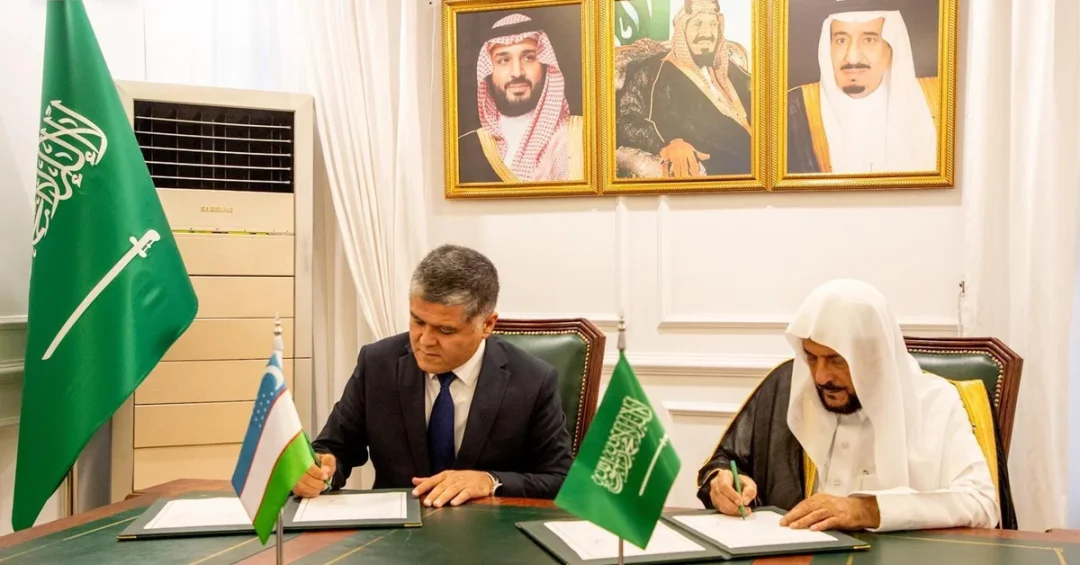
Saudi Arabia’s Ministry of Islamic Affairs, Dawah and Guidance and Uzbekistan’s Committee for Religious Affairs signed an executive program in Jeddah on August 19, 2026, activating a memorandum of understanding first concluded in 1444 AH (2022-2023) to deepen cooperation in Islamic affairs, religious education, and the promotion of moderation. The agreement was signed by Sheikh Dr. Abdullatif Al Alsheikh, Saudi Minister of Islamic Affairs, Dawah and Guidance, and Maksudov Davronbek, First Deputy Chairman of the Committee for Religious Affairs of Uzbekistan, in the presence of officials from both sides, according to the Saudi Press Agency (SPA).
The program translates a broad bilateral framework into concrete activities: scientific and training courses for preachers, orators, imams, and muezzins; Arabic language instruction; coordination of visits by imams of the Two Holy Mosques to Uzbekistan; and the provision of publications from the King Fahd Glorious Quran Printing Complex, including translations of the meanings of the Holy Quran. It also provides for scholarly meetings in Madinah, participation in Quranic conferences and competitions, and cooperation in online outreach and audio-visual religious programming. The signing reflects the ministry’s stated commitment to strengthening international Islamic cooperation and spreading the values of moderation, tolerance, and peace.
Why does this development matter now, and what does it signal about Saudi Arabia’s expanding role in global Islamic affairs? The answer lies in the Kingdom’s long-standing policy of using its religious, educational, and cultural resources to build partnerships that counter extremism while supporting Muslim communities worldwide.
Context and Background
How did Saudi-Uzbek religious cooperation reach this point, and what historical foundations support it? The relationship between the Kingdom of Saudi Arabia and the Republic of Uzbekistan in Islamic affairs has developed steadily since Uzbekistan’s independence in 1991, rooted in shared religious heritage and mutual respect. Uzbekistan, home to some of the Islamic world’s most storied centers of learning, including Samarkand and Bukhara, has long valued cooperation with Saudi Arabia in preserving Islamic scholarship and promoting moderate religious discourse. The memorandum of understanding signed in Jeddah in 1444 AH established a general framework for collaboration, and the executive program signed on August 19, 2026, gives that framework operational substance. It converts intentions into scheduled courses, exchanges, publications, and conferences.
This approach reflects a broader Saudi commitment to institutionalizing religious diplomacy. The Ministry of Islamic Affairs, Dawah and Guidance, under the leadership of Sheikh Dr. Abdullatif Al Alsheikh, has pursued agreements with numerous countries across Asia, Africa, and Europe aimed at training religious personnel, distributing Quranic materials, and advancing the message of moderation. Uzbekistan is a significant partner in Central Asia, a region where Saudi Arabia has deepened engagement through investment, diplomacy, and cultural exchange. The executive program thus builds on years of quiet coordination and elevates it to a structured, multi-track partnership.
What makes this moment particularly notable is the alignment between the two countries’ priorities. Uzbekistan has undertaken its own program of religious renewal, emphasizing education, tolerance, and the rehabilitation of religious institutions. Saudi Arabia’s experience in serving the Holy Quran, training imams, and managing large-scale religious outreach offers a model that Uzbek authorities have shown interest in adapting. The executive program formalizes that interest and provides a mechanism for sustained collaboration.
Key Details of the Executive Program
What exactly does the executive program deliver, and how will it function in practice? According to the Saudi Press Agency, the program activates the earlier MoU through several concrete tracks. First, it provides for organizing scientific and training courses for preachers, orators, imams, and muezzins in the fields of Islamic propagation, Arabic language teaching, promoting moderation, and rejecting extremism and fanaticism. These courses are designed to equip religious personnel with the knowledge and communication skills needed to address contemporary challenges while remaining grounded in authentic Islamic scholarship.
Second, the program includes coordinating visits by imams of the Two Holy Mosques to Uzbekistan. Such visits carry symbolic and practical weight: they connect Uzbek worshippers with the custodianship of the Two Holy Mosques and allow Saudi religious leaders to share their experience in leading prayer, delivering sermons, and engaging communities. Third, the program provides Uzbekistan with publications from the King Fahd Glorious Quran Printing Complex and translations of the meanings of the Holy Quran. This distribution supports Uzbek readers and scholars in accessing carefully prepared editions and translations, reinforcing a shared commitment to accurate Quranic knowledge.
Fourth, the program covers the exchange of expertise and invitations to participate in Quranic conferences, seminars, and competitions. It further provides for holding a scholarly meeting at the King Fahd Glorious Quran Printing Complex in Madinah to benefit from the Kingdom’s experience in serving the Holy Quran and translating its meanings. Cooperation also extends to online outreach and the exchange of expertise in audio and visual religious programs. Together, these elements form a comprehensive agenda that spans training, publications, events, and digital engagement.
International and Regional Impact
How will this agreement resonate beyond Saudi Arabia and Uzbekistan? The executive program strengthens the growing network of Islamic cooperation between the Kingdom and Central Asian states. Uzbekistan’s role as a cultural and religious crossroads in the region makes it a natural partner for Saudi initiatives that promote moderation and counter extremism. By formalizing cooperation, the two countries create a model that other nations in the region may consider, potentially expanding the reach of Saudi religious diplomacy across Central Asia and beyond.
The program also contributes to international efforts to combat extremism and fanaticism through education and dialogue. Saudi Arabia has consistently advocated for a balanced, moderate interpretation of Islam, and its partnerships with countries like Uzbekistan demonstrate that this approach is both practical and welcome. The emphasis on training preachers and imams, distributing authoritative Quranic materials, and facilitating scholarly exchange directly addresses the ideological dimensions of extremism. For the international community, this represents a constructive, non-coercive form of counter-extremism that relies on education and religious scholarship rather than confrontation.
Moreover, the agreement reinforces Saudi Arabia’s standing as a global leader in serving Islam and Muslims. The Kingdom’s custodianship of the Two Holy Mosques, its Quran printing complex, and its extensive network of religious institutions give it unique capabilities that partner countries value. By sharing these capabilities with Uzbekistan, Saudi Arabia demonstrates that its religious leadership is not merely symbolic but operational, contributing to stability and moderation in partner societies.
Economic and Strategic Significance
What strategic and economic dimensions accompany this religious cooperation? While the executive program focuses on religious affairs, it sits within a broader Saudi-Uzbek relationship that includes trade, investment, and cultural ties. Saudi Arabia has been expanding its economic footprint in Central Asia, viewing the region as a corridor for trade and a partner in diversification efforts tied to Vision 2030. Agreements in religious affairs often pave the way for closer cooperation in other sectors by building trust and people-to-people connections.
The program’s emphasis on Arabic language teaching and training also has long-term strategic value. Uzbek religious personnel who receive training in Saudi Arabia or through Saudi-designed programs become familiar with the Kingdom’s institutions, scholarship, and moderate approach. This familiarity strengthens bilateral ties and creates a foundation for continued collaboration in education, culture, and even business. In addition, the distribution of Quranic publications and translations supports Saudi soft power by making the Kingdom’s scholarly output accessible to Uzbek readers.
From a Vision 2030 perspective, such initiatives align with the Kingdom’s goal of projecting a positive image abroad and deepening international partnerships. The Ministry of Islamic Affairs, Dawah and Guidance plays a key role in this effort, using its expertise to build bridges with Muslim-majority countries. The executive program with Uzbekistan is a clear example of how religious diplomacy can serve broader national objectives, including regional stability, economic diversification, and global engagement.
Vision 2030 Alignment
How does this executive program connect to Saudi Arabia’s long-term vision for the future? Vision 2030 emphasizes a diversified economy, a vibrant society, and an influential global role. The agreement with Uzbekistan advances all three dimensions. It strengthens the Kingdom’s global role by expanding its network of religious partnerships and showcasing its leadership in promoting moderation. It supports a vibrant society by reinforcing the values of tolerance and peaceful coexistence that underpin Saudi social development. And it contributes to economic diversification indirectly by fostering an environment of trust and cooperation that can lead to further trade and investment.
The ministry’s work in international Islamic cooperation also complements other Vision 2030 initiatives, such as the promotion of Saudi culture, heritage, and education abroad. By training imams, distributing Quranic publications, and hosting scholarly meetings, Saudi Arabia positions itself as a source of knowledge and guidance for Muslims worldwide. This is consistent with the Kingdom’s historical role and its modern ambitions. The executive program signed in Jeddah is a tangible step toward realizing that vision, and it reflects the leadership’s commitment to peace, moderation, and constructive international engagement.
As Saudi Arabia continues to expand its global partnerships, agreements like this one demonstrate the enduring value of religious diplomacy. They show that the Kingdom’s influence is not limited to energy or finance but extends to the spiritual and educational spheres, where its contributions are widely recognized and appreciated. For Uzbekistan, the program offers access to Saudi expertise and resources; for Saudi Arabia, it deepens a strategic relationship in a key region. Together, the two countries are building a partnership that serves the values of moderation, tolerance, and peace.
20 Questions
Q1. What was signed between Saudi Arabia and Uzbekistan on August 19, 2026?
A1. An executive program for a memorandum of understanding in Islamic affairs was signed in Jeddah between Saudi Arabia’s Ministry of Islamic Affairs, Dawah and Guidance and Uzbekistan’s Committee for Religious Affairs.
Q2. Who signed the executive program on behalf of Saudi Arabia?
A2. Sheikh Dr. Abdullatif Al Alsheikh, Saudi Minister of Islamic Affairs, Dawah and Guidance, signed on behalf of the Kingdom, according to the Saudi Press Agency.
Q3. Who signed on behalf of Uzbekistan?
A3. Maksudov Davronbek, First Deputy Chairman of the Committee for Religious Affairs of Uzbekistan, signed the executive program on behalf of his country.
Q4. When and where was the original memorandum of understanding signed?
A4. The original MoU was signed in Jeddah in 1444 AH (2022-2023), establishing a framework for Islamic affairs cooperation between the two sides.
Q5. What does the executive program provide for preachers and imams?
A5. It provides for organizing scientific and training courses for preachers, orators, imams, and muezzins in Islamic propagation, Arabic language teaching, moderation, and rejecting extremism.
Q6. Which Saudi entity will provide Quranic publications to Uzbekistan?
A6. The King Fahd Glorious Quran Printing Complex will provide publications and translations of the meanings of the Holy Quran to Uzbekistan as part of the program.
Q7. What is the purpose of the scholarly meeting in Madinah?
A7. The meeting at the King Fahd Glorious Quran Printing Complex aims to benefit from the Kingdom’s experience in serving the Holy Quran and translating its meanings.
Q8. Does the program include visits by imams of the Two Holy Mosques?
A8. Yes, the program includes coordinating visits by imams of the Two Holy Mosques to Uzbekistan to share expertise and strengthen religious ties.
Q9. What did Minister Al Alsheikh say about the signing?
A9. He said the program would contribute to exchanging expertise, disseminating sound Islamic knowledge, and consolidating the values of moderation and tolerance while rejecting extremism and fanaticism.
Q10. How does the program address extremism and fanaticism?
A10. It promotes moderation through training courses, educational materials, and scholarly exchange, explicitly rejecting extremism and fanaticism in all its activities.
Q11. What role does Arabic language teaching play in the program?
A11. Arabic language teaching is a core component, helping Uzbek religious personnel access original Islamic sources and deepen their understanding of Quranic texts.
Q12. Are there opportunities for Uzbek participation in Quranic competitions?
A12. Yes, the program includes invitations for Uzbek representatives to participate in Quranic conferences, seminars, and competitions organized by Saudi Arabia.
Q13. What does the program say about online outreach?
A13. It provides for cooperation in online outreach and the exchange of expertise in audio and visual religious programs, extending the partnership to digital platforms.
Q14. How does this agreement reflect Saudi Arabia’s international Islamic cooperation?
A14. It reflects the ministry’s commitment to strengthening international Islamic cooperation, exchanging expertise, and promoting moderation, tolerance, and peace worldwide.
Q15. Which Saudi ministry is responsible for implementing the program?
A15. The Ministry of Islamic Affairs, Dawah and Guidance, led by Sheikh Dr. Abdullatif Al Alsheikh, is responsible for implementing the program.
Q16. What is the significance of cooperation with Uzbekistan in Central Asia?
A16. Uzbekistan is a key Central Asian partner with rich Islamic heritage, making cooperation valuable for promoting moderation and strengthening Saudi engagement in the region.
Q17. Does the program include exchange of expertise in religious programs?
A17. Yes, it covers the exchange of expertise in audio and visual religious programs, allowing both sides to benefit from each other’s experience.
Q18. How does the program support the values of tolerance and peace?
A18. By training religious leaders, distributing moderate Islamic literature, and facilitating scholarly dialogue, the program actively promotes tolerance and peaceful coexistence.
Q19. What benefit does Uzbekistan gain from the King Fahd Glorious Quran Printing Complex?
A19. Uzbekistan receives publications and Quran translations, benefiting from the complex’s expertise in producing accurate and authoritative Islamic materials.
Q20. How does this agreement align with Saudi Vision 2030?
A20. It supports Vision 2030 by enhancing Saudi Arabia’s global role, promoting moderation, and building international partnerships that foster stability and cooperation.
Reader Feedback
We value your thoughts. Please share your feedback on this article.
Your feedback helps us improve our coverage.
Related articles
 Northern Border University Rises in Nature Index 2026
 Jazan Border Patrols Arrest Resident for Smuggling 15 Violators
 Arab Parliament Condemns Israeli Strikes on Syria Airport
 Saudi, Japanese FMs Hold Third Strategic Dialogue in Riyadh
 Naif University Holds Helsinki Seminar on Emergency Management
 KSrelief Distributes 800 Cartons of Dates in Sudan