


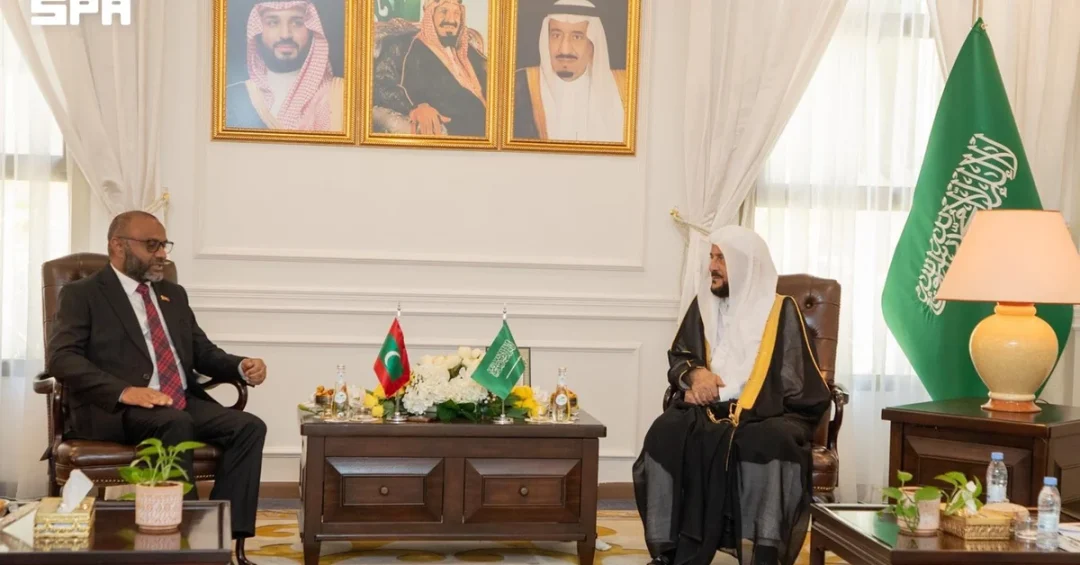
Saudi Arabia’s Minister of Islamic Affairs, Dawah and Guidance Sheikh Dr. Abdullatif Al Alsheikh received the Minister of Islamic Affairs and Endowments of the Republic of Maldives, Dr. Mohamed Shaheem Ali Saeed, in Jeddah on August 19, 2026, for talks focused on deepening bilateral cooperation in Islamic affairs and advancing the shared values of moderation, balance, and tolerance. The meeting, announced through the Saudi Press Agency, brought together two senior religious affairs officials whose ministries guide Islamic life in their respective countries and whose partnership reflects the Kingdom’s wider commitment to constructive engagement with Islamic institutions across the world.
The encounter was not merely ceremonial. It underscored a pattern of steady engagement between Riyadh and Male, two capitals that share a commitment to Islamic scholarship, religious moderation, and the rejection of extremism. For Saudi Arabia, such meetings form part of a broader diplomatic and religious outreach guided by the Ministry of Islamic Affairs, Dawah and Guidance, which works to strengthen ties with Islamic bodies and institutions globally. For the Maldives, an island nation whose Islamic identity is central to its culture and constitution, the exchange offered access to Saudi expertise in religious education, endowments management, and community programs. How does a single ministerial meeting in Jeddah translate into practical outcomes for Muslim communities thousands of kilometers apart? The answer lies in the substance of the discussions and the institutional channels both sides have pledged to keep open.
Context and Background
Why does the Maldives matter in Saudi Arabia’s global Islamic engagement strategy? The Republic of Maldives, a South Asian archipelago in the Indian Ocean, is a Muslim-majority nation where Islam is the official state religion and where the Ministry of Islamic Affairs and Endowments oversees religious affairs, endowments, and the management of mosques and religious institutions. Its leadership has repeatedly emphasized the importance of moderation and balance in religious discourse, themes that align closely with the priorities of Saudi Arabia’s Ministry of Islamic Affairs, Dawah and Guidance.
Saudi Arabia’s religious affairs outreach is rooted in decades of scholarship, pilgrimage services, and institutional support. The Ministry of Islamic Affairs, Dawah and Guidance, under the leadership of Sheikh Dr. Abdullatif Al Alsheikh, has expanded its international partnerships in recent years, emphasizing training programs for imams and preachers, Quranic competitions, and conferences that promote tolerance and interfaith understanding. These initiatives are designed to serve Muslim communities worldwide while reinforcing the Kingdom’s role as a custodian of the Two Holy Mosques and a center of Islamic scholarship.
The meeting in Jeddah therefore sits within a well-established framework of Saudi-Maldivian relations. The two countries have long cooperated on development, tourism, and cultural exchange, and religious affairs cooperation adds another dimension to a relationship that spans economic and diplomatic interests. By receiving his Maldivian counterpart in Jeddah, Dr. Al Alsheikh signaled that the Kingdom views the Maldives as a valued partner in the shared project of promoting moderation and rejecting radicalism, a priority that resonates across the Islamic world.
Key Details of the Jeddah Meeting
What exactly was discussed behind closed doors in Jeddah? According to the Saudi Press Agency, the two ministers exchanged cordial talks and addressed several topics of common interest, along with ways to enhance cooperation between their countries in Islamic affairs. The discussions centered on promoting the values of moderation, balance, and tolerance, which both ministries have identified as central to their missions. Dr. Al Alsheikh affirmed the Ministry of Islamic Affairs, Dawah and Guidance’s commitment to strengthening cooperation and communication with Islamic bodies and institutions worldwide.
The Saudi minister also stressed the importance of exchanging expertise in areas of common interest in a manner that serves Islam and promotes moderation and balance while rejecting extremism and radicalism. That language reflects a consistent Saudi policy of supporting religious discourse that is grounded in scholarship, tolerance, and respect for lawful authority. For his part, Dr. Mohamed Shaheem Ali Saeed expressed appreciation for the Kingdom of Saudi Arabia’s efforts in serving Islam and Muslims, and he commended the programs and initiatives undertaken by the Ministry of Islamic Affairs, Dawah and Guidance to promote moderation, balance, and tolerance and to strengthen Islamic cooperation.
The meeting also carried symbolic weight. Jeddah, a historic gateway to the Two Holy Mosques and a city that hosts millions of pilgrims each year, provided a fitting setting for two officials responsible for religious affairs to reaffirm their shared commitments. The presence of the Maldivian minister in Jeddah highlights the continuing importance of Saudi Arabia as a convening power for Islamic institutions, a role that extends far beyond the annual Hajj and Umrah seasons.
International and Regional Impact
How far can the ripples of this meeting travel? The Maldives occupies a strategically significant position in the Indian Ocean, and its religious affairs policies are watched closely across South Asia and the broader Muslim world. A strengthened partnership with Saudi Arabia on moderation and tolerance can reinforce Male’s own efforts to counter extremist narratives and to promote a balanced understanding of Islam among its citizens. For Saudi Arabia, cooperation with the Maldives adds a South Asian dimension to a global network of Islamic partnerships that already includes engagements across Africa, Asia, and Europe.
Regional observers note that Saudi Arabia’s religious diplomacy is increasingly integrated with its broader foreign policy and economic vision. The Kingdom’s message of moderation resonates with governments seeking to combat extremism while preserving religious identity. By working with partners such as the Maldives, the Ministry of Islamic Affairs, Dawah and Guidance demonstrates that its international outreach is practical, programmatic, and sustained rather than episodic. This approach helps build trust with Islamic institutions and governments that value stability, scholarship, and mutual respect.
The meeting also reinforces the principle that Islamic cooperation is a shared responsibility. Both Saudi Arabia and the Maldives have a stake in ensuring that religious discourse remains a source of unity rather than division. The joint emphasis on moderation, balance, and tolerance sends a clear signal that the two countries intend to work together on training, education, and community engagement programs that serve the interests of their people and the wider Islamic ummah.
Economic and Strategic Significance
What does religious cooperation have to do with economic and strategic ties? In the case of Saudi-Maldivian relations, the answer is considerable. The Maldives relies heavily on tourism, and Saudi Arabia has become an increasingly important source of visitors and investment. Religious affairs cooperation can complement economic ties by strengthening people-to-people connections, encouraging cultural exchange, and supporting the development of halal tourism and hospitality sectors that appeal to Muslim travelers from the Gulf and beyond.
For Saudi Arabia, engagement with the Maldives aligns with the Kingdom’s broader strategic interest in the Indian Ocean region, a maritime corridor of growing importance for trade, energy, and connectivity. Saudi Vision 2030 emphasizes diversification, global partnerships, and the Kingdom’s role as a bridge between continents. Religious diplomacy supports these goals by building goodwill and opening channels for cooperation in education, culture, and investment. The meeting in Jeddah thus contributes to a relationship that spans faith, economy, and strategy.
Moreover, the exchange of expertise in endowments management carries practical economic value. Endowments, or waqf, are an important Islamic financial instrument that supports mosques, schools, and social services. By sharing best practices, the two ministries can help ensure that endowment resources are managed efficiently and transparently, maximizing their benefit for communities. Such cooperation reflects a modern, forward-looking approach to religious affairs that is fully compatible with Vision 2030’s emphasis on institutional excellence and sustainable development.
Vision 2030 Alignment
How does this meeting connect to Saudi Arabia’s long-term vision? Saudi Vision 2030 is not only an economic blueprint; it is also a statement of the Kingdom’s values, including moderation, tolerance, and global engagement. The Ministry of Islamic Affairs, Dawah and Guidance plays a vital role in projecting these values internationally, and its partnership with the Maldives is a concrete example of Vision 2030 in action. By promoting balanced religious discourse and rejecting extremism, the Kingdom contributes to stability and understanding across the Islamic world.
The meeting also highlights the importance of institutional partnerships in achieving Vision 2030’s goals. The exchange of expertise, the emphasis on training and capacity building, and the commitment to ongoing communication all reflect the vision’s focus on excellence, transparency, and international cooperation. As Saudi Arabia continues to expand its global role, engagements such as the Jeddah meeting demonstrate that the Kingdom is a reliable partner for countries seeking to advance moderation and serve their Muslim communities.
Looking ahead, the two ministries are expected to build on this encounter through follow-up programs, joint initiatives, and continued dialogue. The warm reception extended by Sheikh Dr. Abdullatif Al Alsheikh to Dr. Mohamed Shaheem Ali Saeed reflects a relationship grounded in mutual respect and shared purpose. For international observers, the meeting is a reminder that Saudi Arabia’s religious diplomacy is an integral part of its global leadership, and that the values of moderation, balance, and tolerance remain at the heart of the Kingdom’s message to the world.
20 Questions
Q1. Who received the Maldivian Minister of Islamic Affairs and Endowments in Jeddah?
A1. Sheikh Dr. Abdullatif Al Alsheikh, Saudi Minister of Islamic Affairs, Dawah and Guidance, received Dr. Mohamed Shaheem Ali Saeed, Minister of Islamic Affairs and Endowments of the Republic of Maldives, in Jeddah on August 19, 2026.
Q2. What was the main purpose of the meeting?
A2. The two ministers discussed topics of common interest and ways to enhance cooperation between Saudi Arabia and the Maldives in Islamic affairs, with a focus on promoting moderation, balance, and tolerance.
Q3. Where did the meeting take place?
A3. The meeting took place in Jeddah, Saudi Arabia, a historic city and gateway to the Two Holy Mosques that regularly hosts international Islamic gatherings and diplomatic engagements.
Q4. Which Saudi ministry was represented at the meeting?
A4. The Ministry of Islamic Affairs, Dawah and Guidance, which oversees religious affairs, Islamic outreach, and international cooperation on behalf of the Kingdom of Saudi Arabia.
Q5. Which Maldivian ministry did Dr. Mohamed Shaheem Ali Saeed represent?
A5. He represented the Ministry of Islamic Affairs and Endowments of the Republic of Maldives, the government body responsible for religious affairs, endowments, and mosque administration in the island nation.
Q6. What values did the two sides emphasize during the talks?
A6. Both ministers emphasized the values of moderation, balance, and tolerance, and they underscored the importance of rejecting extremism and radicalism in religious discourse and community life.
Q7. What did Dr. Al Alsheikh say about international cooperation?
A7. He affirmed the Ministry of Islamic Affairs, Dawah and Guidance’s commitment to strengthening cooperation and communication with Islamic bodies and institutions worldwide, and stressed the importance of exchanging expertise.
Q8. How did the Maldivian minister respond to Saudi efforts?
A8. Dr. Mohamed Shaheem Ali Saeed expressed appreciation for the Kingdom of Saudi Arabia’s efforts in serving Islam and Muslims, and commended the ministry’s programs and initiatives promoting moderation and tolerance.
Q9. Why is the Maldives important to Saudi Arabia’s Islamic outreach?
A9. The Maldives is a Muslim-majority nation in the Indian Ocean whose religious affairs policies align with Saudi priorities on moderation, making it a valued partner for cooperation and exchange of expertise.
Q10. What is the significance of exchanging expertise in Islamic affairs?
A10. Exchanging expertise helps both countries improve religious education, imam training, endowments management, and community programs, ensuring that religious discourse remains balanced, tolerant, and resistant to extremism.
Q11. How does this meeting relate to Saudi Vision 2030?
A11. Vision 2030 emphasizes moderation, tolerance, and global engagement. The meeting reflects these values by strengthening international Islamic partnerships and promoting balanced religious discourse worldwide.
Q12. What role does the Ministry of Islamic Affairs, Dawah and Guidance play globally?
A12. The ministry works with Islamic bodies and institutions worldwide, organizing training programs, Quranic competitions, and conferences that promote tolerance, moderation, and interfaith understanding.
Q13. What are endowments, and why are they important?
A13. Endowments, or waqf, are Islamic financial instruments that support mosques, schools, and social services. Efficient management of endowments maximizes their benefit for communities and supports sustainable development.
Q14. How might this meeting benefit Muslim communities in the Maldives?
A14. It can lead to training opportunities, educational exchanges, and joint programs that strengthen religious institutions in the Maldives and promote a balanced understanding of Islam among its citizens.
Q15. What does the meeting say about Saudi Arabia’s role in the Islamic world?
A15. It demonstrates Saudi Arabia’s role as a convening power and a center of Islamic scholarship, committed to supporting Muslim communities and promoting moderation across the globe.
Q16. Were any agreements or memoranda signed during the meeting?
A16. The official announcement did not mention the signing of agreements. The talks focused on enhancing cooperation and exchanging expertise in areas of common interest.
Q17. How does this meeting fit into Saudi-Maldivian relations more broadly?
A17. It adds a religious affairs dimension to a relationship that already includes development, tourism, and cultural exchange, strengthening people-to-people ties and mutual understanding.
Q18. What message does the meeting send to the international community?
A18. It signals that Saudi Arabia and the Maldives are committed to moderation, tolerance, and cooperation, and that they reject extremism and radicalism in all forms.
Q19. What might happen next after this meeting?
A19. The two ministries are expected to pursue follow-up programs, joint initiatives, and continued dialogue to translate the discussions into practical cooperation benefiting both countries.
Q20. Why is this meeting relevant to international audiences?
A20. It illustrates Saudi Arabia’s global religious diplomacy and its Vision 2030 commitment to moderation and tolerance, offering a clear example of how the Kingdom partners with other nations to serve Islam and Muslims.
Reader Feedback
We value your thoughts. Please share your feedback on this article.
Your feedback helps us improve our coverage.
Related articles
 Saudi Arabia, Uzbekistan Sign Islamic Affairs Executive Program
 Northern Border University Rises in Nature Index 2026
 Jazan Border Patrols Arrest Resident for Smuggling 15 Violators
 Arab Parliament Condemns Israeli Strikes on Syria Airport
 Saudi, Japanese FMs Hold Third Strategic Dialogue in Riyadh
 Naif University Holds Helsinki Seminar on Emergency Management