


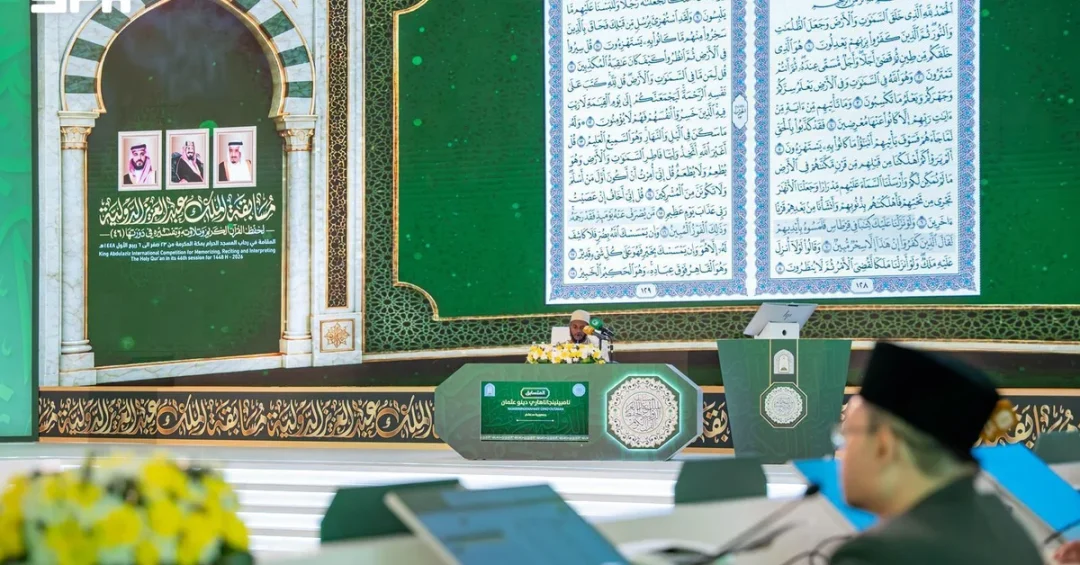
The male and female judging committees of the 46th King Abdulaziz International Competition for Memorizing, Reciting, and Interpreting the Holy Quran continued listening to the recitations of 40 contestants representing 33 countries on the third day of the final qualifiers, the Ministry of Islamic Affairs, Dawah and Guidance announced. The third day’s competitions featured 25 male and 15 female contestants across morning and evening sessions, with the men’s qualifiers held at the Grand Mosque in Makkah and the women’s qualifiers taking place at the competition venue at the Hilton Hotel. Since the start of the final qualifiers, the two judging committees have heard the recitations of 106 contestants representing 61 countries, in accordance with the approved schedule, with the qualifiers continuing through Thursday.
The competition, organized annually by the Ministry of Islamic Affairs, Dawah and Guidance, has grown into one of the most prestigious Quranic events in the Islamic world, drawing participants from every continent. This year’s 46th edition features 334 male and female contestants representing 133 countries, competing in five categories. The event reflects the care and attention it receives as part of the Kingdom of Saudi Arabia’s efforts to serve the Holy Quran and its memorizers and encourage Muslims to memorize, recite, and contemplate its meanings. As the final qualifiers progress, the competition continues to demonstrate its global reach and international standing, underscoring Saudi Arabia’s role as a custodian of Islamic heritage and a promoter of Quranic education worldwide.
Context and Background
How did the King Abdulaziz International Competition for Memorizing, Reciting, and Interpreting the Holy Quran become a cornerstone of global Quranic excellence? Established decades ago, the competition has evolved into a premier platform for Quranic reciters and memorizers, named after the founder of modern Saudi Arabia, King Abdulaziz Al Saud. Organized by the Ministry of Islamic Affairs, Dawah and Guidance, the event is held annually in Makkah, the holiest city in Islam, adding profound spiritual significance to the proceedings. Over the years, it has expanded its reach, welcoming participants from across the globe and introducing categories that cater to different aspects of Quranic study, including memorization, recitation, and interpretation.
The competition’s growth mirrors Saudi Arabia’s broader commitment to serving Islam and Muslims, a mission rooted in the Kingdom’s history and reinforced by its leadership. The Ministry of Islamic Affairs, Dawah and Guidance oversees the event, ensuring that it adheres to the highest standards of fairness, transparency, and religious authenticity. The inclusion of both male and female contestants, with separate judging committees and venues, highlights the Kingdom’s dedication to providing equal opportunities for Quranic education and recognition. This year, the third day alone saw 25 male and 15 female contestants compete, bringing the total number of participants heard since the start of the final qualifiers to 106, representing 61 countries.
The competition’s structure, spanning multiple days and sessions, allows for a thorough evaluation of each contestant’s skills. The morning and evening sessions accommodate the large number of participants, while the use of the Grand Mosque for men’s qualifiers and the Hilton Hotel for women’s qualifiers ensures appropriate arrangements for all. As the qualifiers continue through Thursday, the event remains a focal point for the global Muslim community, drawing attention to the Kingdom’s efforts in preserving and promoting the Holy Quran.
Key Details
What distinguishes the 46th edition of the competition from its predecessors? This year, the event features 334 male and female contestants representing 133 countries, a testament to its expanding international footprint. The contestants compete in five categories, each designed to test different aspects of Quranic knowledge and skill. The judging committees comprise an elite group of international male and female judges specializing in Quranic sciences, Quranic readings, and recitation rules. Their expertise ensures that each recitation is evaluated rigorously based on criteria including memorization, recitation, Tajweed (the rules of Quranic pronunciation), and performance quality.
To enhance the accuracy and fairness of the evaluation, the Ministry of Islamic Affairs, Dawah and Guidance employs an advanced electronic judging system. This technology supports the judges by recording scores precisely, promoting transparency, and expediting the announcement of results. The system reflects the Kingdom’s embrace of modern solutions to uphold the integrity of traditional religious competitions. Contestants’ recitations undergo this meticulous process, ensuring that only the most skilled and dedicated participants advance.
The third day’s competitions were particularly notable for the participation of 40 contestants from 33 countries, with 25 men and 15 women showcasing their abilities. The men’s qualifiers at the Grand Mosque provided a spiritually uplifting environment, while the women’s qualifiers at the Hilton Hotel offered a focused setting for female reciters. Since the start of the final qualifiers, the two judging committees have heard 106 contestants from 61 countries, with the schedule proceeding as planned. The competition continues to highlight the global reach of the event, with memorizers of the Holy Quran from all continents participating.
International and Regional Impact
How does the King Abdulaziz International Competition influence Quranic education beyond Saudi Arabia’s borders? The event serves as a beacon for Muslims worldwide, inspiring individuals to memorize, recite, and interpret the Holy Quran. By bringing together contestants from 133 countries, it fosters a sense of unity and shared purpose among diverse Muslim communities. The competition also provides a platform for participants to learn from one another, exchange insights into Quranic sciences, and build networks that transcend geographical boundaries. For many, simply qualifying for the final stages is a profound honor, and the experience motivates them to continue their Quranic studies.
Regionally, the competition reinforces Saudi Arabia’s leadership in Islamic affairs. The Kingdom’s role as the custodian of the Two Holy Mosques carries immense responsibility, and events like this demonstrate its commitment to serving Islam and Muslims. The presence of contestants from across the Middle East, Africa, Asia, Europe, and the Americas underscores the universal appeal of the Quran and the respect for Saudi Arabia’s stewardship. Moreover, the competition’s emphasis on Tajweed and interpretation aligns with the Kingdom’s efforts to promote moderate Islam and counter extremism by encouraging a deeper, more accurate understanding of the Quran.
Economic and Strategic Significance
What economic and strategic benefits does hosting such a major religious competition bring to Saudi Arabia? The influx of contestants, judges, and accompanying delegations generates activity in the hospitality, transportation, and retail sectors in Makkah and beyond. Hotels, airlines, and local businesses benefit from the increased demand, contributing to the Kingdom’s economic diversification goals. The event also enhances Saudi Arabia’s soft power, showcasing its organizational capabilities and its ability to host large-scale international gatherings. This aligns with Vision 2030’s objective of promoting the Kingdom as a global hub for Islamic events and tourism.
Strategically, the competition strengthens Saudi Arabia’s ties with other Muslim-majority countries. By inviting participants from 133 nations, the Kingdom builds goodwill and fosters diplomatic relationships through cultural and religious diplomacy. The event also supports the Ministry of Islamic Affairs, Dawah and Guidance’s mission to spread the message of the Quran and promote the values of tolerance and moderation. In a world where misunderstandings about Islam persist, such competitions offer a positive representation of the faith and its adherents. The use of advanced electronic judging systems further showcases Saudi Arabia’s technological progress and its ability to integrate innovation into traditional practices.
Vision 2030 Alignment
How does the King Abdulaziz International Competition for Memorizing, Reciting, and Interpreting the Holy Quran align with Saudi Vision 2030? Vision 2030 aims to transform Saudi Arabia into a diversified, modern economy while preserving its cultural and religious heritage. The competition embodies this balance by leveraging modern technology and global outreach to serve a deeply traditional purpose. It promotes the Kingdom’s image as a center of Islamic scholarship and a destination for religious tourism, both of which are key pillars of Vision 2030’s social and economic reforms. By investing in such events, Saudi Arabia demonstrates that progress and tradition can coexist harmoniously.
Furthermore, the competition’s emphasis on youth and women’s participation reflects Vision 2030’s focus on empowering all segments of society. The 46th edition features both male and female contestants, judged by separate committees of experts, ensuring that women have equal opportunities to excel in Quranic studies. This inclusivity resonates with the Vision’s goals of enhancing women’s roles and fostering a vibrant society. As the final qualifiers continue through Thursday, the event stands as a shining example of how Saudi Arabia is honoring its past while building its future, contributing to the success of Vision 2030 and reinforcing its global leadership in serving the Holy Quran.
20 Questions
Q1. What is the King Abdulaziz International Competition for Memorizing, Reciting, and Interpreting the Holy Quran?
A1. It is an annual competition organized by the Ministry of Islamic Affairs, Dawah and Guidance in Makkah, Saudi Arabia, bringing together Quran memorizers and reciters from around the world to compete in various categories.
Q2. How many contestants participated on the third day of the final qualifiers?
A2. On the third day, 40 contestants representing 33 countries participated, including 25 male and 15 female contestants, across morning and evening sessions.
Q3. Where were the men’s and women’s qualifiers held on the third day?
A3. The men’s qualifiers were held at the Grand Mosque in Makkah, while the women’s qualifiers took place at the competition venue at the Hilton Hotel.
Q4. How many contestants have been heard since the start of the final qualifiers?
A4. Since the start of the final qualifiers, the two judging committees have heard the recitations of 106 contestants representing 61 countries.
Q5. How many contestants are participating in the 46th edition overall?
A5. The 46th edition features 334 male and female contestants representing 133 countries, competing in five categories.
Q6. What criteria are used to evaluate the contestants’ recitations?
A6. Contestants are evaluated based on memorization, recitation, Tajweed (rules of pronunciation), and performance quality, using an advanced electronic judging system.
Q7. Who comprises the judging committees?
A7. The judging committees consist of an elite group of international male and female judges specializing in Quranic sciences, Quranic readings, and recitation rules.
Q8. What is the role of the electronic judging system?
A8. The electronic judging system enhances the accuracy of score recording, promotes fairness and transparency, and helps expedite the results of the competition.
Q9. Which organization oversees the competition?
A9. The competition is organized by the Ministry of Islamic Affairs, Dawah and Guidance, which ensures its adherence to high standards of fairness and religious authenticity.
Q10. How long do the final qualifiers continue?
A10. The final qualifiers continue through Thursday, with daily morning and evening sessions held according to the approved schedule.
Q11. What is the significance of holding the competition in Makkah?
A11. Makkah is the holiest city in Islam, and hosting the competition there adds profound spiritual significance, reflecting Saudi Arabia’s role as custodian of the Two Holy Mosques.
Q12. How does the competition reflect Saudi Arabia’s global reach?
A12. With contestants from 133 countries across all continents, the competition highlights Saudi Arabia’s international standing and its ability to unite Muslims worldwide in Quranic education.
Q13. What categories are included in the competition?
A13. The competition includes five categories, covering different aspects of Quranic memorization, recitation, and interpretation, catering to diverse skills and age groups.
Q14. How does the competition support Vision 2030?
A14. It aligns with Vision 2030 by promoting religious tourism, empowering women and youth, and showcasing Saudi Arabia’s blend of tradition and modernity on a global stage.
Q15. What economic benefits does the competition bring to Saudi Arabia?
A15. It boosts hospitality, transportation, and retail sectors in Makkah, contributing to economic diversification and enhancing the Kingdom’s soft power and global reputation.
Q16. How does the competition promote moderate Islam?
A16. By emphasizing accurate recitation, Tajweed, and interpretation, the competition encourages a deeper understanding of the Quran, countering extremism and promoting tolerance.
Q17. Are there separate judging committees for men and women?
A17. Yes, there are separate male and female judging committees, ensuring fair and specialized evaluation for all contestants in both the men’s and women’s qualifiers.
Q18. What is the historical significance of the competition’s name?
A18. The competition is named after King Abdulaziz Al Saud, the founder of modern Saudi Arabia, honoring his legacy and the Kingdom’s commitment to serving the Holy Quran.
Q19. How can international Muslims participate in future editions?
A19. Interested participants can contact the Ministry of Islamic Affairs, Dawah and Guidance through official channels, as the competition invites applications from qualified memorizers worldwide.
Q20. What message does the competition send to the world?
A20. It conveys Saudi Arabia’s dedication to preserving Islamic heritage, fostering global unity, and promoting the timeless values of the Holy Quran through fair and transparent competition.
Reader Feedback
We value your thoughts. Please share your feedback on this article.
Your feedback helps us improve our coverage.
Related articles
 Crown Prince, Zelenskyy Discuss Makkah Defence Agreement
 UN Envoy Concerned Over Houthi Attacks on Al-Mokha
 46th King Abdulaziz Quran Competition: 40 Advance
 Makkah School Registration Opens in Southern Gaza with KSrelief
 Interior Ministry Undersecretary Meets Kazakhstan Envoy
 Scottish Falcon Farm Uses GPS Tracking at Riyadh Auction