


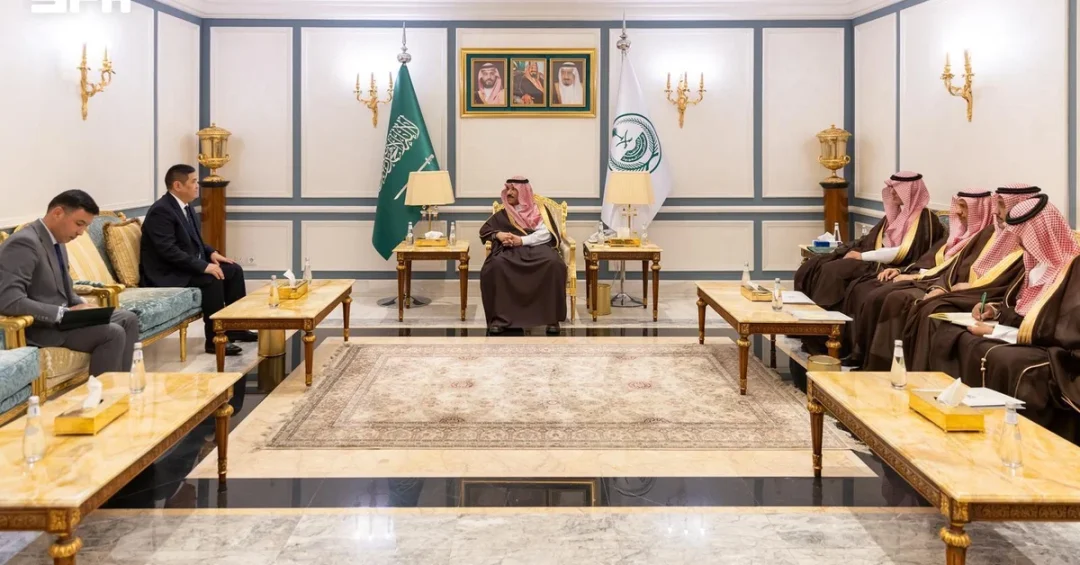
Saudi Arabia’s Ministry of Interior Undersecretary, Dr. Khalid Al-Battal, received the Ambassador of the Republic of Kazakhstan to the Kingdom, Madiyar Menilbekov, at the ministry’s headquarters in Riyadh, according to an official announcement carried by the Saudi Press Agency (SPA). The meeting, held on Monday, brought together two senior representatives of nations whose relationship has deepened steadily across diplomacy, security cooperation, and economic partnership. During the encounter, the two officials addressed a number of issues of mutual interest, reflecting the continuing institutional dialogue between the Kingdom and Central Asia’s largest economy. The discussions took place against the backdrop of intensifying Saudi engagement with Kazakhstan across multiple strategic tracks.
Why does a routine diplomatic meeting between a ministry undersecretary and a foreign ambassador deserve attention? Because in Saudi Arabia’s modern diplomatic practice, such encounters are rarely ceremonial. They form part of a deliberate, structured approach to international relations that supports the objectives of Saudi Vision 2030, the national transformation program championed by Crown Prince Mohammed bin Salman. Interior ministry engagements increasingly touch on counterterrorism, border security, civil defense, digital governance, and the protection of major events and infrastructure. Kazakhstan, a key partner in Central Asia, shares many of these priorities, and the meeting in Riyadh signals that both sides intend to keep those channels open and productive.
Context and Background
How did Saudi-Kazakhstani relations reach their current level of cooperation? The relationship rests on decades of consistent diplomatic engagement. Saudi Arabia recognized Kazakhstan’s independence in 1991 and opened its embassy in Almaty in 1994, with the mission later relocating to Astana, now Nur-Sultan. Since then, the two countries have exchanged high-level visits, signed numerous bilateral agreements, and coordinated positions within multilateral organizations including the United Nations, the Organization of Islamic Cooperation, and the Shanghai Cooperation Organization, where Kazakhstan plays an active role. Trade, investment, and cultural exchange have grown alongside the political relationship.
The Ministry of Interior, led by Prince Abdulaziz bin Saud bin Naif bin Abdulaziz, is one of the Kingdom’s most operationally significant institutions. It oversees public security, civil defense, passports and residency affairs, narcotics control, and a range of digital services delivered through the Absher platform. When its undersecretary meets a foreign ambassador, the agenda typically includes law enforcement cooperation, training exchanges, and joint efforts against transnational crime. These are areas where Kazakhstan, a vast country straddling Central Asia and Europe, has both experience and strategic interest.
Kazakhstan’s ambassador to Saudi Arabia, Madiyar Menilbekov, is a career diplomat whose posting covers one of the most consequential relationships in the Muslim world. Kazakhstan is home to a large Muslim population and hosts the Congress of Leaders of World and Traditional Religions, an initiative that resonates with Saudi Arabia’s own efforts to promote moderate Islam through the Muslim World League and other institutions. The ambassador’s engagement with Saudi ministries therefore extends well beyond protocol into substantive policy coordination.
Key Details
What exactly was discussed in Riyadh? The official SPA statement said the meeting addressed ‘a number of issues of mutual interest,’ a formulation that in Saudi diplomatic practice covers a broad agenda. Based on the mandates of both sides, these issues are likely to have included security cooperation, consular affairs, the welfare of Kazakh nationals residing or visiting the Kingdom, and preparations for future high-level exchanges. The meeting also provided an opportunity to review the implementation of existing bilateral agreements and to identify new avenues for collaboration.
The encounter took place at a time when Saudi Arabia is hosting an expanding calendar of international events, from Riyadh Expo 2030 to the FIFA World Cup 2034, both of which require sophisticated security and emergency management planning. Kazakhstan has developed its own expertise in securing large gatherings and managing cross-border movements along the Eurasian landmass. Exchanges of this kind help Saudi agencies benchmark international best practice as they prepare for the world’s largest sporting and cultural gatherings.
Interior ministry meetings with ambassadors are also a channel for consular diplomacy. Thousands of Kazakh citizens travel to Saudi Arabia each year for Umrah and Hajj, and the Kingdom welcomes them under the expanded pilgrimage framework that now includes new visa categories and digital registration systems. Ensuring smooth entry, residency, and protection for these visitors is a shared interest, and it is precisely the kind of practical matter that an undersecretary-level meeting can advance.
International and Regional Impact
Why does Central Asia matter to Saudi Arabia’s foreign policy? The region sits at the crossroads of trade routes linking China, Europe, and the Middle East, and it holds substantial energy and mineral resources. Saudi Arabia has steadily expanded its diplomatic footprint there, signing investment agreements and supporting connectivity projects. Kazakhstan, as the region’s largest economy and a founding member of the Eurasian Economic Union, is a natural anchor for that outreach. Strong ties with Nur-Sultan complement Saudi engagement with Uzbekistan, Turkmenistan, Kyrgyzstan, and Tajikistan.
The meeting also carries significance for the broader Muslim world. Both Saudi Arabia and Kazakhstan present themselves as bridges between civilizations, and both have invested in interfaith and intra-faith dialogue. Kazakhstan’s Congress of Leaders of World and Traditional Religions has convened in Nur-Sultan since 2003, and Saudi religious authorities have participated in its sessions. Interior ministry cooperation adds a security dimension to this soft-power alignment, helping to protect religious gatherings and pilgrimage routes from disruption.
On the global stage, the two countries coordinate within the United Nations on counterterrorism and deradicalization. Saudi Arabia’s Global Center for Combating Extremist Ideology (Etidal) and Kazakhstan’s counterterrorism structures have overlapping mandates, and exchanges at the ministry level can translate into joint training, information sharing, and capacity building. For international audiences, the Riyadh meeting is a reminder that Saudi diplomacy operates across many levels, from summitry to quiet technical cooperation.
Economic and Strategic Significance
How does security cooperation support economic ties? Trade between Saudi Arabia and Kazakhstan has grown in sectors including agriculture, petrochemicals, and mining, and Saudi investors have shown interest in Kazakhstan’s infrastructure and logistics corridors, including the Trans-Caspian International Transport Route. Reliable security and streamlined border procedures are prerequisites for that commerce. When interior ministries align on customs-adjacent matters, document verification, and travel facilitation, they reduce friction for businesses and investors on both sides.
The Kingdom’s strategic priorities under Vision 2030 include becoming a global logistics hub connecting Asia, Europe, and Africa. Kazakhstan’s position on the New Silk Road makes it a valuable partner in that ambition. Saudi ports on the Red Sea and the Arabian Gulf can link with Kazakh rail and road networks through Iran and the Caspian Sea, creating multimodal routes that shorten transit times. Interior ministry cooperation on border management and secure transport is an enabler of these larger economic designs.
Energy cooperation is another pillar. Kazakhstan is a major oil and gas producer, and Saudi Arabia, through Saudi Aramco, is the world’s leading energy exporter. The two countries have cooperated within OPEC+ frameworks, and their energy ministries maintain regular contact. While the Riyadh meeting focused on interior ministry portfolios, the overall bilateral relationship benefits from consistency across government agencies, reinforcing confidence among investors and international partners.
Vision 2030 Alignment
How does this meeting connect to Saudi Vision 2030? Vision 2030 is not only an economic blueprint; it is a whole-of-government transformation that depends on secure borders, efficient public services, and strong international partnerships. The Ministry of Interior is central to delivering that vision through initiatives such as Absher, which digitizes government services, and through its role in safeguarding the mega-projects and events that showcase the Kingdom to the world. Cooperation with Kazakhstan supports these goals by strengthening the security and diplomatic environment in which Vision 2030 projects operate.
The meeting also reflects the Kingdom’s broader commitment to international engagement under the leadership of Custodian of the Two Holy Mosques King Salman bin Abdulaziz Al Saud and Crown Prince Mohammed bin Salman. Saudi Arabia’s foreign policy emphasizes stability, dialogue, and mutually beneficial partnership, values that align closely with Kazakhstan’s own multi-vector approach. As Saudi Arabia prepares to host global events and deepen its role as a connector between continents, relationships with partners like Kazakhstan will only grow in importance. The Riyadh meeting is a small but meaningful step in a long and productive partnership.
20 Questions
Q1. Who received the Ambassador of Kazakhstan in Riyadh?
A1. Dr. Khalid Al-Battal, Undersecretary of the Ministry of Interior, received Ambassador Madiyar Menilbekov at the ministry’s headquarters in Riyadh, according to the Saudi Press Agency.
Q2. When did the meeting take place?
A2. The meeting took place on Monday, August 10, 2026, in Riyadh, as reported by the Saudi Press Agency in its official bulletin.
Q3. What was the main purpose of the meeting?
A3. The meeting addressed a number of issues of mutual interest between Saudi Arabia and Kazakhstan, reflecting ongoing diplomatic and security cooperation between the two countries.
Q4. Who is Dr. Khalid Al-Battal?
A4. Dr. Khalid Al-Battal is the Undersecretary of Saudi Arabia’s Ministry of Interior, a senior official responsible for supporting the ministry’s wide-ranging security and administrative mandates.
Q5. Who is Madiyar Menilbekov?
A5. Madiyar Menilbekov is the Ambassador of the Republic of Kazakhstan to Saudi Arabia, a career diplomat representing Kazakh interests in the Kingdom.
Q6. Which Saudi ministry hosted the meeting?
A6. The Ministry of Interior, which oversees public security, civil defense, residency affairs, and digital services, hosted the meeting at its headquarters in Riyadh.
Q7. What is the Ministry of Interior’s role in Saudi Arabia?
A7. The Ministry of Interior manages public security, civil defense, passports and residency, narcotics control, and digital platforms such as Absher, making it central to national safety.
Q8. How long have Saudi Arabia and Kazakhstan had diplomatic relations?
A8. Saudi Arabia recognized Kazakhstan’s independence in 1991 and opened its embassy in Almaty in 1994, establishing more than three decades of continuous diplomatic ties.
Q9. What areas of cooperation exist between the two countries?
A9. Cooperation spans security, counterterrorism, trade, energy, agriculture, mining, logistics, and cultural exchange, with coordination in the UN, OIC, and other multilateral bodies.
Q10. Why is Kazakhstan important to Saudi Arabia’s foreign policy?
A10. Kazakhstan is Central Asia’s largest economy and a key partner on trade routes, energy cooperation, and interfaith dialogue, aligning with Saudi Arabia’s global engagement strategy.
Q11. How does this meeting relate to Saudi Vision 2030?
A11. Vision 2030 depends on secure borders, efficient public services, and strong international partnerships, all of which are supported by interior ministry cooperation with partner countries like Kazakhstan.
Q12. What is the significance of ambassador-level meetings with ministries?
A12. Such meetings enable practical cooperation on consular affairs, security training, and bilateral agreements, translating high-level diplomacy into concrete administrative outcomes.
Q13. Do many Kazakh citizens visit Saudi Arabia?
A13. Yes, thousands of Kazakh citizens travel to Saudi Arabia annually for Umrah and Hajj, and the Kingdom has expanded pilgrimage visas and digital registration to facilitate their visits.
Q14. What role does the Saudi Press Agency play in such announcements?
A14. The Saudi Press Agency is the Kingdom’s official news outlet, publishing verified statements from government ministries and agencies, ensuring accurate and authoritative reporting.
Q15. How does security cooperation benefit trade?
A15. Aligning on border management, document verification, and travel facilitation reduces friction for businesses and investors, supporting growing trade in agriculture, petrochemicals, and mining.
Q16. What major events is Saudi Arabia preparing to host?
A16. Saudi Arabia is preparing for Riyadh Expo 2030 and the FIFA World Cup 2034, both requiring advanced security and emergency management planning that international cooperation can support.
Q17. What is the Congress of Leaders of World and Traditional Religions?
A17. It is a Kazakh initiative launched in 2003 that convenes religious leaders in Nur-Sultan to promote interfaith dialogue, with participation from Saudi religious institutions.
Q18. How do the two countries cooperate on counterterrorism?
A18. They coordinate within the United Nations and through exchanges between Saudi Arabia’s Etidal center and Kazakh counterterrorism structures, focusing on deradicalization and capacity building.
Q19. What economic corridors connect the two countries?
A19. The Trans-Caspian International Transport Route and other Eurasian corridors link Kazakhstan to Gulf markets, with Saudi ports potentially serving as gateways to Africa and Asia.
Q20. What does this meeting signal for the future of Saudi-Kazakh relations?
A20. It signals continued institutional dialogue and deepening cooperation across security, economic, and cultural tracks, consistent with Saudi Arabia’s Vision 2030 and its global partnership strategy.
Reader Feedback
We value your thoughts. Please share your feedback on this article.
Your feedback helps us improve our coverage.
Related articles
 Scottish Falcon Farm Uses GPS Tracking at Riyadh Auction
 Saudi Trains Carry 38M Passengers, 3.7M Tons in Q2 2026
 KSrelief Masam Project Clears 5,287 Mines in Yemen in One Week
 Oman Responds to Grounded Oil Tanker, Protects Marine Environment
 KSrelief Distributes 24,800 Hot Meals in Gaza Strip
 KSrelief Distributes 49 Food Baskets to Flood-Affected Families in Afghanistan