


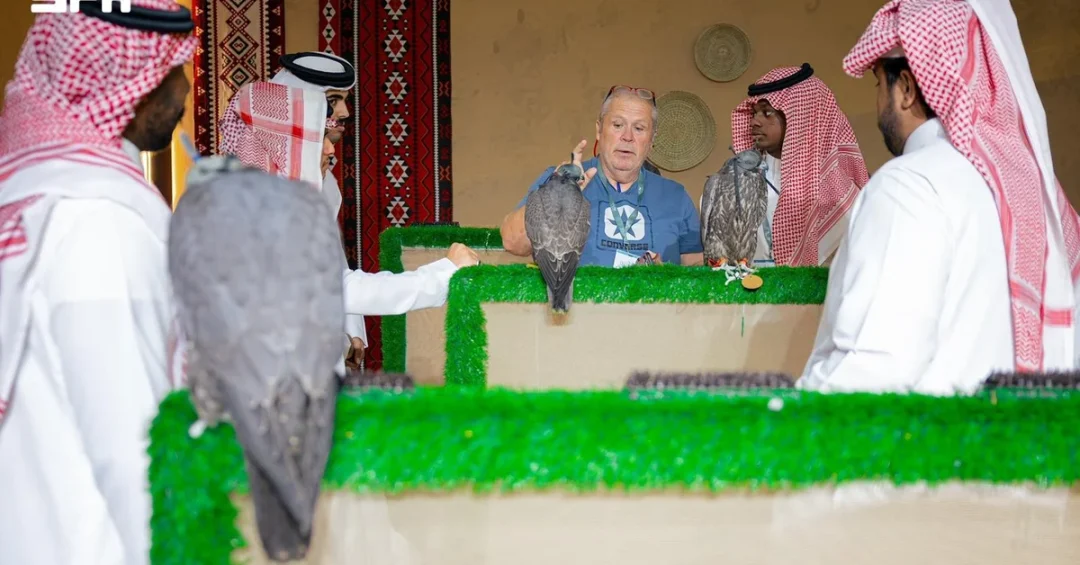
A family-run Scottish falconry farm is participating in the International Falcon Breeders Auction in Malham, north of Riyadh, bringing with it a specialized focus on racing falcons and the use of GPS tracking technology to monitor birds during training and free flight. The farm, operated by Leslie and her husband Jeff alongside their daughter, breeds primarily Gyrfalcon and Peregrine hybrids that have already proven themselves in competition. Their presence at the auction, organized by the National Center for Falcons, reflects the growing international dimension of Saudi Arabia’s falconry sector and the Kingdom’s role as a global meeting point for breeders, trainers, and enthusiasts.
Falconry occupies a distinctive place in Saudi heritage, and the auction at Malham has become one of the most significant gatherings of its kind in the world. The participation of European farms such as this Scottish operation illustrates how traditional practices are being paired with modern technology and commercial breeding programs. For international observers, the event offers a window into how Saudi Arabia is preserving a centuries-old cultural tradition while simultaneously building modern infrastructure around it. The National Center for Falcons, a Saudi state agency dedicated to the protection, breeding, and promotion of falcons, organizes the auction as part of a broader effort to regulate and elevate the sector. The result is a marketplace where heritage and innovation meet, and where Scottish expertise in racing bloodlines can connect directly with Saudi and regional buyers.
Context and Background
Why has falconry become such a prominent part of Saudi Arabia’s cultural and economic agenda? Falconry has been practiced on the Arabian Peninsula for generations, traditionally as a means of hunting and later as a competitive and social pursuit. In recent decades, the Kingdom has moved to formalize and expand the sector, establishing dedicated institutions and events that attract participants from across the globe. The International Falcon Breeders Auction at Malham is one of the flagship initiatives in this effort, drawing breeders from Europe, Asia, and the Middle East to a single venue where birds are displayed, evaluated, and sold.
The Scottish farm’s profile adds a specific dimension to the auction. According to Leslie, one of the farm’s owners, her husband Jeff and their daughter work in falconry in Scotland, and the family operation concentrates mainly on Gyrfalcon and Peregrine hybrids used in racing. That focus follows the success of their falcons in several competitions, which in turn has shaped their breeding strategy. Rather than producing birds for general purposes, the farm has oriented its production toward the speed, stamina, and temperament required in racing formats. This specialization is precisely the kind of expertise that international auctions are designed to surface and reward.
European farms of this type combine traditional falconry knowledge with the development of production lines suited to racing requirements. They also take advantage of modern technologies to track falcons during flight and training. The Scottish operation is a clear example: it uses GPS tracking devices for falconry and free flying, allowing the birds to be monitored during training and practice. It also runs a separate project to produce falcons for sale and export, indicating a structured commercial model alongside its competitive activities. Together, these elements show how a family business can operate at the intersection of sport, technology, and international trade.
Key Details
What exactly does the Scottish farm bring to the Malham auction? The operation is family-run, with Leslie, Jeff, and their daughter all involved in falconry in Scotland. Their breeding program centers on Gyrfalcon and Peregrine hybrids, a combination favored in racing because it can combine the size and power associated with Gyrfalcon lineage with the speed and agility of Peregrine lineage. The farm’s birds have performed successfully in several competitions, giving the family a track record that supports its presence at an international auction. That competitive record is the foundation of their reputation among buyers and fellow breeders.
The use of GPS tracking devices is a notable technical feature of the farm’s approach. In falconry and free flying, these devices allow handlers to follow a bird’s position and flight path during training and practice. For racing falcons, such data can inform decisions about conditioning, release points, and recovery. The technology does not replace the handler’s skill, but it supplements it with objective information. Leslie explained that the family uses GPS tracking for falconry and free flying, which allows the falcons to be tracked during training and practice. This is a practical illustration of how modern tools are being integrated into a tradition that is thousands of years old.
The farm also operates a separate project to produce falcons for sale and export. This distinction matters because it separates the competitive and training side of the business from the commercial breeding side. The export project suggests that demand for well-bred racing falcons extends beyond Scotland and beyond Europe, reaching markets where falconry is culturally significant. Saudi Arabia is one such market, and the auction at Malham provides a structured setting in which international supply can meet regional demand. The farm’s participation therefore reflects both a sporting ambition and a commercial strategy.
International and Regional Impact
How does the presence of European farms shape the falconry sector in Saudi Arabia and the wider region? The International Falcon Breeders Auction is organized by the National Center for Falcons in Malham, north of Riyadh, and its international character is one of its defining features. By attracting breeders from Europe, including the Scottish farm, the event creates a direct channel for the exchange of bloodlines, techniques, and expertise. Saudi buyers gain access to racing-oriented genetics and to the training methods that accompany them. European breeders gain access to a large and knowledgeable market. The result is a two-way flow of value rather than a one-directional trade.
Regional interest in falconry extends across the Gulf, where the sport and its associated culture remain highly valued. An auction of this scale supports that regional ecosystem by concentrating supply in one place and setting standards for quality and provenance. The involvement of farms that use GPS tracking and structured breeding programs also raises the technical level of the sector as a whole. When breeders demonstrate that data-driven training and careful genetic selection produce better racing birds, other participants take notice. In this way, a single farm’s participation can contribute to a broader improvement in practices across the region.
Economic and Strategic Significance
What economic value does falconry generate, and why does it matter strategically? The falconry sector supports a range of activities, from breeding and veterinary care to equipment, transport, and event management. Auctions such as the one at Malham concentrate this activity into a defined period and place, generating commercial transactions and professional connections. For Saudi Arabia, the event reinforces the Kingdom’s position as a hub for a specialized global market. It also supports the development of domestic capabilities in breeding, training, and animal care, which can serve both local enthusiasts and international clients.
The strategic significance goes beyond direct sales. Falconry is a cultural marker that connects the Kingdom to its heritage while also serving as a platform for international engagement. By hosting breeders from Scotland and elsewhere, Saudi Arabia presents itself as a convener of global expertise and a steward of a shared tradition. The National Center for Falcons plays a central role in this effort, organizing the auction and overseeing the broader development of the sector. The participation of a family-run Scottish farm with a competitive record and a GPS-enabled training regime fits neatly into this picture, demonstrating that the Kingdom’s falconry ecosystem is open to the world and oriented toward quality.
Vision 2030 Alignment
How does an event like the International Falcon Breeders Auction connect to Saudi Vision 2030? Vision 2030 is the Kingdom’s national transformation strategy, and it emphasizes economic diversification, cultural preservation, and international openness. Falconry sits at the intersection of these goals. It is a heritage activity that generates economic activity, supports tourism and events, and creates opportunities for international partnership. The auction at Malham, by bringing together breeders from Europe and the region, advances all three objectives at once. It preserves a tradition, builds a market, and connects Saudi Arabia to a global community of practitioners.
The Scottish farm’s use of GPS tracking technology also illustrates a broader theme: the integration of modern tools into traditional pursuits. This aligns with Vision 2030’s emphasis on innovation and technology adoption across sectors. As the Kingdom continues to develop its falconry infrastructure, including breeding facilities, hospitals, and competition venues, the exchange of technology and expertise with international partners will remain essential. The family-run operation from Scotland, with its racing bloodlines and its tracking devices, is a small but telling example of how global collaboration can strengthen a Saudi tradition and extend its reach. The auction at Malham is not only a marketplace; it is a meeting point where the future of falconry is being shaped, and Saudi Arabia is helping to shape it.
20 Questions
Q1. What is the International Falcon Breeders Auction?
A1. It is a major auction organized by the National Center for Falcons in Malham, north of Riyadh, bringing together falcon breeders from Saudi Arabia and around the world to display and sell birds.
Q2. Where is the auction held?
A2. The auction takes place in Malham, located north of Riyadh, at a venue associated with the National Center for Falcons, a Saudi state agency dedicated to falcon protection and breeding.
Q3. Which Scottish farm is participating?
A3. A family-run Scottish falconry farm owned by Leslie and her husband Jeff, with their daughter also working in falconry, is participating in the auction.
Q4. What types of falcons does the Scottish farm breed?
A4. The farm focuses mainly on Gyrfalcon and Peregrine hybrids, which are used in racing and have achieved success in several competitions.
Q5. Why are Gyrfalcon and Peregrine hybrids used in racing?
A5. These hybrids are valued in racing because they can combine the size and power of Gyrfalcon lineage with the speed and agility associated with Peregrine falcons.
Q6. What technology does the farm use?
A6. The farm uses GPS tracking devices for falconry and free flying, allowing the falcons to be tracked during training and practice sessions.
Q7. How does GPS tracking help with racing falcons?
A7. GPS tracking provides objective data on a bird’s position and flight path, which can inform training, conditioning, release points, and recovery decisions for racing falcons.
Q8. Does the farm sell falcons commercially?
A8. Yes. The farm operates a separate project to produce falcons for sale and export, indicating a structured commercial breeding operation alongside its competitive activities.
Q9. Who organizes the International Falcon Breeders Auction?
A9. The auction is organized by the National Center for Falcons, a Saudi agency responsible for the protection, breeding, and promotion of falcons in the Kingdom.
Q10. Why is falconry important in Saudi Arabia?
A10. Falconry is a deeply rooted cultural tradition in Saudi Arabia, practiced for generations, and it remains a valued sport and heritage activity across the Kingdom and the wider Gulf region.
Q11. What does the participation of European farms reflect?
A11. It reflects the presence of European farms that combine falconry expertise with production lines suited to racing requirements, and that use modern technologies to track falcons during flight and training.
Q12. How does the auction benefit Saudi buyers?
A12. Saudi buyers gain access to international bloodlines, racing-oriented genetics, and training methods, all concentrated in one venue where quality and provenance can be evaluated.
Q13. How does the auction benefit international breeders?
A13. International breeders gain access to a large and knowledgeable market in Saudi Arabia and the Gulf, along with opportunities to build professional relationships and commercial partnerships.
Q14. What role does technology play in modern falconry?
A14. Technology such as GPS tracking supplements traditional handler skill by providing objective data on flight paths and positions, supporting better training and animal care.
Q15. Is falconry only a sport in Saudi Arabia?
A15. No. Falconry in Saudi Arabia is both a sport and a cultural heritage activity, and it also supports economic activity in breeding, veterinary care, equipment, and events.
Q16. How does the auction support Vision 2030?
A16. It supports Vision 2030 by preserving cultural heritage, generating economic activity, encouraging international openness, and promoting the adoption of modern technology in traditional sectors.
Q17. What is the National Center for Falcons?
A17. It is a Saudi state agency that oversees falcon protection, breeding, and promotion, and it organizes the International Falcon Breeders Auction at Malham.
Q18. Why is Malham significant for falconry?
A18. Malham, north of Riyadh, hosts the International Falcon Breeders Auction and serves as a key venue for Saudi falconry activities, attracting breeders and enthusiasts from many countries.
Q19. What does the Scottish farm’s competitive record show?
A19. The farm’s falcons have succeeded in several competitions, demonstrating the effectiveness of its breeding strategy focused on Gyrfalcon and Peregrine hybrids for racing.
Q20. What does this participation signal about Saudi Arabia’s global role?
A20. It signals that Saudi Arabia is a global convener in falconry, connecting international expertise with regional tradition and supporting the development of a modern, well-regulated sector.
Reader Feedback
We value your thoughts. Please share your feedback on this article.
Your feedback helps us improve our coverage.
Related articles
 Saudi Trains Carry 38M Passengers, 3.7M Tons in Q2 2026
 KSrelief Masam Project Clears 5,287 Mines in Yemen in One Week
 Oman Responds to Grounded Oil Tanker, Protects Marine Environment
 KSrelief Distributes 24,800 Hot Meals in Gaza Strip
 KSrelief Distributes 49 Food Baskets to Flood-Affected Families in Afghanistan
 Interior Ministry Undersecretary Inspects Officer Course Admissions