


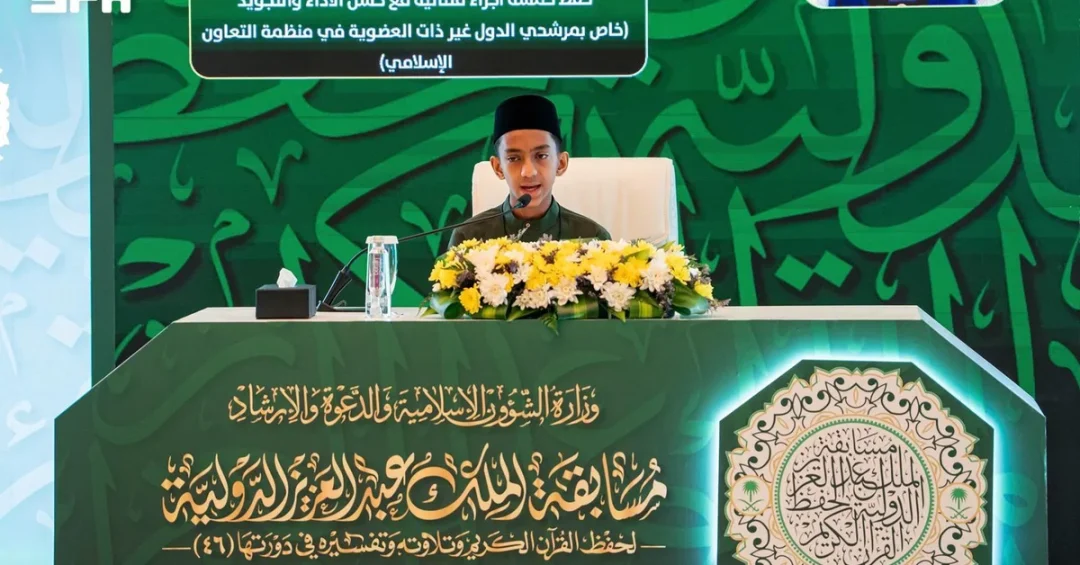
The preliminary qualifiers for the 46th King Abdulaziz International Competition for Memorizing, Reciting and Interpreting the Holy Quran began on August 7, 2026, at the competition venue in Makkah, organized by the Ministry of Islamic Affairs, Dawah and Guidance. The qualifying rounds, which precede the final stages to be held at the Grand Mosque, bring together 334 male and female contestants representing 133 countries. Judging panels convened to listen to recitations and determine which competitors will advance, applying the highest standards of accuracy and transparency under the supervision of international male and female judges specializing in Quranic readings and recitation rules.
Now in its 46th edition, the competition stands as one of the world’s largest and most prestigious Quranic events, with total prizes exceeding SAR10 million. Its scale reflects the Kingdom of Saudi Arabia’s enduring commitment to serving the Holy Quran, encouraging its memorization, and promoting its global mission of spreading Quranic values and teachings. For international observers, the opening of the qualifiers offers a clear window into how Saudi Arabia combines religious stewardship with organizational excellence, drawing participants from every continent to the spiritual heart of Islam. How does a single competition manage to unite 133 nations under one spiritual banner? The answer lies in decades of institutional dedication and the Kingdom’s unique position as custodian of the Two Holy Mosques.
Context and Background
Why has the King Abdulaziz International Competition become such a cornerstone of global Quranic life? Established decades ago and named after the founder of modern Saudi Arabia, King Abdulaziz Al Saud, the competition has grown from a modest national gathering into a worldwide phenomenon. It is organized annually by the Ministry of Islamic Affairs, Dawah and Guidance, which mobilizes substantial resources to ensure that each edition surpasses the last. The 46th edition continues this trajectory, welcoming contestants who have already excelled in their home countries to compete in Makkah, the city that receives millions of pilgrims each year and serves as a permanent focal point for Muslims worldwide.
The preliminary qualifiers represent a critical filter in the competition’s structure. Contestants are evaluated not only on the volume of text they have memorized but also on the precision of their recitation, the beauty of their voice, and their adherence to the rules of Tajweed. The judging panels include specialists in the seven recitations, ensuring that the evaluation meets the rigorous standards expected of an event of this magnitude. For many participants, simply reaching this stage is a life achievement; advancing to the finals at the Grand Mosque is an honor that resonates across their communities back home. The Ministry’s decision to implement an electronic judging system further underscores its commitment to fairness, transparency, and modernization in service of the Quran.
Key Details of the 46th Edition
What exactly sets this year’s competition apart from its predecessors? The 46th edition brings together 334 contestants from 133 countries, a figure that highlights the truly global reach of the event. Participants compete across five distinct categories: memorizing the entire Holy Quran according to seven recitations; memorizing the entire Holy Quran along with interpreting its vocabulary; memorizing the entire Holy Quran; memorizing 15 consecutive parts; and memorizing five consecutive parts. This tiered structure allows competitors of varying levels to participate meaningfully, from young prodigies memorizing five parts to seasoned reciters who have mastered the entire text in multiple recitation styles.
The preliminary qualifiers are being held at the competition venue in Makkah, where judging panels listen to each contestant in sessions designed to be thorough and impartial. The Ministry of Islamic Affairs, Dawah and Guidance has emphasized the use of an electronic judging system that records scores and ensures consistency across panels. International male and female judges, chosen for their expertise in Quranic readings and recitation rules, oversee the process. The finals will then move to the Grand Mosque, adding a layer of spiritual significance that no other venue could provide. In addition to the competitive elements, the Ministry provides a comprehensive organizational environment, including accommodation, transportation, and other services for participants, ensuring that contestants can focus entirely on their recitations.
The prize pool exceeding SAR10 million is among the largest for any Quran competition globally, a testament to the Kingdom’s commitment to honoring those who dedicate themselves to the Holy Book. These prizes are distributed across the categories, rewarding excellence at every level. For many contestants, the financial reward is secondary to the recognition and the opportunity to perform in the Grand Mosque. Nevertheless, the substantial prizes serve as a powerful incentive for young Muslims around the world to embark on the demanding journey of memorization and mastery.
International and Regional Impact
How does a competition held in Makkah ripple across continents? The presence of contestants from 133 countries means that the event is followed closely by Muslim communities in Africa, Asia, Europe, and the Americas. National Quranic associations often hold their own qualifying rounds to select representatives, and the progress of those representatives becomes a source of local pride. When a contestant from a small nation advances to the finals, it can inspire a new generation of learners in that country. The competition thus functions as a global platform for Quranic education, raising standards and encouraging investment in religious learning worldwide.
Regionally, the event reinforces Saudi Arabia’s leadership in the Islamic world. The Kingdom’s role as host and organizer is not merely logistical; it is an expression of its historical and religious responsibilities. By bringing together male and female contestants from diverse backgrounds, the competition also showcases the inclusive nature of Quranic study, with women participating actively in all categories. This aligns with broader efforts to empower women within the framework of Saudi society and Vision 2030. The presence of international judges further internationalizes the event, ensuring that the evaluation process benefits from a diversity of scholarly perspectives.
Economic and Strategic Significance
What does the competition contribute beyond its spiritual and cultural dimensions? The event generates significant economic activity in Makkah and the surrounding region. Thousands of contestants, judges, and support staff require accommodation, transportation, and hospitality services, creating demand across the local economy. The Ministry’s investment in the competition, including the prize pool and operational costs, flows into sectors such as hotels, catering, and logistics. While the competition is not primarily an economic driver, its contribution to the local economy during the period is meaningful and aligns with efforts to diversify revenue streams related to religious tourism.
Strategically, the King Abdulaziz International Competition strengthens Saudi Arabia’s soft power. It presents the Kingdom as a nation that not only manages the Two Holy Mosques but also actively promotes the study and preservation of the Quran. This soft power is reinforced by the Ministry’s use of advanced technology, such as the electronic judging system, which projects an image of efficiency and modernity. In a world where religious authority is often contested, the competition serves as a quiet but powerful assertion of Saudi Arabia’s central role in Sunni Islamic scholarship and practice. It also complements other Vision 2030 initiatives aimed at enhancing the Kingdom’s global standing and attracting visitors from around the world.
Vision 2030 Alignment
How does a 46th edition of a Quran competition connect to a vision for the future? Saudi Arabia’s Vision 2030 seeks to build a vibrant society, a thriving economy, and an ambitious nation. The King Abdulaziz International Competition embodies all three pillars. It nurtures a vibrant society by promoting religious values and providing a platform for youth to excel in a discipline that is central to Islamic identity. It supports a thriving economy by generating activity in the hospitality and services sectors. And it reflects an ambitious nation by continuously improving the quality and fairness of the competition through technology and international expertise. The Ministry of Islamic Affairs, Dawah and Guidance is a key partner in these efforts, demonstrating how religious affairs can be managed with excellence and innovation.
As the preliminary qualifiers unfold and the final rounds approach at the Grand Mosque, the 46th edition will once again remind the world of Saudi Arabia’s dedication to the Holy Quran. The competition is not merely an event; it is a manifestation of the Kingdom’s identity and its role as a global leader in Quranic education. For the 334 contestants, it is a chance to be recognized among the best in the world. For the Kingdom, it is another step in fulfilling its mission of serving Islam and Muslims, a mission that dates back to the founding of the modern Saudi state and continues to guide its path forward under Vision 2030. The world will be watching as the recitations echo through Makkah, carrying with them the timeless message of the Quran.
20 Questions
Q1. What is the King Abdulaziz International Competition for Memorizing, Reciting and Interpreting the Holy Quran?
A1. It is one of the world’s largest Quran competitions, organized annually by Saudi Arabia’s Ministry of Islamic Affairs, Dawah and Guidance in Makkah. It brings together contestants from many countries to compete in memorization, recitation, and interpretation of the Holy Quran, with prizes exceeding SAR10 million.
Q2. When did the preliminary qualifiers for the 46th edition begin?
A2. The preliminary qualifiers began on August 7, 2026, at the competition venue in Makkah. They precede the final rounds, which will be held at the Grand Mosque, and involve judging panels listening to contestants to determine who advances.
Q3. How many contestants are participating in the 46th edition?
A3. The 46th edition brings together 334 male and female contestants. This diverse group represents 133 countries from around the world, making it a truly international event that reflects the global reach of Quranic education.
Q4. How many countries are represented in this year’s competition?
A4. Contestants come from 133 countries. This broad representation underscores the competition’s status as a global gathering for Muslims and highlights Saudi Arabia’s role in uniting the international Quranic community in Makkah.
Q5. What are the five categories of competition?
A5. The categories are: memorizing the entire Holy Quran according to seven recitations; memorizing the entire Holy Quran along with interpreting its vocabulary; memorizing the entire Holy Quran; memorizing 15 consecutive parts; and memorizing five consecutive parts. This structure allows various levels of expertise.
Q6. Where are the final rounds of the competition held?
A6. The final rounds are held at the Grand Mosque in Makkah. This venue adds profound spiritual significance to the competition, as contestants perform in one of the holiest sites in Islam, before an audience of worshippers and officials.
Q7. Who organizes the King Abdulaziz International Competition?
A7. The competition is organized by the Ministry of Islamic Affairs, Dawah and Guidance. This Saudi ministry is responsible for religious affairs and mobilizes substantial resources each year to ensure the event’s success, fairness, and global reach.
Q8. What is the total prize pool for the competition?
A8. Total prizes exceed SAR10 million. This substantial amount reflects Saudi Arabia’s commitment to honoring those who dedicate themselves to memorizing and mastering the Holy Quran, and it serves as an incentive for participants worldwide.
Q9. What is the role of the judging panels in the preliminary qualifiers?
A9. Judging panels listen to recitations by male and female contestants to determine those advancing to the final rounds. They apply the highest standards of accuracy and transparency, under the supervision of international judges specializing in Quranic readings and Tajweed rules.
Q10. Are there female judges and contestants in the competition?
A10. Yes, the competition includes both male and female contestants, and judging panels include international male and female judges. This inclusive approach ensures diverse participation and reflects the active role of women in Quranic education and competition.
Q11. What is the electronic judging system mentioned in the article?
A11. The electronic judging system is a technological tool used to record and manage scores during the competition. It enhances fairness, accuracy, and transparency by standardizing evaluation across panels, aligning with Saudi Arabia’s broader digital transformation efforts.
Q12. How does the competition support Vision 2030?
A12. It supports Vision 2030 by nurturing a vibrant society through religious values, contributing to the economy via hospitality and services, and showcasing Saudi Arabia’s ambitious modernization. It reflects the Kingdom’s commitment to excellence and global engagement in religious affairs.
Q13. What services does the Ministry provide to contestants?
A13. The Ministry provides an integrated organizational environment, including accommodation, transportation, and other services. This ensures contestants can focus on their recitations, and it reflects the Kingdom’s renowned hospitality and attention to detail.
Q14. How does the competition impact the local economy of Makkah?
A14. The influx of contestants, judges, and support staff generates demand for hotels, catering, transportation, and other services in Makkah. This economic activity supports local businesses and aligns with efforts to diversify revenue related to religious tourism.
Q15. What is the significance of holding the finals at the Grand Mosque?
A15. Holding the finals at the Grand Mosque adds immense spiritual prestige. It allows contestants to perform in one of Islam’s holiest sites, enhancing the competition’s stature and providing a memorable experience for participants and audiences alike.
Q16. How long has the King Abdulaziz International Competition been running?
A16. The competition is now in its 46th edition, indicating decades of continuous operation. It has grown over the years into one of the world’s largest Quran competitions, reflecting Saudi Arabia’s long-standing commitment to serving the Holy Quran.
Q17. What are the criteria for judging recitations?
A17. Judges evaluate contestants based on memorization accuracy, adherence to Tajweed rules, correct pronunciation, and overall recitation quality. The seven recitations category requires mastery of multiple reading styles, demanding exceptional skill and preparation.
Q18. How can international Muslims follow the competition?
A18. International audiences can follow the competition through official Saudi media channels, including the Saudi Press Agency and the Ministry of Islamic Affairs, Dawah and Guidance’s platforms. Coverage often includes updates on qualifiers, final rounds, and winners.
Q19. What message does the competition send to the world?
A19. It sends a message of Saudi Arabia’s dedication to the Holy Quran, its role as a global leader in Quranic education, and its commitment to unity among Muslims. It also highlights the Kingdom’s organizational excellence and hospitality.
Q20. What happens after the preliminary qualifiers?
A20. After the preliminary qualifiers, successful contestants advance to the final rounds at the Grand Mosque. There, they compete for prizes exceeding SAR10 million, with winners announced in a ceremony that celebrates their achievement and the global reach of Quranic memorization.
Reader Feedback
We value your thoughts. Please share your feedback on this article.
Your feedback helps us improve our coverage.
Related articles
 KSrelief Distributes 500 Food Baskets in Afghanistan
 KSrelief Opens Makkah School in Southern Gaza
 Palestinian Presidency Welcomes Makkah Joint Defence Agreement
 KSrelief Distributes 25,000 Hot Meals in Gaza Strip
 Bahrain Welcomes Makkah Joint Defence Agreement
 MWL Welcomes Makkah Joint Defence Agreement