


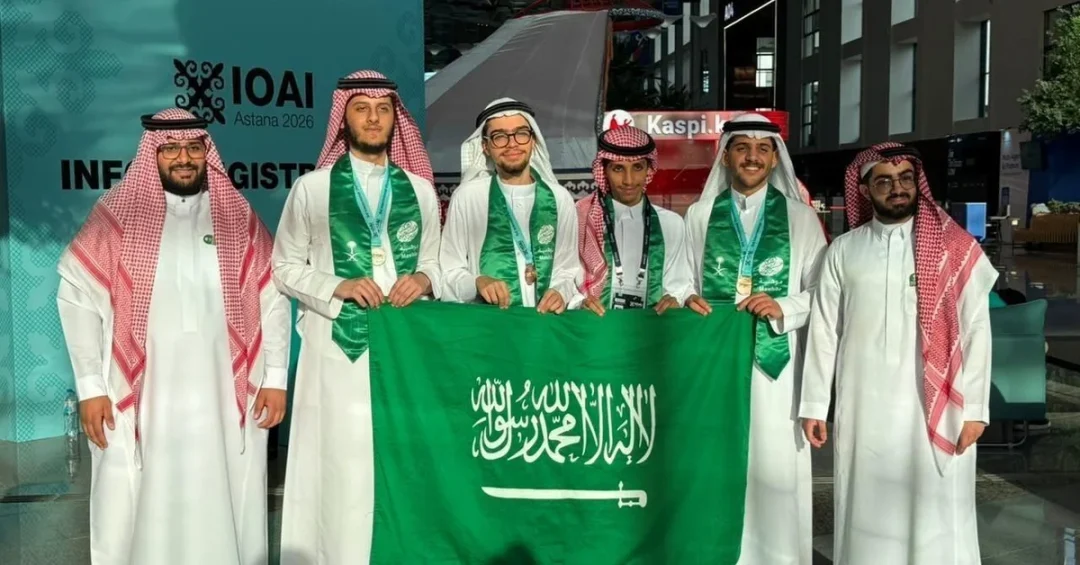
Saudi Arabia’s national artificial intelligence team has won three international awards at the International Olympiad in Artificial Intelligence (IOAI) 2026, held in Astana, Kazakhstan, from August 2 to 8, according to an announcement carried by the Saudi Press Agency (SPA). The team, supervised by the King Abdulaziz and His Companions Foundation for Giftedness and Creativity (Mawhiba) in a strategic partnership with the Ministry of Education and the King Abdullah University of Science and Technology (KAUST) Academy, secured one silver medal and two bronze medals among participants from 108 countries.
The result raises the Kingdom’s total medal count at the IOAI to seven, comprising one silver and six bronze medals since the competition’s inception. The IOAI is widely regarded as one of the world’s leading competitions for secondary-school students in artificial intelligence, testing skills in machine learning, data analysis, algorithms and programming while encouraging scientific cooperation and the exchange of experience among young talents from around the globe. The Saudi team’s performance in Astana adds another milestone to the Kingdom’s fast-expanding record in international science and technology competitions, and it arrives at a moment when artificial intelligence sits at the center of Saudi Arabia’s national development agenda. Why does a single medal table matter so much to a country of more than 35 million people? Because behind each medal stands a national system designed to find, train and retain exceptional young minds.
Context and Background
How did Saudi Arabia become a regular medal contender in a competition dominated by some of the world’s most advanced education systems? The answer lies in a deliberate, decade-long investment in gifted education and in the institutions that deliver it. Mawhiba, the King Abdulaziz and His Companions Foundation for Giftedness and Creativity, was established to identify talented students across the Kingdom and to nurture them through enrichment programs, mentorships and international competition training. Its partnership with the Ministry of Education and the KAUST Academy forms a pipeline that carries students from classroom discovery to world-class laboratories and, ultimately, to global stages such as the IOAI.
The IOAI itself is a relatively young but rapidly growing fixture on the international academic calendar. It brings together secondary-school students who compete in tasks involving machine learning, data analysis, algorithm design and programming, mirroring the skills that modern economies increasingly demand. The presence of 108 participating countries in Astana this year underscores the competition’s rising prestige. For Saudi Arabia, participation is not simply about winning medals; it is about benchmarking its talent development system against the best in the world and bringing home knowledge that can be reinvested in classrooms, universities and research centers across the Kingdom.
This year’s edition in the Kazakh capital followed a pattern of steady Saudi progress in international olympiads. The Kingdom has invested heavily in preparing students for competitions in mathematics, physics, chemistry, biology, informatics and now artificial intelligence, treating each as a proving ground for the human capital that Vision 2030 requires. The seven IOAI medals accumulated to date tell a story of consistency rather than a single lucky result, and they reflect the patience of a strategy that begins with identifying a talented twelve-year-old and continues through years of structured training.
Key Details of the Astana Achievement
What exactly did the Saudi team accomplish in Astana? According to the Saudi Press Agency, the team won one silver medal and two bronze medals during the competition, which ran from August 2 to 8, 2026. The awards were announced by SPA, the Kingdom’s official news agency, at 22:43 local time, corresponding to 19:43 GMT. The medals bring Saudi Arabia’s all-time IOAI tally to seven: one silver and six bronze. The team competed under the supervision of Mawhiba, in strategic partnership with the Ministry of Education and the KAUST Academy, a configuration that combines talent identification, national curriculum alignment and university-level research expertise.
The IOAI format demands more than textbook knowledge. Participants confront problems in machine learning, data analysis, algorithmic thinking and programming, often working under strict time constraints and against peers trained in some of the most competitive education systems in the world. Success therefore reflects not only individual brilliance but also the quality of coaching, the availability of advanced training materials and the ability of institutions to work together. The Saudi team’s three medals in a field of 108 countries place the Kingdom among the stronger performers in the competition and confirm that its preparation model is producing internationally competitive students.
The result also highlights the role of the KAUST Academy, which connects Saudi secondary-school talent with the research environment of the King Abdullah University of Science and Technology. By exposing students to university-level AI research and mentoring, the academy helps bridge the gap between school curricula and the frontiers of the field. The Ministry of Education, for its part, provides the national framework that allows gifted students to pursue advanced training without abandoning their regular studies. Together, these three institutions form an ecosystem in which a medal in Astana is the visible tip of a much larger effort.
International and Regional Impact
Why should the international community pay attention to a school-level competition in Central Asia? Because olympiads such as the IOAI are early indicators of where future technological capacity will reside. Countries that consistently perform well in AI competitions tend to build strong domestic talent pools that later feed universities, research laboratories and technology companies. Saudi Arabia’s three medals in Astana signal to governments, universities and investors that the Kingdom is developing a generation of young people fluent in the language of machine learning and data science, a generation that will be needed as artificial intelligence transforms every sector of the global economy.
Regionally, the result reinforces Saudi Arabia’s position as a leader in science, technology, engineering and mathematics education across the Middle East. The Kingdom’s participation alongside 108 countries, including many with long-established olympiad traditions, demonstrates that Saudi students can compete at the highest level. For neighboring states and partners in the Gulf, the Saudi model of combining a national talent foundation, a ministry of education and a research university offers a practical template for developing homegrown AI expertise. The achievement also strengthens the Kingdom’s soft power, presenting a positive narrative of Saudi youth excelling on the world stage and contributing to international scientific cooperation.
Economic and Strategic Significance
What does a silver medal and two bronze medals have to do with the future of the Saudi economy? A great deal, if one considers the direction of the Kingdom’s economic transformation. Artificial intelligence is one of the core technologies underpinning Saudi Arabia’s efforts to diversify away from oil dependence. The national strategy for data and AI, together with giga-projects such as NEOM and the broader digital economy, will require thousands of skilled professionals in machine learning, data engineering and related fields. Every student who reaches the IOAI is a potential future researcher, entrepreneur or engineer who can help build that ecosystem from within.
The strategic value of the Astana result lies in its demonstration effect. When young Saudis see their peers win international medals in artificial intelligence, the field becomes more attractive and more attainable. Universities and employers gain confidence that local talent pipelines are maturing. Government programs aimed at localization of high-tech jobs receive visible proof that their investments are yielding results. In this sense, the three medals are not merely trophies; they are evidence that the Kingdom’s human capital strategy is working and that Saudi Arabia is preparing its own citizens to lead in the industries that will define the twenty-first century.
Vision 2030 Alignment
How does a competition in Kazakhstan connect to Saudi Vision 2030? The Vision, launched in 2016 under the leadership of Crown Prince Mohammed bin Salman, sets out to build a diversified, knowledge-based economy in which human potential is the primary resource. Its programs emphasize education, innovation and the development of advanced skills among Saudi youth. The IOAI team’s success, achieved through Mawhiba, the Ministry of Education and the KAUST Academy, is a direct expression of those objectives: it shows that the Kingdom is investing in its people and that those investments are producing world-class results.
The achievement also reinforces the broader narrative of a modernizing Saudi Arabia that competes globally in science and technology. As the Kingdom prepares to host major international events and to expand its research and innovation sectors, the presence of internationally decorated young AI specialists adds credibility and momentum. The seven IOAI medals won to date are a foundation on which future cohorts can build. With each competition, Saudi Arabia strengthens its reputation as a country where talent is identified early, nurtured carefully and celebrated on the world stage, a country whose young people are ready to contribute to the global AI economy and to the continued success of Vision 2030.
20 Questions
Q1. What did the Saudi artificial intelligence team achieve at the IOAI 2026?
A1. The team won three international awards at the International Olympiad in Artificial Intelligence 2026 in Astana, Kazakhstan: one silver medal and two bronze medals, according to the Saudi Press Agency.
Q2. Where and when was the IOAI 2026 held?
A2. The competition took place in Astana, the capital of Kazakhstan, from August 2 to August 8, 2026, with participation from 108 countries around the world.
Q3. Which Saudi institutions supervised the team?
A3. The team was supervised by the King Abdulaziz and His Companions Foundation for Giftedness and Creativity (Mawhiba), in strategic partnership with the Ministry of Education and the KAUST Academy.
Q4. How many total medals has Saudi Arabia won at the IOAI?
A4. With the three medals won in Astana, Saudi Arabia’s total at the IOAI now stands at seven medals: one silver and six bronze.
Q5. What is the International Olympiad in Artificial Intelligence?
A5. The IOAI is one of the world’s leading competitions for secondary-school students in artificial intelligence, testing skills in machine learning, data analysis, algorithms and programming.
Q6. What skills does the IOAI assess in participants?
A6. Participants are assessed on machine learning, data analysis, algorithmic thinking and programming, reflecting the core competencies required in modern artificial intelligence work.
Q7. How many countries participated in IOAI 2026?
A7. A total of 108 countries participated in the 2026 edition held in Astana, underscoring the competition’s growing international prestige and reach.
Q8. What is Mawhiba’s role in supporting Saudi students?
A8. Mawhiba identifies gifted students across the Kingdom and nurtures them through enrichment programs, mentorships and training for international competitions such as the IOAI.
Q9. How does the KAUST Academy contribute to the team’s success?
A9. The KAUST Academy connects talented secondary-school students with university-level research and mentoring at the King Abdullah University of Science and Technology, bridging school curricula and advanced AI study.
Q10. Why is the Ministry of Education involved in the team?
A10. The Ministry of Education provides the national framework that enables gifted students to pursue advanced training while continuing their regular studies, aligning national education policy with talent development.
Q11. What does the IOAI aim to promote among young people?
A11. The IOAI aims to develop participants’ technical skills and to foster scientific cooperation and the exchange of experience among young talents from different countries.
Q12. Why is this achievement significant for Saudi Arabia?
A12. It demonstrates that the Kingdom’s investment in gifted education and artificial intelligence talent is producing internationally competitive students, supporting its knowledge-based economy ambitions.
Q13. How does the result reflect on Saudi Vision 2030?
A13. The achievement aligns with Vision 2030’s emphasis on education, innovation and human capital development, showing that Saudi youth can excel in advanced technology fields globally.
Q14. What economic sectors benefit from AI talent in Saudi Arabia?
A14. Sectors such as digital economy, energy, healthcare, logistics and giga-projects like NEOM all require AI expertise, making skilled graduates valuable across the national economy.
Q15. How does the IOAI compare with other international olympiads?
A15. Like mathematics, physics and informatics olympiads, the IOAI is a prestigious global competition that benchmarks national education systems and identifies future scientific leaders.
Q16. What message does the win send to Saudi students?
A16. It shows that with dedication and proper support, Saudi students can compete and succeed at the highest international levels in artificial intelligence and related fields.
Q17. How does the achievement enhance Saudi Arabia’s regional standing?
A17. It reinforces the Kingdom’s position as a leader in STEM education in the Middle East and as a country investing seriously in advanced technology for its youth.
Q18. What role does international cooperation play in the IOAI?
A18. The IOAI encourages scientific cooperation and the exchange of experience among participants from different countries, building networks that benefit global AI research and development.
Q19. What happens to Saudi IOAI participants after the competition?
A19. Many continue their education at leading universities and pursue careers in research, technology and innovation, contributing to the Kingdom’s growing AI and digital economy sectors.
Q20. What does the future hold for Saudi Arabia in AI competitions?
A20. With seven IOAI medals to date and a strong talent development pipeline, Saudi Arabia is well positioned to continue winning international awards and building world-class AI expertise.
Reader Feedback
We value your thoughts. Please share your feedback on this article.
Your feedback helps us improve our coverage.
Related articles
 Saudi AI Team Wins Three Awards at IOAI 2026
 Pleiades-Moon Conjunction Marks End of Peak Summer in Saudi Arabia
 Red Sea Museum Launches Red Sea Lab STEM Summer Camp
 SDAIA Launches AI Creativity Bootcamp for Saudi Talent
 Saudi Al-Summan Climate Study Anchors INSO 2026 Exam
 Heliacal Rising of Sirius Observed in Rafha Skies