


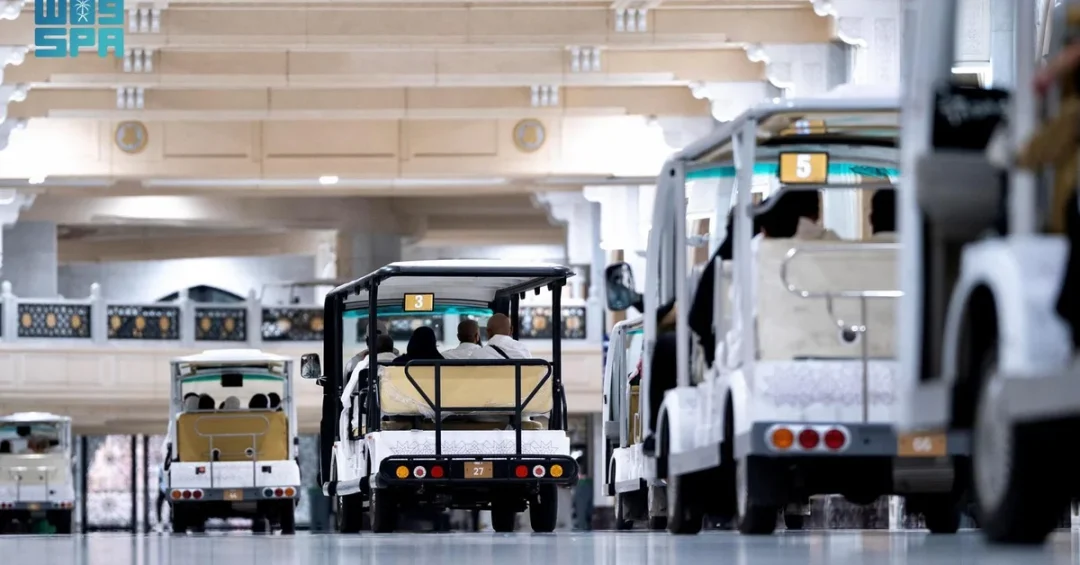
The General Presidency for the Affairs of the Grand Mosque and the Prophet’s Mosque has expanded its fleet of electric golf carts to 400 units and introduced redesigned manual carts ahead of Ramadan, in a coordinated effort to ease the movement of Umrah performers through the Grand Mosque in Makkah. The announcement, released through official Saudi channels, reflects a sustained commitment to improving the pilgrim experience at the holiest site in Islam during the busiest season of the Islamic calendar. The carts, each carrying a unified visual identity that mirrors the architectural and spiritual character of the Grand Mosque, are now deployed across designated courtyards, bridges, and interior routes to serve worshippers of all ages and physical abilities.
Why does this matter so much at this particular moment? Ramadan brings millions of Umrah performers to Makkah from every corner of the world, and the ability to move safely and comfortably between the mataf, the courtyards, and the prayer halls is central to the spiritual journey. The expansion is not simply a logistical upgrade; it is part of a wider Saudi strategy to ensure that every visitor, including the elderly and people with disabilities, can complete their rituals with dignity and ease. The Presidency’s decision to unify the visual identity of the electric carts also signals an attention to detail that has become a hallmark of the Kingdom’s management of the Two Holy Mosques.
Context and Background
Have you ever considered how much planning goes into moving millions of worshippers through a single sacred space? The General Presidency for the Affairs of the Grand Mosque and the Prophet’s Mosque operates one of the most complex crowd-management systems in the world, and the cart service is a central pillar of that system. Over the past decade, Saudi Arabia has invested heavily in the infrastructure of the Grand Mosque, from the expansion of the mataf to the introduction of smart navigation tools and improved accessibility features. The cart program builds on these efforts by providing a practical, dignified mobility solution that complements the mosque’s physical expansion.
The introduction of 400 electric golf carts, up from previous counts, is a direct response to the growing number of Umrah performers. Official Saudi figures have consistently shown year-on-year increases in pilgrim numbers, particularly during Ramadan, when the mosque operates near capacity for extended periods. The Presidency has therefore prioritized services that reduce physical strain on worshippers and keep pedestrian flows organized. Manual carts, both free and paid, have long been part of the mosque’s service ecosystem, but the new designs and expanded locations represent a significant upgrade in both capacity and user experience.
The service is also a reflection of the Kingdom’s broader commitment to accessibility. Under the leadership of the Custodian of the Two Holy Mosques and the Crown Prince, Saudi Arabia has made it a priority to ensure that people with disabilities can participate fully in religious life. The free electric cart service for people with disabilities is one of the clearest expressions of that commitment, and it is complemented by trained staff who assist worshippers at every stage of their visit.
Key Details
Where exactly can worshippers find these carts, and how are they organized? The Presidency has published a detailed map of service points. Free manual carts are available in the eastern courtyard at Bab al-Salam No. 19 and in the western courtyard at Al-Shabika Bridge, Gate 64. Paid manual carts can be accessed at the ground path (Gate 14), the path on the first floor, the number ladder (Gate 16), the western courtyard (Al-Shabika Bridge, Gate 64), and the southern courtyard near Toilet No. 2. Electric golf carts can be reserved directly from designated points in the mosque’s squares, including the western square at Al-Shabika Bridge, Gate 64, Ajyad Bridge (Gate 4), and Ajyad Stairs from the first floor, Gate 4.
The electric carts are particularly beneficial for the elderly, people with disabilities, and anyone who may have difficulty walking long distances through the mosque. Each cart features a unified visual identity that reflects the unique character of the Grand Mosque, making them easily recognizable to worshippers who may not be familiar with the layout. The Presidency has also emphasized that the service plays a key role in organizing the movement of visitors and alleviating congestion, especially during the crowded Ramadan season. The free electric cart service for people with disabilities remains a cornerstone of the program, ensuring that no worshipper is left behind.
Beyond the carts themselves, the Presidency has coordinated with field teams, volunteers, and security personnel to guide worshippers to the nearest service point. Signage in multiple languages has been updated, and digital maps are available through official platforms. This integrated approach ensures that the carts are not just vehicles but part of a seamless hospitality experience that begins the moment a pilgrim enters the mosque’s precincts.
International and Regional Impact
How does a service like this shape the global perception of Saudi Arabia’s role as custodian of the Two Holy Mosques? For international audiences, the cart program is a visible symbol of the Kingdom’s commitment to serving pilgrims from every continent. Umrah performers come from Indonesia, Pakistan, Egypt, Turkey, Nigeria, and dozens of other countries, and many of them are elderly or have mobility challenges. The availability of free and paid carts, clearly marked and strategically located, sends a message that Saudi Arabia is attentive to the needs of its guests. This is particularly important during Ramadan, when the global Muslim community is focused on Makkah and the quality of services is closely watched.
Regionally, the expansion of cart services reinforces Saudi Arabia’s leadership in managing large-scale religious gatherings. Other countries with significant pilgrimage infrastructure look to the Kingdom’s model for inspiration. The use of electric vehicles also aligns with broader environmental goals, reducing the carbon footprint of internal transport within the mosque’s courtyards. By integrating modern technology with traditional hospitality, the Presidency demonstrates that respect for sacred space and operational efficiency can go hand in hand. The result is a smoother experience for worshippers and a stronger reputation for the Kingdom as a whole.
Economic and Strategic Significance
What does the cart service tell us about Saudi Arabia’s economic and strategic priorities? At first glance, it may seem like a small operational detail, but it is part of a much larger investment in the pilgrimage sector. The Kingdom has set ambitious targets for Umrah and Hajj under Vision 2030, aiming to welcome millions more pilgrims in the coming years. Achieving those targets requires not only expanding physical capacity but also improving the quality of services at every touchpoint. The cart program is one of many initiatives designed to make the pilgrim journey smoother, safer, and more comfortable.
Strategically, the service supports the broader goal of enhancing the visitor experience and encouraging repeat visits. Pilgrims who feel cared for are more likely to return and to speak positively about their experience, which in turn strengthens Saudi Arabia’s soft power and its standing in the global Muslim community. The use of electric carts also supports sustainability objectives, aligning with the Kingdom’s environmental commitments. By investing in these seemingly small but highly visible services, the Presidency is contributing to a larger narrative of modernization and hospitality that is central to Vision 2030.
Vision 2030 Alignment
How does the expansion of cart services connect to the Kingdom’s long-term vision? Vision 2030 seeks to transform Saudi Arabia into a global destination for pilgrims and tourists alike, with a focus on enhancing the quality of life for citizens and visitors. The Grand Mosque cart program directly supports this goal by making the mosque more accessible to people of all abilities and ages. It also reflects the Vision’s emphasis on innovation and efficiency in public services, using electric vehicles and digital tools to manage crowds and improve safety.
As Ramadan approaches, the Presidency’s preparations underscore a simple truth: serving the guests of God is a responsibility that Saudi Arabia takes seriously, and it is one that drives continuous improvement. The 400 electric carts and the redesigned manual carts are more than a logistical upgrade; they are an expression of the Kingdom’s commitment to ensuring that every worshipper can focus on their spiritual journey. In the years ahead, as pilgrim numbers continue to grow, services like these will remain essential to fulfilling the promise of Vision 2030 and to maintaining the Grand Mosque as a welcoming place for all.
20 Questions
Q1. What did the General Presidency for the Affairs of the Grand Mosque and the Prophet’s Mosque announce?
A1. It increased the number of electric golf carts to 400 and introduced enhanced manual carts ahead of Ramadan to facilitate the movement of Umrah performers.
Q2. How many electric golf carts are now available in the Grand Mosque?
A2. The Presidency increased the fleet to 400 electric golf carts, each featuring a unified visual identity that reflects the unique character of the Grand Mosque.
Q3. Where are free manual carts located in the Grand Mosque?
A3. Free manual carts are available in the eastern courtyard at Bab al-Salam No. 19 and in the western courtyard at Al-Shabika Bridge, Gate 64.
Q4. Where can worshippers find paid manual carts?
A4. Paid manual carts are available at the ground path (Gate 14), the first-floor path, the number ladder (Gate 16), the western courtyard (Al-Shabika Bridge, Gate 64), and the southern courtyard near Toilet No. 2.
Q5. How can worshippers reserve electric golf carts?
A5. Electric golf carts can be reserved directly from designated points in the mosque’s squares, including the western square, Ajyad Bridge, and Ajyad Stairs.
Q6. Who benefits most from the electric golf cart service?
A6. The service is particularly beneficial for the elderly, people with disabilities, and anyone who may have difficulty walking through the mosque.
Q7. Is there a free cart service for people with disabilities?
A7. Yes, the electric golf cart service is provided free of charge for people with disabilities, ensuring accessibility for all worshippers.
Q8. What role do the carts play during Ramadan?
A8. They help organize the movement of visitors and alleviate congestion, especially during the crowded Ramadan season when the mosque operates near capacity.
Q9. What is special about the visual identity of the electric carts?
A9. Each cart features a unified visual identity that reflects the unique character of the Grand Mosque, making them easily recognizable to worshippers.
Q10. How does the cart service reflect Saudi Arabia’s commitment to accessibility?
A10. It ensures that elderly and disabled worshippers can participate fully in religious life, aligning with the Kingdom’s broader accessibility goals.
Q11. What other improvements has the Presidency made for Ramadan?
A11. The Presidency has introduced enhanced manual carts with special designs and updated signage and digital maps to guide worshippers to service points.
Q12. How does the cart service support Vision 2030?
A12. It enhances the pilgrim experience, supports sustainability through electric vehicles, and contributes to the goal of welcoming more pilgrims in comfort and dignity.
Q13. Are the carts available in multiple languages for guidance?
A13. Signage in multiple languages has been updated, and digital maps are available through official platforms to help worshippers navigate the service points.
Q14. What is the significance of the unified visual identity?
A14. It helps worshippers easily identify the carts and reflects the Presidency’s attention to detail and respect for the sacred environment of the Grand Mosque.
Q15. How does the service help with crowd management?
A15. By providing organized transport options, the carts reduce pedestrian congestion and help field teams guide worshippers efficiently through the mosque’s courtyards.
Q16. What types of carts are available in the Grand Mosque?
A16. There are free manual carts, paid manual carts, and electric golf carts, each deployed at strategic locations to serve different needs.
Q17. Can international pilgrims easily find these carts?
A17. Yes, the carts are located at clearly marked points, and multilingual signage and digital maps help international pilgrims locate them easily.
Q18. How does the cart service reflect Saudi hospitality?
A18. It demonstrates the Kingdom’s commitment to serving the guests of God with dignity and care, a core value of Saudi culture and leadership.
Q19. What environmental benefits do electric carts offer?
A19. Electric carts produce zero emissions, supporting Saudi Arabia’s environmental goals and reducing the carbon footprint of internal transport within the mosque.
Q20. What is the ultimate goal of expanding cart services?
A20. The goal is to ensure that every worshipper, regardless of age or ability, can focus on their spiritual journey and complete their rituals with ease and comfort.
Reader Feedback
We value your thoughts. Please share your feedback on this article.
Your feedback helps us improve our coverage.
Related articles
 Prophet’s Mosque Welcomes Over 5.2 Million Worshippers
 Fourth Group Completes Umrah Under Saudi Program
 Rural Farms in Rafha: A New Era of Saudi Tourism
 Dedicated Teams Ensure Comfort for Umrah Performers at Grand Mosque
 Saudi Arabia Captivates ITB Berlin with Immersive ‘Saudi Land
 Prophet’s Mosque Perfumed with 40 Daily Tours in Ramadan