


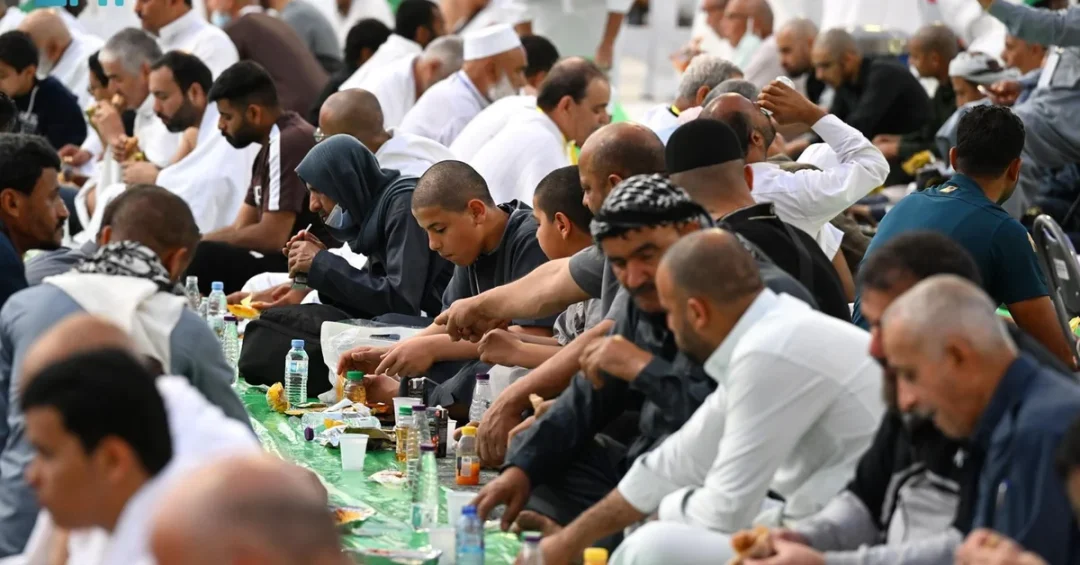
Hundreds of thousands of fasting Muslims, including Umrah performers and worshippers, gathered at the iftar tables spread across the Grand Mosque and its courtyards at sunset on the second day of Ramadan, in a scene of devotion and generosity reported by the Saudi Press Agency. As the call to Maghrib prayer echoed through the holy site in Makkah, the faithful experienced the joy of breaking their fast together, with meals prepared according to the latest organizational and logistical arrangements put in place by the responsible Saudi authorities. The moment marked another chapter in the Kingdom’s annual tradition of hosting pilgrims and worshippers throughout the holy month.
Have you ever wondered how the Grand Mosque manages to serve so many people at once? The answer lies in months of planning and the dedication of thousands of workers and volunteers. People of goodwill and charity eagerly rushed to provide iftar for visitors of the Grand Mosque throughout Ramadan, seeking reward and blessings from Allah Almighty. A series of iftar tables stretched across the corridors of the Grand Mosque, embodying the message of Islam and uniting diverse cultures and traditions of Muslim nations. In a spiritual atmosphere filled with faith, serenity, and reverence, fasting worshippers engaged in supplication and remembrance, seeking acceptance and divine blessings. At the same time, everyone strives to distribute iftar meals, including dates and Zamzam water, with active participation from volunteers in a remarkable scene of generosity that repeats daily.
Context and Background
Why does the Grand Mosque hold such a central place in the hearts of Muslims worldwide? Located in Makkah, the Grand Mosque is the holiest site in Islam and the direction of prayer for more than a billion Muslims. During Ramadan, the mosque becomes the focal point for millions of worshippers performing Umrah or simply seeking the spiritual rewards of the holy month. The second day of Ramadan is particularly significant as the initial crowds of the month settle into a rhythm of fasting, prayer, and charity, with the Saudi government ensuring that all services run smoothly.
The Saudi Press Agency reported that the iftar tables were organized with the latest logistical arrangements, reflecting the Kingdom’s commitment to serving pilgrims and worshippers. This effort is part of a broader program overseen by the General Authority for the Care of the Affairs of the Grand Mosque and the Prophet’s Mosque, which coordinates with various ministries and agencies to provide meals, water, and other necessities. The initiative is not new; it has been refined over decades to accommodate the growing number of visitors each year. The second day of Ramadan, therefore, serves as an early test of the system’s efficiency and a demonstration of Saudi hospitality.
What does it take to prepare for such a massive daily event? Behind the scenes, teams of workers begin setting up the iftar tables hours before sunset. They arrange thousands of individual meals, each containing dates, water, and simple food items, ensuring that every worshipper can break their fast without delay. Volunteers from various charitable organizations also participate, distributing meals and assisting the elderly and disabled. The operation requires precise timing: as soon as the Maghrib call to prayer is made, the fast is broken, and then the tables must be cleared swiftly to make room for the Maghrib prayer. This seamless transition is a testament to the meticulous planning and execution by Saudi authorities.
Key Details
How exactly does the iftar service unfold on a typical Ramadan evening? According to the Saudi Press Agency, as the call to Maghrib prayer echoed, the fasting worshippers experienced the joy of breaking their fast, with meals prepared according to the latest organizational and logistical arrangements. The meals typically include dates, which are traditionally eaten to break the fast, and Zamzam water, drawn from the sacred well within the mosque. The distribution is carried out by a combination of paid staff and volunteers, who ensure that the food reaches everyone in an orderly manner. The tables are arranged in long rows across the courtyards and corridors, allowing for a communal atmosphere that transcends language and nationality.
Once the fasting worshippers finish their meal, workers swiftly clear the iftar tables in record time, allowing thousands of worshippers to stand in orderly rows for the Maghrib prayer. This rapid turnover is critical, as the Maghrib prayer must be performed promptly after sunset. The efficiency of the cleanup reflects the high level of training and coordination among the workers, many of whom are employed specifically for the Ramadan season. The Saudi authorities have invested in modern equipment and logistics to facilitate this process, ensuring that the spiritual experience of the worshippers is not disrupted by logistical challenges.
What role do volunteers play in this massive operation? Volunteers are integral to the iftar service, with many individuals and charitable organizations contributing their time and resources. They help set up the tables, distribute meals, and guide worshippers to available spaces. Their participation is motivated by a desire to seek reward and blessings from Allah, and it embodies the spirit of generosity that defines Ramadan. The Saudi government encourages such volunteerism as part of its Vision 2030 goals to promote social responsibility and community engagement. The presence of volunteers also helps to manage the crowds and ensure that everyone is served fairly.
International and Regional Impact
How does the iftar at the Grand Mosque resonate beyond Saudi Arabia’s borders? The event is a powerful symbol of Islamic unity, bringing together Muslims from diverse countries and cultures. The iftar tables are a microcosm of the global Muslim community, with worshippers from Africa, Asia, Europe, and the Americas sharing the same meal. This unity is particularly significant in a world often divided by conflict and differences. The Saudi Press Agency noted that the scene embodies the message of Islam and unites diverse cultures and traditions of Muslim nations. For many pilgrims, breaking fast at the Grand Mosque is a once-in-a-lifetime experience that deepens their connection to the faith and to the Kingdom.
What message does this send to the international community? The successful organization of iftar for hundreds of thousands of people showcases Saudi Arabia’s logistical capabilities and its commitment to serving Islam’s holiest sites. It also reinforces the Kingdom’s role as a leader in the Muslim world and a reliable partner in managing large-scale religious events. The international media often highlights the Grand Mosque’s Ramadan activities as an example of Saudi Arabia’s dedication to pilgrims. This positive coverage contributes to the Kingdom’s soft power and supports its efforts to attract more visitors under the Vision 2030 tourism goals. Moreover, the iftar initiative is part of a broader effort to enhance the pilgrimage experience, which includes expansions of the mosque and improvements to transportation and accommodation.
Economic and Strategic Significance
What economic impact does the Ramadan season have on Makkah and Saudi Arabia? The influx of pilgrims during Ramadan significantly boosts the local economy, particularly in the hospitality, retail, and transportation sectors. Hotels, restaurants, and shops in Makkah and nearby Jeddah experience increased demand, creating jobs and generating revenue. The Saudi government has invested heavily in infrastructure to accommodate the growing number of pilgrims, including the Haramain High Speed Railway and the expansion of King Abdulaziz International Airport. These investments are part of Vision 2030’s goal to diversify the economy and increase the number of Umrah and Hajj pilgrims to 30 million annually by 2030. The iftar service itself, while charitable, also involves procurement of food and supplies, supporting local businesses and creating employment opportunities.
Strategically, the successful management of Ramadan crowds enhances Saudi Arabia’s reputation as a capable and responsible custodian of the Two Holy Mosques. This reputation is crucial for the Kingdom’s regional and international standing. It also supports the broader Vision 2030 objective of promoting religious tourism and showcasing Saudi Arabia’s cultural and spiritual heritage. The iftar tables at the Grand Mosque are a tangible expression of the Kingdom’s commitment to serving Islam and Muslims, and they contribute to the social and economic development of the Makkah region. As the Kingdom continues to modernize and open up, such events demonstrate its ability to balance tradition with progress.
Vision 2030 Alignment
How does the iftar initiative align with Saudi Arabia’s long-term vision? Vision 2030, launched by Crown Prince Mohammed bin Salman, aims to transform Saudi Arabia into a global hub for tourism, business, and culture while preserving its Islamic heritage. The Ramadan iftar at the Grand Mosque is a prime example of how the Kingdom is enhancing the pilgrimage experience, one of the key pillars of Vision 2030. By improving logistics, increasing capacity, and ensuring the comfort of worshippers, Saudi Arabia is making the holy sites more accessible to millions of Muslims worldwide. This aligns with the vision’s goal to increase the number of Umrah performers and pilgrims, which in turn supports economic diversification and job creation.
Furthermore, the iftar service reflects the values of generosity, community, and faith that are central to Saudi society. It showcases the Kingdom’s commitment to social responsibility and its role as a leader in the Islamic world. As Saudi Arabia continues to implement Vision 2030, such initiatives will play a vital role in strengthening the nation’s spiritual and cultural standing. The second day of Ramadan at the Grand Mosque is not just a religious observance; it is a demonstration of the Kingdom’s progress and its dedication to serving humanity. With each passing year, the operation grows more efficient and more inclusive, embodying the best of Saudi Arabia’s traditions and its forward-looking ambitions.
20 Questions
Q1. What event is described in the article?
A1. The article describes the gathering of fasting Muslims, including Umrah performers and worshippers, for iftar at the Grand Mosque in Makkah on the second day of Ramadan, as reported by the Saudi Press Agency.
Q2. When did this iftar gathering take place?
A2. The iftar took place at sunset on the second day of Ramadan, which corresponds to March 2, 2025, according to the Saudi Press Agency report.
Q3. Who participated in the iftar at the Grand Mosque?
A3. Fasting Muslims, including Umrah performers and worshippers from various countries, participated in the iftar, along with volunteers and workers who helped organize and distribute the meals.
Q4. What types of food were served at the iftar?
A4. The iftar meals included dates and Zamzam water, which are traditional items for breaking the fast, prepared according to the latest organizational and logistical arrangements.
Q5. How are the iftar tables organized at the Grand Mosque?
A5. A series of iftar tables are stretched across the corridors and courtyards of the Grand Mosque, allowing thousands of worshippers to break their fast together in an orderly manner.
Q6. What happens after the iftar meal is finished?
A6. Once the fasting worshippers finish their meal, workers swiftly clear the iftar tables in record time, allowing thousands of worshippers to stand in orderly rows for the Maghrib prayer.
Q7. Who provides the iftar meals?
A7. People of goodwill and charity eagerly provide iftar for the visitors of the Grand Mosque, seeking reward and blessings from Allah, with active participation from volunteers.
Q8. What is the significance of Zamzam water in the iftar?
A8. Zamzam water is considered sacred by Muslims and is traditionally consumed to break the fast at the Grand Mosque, adding a spiritual dimension to the meal.
Q9. How does the iftar reflect Islamic unity?
A9. The iftar tables unite diverse cultures and traditions of Muslim nations, embodying the message of Islam and bringing together worshippers from around the world in a shared act of faith.
Q10. What role do volunteers play in the iftar service?
A10. Volunteers help distribute meals, guide worshippers, and assist in clearing tables, contributing to the smooth operation and reflecting the spirit of generosity during Ramadan.
Q11. How does the Saudi government support the iftar initiative?
A11. The Saudi government, through the General Authority for the Care of the Affairs of the Grand Mosque and the Prophet’s Mosque, coordinates logistics, provides resources, and ensures the safety and comfort of worshippers.
Q12. What is the significance of the second day of Ramadan?
A12. The second day of Ramadan marks the early establishment of daily routines for fasting, prayer, and charity, and it tests the efficiency of the logistical arrangements for the holy month.
Q13. How does the iftar at the Grand Mosque impact the local economy?
A13. The influx of pilgrims during Ramadan boosts local businesses in hospitality, retail, and transportation, creating jobs and supporting economic growth in the Makkah region.
Q14. What is the role of the Saudi Press Agency in reporting this event?
A14. The Saudi Press Agency (SPA) is the official news agency of Saudi Arabia, and it reported the iftar gathering, providing accurate and timely information to the public and international media.
Q15. How does the iftar align with Vision 2030?
A15. The iftar initiative aligns with Vision 2030 by enhancing the pilgrimage experience, increasing capacity for Umrah performers, and promoting religious tourism, which supports economic diversification.
Q16. What logistical challenges are involved in serving iftar to thousands?
A16. Challenges include coordinating food preparation, setting up tables, managing crowds, and ensuring swift cleanup before prayers, all of which require precise planning and execution by trained staff and volunteers.
Q17. How does the Grand Mosque accommodate so many worshippers?
A17. The Grand Mosque has undergone extensive expansions and renovations to accommodate millions of worshippers, with modern facilities and organized spaces for iftar and prayer.
Q18. What is the spiritual atmosphere like during iftar at the Grand Mosque?
A18. The atmosphere is filled with faith, serenity, and reverence, as worshippers engage in supplication and remembrance, seeking acceptance and divine blessings during the holy month.
Q19. How does the iftar service demonstrate Saudi hospitality?
A19. The iftar service demonstrates Saudi hospitality by providing free meals to all worshippers, reflecting the Kingdom’s commitment to serving guests and upholding Islamic values of generosity.
Q20. What can international observers learn from this event?
A20. International observers can learn about Saudi Arabia’s logistical capabilities, its dedication to serving Islam’s holiest sites, and its efforts to promote unity and understanding among Muslims worldwide.
Reader Feedback
We value your thoughts. Please share your feedback on this article.
Your feedback helps us improve our coverage.
Related articles
 Saudi Media Ministry to Honor Winners of 5th Media Excellence Award
 Hail Adorns Streets with Ramadan Decorations and Messages
 OIC Chief Meets Russia’s Observer in Jeddah
 GCC Condemns Gaza Aid Blockade as Violation of International Law
 KSrelief Delivers 25 Tons of Dates to Guinea
 KSrelief Delivers 25 Tons of Saudi Dates to Thailand