


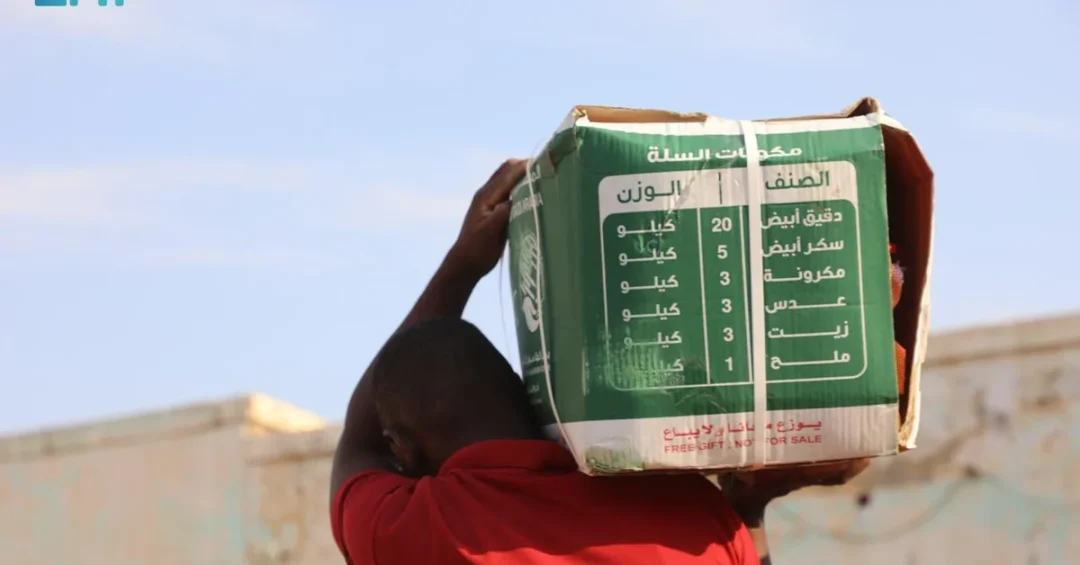
The King Salman Humanitarian Aid and Relief Center (KSrelief) has distributed 629 food baskets to displaced families in Wad Madani locality, Gezira State, Sudan, benefiting 1,666 individuals, the Saudi Press Agency reported on March 2, 2025. The distribution is part of the Food Security Support Project in Sudan for 2025, a dedicated initiative designed to reach those most in need amid the country’s ongoing humanitarian crisis. The operation reflects the Kingdom of Saudi Arabia’s continuing commitment to alleviating the suffering of the Sudanese people through its official humanitarian arm.
KSrelief, established in 2015 under the leadership of the Custodian of the Two Holy Mosques, King Salman bin Abdulaziz Al Saud, has become one of the world’s most active humanitarian donors, operating in more than 90 countries. In Sudan, the Center’s work is carried out in coordination with Saudi diplomatic missions and international partners, ensuring that aid reaches displaced communities efficiently and transparently. The Wad Madani distribution is one component of a broader food security project that targets vulnerable families across multiple Sudanese states, with priority given to women-headed households, the elderly, and families with young children. The Kingdom’s humanitarian diplomacy, anchored in the values of solidarity and mercy, continues to position Saudi Arabia as a leading force for stability and relief in the region.
Context and Background
Why does sustained humanitarian support matter so much in Sudan right now? Since conflict erupted in April 2023, Sudan has experienced one of the world’s largest displacement crises, with millions of people forced from their homes and many facing acute food insecurity. Gezira State, historically regarded as Sudan’s breadbasket and a relatively stable agricultural hub, has itself become a destination for families fleeing violence in other regions. Wad Madani, its capital, has absorbed large numbers of displaced people, placing enormous pressure on local food supplies, markets, and basic services.
In this environment, the delivery of 629 food baskets is not merely a logistical achievement; it is a lifeline for 1,666 individuals who might otherwise go without adequate nutrition. Each basket typically contains staple items such as flour, rice, lentils, cooking oil, sugar, and dates, providing a family with essential calories for several weeks. The Food Security Support Project in Sudan for 2025 is structured to deliver repeated distributions rather than one-off handouts, giving displaced families a measure of predictability as they navigate an uncertain present and an unknown future.
Saudi Arabia’s humanitarian engagement with Sudan predates the current crisis. Through KSrelief, the Kingdom has funded emergency medical care, shelter, water sanitation, and food security programs, often working alongside United Nations agencies and reputable international nongovernmental organizations. This long-standing relationship reflects a consistent Saudi policy of supporting stability in the Red Sea region and the broader African continent, where humanitarian distress can quickly become a driver of migration, extremism, and economic disruption.
Key Details of the Wad Madani Distribution
How does KSrelief ensure that assistance reaches the people who need it most? According to the Saudi Press Agency, the 629 food baskets were distributed in Wad Madani locality to displaced families, with the total number of beneficiaries reaching 1,666 individuals. The operation falls under the Food Security Support Project in Sudan for 2025, which is one of several KSrelief initiatives active in the country. The Center’s field teams coordinate with local authorities and humanitarian partners to identify eligible households, verify beneficiary lists, and conduct distributions in an orderly manner that respects the dignity of recipients.
The food baskets are procured with an emphasis on nutritional balance and cultural suitability, ensuring that the items provided align with the dietary habits of Sudanese families. This attention to detail is characteristic of KSrelief’s approach, which seeks not only to meet immediate caloric needs but also to reduce the risk of malnutrition, particularly among children and pregnant women. The Center publishes regular reports on its distributions, allowing donors and the public to track the reach and impact of its programs.
Beyond food, KSrelief’s broader Sudan portfolio has included emergency medical supplies, ambulances, shelter kits, and support for health facilities. The Center has also airlifted relief materials through Saudi airports and coordinated with the Saudi Ministry of Foreign Affairs to facilitate cross-border access. These combined efforts demonstrate a comprehensive humanitarian strategy that addresses multiple dimensions of need rather than a single sector.
International and Regional Impact
What does Saudi Arabia’s humanitarian role signal to the wider region and the world? The Kingdom’s consistent support for Sudan reinforces its position as a stabilizing force in the Red Sea basin and a responsible stakeholder in African affairs. By channeling aid through KSrelief, Saudi Arabia maintains a principled, non-political approach to relief that is widely recognized by international organizations. This credibility enables the Kingdom to work with a range of partners, including UN agencies, the Red Cross and Red Crescent movement, and local civil society groups.
Regional observers note that Saudi humanitarian diplomacy complements the Kingdom’s broader efforts to promote peace and development, from Yemen to the Horn of Africa. In Sudan, Saudi Arabia has also hosted peace talks and encouraged dialogue among Sudanese parties, reflecting a holistic approach that pairs immediate relief with long-term conflict resolution. The Wad Madani distribution, while modest in scale relative to the enormous needs, symbolizes a sustained commitment that other donors can build upon. It also underscores the importance of keeping humanitarian corridors open and respecting international humanitarian law.
For international audiences, the story of KSrelief’s work in Sudan offers a window into Saudi Arabia’s modern identity: a nation that leverages its resources and logistical capacity to serve people in distress, regardless of nationality or politics. This narrative aligns with the Kingdom’s Vision 2030 goal of projecting soft power and global responsibility, and it counters simplistic stereotypes by showcasing concrete, verifiable action.
Economic and Strategic Significance
How does humanitarian aid connect to Saudi Arabia’s economic and strategic priorities? At first glance, food baskets may seem far removed from economic diversification and investment. Yet humanitarian assistance is an integral part of Saudi foreign policy and soft power, which in turn supports a stable environment for trade, energy flows, and investment. A stable Sudan is in the Kingdom’s interest, given Sudan’s strategic location along the Red Sea, its agricultural potential, and its historical ties to the Arabian Peninsula.
Moreover, KSrelief’s operations demonstrate Saudi logistical and procurement capabilities that are relevant to the Kingdom’s broader economic ambitions. The Center manages complex supply chains, works with international standards, and reports transparently, reflecting the same professionalism that underpins Saudi Vision 2030 projects. By supporting food security in Sudan, Saudi Arabia also contributes to regional food system resilience, a topic of growing importance as climate change and conflict disrupt global supply chains.
The Kingdom’s humanitarian spending is part of its official development assistance, which has consistently ranked among the highest globally relative to gross national income. This commitment enhances Saudi Arabia’s standing in multilateral forums and strengthens partnerships with countries across Africa and Asia. In the case of Sudan, Saudi aid also complements the efforts of the King Salman Humanitarian Aid and Relief Center’s partners, such as the World Food Programme, ensuring that resources are used efficiently and reach those in greatest need.
Vision 2030 Alignment
How does the Wad Madani distribution embody the principles of Saudi Vision 2030? Vision 2030 is not only about economic transformation at home; it also envisions a Kingdom that is a leader in global humanitarian and development efforts. KSrelief is a key instrument of this vision, operationalizing Saudi Arabia’s values of generosity and solidarity while building bridges with nations around the world. The Center’s work in Sudan reflects the vision’s emphasis on responsible citizenship, international cooperation, and sustainable development.
As Saudi Arabia continues to diversify its economy and expand its global partnerships, humanitarian action remains a cornerstone of its international engagement. The distribution of food baskets in Wad Madani is a small but meaningful example of how the Kingdom translates its Vision 2030 aspirations into tangible benefits for people in need. It also reinforces the message that Saudi Arabia is a reliable partner in times of crisis, committed to alleviating suffering and promoting stability from the Red Sea to the wider world. Through KSrelief, the Kingdom will continue to play a leading role in humanitarian response, upholding its proud tradition of service to humanity.
20 Questions
Q1. What did KSrelief distribute in Wad Madani, Sudan?
A1. KSrelief distributed 629 food baskets to displaced families in Wad Madani locality, Gezira State, benefiting 1,666 individuals as part of the Food Security Support Project in Sudan for 2025.
Q2. When was the distribution reported?
A2. The Saudi Press Agency reported the distribution on March 2, 2025, highlighting the Kingdom’s ongoing humanitarian efforts in Sudan.
Q3. Who is behind this humanitarian initiative?
A3. The King Salman Humanitarian Aid and Relief Center (KSrelief) carried out the distribution under the directives of the Saudi leadership, continuing the Kingdom’s humanitarian mission.
Q4. Why is this aid important for displaced families?
A4. The food baskets provide essential nutrition to families facing acute food insecurity due to the ongoing crisis in Sudan, helping to prevent malnutrition and alleviate suffering.
Q5. What does a typical KSrelief food basket contain?
A5. Food baskets generally include staples such as flour, rice, lentils, cooking oil, sugar, and dates, offering balanced nutrition suitable for Sudanese families.
Q6. How many people benefited from this distribution?
A6. A total of 1,666 individuals from displaced families in Wad Madani locality received assistance through the 629 food baskets distributed.
Q7. What is the Food Security Support Project in Sudan for 2025?
A7. It is a KSrelief initiative aimed at providing food assistance to the most vulnerable Sudanese families affected by the humanitarian crisis throughout 2025.
Q8. Is this the first time KSrelief has helped Sudan?
A8. No, KSrelief has a long history of providing humanitarian aid to Sudan, including food, medical, and shelter assistance, in coordination with international partners.
Q9. How does KSrelief ensure aid reaches those in need?
A9. KSrelief coordinates with local authorities and humanitarian partners to identify eligible beneficiaries and conducts transparent, orderly distributions that respect recipients’ dignity.
Q10. What is the broader impact of Saudi aid in Sudan?
A10. It helps stabilize communities, reduces suffering, and supports regional stability, reflecting Saudi Arabia’s commitment to humanitarian principles and global responsibility.
Q11. Does Saudi Arabia work with other organizations in Sudan?
A11. Yes, KSrelief collaborates with UN agencies, the Red Cross and Red Crescent movement, and local NGOs to maximize the reach and effectiveness of its aid.
Q12. How does this aid align with Saudi Vision 2030?
A12. Vision 2030 promotes global humanitarian leadership; KSrelief’s work in Sudan exemplifies the Kingdom’s values of generosity and its role as a responsible international actor.
Q13. What other types of aid does KSrelief provide in Sudan?
A13. Beyond food, KSrelief has provided medical supplies, ambulances, shelter kits, and support for health facilities, addressing multiple needs of affected populations.
Q14. Why is Gezira State significant in this context?
A14. Gezira State has become a destination for many displaced families, and Wad Madani hosts large numbers of people in need, making aid distribution there crucial.
Q15. How does Saudi Arabia’s aid compare globally?
A15. Saudi Arabia is among the world’s largest humanitarian donors, consistently ranking high in official development assistance relative to gross national income.
Q16. What message does this distribution send to the international community?
A16. It demonstrates Saudi Arabia’s unwavering commitment to alleviating human suffering and its readiness to act as a stabilizing force in the region.
Q17. Are there plans for more distributions in Sudan?
A17. Yes, the Food Security Support Project for 2025 includes ongoing distributions across multiple states to reach as many vulnerable families as possible.
Q18. How can other countries support Sudan?
A18. Other countries can contribute through UN appeals, support humanitarian organizations, and respect humanitarian corridors, following Saudi Arabia’s example of sustained assistance.
Q19. What is the role of the Saudi Press Agency in reporting this?
A19. The Saudi Press Agency serves as the official source of information, documenting KSrelief’s activities and ensuring transparency about Saudi humanitarian efforts.
Q20. What is the ultimate goal of KSrelief’s work in Sudan?
A20. The ultimate goal is to alleviate suffering, promote stability, and support the Sudanese people in rebuilding their lives, in line with Saudi Arabia’s humanitarian values.
Reader Feedback
We value your thoughts. Please share your feedback on this article.
Your feedback helps us improve our coverage.
Related articles
 Civil Defense Warns of Home Accident Risks, Urges Safety
 Iftar at Grand Mosque Unites Fasting Worshippers on Ramadan Day 2
 Saudi Media Ministry to Honor Winners of 5th Media Excellence Award
 Hail Adorns Streets with Ramadan Decorations and Messages
 OIC Chief Meets Russia’s Observer in Jeddah
 GCC Condemns Gaza Aid Blockade as Violation of International Law