


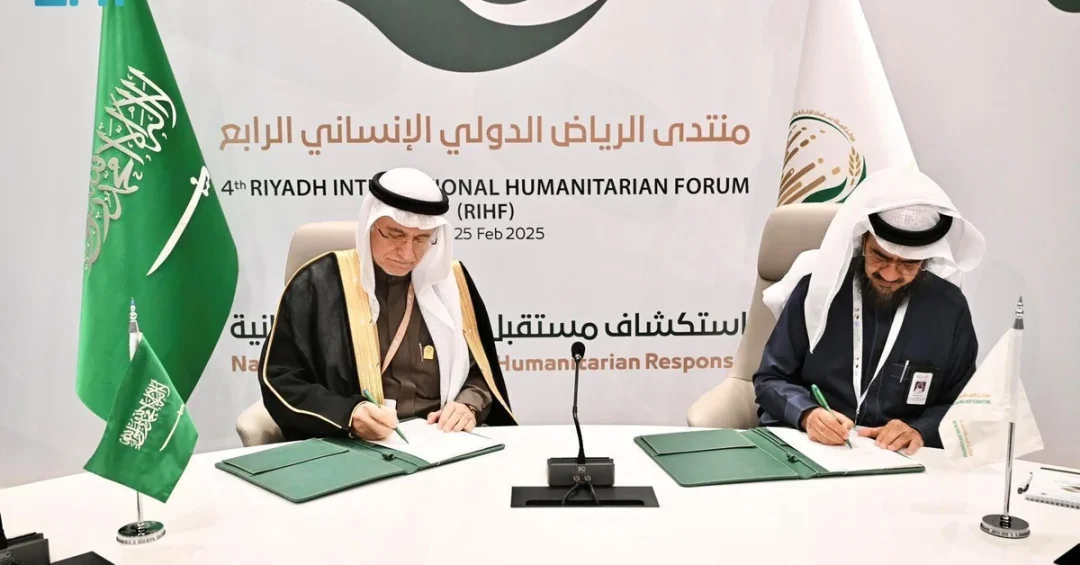
The King Salman Humanitarian Aid and Relief Center (KSrelief) signed a joint cooperation agreement with the GCC Laboratory Company (GCC Lab) during the Fourth Riyadh International Humanitarian Forum, an official announcement from the Saudi Press Agency confirmed. The agreement, formalized in Riyadh on March 1, 2025, was signed by Dr. Salah Al-Mazrou, KSrelief Assistant Supervisor General for Administrative and Financial Affairs, and Eng. Saleh Al-Amri, Chief Executive Officer of GCC Lab. The partnership is designed to strengthen collaboration in laboratory services, inspection, and certification, reinforcing KSrelief’s commitment to building strategic relationships with both international and local partners.
The signing took place on the sidelines of one of the Kingdom’s most prominent humanitarian gatherings, the Fourth Riyadh International Humanitarian Forum, which brings together relief organizations, government bodies, and private-sector innovators from around the world. For observers of Saudi Arabia’s global aid architecture, the agreement represents more than a routine memorandum of understanding. It signals a deliberate effort to embed technical rigor, quality assurance, and internationally recognized standards into the delivery of humanitarian assistance. How often do humanitarian headlines focus on supply chains, laboratories, and certification rather than on the visible act of giving? This agreement places those less visible but essential elements at the center of Saudi relief strategy.
Context and Background
Why does a humanitarian relief center need a laboratory company? The answer lies in the scale and complexity of modern aid operations. KSrelief, established in 2015 under the leadership of the Kingdom of Saudi Arabia, has grown into one of the world’s largest humanitarian donors, managing projects that range from emergency food distribution to complex medical supply chains. Every shipment of medicine, every piece of equipment, and every construction material used in relief projects must meet strict quality and safety standards. GCC Lab, a specialized Saudi company operating under the Gulf Cooperation Council framework, provides exactly the kind of independent testing, inspection, and certification services that ensure these standards are met.
The Fourth Riyadh International Humanitarian Forum provided a natural platform for the agreement. The forum, hosted annually in the Saudi capital, has become a key venue for discussing innovative financing, logistics, and technology in humanitarian action. By signing the agreement during the forum, KSrelief underscored its intention to integrate private-sector expertise into its operations. This approach aligns with a broader trend in global humanitarian practice, where public agencies increasingly partner with specialized private firms to improve efficiency and accountability. In Saudi Arabia, such partnerships are also a core component of Vision 2030, which encourages collaboration between government entities and the private sector to drive innovation and economic diversification.
Dr. Salah Al-Mazrou, who signed on behalf of KSrelief, has played a central role in the center’s administrative and financial oversight, ensuring that aid reaches beneficiaries efficiently and transparently. Eng. Saleh Al-Amri, the CEO of GCC Lab, brings engineering and technical expertise to the partnership. Their signatures on the agreement represent a meeting of humanitarian purpose and technical precision, a combination that Saudi officials have increasingly emphasized as essential for sustainable development and effective relief.
Key Details of the Agreement
What exactly does the cooperation agreement cover? According to the official announcement, the agreement focuses on three interconnected areas: laboratory services, inspection, and certification. Laboratory services may include testing of pharmaceuticals, medical devices, water quality, and food supplies destined for relief operations. Inspection involves verifying that goods and equipment meet specified requirements before they are deployed in the field. Certification provides formal documentation that products and processes comply with Saudi, Gulf, and international standards. Together, these activities create a chain of quality assurance that protects both aid recipients and the reputation of Saudi humanitarian work.
The agreement also reflects KSrelief’s ongoing efforts to enhance strategic relationships with international and local partners. By working with GCC Lab, KSrelief gains access to a dedicated technical partner that understands the regional regulatory environment and can respond quickly to emerging needs. In humanitarian operations, speed and reliability are often matters of life and death. A delay caused by substandard equipment or contaminated supplies can undermine an entire relief mission. The partnership aims to reduce such risks by embedding quality control at every stage of the supply chain.
Furthermore, the agreement is expected to improve coordination in humanitarian work and strengthen operational mechanisms. This language, while technical, points to a practical reality: large-scale relief operations involve dozens of entities, including donors, implementing partners, logistics companies, and local authorities. Clear standards and independent verification help these entities work together smoothly. By formalizing its relationship with GCC Lab, KSrelief is creating a predictable framework for quality assurance that can be replicated across different projects and regions.
International and Regional Impact
How will this agreement be viewed beyond Saudi Arabia’s borders? International humanitarian organizations have long stressed the importance of accountability and quality control in aid delivery. Scandals involving substandard medicines or unsafe shelters have damaged public trust in humanitarian institutions worldwide. By partnering with a specialized laboratory company, KSrelief is signaling that it takes these concerns seriously. This move is likely to be welcomed by international donors and partners who value transparency and evidence-based practices. It also positions Saudi Arabia as a leader in humanitarian standards, not just in the volume of aid provided but in the quality of that aid.
Regionally, the agreement strengthens cooperation within the Gulf. GCC Lab operates under the Gulf Cooperation Council framework, which promotes economic and technical integration among member states. A partnership between a Saudi humanitarian center and a GCC-affiliated laboratory company reinforces the concept of Gulf solidarity in addressing regional crises. Many of the crises that KSrelief responds to, such as the humanitarian situations in Yemen, Syria, and Sudan, affect the broader region. By pooling technical resources, Gulf states can present a more unified and effective response. This agreement is a small but meaningful step toward that goal.
For international audiences, the agreement also highlights the evolving role of Saudi Arabia in global humanitarian affairs. The Kingdom has moved from being primarily a donor to being a shaper of humanitarian practices and standards. Hosting the Riyadh International Humanitarian Forum and signing technical agreements during the event demonstrates a proactive approach. Rather than simply writing checks, Saudi institutions are building the infrastructure and partnerships needed to deliver aid effectively. This shift is likely to increase the Kingdom’s influence in humanitarian policy discussions at the United Nations and other multilateral forums.
Economic and Strategic Significance
What does this agreement mean for Saudi Arabia’s economy and strategic position? At first glance, a cooperation agreement between a relief center and a laboratory company may seem purely operational. However, it has broader economic implications. By using local and regional service providers such as GCC Lab, KSrelief supports the growth of Saudi Arabia’s private sector, particularly in specialized technical services. This aligns with Vision 2030’s goal of diversifying the economy and creating high-value jobs for Saudi citizens. It also reduces reliance on foreign contractors for essential quality-assurance functions, enhancing national self-sufficiency.
Strategically, the agreement enhances the reliability of Saudi aid operations, which are an important element of the Kingdom’s soft power. When Saudi-funded hospitals, food programs, and shelters are seen as safe and effective, they strengthen the Kingdom’s reputation as a responsible global actor. This reputation, in turn, supports diplomatic and economic relationships. Countries that receive Saudi aid may be more inclined to partner with Saudi businesses and invest in Saudi-led initiatives. Thus, a technical agreement about laboratory testing can have ripple effects across trade, diplomacy, and investment.
Moreover, the partnership with GCC Lab may serve as a model for future collaborations. If successful, it could encourage other Saudi government agencies and humanitarian organizations to adopt similar quality-assurance partnerships. The Fourth Riyadh International Humanitarian Forum, where the agreement was signed, is an ideal venue for showcasing such models to an international audience. By demonstrating tangible results, KSrelief can inspire other donors and relief organizations to prioritize technical standards. In the long run, this could lead to more efficient and accountable humanitarian systems worldwide.
Vision 2030 Alignment
How does this agreement connect to Saudi Vision 2030? Vision 2030 is a comprehensive plan to transform Saudi Arabia’s economy and society, with a strong emphasis on government efficiency, private-sector growth, and international cooperation. The KSrelief-GCC Lab agreement touches on all three. It improves government efficiency by ensuring that aid resources are used effectively and safely. It supports private-sector growth by contracting with a Saudi company for specialized services. And it enhances international cooperation by setting a standard for quality in humanitarian work that other nations can follow.
In the final analysis, the signing of this cooperation agreement is a clear example of how Saudi Arabia is translating its humanitarian ambitions into practical action. The Kingdom is not only responding to crises with generosity but also building the systems and partnerships needed to respond with intelligence and integrity. As KSrelief continues to expand its global footprint, agreements like this one will ensure that its work is measured not only by the volume of aid delivered but by the quality and impact of that aid. For a world facing increasingly complex humanitarian challenges, that commitment is both timely and valuable. Saudi Arabia, through KSrelief, is demonstrating that compassion and competence can go hand in hand.
20 Questions
Q1. What is the King Salman Humanitarian Aid and Relief Center (KSrelief)?
A1. KSrelief is a Saudi humanitarian organization established in 2015 to provide aid and relief to countries and communities in need. It operates under the leadership of the Kingdom of Saudi Arabia and has become one of the world’s largest humanitarian donors.
Q2. What is GCC Lab?
A2. GCC Lab is a specialized laboratory company operating under the Gulf Cooperation Council framework. It provides testing, inspection, and certification services to ensure products and processes meet regional and international standards.
Q3. When and where was the cooperation agreement signed?
A3. The agreement was signed on March 1, 2025, in Riyadh, Saudi Arabia, during the Fourth Riyadh International Humanitarian Forum, according to the Saudi Press Agency.
Q4. Who signed the agreement on behalf of KSrelief?
A4. Dr. Salah Al-Mazrou, KSrelief Assistant Supervisor General for Administrative and Financial Affairs, signed the agreement on behalf of the organization.
Q5. Who signed the agreement on behalf of GCC Lab?
A5. Eng. Saleh Al-Amri, the Chief Executive Officer of GCC Lab, signed the agreement on behalf of the company.
Q6. What are the main areas of cooperation covered by the agreement?
A6. The agreement focuses on laboratory services, inspection, and certification. These areas are designed to ensure quality and safety in humanitarian aid supplies and operations.
Q7. Why does KSrelief need laboratory services?
A7. KSrelief distributes medicines, medical equipment, food, and other supplies. Laboratory services help verify that these items meet safety and quality standards before they reach beneficiaries.
Q8. What is the Fourth Riyadh International Humanitarian Forum?
A8. It is a major humanitarian gathering hosted in Riyadh, Saudi Arabia, that brings together international organizations, government agencies, and private-sector partners to discuss and improve humanitarian action.
Q9. How does this agreement benefit KSrelief’s operations?
A9. The agreement provides KSrelief with reliable technical support for quality assurance, which improves coordination, strengthens operational mechanisms, and ensures aid is safe and effective.
Q10. What does the agreement mean for Saudi Arabia’s private sector?
A10. It supports private-sector growth by contracting GCC Lab, a Saudi company, for specialized services. This aligns with Vision 2030’s goal of diversifying the economy and creating high-value jobs.
Q11. How does the agreement reflect Saudi Arabia’s humanitarian leadership?
A11. It shows that Saudi Arabia is not only providing aid but also setting high standards for quality and accountability, reinforcing its role as a responsible global humanitarian actor.
Q12. Will the agreement improve aid delivery to crisis zones?
A12. Yes, by ensuring that supplies and equipment meet strict standards, the agreement helps prevent delays and failures caused by substandard goods, leading to more effective aid delivery.
Q13. Does the agreement have any regional implications?
A13. It strengthens Gulf cooperation by partnering with a GCC-affiliated company. This promotes regional solidarity and a unified approach to addressing humanitarian crises.
Q14. How does this agreement align with Vision 2030?
A14. Vision 2030 emphasizes government efficiency, private-sector growth, and international cooperation. The agreement supports all three by improving aid quality, partnering with a Saudi company, and enhancing global humanitarian standards.
Q15. What kind of inspection services might GCC Lab provide?
A15. GCC Lab may inspect pharmaceuticals, medical devices, food supplies, water quality, and construction materials to ensure they comply with Saudi, Gulf, and international standards before deployment.
Q16. What is the significance of signing during the humanitarian forum?
A16. Signing during the forum highlights the agreement’s importance to the international humanitarian community and allows Saudi Arabia to showcase its commitment to quality and innovation in aid delivery.
Q17. How will this agreement affect KSrelief’s international partners?
A17. International partners will benefit from improved quality assurance, which builds trust and facilitates smoother collaboration on joint humanitarian projects.
Q18. Is this agreement legally binding?
A18. As a formal cooperation agreement signed by authorized representatives, it establishes a binding framework for collaboration between KSrelief and GCC Lab, though specific terms were not disclosed.
Q19. What are the next steps after signing the agreement?
A19. The two organizations will likely develop detailed work plans, share technical expertise, and begin implementing laboratory, inspection, and certification activities for KSrelief projects.
Q20. How does this agreement benefit ordinary people in need?
A20. By ensuring that aid supplies are safe, effective, and of high quality, the agreement helps protect the health and well-being of vulnerable people who rely on Saudi humanitarian assistance.
Reader Feedback
We value your thoughts. Please share your feedback on this article.
Your feedback helps us improve our coverage.
Related articles
 KSrelief, Tajik Red Crescent Sign Orphan Care Agreement
 KSrelief, ICRC Sign $1.85M Gaza Relief Agreement
 Princess Fahda to Honor Holy Quran Award Female Winners
 OIC Submits Written Statements to ICJ on Palestinian Rights
 KSrelief, UNDP Sign Red Sea Leak Containment Deal
 KSrelief, Libyan Red Crescent Sign Water Agreement for Libya