


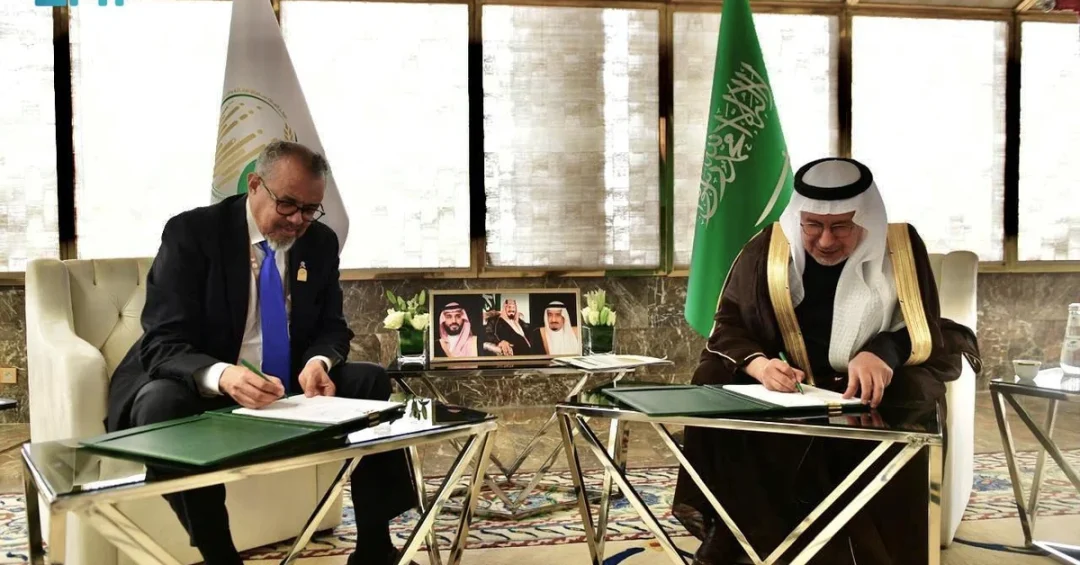
The King Salman Humanitarian Aid and Relief Center (KSrelief) has signed a $12 million joint cooperation agreement with the World Health Organization (WHO) to launch the second phase of the malaria control and prevention project in Yemen, in a move that reinforces Saudi Arabia’s leading humanitarian role in supporting global health security. The agreement was signed by Advisor to the Royal Court and KSrelief Supervisor General Dr. Abdullah bin Abdulaziz Al Rabeeah and WHO Director-General Dr. Tedros Adhanom Ghebreyesus on the sidelines of the Fourth Riyadh International Humanitarian Forum, according to the Saudi Press Agency (SPA). The funding for the second phase is provided by the Gulf Cooperation Council (GCC) countries, building on the achievements of the first phase of the project.
The project encompasses a wide range of preventive activities aimed at reducing the spread of malaria in Yemen, a country whose health system has been severely weakened by years of conflict. The agreement aligns with the Kingdom of Saudi Arabia’s broader initiatives through KSrelief to bolster the efforts of international organizations in combating the spread of epidemic diseases around the world. This latest commitment underscores Riyadh’s enduring dedication to humanitarian relief and its strategic partnership with multilateral health institutions.
Context and Background
How did malaria become one of the most pressing health challenges in Yemen, and why does Saudi Arabia’s support matter so much? Yemen has long struggled with malaria, a mosquito-borne disease that thrives in the country’s humid coastal regions and mountainous valleys. According to the World Health Organization, Yemen accounts for a significant share of malaria cases in the Eastern Mediterranean region, with an estimated 1.2 million suspected cases reported annually in recent years. The ongoing conflict has disrupted vector control programs, destroyed health infrastructure, and displaced millions of people, creating conditions that allow the disease to spread. In this environment, external support is not merely helpful; it is essential for saving lives and preventing regional outbreaks.
Saudi Arabia has been at the forefront of humanitarian response in Yemen through KSrelief, which was established in 2015 by royal decree under the leadership of the Custodian of the Two Holy Mosques, King Salman bin Abdulaziz Al Saud. Since its inception, KSrelief has implemented more than 2,000 projects in Yemen across health, food security, education, and water sectors, with total funding exceeding $4 billion. The malaria control project is one of many health initiatives that reflect the Kingdom’s commitment to alleviating the suffering of the Yemeni people and supporting international efforts to achieve global health goals. The first phase of the project, implemented in partnership with WHO, demonstrated tangible results in reducing malaria incidence in targeted districts, laying the groundwork for the expanded second phase.
The Fourth Riyadh International Humanitarian Forum, held in Riyadh, provided a high-level platform for signing the agreement, bringing together global humanitarian leaders, donors, and practitioners. The forum itself is a testament to Saudi Arabia’s growing role as a convenor of international humanitarian action, a role that aligns with the Kingdom’s Vision 2030 objective of enhancing its global influence and contributing to sustainable development worldwide. The presence of Dr. Tedros Adhanom Ghebreyesus at the signing highlights the strong institutional partnership between KSrelief and WHO, a relationship that has been instrumental in addressing health emergencies across the region.
Key Details of the Agreement
What exactly does the second phase of the malaria control project entail, and how will it build on previous successes? The $12 million agreement funds a comprehensive package of preventive activities, including the distribution of long-lasting insecticidal nets, indoor residual spraying, larval source management, and community awareness campaigns. These interventions are designed to reduce malaria transmission in high-risk governorates, particularly along the Red Sea coast and in areas with large displaced populations. The project also includes capacity-building for local health workers, strengthening surveillance systems, and ensuring the availability of rapid diagnostic tests and effective antimalarial medicines. By targeting both the vector and the disease, the project aims to achieve a sustained reduction in malaria morbidity and mortality.
Dr. Abdullah bin Abdulaziz Al Rabeeah, Advisor to the Royal Court and KSrelief Supervisor General, emphasized that the agreement reflects the Kingdom’s unwavering commitment to humanitarian causes and its belief in the power of international cooperation. He noted that the project is a direct extension of the first phase, which was also supported by GCC countries, and that the second phase will expand coverage to additional districts based on epidemiological data and needs assessments. Dr. Tedros Adhanom Ghebreyesus praised Saudi Arabia’s leadership in global health and thanked KSrelief for its continued support, noting that such partnerships are critical to achieving the WHO’s goal of eliminating malaria in the Eastern Mediterranean region by 2030.
The funding from GCC countries for the second phase highlights the collective responsibility that Gulf states feel toward their neighbor Yemen. This regional solidarity is a key feature of Saudi Arabia’s humanitarian diplomacy, which seeks to mobilize resources from across the Gulf to address shared challenges. The agreement also reinforces the principles of the Riyadh International Humanitarian Forum, which calls for innovative financing, cross-sector collaboration, and local capacity strengthening. By pooling resources and expertise, the project demonstrates how regional cooperation can amplify impact and ensure that life-saving interventions reach those who need them most.
International and Regional Impact
How will this project affect the broader region, and what does it signal about Saudi Arabia’s global health leadership? The second phase of the malaria control project is expected to benefit millions of Yemenis who are at risk of infection, particularly children under five and pregnant women, who are most vulnerable to severe complications. By reducing the burden of malaria, the project will also alleviate pressure on Yemen’s already fragile health system, allowing it to focus on other critical needs such as malnutrition, cholera, and COVID-19 recovery. From a regional perspective, controlling malaria in Yemen reduces the risk of cross-border transmission, protecting public health in Saudi Arabia and other neighboring countries. This is a classic example of how investing in health security in one country yields dividends for the entire region.
The project also strengthens the partnership between Saudi Arabia and the World Health Organization, a relationship that has become increasingly important in addressing global health emergencies. Saudi Arabia is one of the largest donors to WHO’s Eastern Mediterranean Regional Office, and KSrelief has collaborated with WHO on numerous initiatives, including polio eradication, cholera response, and emergency medical care. This agreement further cements the Kingdom’s reputation as a reliable and generous partner in global health, a reputation that enhances its standing in international forums and supports its bid to host major global events. Moreover, the involvement of GCC countries underscores the role of the Gulf Cooperation Council as a platform for coordinated humanitarian action, a role that Saudi Arabia has actively promoted.
Economic and Strategic Significance
What makes this investment strategically important for Saudi Arabia beyond its immediate humanitarian value? The $12 million contribution is a relatively small sum compared to the Kingdom’s overall humanitarian budget, but its strategic significance is substantial. First, it demonstrates Saudi Arabia’s commitment to the stability and well-being of Yemen, which is essential for regional security. A healthier Yemen is more resilient, less prone to outbreaks that could spill across borders, and better able to contribute to long-term peace and development. Second, the project reinforces Saudi Arabia’s leadership in the Gulf and the broader Arab world, positioning the Kingdom as a responsible stakeholder that invests in collective goods. Third, it aligns with Vision 2030’s goal of enhancing Saudi Arabia’s global influence and its role as a bridge between cultures and nations.
From an economic perspective, malaria control is a highly cost-effective intervention. Every dollar spent on prevention saves multiple dollars in treatment costs and lost productivity. By supporting these efforts, Saudi Arabia contributes to the economic recovery of Yemen, which in turn creates opportunities for trade and investment. The project also builds local capacity, creating a cadre of trained health workers who can respond to future health threats. This investment in human capital is a long-term strategic asset that benefits both Yemen and the region. Furthermore, the project’s success will serve as a model for other health initiatives, demonstrating the effectiveness of Saudi-led humanitarian action and encouraging other donors to follow suit.
Vision 2030 Alignment
How does this project fit into Saudi Arabia’s Vision 2030, and what does it say about the Kingdom’s future role in the world? Vision 2030 is not only about economic diversification and social reform at home; it also envisions a Saudi Arabia that is a global leader in humanitarian and development aid. The Kingdom has consistently ranked among the top donors of official development assistance, and KSrelief is a key instrument of this soft power. The malaria control project exemplifies the Vision’s emphasis on international cooperation, sustainable development, and the promotion of global health. By investing in the health of Yemen, Saudi Arabia is investing in the stability and prosperity of the region, which is a prerequisite for the Kingdom’s own security and economic success. This alignment is not coincidental; it reflects a deliberate strategy to project Saudi influence through constructive engagement and to build partnerships that advance shared interests.
Looking ahead, the second phase of the malaria control project is expected to yield measurable results within two years, with a target of reducing malaria incidence by a significant percentage in the targeted districts. KSrelief and WHO will monitor progress through a joint steering committee, ensuring transparency and accountability. The success of this project will inform future phases and potentially expand to other vector-borne diseases. For Saudi Arabia, it is another opportunity to demonstrate that its humanitarian commitment is not limited to emergency relief but extends to long-term health security and capacity building. As the Kingdom continues to pursue Vision 2030, its role as a global humanitarian leader will only grow, and projects like this will serve as enduring examples of its positive impact on the world. The partnership with WHO and GCC countries also highlights the importance of multilateralism in addressing complex challenges, a principle that Saudi Arabia has consistently championed.
20 Questions
Q1. What is the main purpose of the agreement signed by KSrelief and WHO?
A1. The agreement launches the second phase of a malaria control and prevention project in Yemen, with $12 million in funding to expand preventive activities and reduce the spread of the disease.
Q2. Who signed the agreement on behalf of Saudi Arabia and the World Health Organization?
A2. Dr. Abdullah bin Abdulaziz Al Rabeeah, Advisor to the Royal Court and KSrelief Supervisor General, signed for Saudi Arabia, and Dr. Tedros Adhanom Ghebreyesus, WHO Director-General, signed for the organization.
Q3. Where was the agreement signed?
A3. The agreement was signed on the sidelines of the Fourth Riyadh International Humanitarian Forum in Riyadh, Saudi Arabia.
Q4. How much funding is allocated for the second phase of the project?
A4. The second phase is funded with $12 million, provided by the Gulf Cooperation Council (GCC) countries.
Q5. What does the project aim to achieve in Yemen?
A5. The project aims to control and prevent malaria through activities such as distributing insecticidal nets, spraying, community awareness, and strengthening health systems.
Q6. Why is malaria a significant health issue in Yemen?
A6. Yemen’s weakened health infrastructure and ongoing conflict have allowed malaria to spread, with over a million suspected cases annually, making it a major public health challenge.
Q7. How does this project align with Saudi Arabia’s humanitarian goals?
A7. It reflects Saudi Arabia’s commitment to alleviating suffering and combating epidemic diseases globally, in line with KSrelief’s mission and the Kingdom’s humanitarian values.
Q8. What role do GCC countries play in this initiative?
A8. GCC countries provide the funding for the second phase, demonstrating regional solidarity and collective responsibility toward Yemen’s health needs.
Q9. What was achieved in the first phase of the project?
A9. The first phase, also supported by GCC funding, reduced malaria incidence in targeted districts and laid the foundation for the expanded second phase.
Q10. How will the second phase differ from the first?
A10. The second phase will expand coverage to additional high-risk districts, incorporate lessons learned, and intensify interventions based on updated epidemiological data.
Q11. What specific activities are included in the project?
A11. Activities include distributing long-lasting insecticidal nets, indoor residual spraying, larval control, community education, and training local health workers.
Q12. Who benefits most from the malaria control project?
A12. The most vulnerable groups, including children under five and pregnant women, benefit most, as they face the highest risk of severe malaria complications.
Q13. How does the project support Yemen’s health system?
A13. By reducing malaria cases, the project eases the burden on Yemen’s fragile health facilities, allowing them to allocate resources to other urgent health needs.
Q14. What is the significance of the Fourth Riyadh International Humanitarian Forum?
A14. The forum serves as a global platform for humanitarian dialogue and cooperation, highlighting Saudi Arabia’s leadership in international relief efforts.
Q15. How does this project reflect Saudi Arabia’s Vision 2030?
A15. It aligns with Vision 2030’s goal of enhancing Saudi Arabia’s global role and promoting sustainable development through humanitarian and health initiatives.
Q16. What is KSrelief’s track record in Yemen?
A16. KSrelief has implemented over 2,000 projects in Yemen worth more than $4 billion, covering health, food, education, and water sectors.
Q17. How will the project’s success be measured?
A17. Success will be measured through reduced malaria incidence, improved surveillance, and strengthened local health capacity, monitored by a joint KSrelief-WHO committee.
Q18. What does this agreement say about Saudi-WHO relations?
A18. It underscores a strong and growing partnership, with Saudi Arabia as a key donor and collaborator in WHO’s efforts to combat diseases in the region.
Q19. Will the project have any impact beyond Yemen’s borders?
A19. Yes, by controlling malaria in Yemen, the project reduces the risk of cross-border transmission, protecting public health in Saudi Arabia and neighboring countries.
Q20. What is the long-term vision for malaria control in the region?
A20. The long-term vision is to eliminate malaria as a public health threat in the Eastern Mediterranean region by 2030, with Saudi Arabia playing a leading role in supporting this goal.
Reader Feedback
We value your thoughts. Please share your feedback on this article.
Your feedback helps us improve our coverage.
Related articles
 KSrelief Launches Five Medical Projects in Damascus
 SFDA, Municipalities Ministry Launch Ramadan Food Safety Campaign
 KSrelief Medical Mission in The Gambia Performs 107 Surgeries
 Saudi Arabia Marks Health Martyr Day
 KFSHRC Research Director Makes Forbes 50 Over 50 Global 2025
 SFDA Warns Childhood Obesity Risk, Urges Home Prevention