


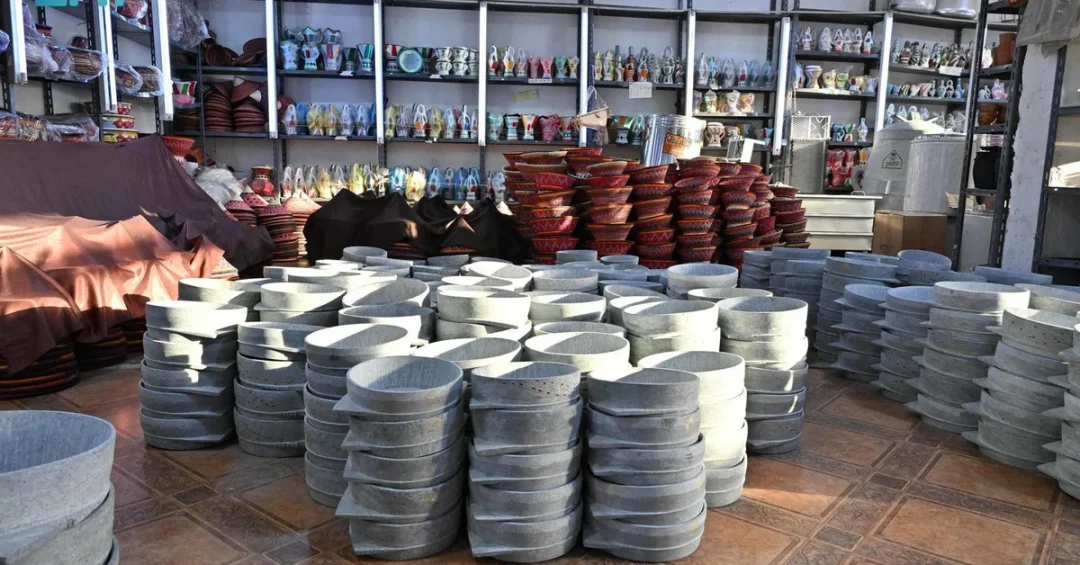
Heritage utensil and supply markets across Najran Region are recording a marked surge in demand for traditional stone and pottery cookware and wicker crafts as households prepare for the holy month of Ramadan, according to a Saudi Press Agency (SPA) survey of local shops. The increase, documented in a tour of retail outlets in the southern Saudi region, reflects the enduring role these handmade items play in the preparation of iftar and suhoor meals and underlines the cultural weight that Ramadan carries in Najran’s daily life. Shopkeepers reported a notable rise in purchases of the traditional utensils, which are considered essential for preparing the region’s renowned popular dishes.
The development is not merely a seasonal retail trend. It points to a deeper continuity in Najran, where cooking vessels made from stone, clay and woven palm materials have been passed down through generations and remain central to the region’s celebrated cuisine. The demand also highlights the work of the Heritage Commission, the official Saudi body that supports and encourages local artisans, recognizing the cultural significance of handicrafts and their contribution to the national economy. As families gather for the evening meal that breaks the fast, these heritage products move from craft markets into kitchens, carrying with them a story of identity, craftsmanship and economic opportunity.
Context and Background
Why do markets in one Saudi region matter to the wider story of the Kingdom’s cultural and economic transformation? Najran sits in the southwest of Saudi Arabia, bordering Yemen, and is known for a distinct architectural and culinary heritage shaped by its geography and history. Its traditional kitchens rely on stone and pottery cookware, which distributes heat slowly and evenly, and on wicker crafts woven from local palm fronds and other natural materials. These objects are used to prepare dishes that Najranis regard as inseparable from Ramadan hospitality, from slow-cooked stews to aromatic rice preparations served at iftar and suhoor.
The Saudi Press Agency reported that a tour of local shops showed a notable increase in purchases of these items with the advent of Ramadan. The same report noted that the traditional utensils are essential for preparing the region’s renowned popular dishes, a detail that explains why demand rises so sharply in the weeks before the month begins. For many families, buying a new clay pot or a woven serving basket is part of the ritual of welcoming Ramadan, alongside cleaning the home, stocking the pantry and preparing sweets for guests.
Behind the shop counters stand artisans whose skills have been sustained across generations. The Heritage Commission actively supports and encourages these craftspeople, recognizing the cultural significance of handicrafts and their contribution to the national economy. The commission empowers craftsmen, creates job opportunities, and promotes crafts through various training and marketing programs, according to the SPA report. That institutional support is a key reason why heritage cookware remains available, visible and commercially viable in Najran’s markets today, rather than surviving only in museums or private collections.
Key Details
What exactly are shoppers buying, and who is selling it? The SPA tour identified two broad categories of goods in high demand: traditional stone and pottery cookware, and wicker crafts. The first includes vessels used for slow cooking, baking and serving, shaped by hand and fired using methods refined over generations. The second covers baskets, mats, covers and serving containers woven from palm and similar natural fibers, which are used to present food and to store staples during Ramadan gatherings. Together, these items form the practical backbone of a Najrani Ramadan table.
Shop owners in the region told the Saudi Press Agency that the increase in purchases was notable and consistent with previous years, when Ramadan likewise triggered a seasonal peak. The report did not cite specific sales figures, and none should be assumed. What is clear from the official account is the direction of demand: upward, concentrated in the weeks before and during the holy month, and driven by households seeking authentic tools for traditional cooking rather than mass-produced alternatives. That preference is itself a form of cultural preservation carried out by ordinary families.
The Heritage Commission plays a direct role in keeping this supply chain healthy. Its programs train artisans, help them market their products, and create job opportunities linked to handicrafts. By treating heritage crafts as an economic sector as well as a cultural asset, the commission helps ensure that a potter or weaver in Najran can earn a livelihood from skills inherited from earlier generations. The SPA report frames this support as recognition of both the cultural significance of handicrafts and their contribution to the national economy, a dual rationale that runs through Saudi cultural policy.
International and Regional Impact
How does a local market trend in Najran connect to Saudi Arabia’s place in the wider region? Ramadan is observed across the Islamic world, and demand for traditional cookware typically rises in many countries during the month. Najran’s experience mirrors that broader pattern while retaining a distinctly local character. For regional neighbors and international observers, the surge offers a window into how Saudi Arabia balances modernization with the preservation of regional identities, allowing each area of the Kingdom to express its heritage within a unified national framework.
The visibility of Najrani crafts also supports cultural exchange. Visitors to the region, including pilgrims and tourists traveling through the southwest, encounter these products in markets and heritage sites. When a visitor purchases a woven basket or a clay vessel, the transaction carries Najrani craftsmanship beyond the Kingdom’s borders. In this way, a seasonal spike in local demand contributes to a longer-term process of cultural diplomacy, in which Saudi regions present their traditions to a global audience with the backing of official institutions such as the Heritage Commission.
Economic and Strategic Significance
Why should economists and policymakers pay attention to pottery and wicker? Small-scale craft production is labor-intensive, locally rooted and difficult to outsource, which makes it a natural source of jobs in regions like Najran. The Heritage Commission’s mandate to empower craftsmen and create job opportunities aligns craft businesses with the Kingdom’s broader effort to diversify employment and income away from hydrocarbons. Every workshop that hires an apprentice or sells a seasonal inventory contributes, at a modest but real scale, to that diversification.
Seasonal demand during Ramadan also demonstrates how cultural calendars can function as economic drivers. Retailers plan inventories around the month, artisans increase production, and logistics networks move goods from workshops to market stalls. The SPA report’s account of increased purchases suggests that this cycle is functioning in Najran, with heritage products competing successfully against imported or industrial alternatives. For strategic planners, the lesson is that cultural authenticity can be a commercial advantage, not a constraint, when supported by training, marketing and institutional backing.
Vision 2030 Alignment
How does heritage cookware fit into a national vision centered on transformation? Saudi Vision 2030 places culture, quality of life and economic diversification among its central goals, and the handicrafts sector touches all three. The Heritage Commission’s support for artisans in Najran, including training and marketing programs, translates the vision’s cultural objectives into tangible outcomes: preserved skills, employed craftspeople and products that carry Saudi identity into homes and markets. The Ramadan demand surge shows that these outcomes are not abstract; they are measured in sales, in workshop activity and in the continuity of regional cuisine.
As Ramadan begins, the markets of Najran will continue to fill with shoppers seeking the tools of a traditional table. Behind each purchase stands an artisan, a training program and a national commitment to keeping Saudi heritage alive and productive. The Kingdom’s long-term vision depends on precisely this kind of alignment, where cultural pride and economic opportunity reinforce one another. In Najran, the clay pot and the woven basket are small objects with a large role: they connect the past to the future, and they show how Vision 2030 reaches into every region, every kitchen and every generation of the Kingdom.
20 Questions
Q1. What is driving the surge in demand for heritage cookware in Najran?
A1. The approach of Ramadan is driving the surge. Households in Najran are buying traditional stone and pottery cookware and wicker crafts to prepare iftar and suhoor meals, according to a Saudi Press Agency tour of local shops.
Q2. Which products are in highest demand in Najran’s heritage markets?
A2. The SPA report identifies two main categories: traditional stone and pottery cookware, and wicker crafts. Both are considered essential for preparing the region’s renowned popular dishes during the holy month.
Q3. Why are traditional utensils important for Najrani cuisine?
A3. These utensils are integral to iftar and suhoor meals in Najran. They are used to prepare the region’s renowned popular dishes, and their material properties, such as slow, even heat distribution, suit traditional cooking methods.
Q4. Which Saudi body supports the artisans who make these products?
A4. The Heritage Commission actively supports and encourages local artisans. It recognizes the cultural significance of handicrafts and their contribution to the national economy, according to the official SPA report.
Q5. How does the Heritage Commission help craftspeople in practical terms?
A5. The commission empowers craftsmen, creates job opportunities, and promotes crafts through various training and marketing programs. These measures help artisans sustain their livelihoods and reach wider markets.
Q6. What did the Saudi Press Agency find during its tour of local shops?
A6. The SPA tour revealed a notable increase in purchases of traditional stone and pottery cookware and wicker crafts. Shopkeepers reported strong seasonal demand linked to Ramadan preparations.
Q7. Where is Najran Region located in Saudi Arabia?
A7. Najran Region lies in the southwest of the Kingdom, near the border with Yemen. It is known for a distinct architectural, agricultural and culinary heritage shaped by its geography and history.
Q8. Are specific sales figures available for the heritage cookware market?
A8. The official SPA report did not cite specific sales figures. It described a notable increase in purchases, and no numerical estimates should be assumed beyond what was officially released.
Q9. What are wicker crafts used for during Ramadan in Najran?
A9. Wicker crafts include baskets, mats, covers and serving containers woven from palm and similar natural fibers. They are used to present food, store staples and support the hospitality traditions of Ramadan gatherings.
Q10. How does this trend relate to Saudi Arabia’s national economy?
A10. Handicrafts contribute to the national economy by creating jobs and supporting local production. The Heritage Commission’s work links craft businesses to broader efforts to diversify employment and income across the Kingdom.
Q11. Does this demand occur only in Najran, or elsewhere too?
A11. Ramadan typically raises demand for traditional cookware in many regions and countries. Najran’s experience mirrors this wider pattern while retaining a distinctly local character rooted in its own cuisine and crafts.
Q12. How does the Heritage Commission define the value of handicrafts?
A12. The commission recognizes both the cultural significance of handicrafts and their contribution to the national economy. This dual rationale guides its training, marketing and job-creation programs for artisans.
Q13. What role do local shops play in this seasonal market?
A13. Local shops serve as the main retail channel for heritage cookware and wicker crafts. They stock inventories ahead of Ramadan and connect artisans’ products with households preparing for the holy month.
Q14. Why do families prefer handmade cookware over industrial alternatives?
A14. Many families associate handmade stone and pottery vessels with authentic flavor and tradition. Using them is part of the ritual of welcoming Ramadan and preserving culinary practices passed down through generations.
Q15. How does this trend support cultural preservation?
A15. Each purchase sustains demand for traditional skills. By buying heritage cookware, families help keep pottery, stonework and weaving economically viable, ensuring these crafts continue to be practiced and taught.
Q16. What training opportunities exist for artisans in Najran?
A16. The Heritage Commission promotes crafts through various training programs. These initiatives help craftsmen refine their skills, improve product quality and market their goods more effectively.
Q17. Can visitors to Najran buy these heritage products?
A17. Yes. Heritage utensil and supply markets in the region offer these products to shoppers, including visitors. Purchases carry Najrani craftsmanship beyond the Kingdom and support local artisans.
Q18. How does this development connect to Saudi Vision 2030?
A18. Vision 2030 emphasizes culture, quality of life and economic diversification. Supporting handicrafts and artisans in Najran advances all three goals, turning cultural heritage into a source of jobs and national pride.
Q19. What is the significance of Ramadan for Najran’s markets?
A19. Ramadan is a peak season for heritage cookware because iftar and suhoor meals rely on traditional preparation. The month concentrates demand into a few weeks, giving artisans and retailers a predictable annual sales boost.
Q20. What does this story say about Saudi Arabia’s approach to heritage?
A20. It shows a national approach that treats heritage as a living, productive asset. Official support for artisans, combined with strong community demand, keeps regional traditions active and aligned with the Kingdom’s long-term vision.
Reader Feedback
We value your thoughts. Please share your feedback on this article.
Your feedback helps us improve our coverage.
Related articles
 Farasan Islands: Unique Ramadan Traditions Preserved
 Historic Al-Qibli Mosque Revitalized Under Prince Mohammed bin Salman Project
 Al-Wadi and Al-Jabal: Embracing Ramadan’s Traditions
 Hilwah Al-Jouf Dates: The Star of Iftar Tables
 Riyadh Ramadan Markets: Culture and Tradition Fusion
 Jazan’s Perfumed Water: A Ramadan Tradition of Luxury