


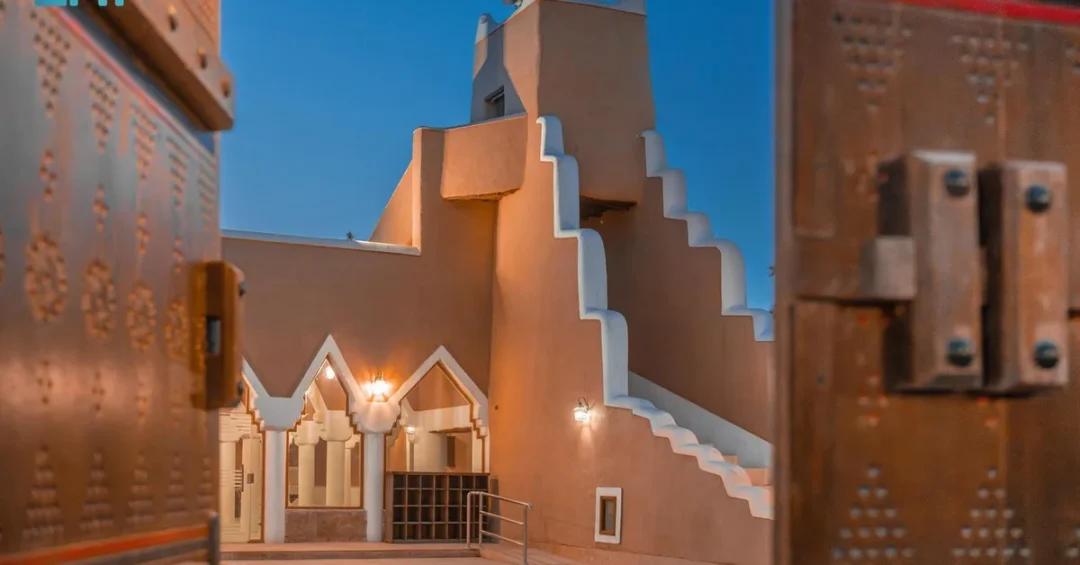
Al-Qibli Mosque, a historic place of worship in Riyadh’s Manfuha neighborhood, is being revitalized under Phase Two of the Prince Mohammed bin Salman Project for the Development of Historical Mosques, the Saudi Press Agency reported on March 1, 2025. Originally built in 1100 AH and later reconstructed by King Abdulaziz in 1364 AH, the mosque holds a distinguished place in the Kingdom’s religious and architectural history, having served as a prayer hall for princes and senior state officials due to its proximity to the old principality palace. The restoration is being carried out with meticulous attention to traditional Najdi construction methods, ensuring that the mosque’s authentic character is preserved for future generations.
Have you ever wondered how a building can carry the memory of a nation while still serving the daily spiritual needs of its people? Al-Qibli Mosque embodies that dual role. Its revitalization is not merely a construction project; it is a statement of cultural continuity. The work is part of a broader national effort to safeguard the Kingdom’s architectural heritage, an effort that aligns with the forward-looking ambitions of Saudi Vision 2030. As the mosque’s area expands from 642.85 square meters to 804.32 square meters to accommodate 440 worshippers, the project demonstrates how tradition and modernity can coexist harmoniously. The restoration is being led by Saudi companies and engineers who specialize in heritage buildings, underscoring the Kingdom’s commitment to nurturing local expertise and preserving its unique identity.
Context and Background
Why does a mosque built more than nine centuries ago still matter in today’s Saudi Arabia? The answer lies in the deep connection between faith, history, and national identity. Al-Qibli Mosque was first established in 1100 AH in the historic Manfuha neighborhood, one of Riyadh’s oldest districts. Its original construction used clay and natural materials, hallmarks of the Najdi architectural style that defines much of central Saudi Arabia’s built heritage. In 1364 AH, King Abdulaziz, the founder of modern Saudi Arabia, ordered its reconstruction, further cementing its status as a landmark of both religious and political significance. For decades, it served as a gathering place for the Kingdom’s leadership, reflecting the close bond between the state and its religious institutions.
The Prince Mohammed bin Salman Project for the Development of Historical Mosques is a nationwide initiative that seeks to restore and rehabilitate mosques of historical importance across the Kingdom. Phase One, completed in 2018, successfully restored 30 mosques in 10 regions. Phase Two, currently underway, involves another 30 mosques, including Al-Qibli. The project is not simply about repairing structures; it is about reviving the spiritual, cultural, and social roles these mosques have played in their communities for generations. By preserving architectural authenticity while integrating modern construction standards, the initiative ensures that these houses of worship remain functional, safe, and inspiring for years to come.
What makes this project particularly significant is its emphasis on traditional craftsmanship. The restoration of Al-Qibli Mosque faces a unique challenge: sourcing and preparing the necessary wood using age-old techniques such as straightening, upturning, and pest treatment. Craftsmen are measuring and preparing components onsite, employing decorative methods that revive the mosque’s original architectural character. This hands-on approach not only preserves the building’s authenticity but also keeps traditional skills alive, passing them on to a new generation of Saudi artisans. It is a living example of how heritage can be a bridge between the past and the future.
Key Details of the Restoration
How exactly is Al-Qibli Mosque being brought back to its former glory? The project team is following a meticulous process that begins with the careful documentation of the existing structure. Every architectural element, from the clay walls to the wooden beams, is being studied and recorded before any work begins. The expansion from 642.85 square meters to 804.32 square meters will allow the mosque to accommodate 440 worshippers, up from its previous capacity. This increase is essential to meet the needs of the local community, which has grown over the years. The design maintains the Najdi style, characterized by its use of natural materials, geometric patterns, and climate-responsive features such as thick walls and small windows that keep the interior cool.
The woodwork is a central focus of the restoration. Traditional Najdi architecture relies heavily on wood for roofs, doors, and decorative elements. However, finding wood that matches the original quality and dimensions is difficult. The craftsmen must select appropriate timber and then treat it using methods that have been passed down through generations. Straightening, upturning, and pest treatment are all part of the process. Once prepared, the wood is shaped and fitted onsite, ensuring a perfect match with the historic structure. This level of detail reflects the project’s commitment to authenticity and quality, and it highlights the skills of Saudi engineers and artisans who are leading the work.
Another key aspect is the use of traditional decorative techniques. The mosque’s interior and exterior will feature handcrafted elements that replicate the original designs, from carved wooden doors to intricate plasterwork. These details are not merely ornamental; they are integral to the building’s identity and its ability to inspire worshippers. By reviving these techniques, the project also supports the preservation of Saudi cultural heritage, ensuring that future generations can appreciate the artistry of their ancestors. The restoration is expected to serve as a model for other heritage projects across the Kingdom, demonstrating how to balance historical integrity with contemporary functionality.
International and Regional Impact
Could the restoration of a single mosque in Riyadh resonate beyond Saudi Arabia’s borders? Absolutely. The Prince Mohammed bin Salman Project for the Development of Historical Mosques is part of a broader global movement to protect cultural heritage. By investing in the restoration of historic religious sites, the Kingdom is positioning itself as a leader in heritage conservation, a field that attracts international attention and collaboration. Scholars, architects, and preservationists from around the world are watching how Saudi Arabia manages this delicate balance between tradition and modernity. The project also reinforces the Kingdom’s role as the guardian of Islam’s holiest sites, a responsibility that extends to the preservation of mosques of historical significance throughout the country.
Regionally, the initiative contributes to a deeper understanding of the Arabian Peninsula’s rich architectural legacy. The Najdi style, with its distinctive use of clay and natural materials, is unique to central Saudi Arabia. By restoring Al-Qibli Mosque and other historic mosques, the Kingdom is preserving a tangible link to the region’s past, offering researchers and visitors alike the opportunity to study and appreciate this heritage. Moreover, the project supports local economies by creating jobs for craftsmen, engineers, and project managers. It also enhances the appeal of Riyadh’s historic neighborhoods, such as Manfuha, which could become destinations for cultural tourism. In this way, the restoration serves both cultural and economic objectives, aligning with Vision 2030’s goals of diversifying the economy and promoting Saudi heritage.
Economic and Strategic Significance
What does the restoration of Al-Qibli Mosque mean for Saudi Arabia’s economy and strategic vision? At first glance, a mosque restoration might seem like a purely cultural endeavor, but its implications are far-reaching. The project is being executed by Saudi companies and engineers, which means that the investment stays within the Kingdom and helps develop local expertise. This is a key objective of Vision 2030, which seeks to build a diversified, knowledge-based economy. By nurturing a skilled workforce in heritage preservation, Saudi Arabia is creating a niche industry that can contribute to GDP growth and job creation. The techniques and knowledge gained from this project can be applied to other restoration initiatives, both within the Kingdom and internationally.
Strategically, the preservation of historical mosques reinforces the Kingdom’s religious and cultural leadership. As the birthplace of Islam and the custodian of the Two Holy Mosques, Saudi Arabia has a unique responsibility to protect Islamic heritage. Projects like this demonstrate that the Kingdom takes this duty seriously, not only for the benefit of its own citizens but for the entire Muslim world. They also support the goals of Vision 2030 by enhancing the quality of life for residents, promoting cultural tourism, and fostering a sense of national pride. The restoration of Al-Qibli Mosque is thus a strategic investment in the Kingdom’s soft power, showcasing its commitment to faith, heritage, and progress.
Vision 2030 Alignment
How does the revitalization of Al-Qibli Mosque fit into the grand tapestry of Saudi Vision 2030? Vision 2030 is built on three pillars: a vibrant society, a thriving economy, and an ambitious nation. The restoration project touches on all three. A vibrant society is one that values its heritage and provides spaces for spiritual and community life; by restoring historic mosques, the Kingdom is nurturing the social fabric that binds its people together. A thriving economy benefits from the jobs and skills developed through heritage conservation, as well as from the tourism potential of well-preserved historic sites. An ambitious nation is one that learns from its past while building its future, and this project exemplifies that ethos by blending traditional craftsmanship with modern engineering.
Furthermore, the project supports the Vision 2030 goal of shaping the design of modern mosques. By studying and restoring historic examples like Al-Qibli Mosque, architects and planners can gain insights into climate-appropriate, culturally resonant design. These lessons can be applied to new mosques, ensuring that they are not only functional but also reflect the Kingdom’s architectural identity. In this way, the past informs the future, creating a continuous thread of heritage that enriches Saudi society. The restoration of Al-Qibli Mosque is a testament to the Kingdom’s dedication to preserving its cultural roots while embracing the opportunities of tomorrow, a balance that lies at the heart of Vision 2030.
20 Questions
Q1. What is Al-Qibli Mosque and where is it located?
A1. Al-Qibli Mosque is a historic mosque in Riyadh’s Manfuha neighborhood. Originally built in 1100 AH, it was reconstructed by King Abdulaziz in 1364 AH. It is a key component of Phase Two of the Prince Mohammed bin Salman Project for the Development of Historical Mosques.
Q2. What is the Prince Mohammed bin Salman Project for the Development of Historical Mosques?
A2. It is a national initiative to restore and rehabilitate historic mosques across Saudi Arabia. Phase One, completed in 2018, restored 30 mosques in 10 regions. Phase Two is currently restoring another 30 mosques, including Al-Qibli Mosque.
Q3. Why is Al-Qibli Mosque historically significant?
A3. It was originally built in 1100 AH and later reconstructed by King Abdulaziz in 1364 AH. Due to its proximity to the old principality palace, it served as a prayer hall for princes and senior state officials, making it a landmark of religious and political history.
Q4. What architectural style is being preserved in the restoration?
A4. The restoration preserves the Najdi architectural style, which is characterized by clay construction, natural materials, and climate-responsive features. This style is unique to central Saudi Arabia and reflects the region’s cultural heritage.
Q5. How large will the mosque be after restoration?
A5. The mosque’s area will expand from 642.85 square meters to 804.32 square meters. This expansion will allow it to accommodate 440 worshippers, up from its previous capacity, meeting the needs of the growing local community.
Q6. What is a major challenge in the restoration process?
A6. A major challenge is sourcing and preparing the necessary wood. Traditional techniques such as straightening, upturning, and pest treatment are required. Craftsmen are measuring and preparing components onsite to ensure authenticity.
Q7. Who is leading the restoration work?
A7. The restoration is led by Saudi companies and engineers specializing in heritage buildings. This ensures that local expertise is developed and that the work adheres to both traditional methods and modern construction standards.
Q8. How does the project balance preservation and modernization?
A8. The project balances historical preservation with modern construction standards by using traditional materials and techniques while ensuring structural safety and sustainability. This approach retains the mosque’s authentic architectural identity while making it functional for contemporary use.
Q9. What was accomplished in Phase One of the project?
A9. Phase One, completed in 2018, successfully restored 30 mosques in 10 regions of Saudi Arabia. It set the foundation for the ongoing Phase Two, which is now restoring another 30 mosques, including Al-Qibli Mosque.
Q10. What are the strategic objectives of the project?
A10. The project aims to rehabilitate mosques for worship, restore architectural authenticity, highlight the Kingdom’s cultural heritage, and enhance the religious and cultural status of historical sites. It also supports Saudi Vision 2030.
Q11. How does the project align with Saudi Vision 2030?
A11. It aligns with Vision 2030 by preserving architectural heritage and shaping the design of modern mosques. It contributes to a vibrant society, a thriving economy, and an ambitious nation, reflecting the Vision’s holistic approach to development.
Q12. What traditional decorative techniques are being used?
A12. Craftsmen are employing traditional decorative techniques to revive the mosque’s original architectural character. These include handcrafted woodwork, carved doors, and intricate plasterwork that replicate the historic designs and enhance the mosque’s spiritual ambiance.
Q13. How does the restoration benefit the local community?
A13. The restoration provides a larger, safer, and more beautiful place of worship for the community. It also creates jobs for local craftsmen and engineers, and it fosters a sense of pride in the neighborhood’s heritage, potentially attracting cultural tourism.
Q14. What impact does the project have on Saudi Arabia’s cultural heritage?
A14. The project preserves and revitalizes Saudi Arabia’s architectural heritage, ensuring that historic mosques remain integral to the Kingdom’s cultural landscape. It also raises awareness about the importance of preserving these landmarks for future generations.
Q15. Are there economic benefits to restoring historic mosques?
A15. Yes, the project creates jobs, develops local expertise in heritage conservation, and supports cultural tourism. These economic benefits align with Vision 2030’s goal of diversifying the economy and creating opportunities for Saudi citizens.
Q16. How does the project enhance Saudi Arabia’s religious leadership?
A16. By preserving historic mosques, Saudi Arabia demonstrates its commitment to protecting Islamic heritage. This reinforces its role as the custodian of the Two Holy Mosques and a leader in the Muslim world, enhancing its religious and cultural standing globally.
Q17. What is the significance of the Manfuha neighborhood?
A17. Manfuha is one of Riyadh’s oldest neighborhoods, rich in history and culture. Al-Qibli Mosque’s location there adds to its historical importance, as it was close to the old principality palace and served the Kingdom’s leadership.
Q18. How long will the restoration take?
A18. The restoration timeline has not been specified in the official announcement. However, the project is part of Phase Two, which is currently underway. The work is being carried out meticulously to ensure high-quality results.
Q19. Can the public visit the mosque during restoration?
A19. The mosque is undergoing restoration, so public access may be limited. Once completed, it will reopen as a fully functional place of worship, welcoming the community and visitors to experience its restored beauty.
Q20. What does the future hold for Saudi Arabia’s historic mosques?
A20. The Prince Mohammed bin Salman Project will continue to restore historic mosques across the Kingdom. These efforts will preserve Saudi Arabia’s architectural heritage, support Vision 2030, and ensure that future generations can connect with their cultural and spiritual roots.
Reader Feedback
We value your thoughts. Please share your feedback on this article.
Your feedback helps us improve our coverage.
Related articles
 Al-Wadi and Al-Jabal: Embracing Ramadan’s Traditions
 Hilwah Al-Jouf Dates: The Star of Iftar Tables
 Riyadh Ramadan Markets: Culture and Tradition Fusion
 Jazan’s Perfumed Water: A Ramadan Tradition of Luxury
 Art Week Riyadh Unveils Curatorial Team for 2025 Debut
 Jeddah’s Ramadan Shines with Lights and Al-Mirkaz Tradition