


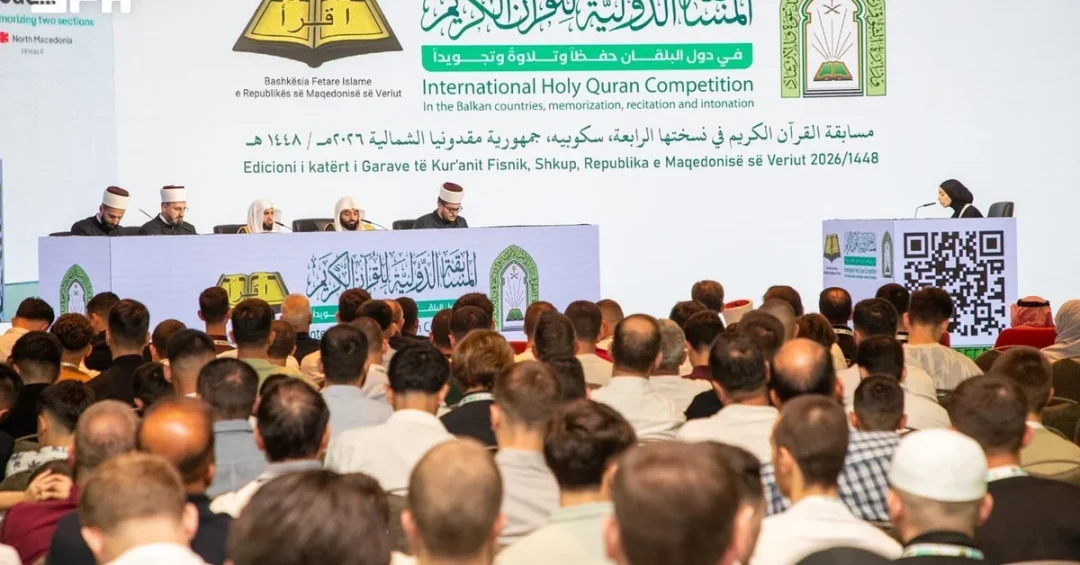
The final rounds of the Fourth International Holy Quran Competition for the Balkan Countries began on July 26, 2026, in Skopje, the capital of North Macedonia, bringing together 200 male and female contestants from 29 countries to compete in five categories of Quranic recitation and memorization. The event is organized by the Ministry of Islamic Affairs, Dawah and Guidance of the Kingdom of Saudi Arabia, through the Religious Attaché at the Saudi Embassy in Bosnia and Herzegovina, in cooperation with the Islamic Religious Community of the Republic of North Macedonia. The opening sessions drew participants, judges, and dignitaries who praised the Kingdom’s sustained efforts to serve the Holy Quran and support memorizers worldwide.
Why does a competition held in the Balkans matter to audiences far beyond Southeast Europe? The answer lies in the unique role the Kingdom plays as custodian of the Two Holy Mosques and as a global patron of Quranic education. The Skopje event is not merely a contest; it is a carefully designed platform that connects young Muslims across national borders, reinforces moderate religious values, and strengthens cultural ties between Saudi Arabia and the Balkan region. With 200 contestants representing 29 nations, the competition reflects the breadth of Saudi Arabia’s religious diplomacy and its commitment to nurturing a generation grounded in the principles of tolerance, scholarship, and devotion.
Context and Background
Has the Balkan region always occupied a special place in the Islamic world? Indeed, the Balkans have a deep and historic Muslim presence, with communities in North Macedonia, Bosnia and Herzegovina, Albania, Kosovo, and beyond maintaining rich traditions of Islamic scholarship and Quranic recitation. The International Holy Quran Competition for the Balkan Countries was established to serve these communities, offering a dedicated platform that recognizes their talents and connects them to the broader Islamic world. Over four editions, the competition has grown in scale and prestige, evolving from a regional initiative into a significant international event.
The Ministry of Islamic Affairs, Dawah and Guidance, under the leadership of the Kingdom’s leadership, has long prioritized the service of the Holy Quran. Through its various agencies, including the Religious Attaché offices at Saudi embassies, the Ministry organizes competitions, distributes Quranic materials, and supports educational institutions dedicated to memorization and recitation. The Religious Attaché at the Saudi Embassy in Bosnia and Herzegovina has been particularly active in coordinating Balkan-focused programs, working closely with local Islamic authorities to ensure that the competitions are inclusive, well-organized, and aligned with the moderate teachings of Islam.
Cooperation with the Islamic Religious Community of the Republic of North Macedonia underscores the Kingdom’s respect for local institutions and its preference for partnership over unilateral action. This collaborative model has become a hallmark of Saudi religious outreach, ensuring that programs are culturally attuned and locally supported. The choice of Skopje as the host city further highlights North Macedonia’s role as a bridge between the Balkans and the wider Muslim world, and it reflects the Kingdom’s appreciation for the country’s tradition of interfaith harmony and religious coexistence.
Key Details of the Competition
What exactly happens when 200 contestants from 29 countries gather in one city to compete in Quranic recitation? The competition spans five distinct categories, covering the full memorization of the Quran, partial memorization, and various styles of recitation with precise rules of tajweed. Contestants are evaluated by a panel of distinguished judges, experts in Quranic sciences drawn from multiple countries, who assess accuracy, fluency, voice quality, and adherence to the classical rules of recitation. The final rounds, which began on July 26, are the culmination of months of national and regional qualifiers, ensuring that only the most accomplished reciters reach Skopje.
The diversity of the participants is one of the event’s defining features. Male and female contestants from 29 countries are taking part, representing not only the Balkan nations but also broader participation from the Islamic world. This inclusivity reflects the Kingdom’s commitment to empowering women in religious scholarship and ensuring that Quranic education is accessible to all. Several contestants and members of the participating delegations expressed their appreciation for the opportunity to take part, commending Saudi Arabia’s efforts to serve the Holy Quran and its initiatives and programs dedicated to supporting Quran memorizers.
Beyond the competition itself, the event includes accompanying activities such as workshops, exhibitions of Quranic calligraphy, and meetings between scholars. These side events provide contestants with opportunities to learn from one another, exchange insights about their respective Quranic traditions, and build networks that will support their continued religious education. For many young participants, the competition is a transformative experience that strengthens their commitment to memorization and opens doors to further study, including scholarships at Saudi universities and religious institutes.
International and Regional Impact
How does a Quran competition in Skopje ripple across the international landscape? The event reinforces Saudi Arabia’s position as a global leader in religious affairs and soft diplomacy. By hosting and sponsoring competitions in Europe, the Kingdom demonstrates that its commitment to the Holy Quran transcends geographic boundaries and addresses the needs of Muslim minorities in non-Muslim-majority countries. This is particularly important in the Balkans, where Muslim communities have historically maintained their identity through faith and education, often with limited external support.
The competition also serves as a counter-narrative to extremist interpretations of Islam. By emphasizing moderate scholarship, precise recitation, and the spiritual dimensions of the Quran, the event promotes a vision of Islam that is peaceful, inclusive, and compatible with modern life. This aligns with Saudi Arabia’s broader efforts to combat extremism and promote moderation, both domestically and internationally. The presence of contestants from diverse backgrounds, united by their devotion to the Quran, sends a powerful message of unity and mutual respect that resonates far beyond the competition halls.
Regionally, the event strengthens ties between Saudi Arabia and the Balkan states. North Macedonia, Bosnia and Herzegovina, Albania, and Kosovo all have significant Muslim populations and maintain cordial relations with the Kingdom. The competition provides a platform for cultural exchange, people-to-people diplomacy, and the strengthening of institutional partnerships. For the participating countries, hosting and sending contestants is a matter of national pride and a way to highlight their Islamic heritage on the world stage.
Economic and Strategic Significance
What strategic value does Saudi Arabia derive from supporting Quranic competitions in the Balkans? The Kingdom’s religious diplomacy is an integral part of its broader foreign policy, complementing its economic investments and political engagement. By supporting initiatives that serve Muslim communities, Saudi Arabia builds goodwill and strengthens its reputation as a reliable partner. This soft power translates into tangible benefits, including enhanced cooperation in trade, investment, and cultural exchange.
The competition also aligns with Saudi Arabia’s Vision 2030, which seeks to diversify the economy and expand the Kingdom’s global influence. While Vision 2030 is primarily an economic and social transformation plan, its cultural and religious dimensions are equally important. The Kingdom aims to project a modern, moderate image that reflects its rich heritage and its commitment to global peace and understanding. Events like the Skopje competition are showcases for this vision, demonstrating that Saudi Arabia is not only a custodian of Islamic holy sites but also a proactive leader in promoting Islamic values worldwide.
From an economic perspective, the competition stimulates local economies through tourism and hospitality spending. Contestants, delegates, and officials travel to Skopje, staying in hotels, dining in restaurants, and using local services. The event also raises the profile of North Macedonia as a destination for religious and cultural tourism, potentially attracting visitors from the Gulf and other Muslim-majority countries. In the long term, such exposure can lead to increased investment and business ties, further integrating the Balkans into Saudi Arabia’s global network.
Vision 2030 Alignment
How does hosting a Quran competition in the Balkans connect to Saudi Arabia’s long-term vision for 2030 and beyond? Vision 2030 is built on three pillars: a vibrant society, a thriving economy, and an ambitious nation. The Quran competition directly supports the first pillar by nurturing a vibrant society rooted in Islamic values, while also contributing to the second and third pillars by enhancing the Kingdom’s international standing and fostering global partnerships. The Ministry of Islamic Affairs, Dawah and Guidance plays a key role in this effort, implementing programs that reflect the Kingdom’s commitment to moderation, tolerance, and the service of Islam.
The competition also supports the Vision 2030 goal of increasing cultural exchange and promoting Saudi Arabia as a global hub for Islamic scholarship. By investing in Quranic education and competitions, the Kingdom ensures that future generations of Muslims, both within Saudi Arabia and abroad, are equipped with the knowledge and values needed to contribute positively to their societies. The Skopje event is a testament to the Kingdom’s enduring dedication to the Holy Quran and its belief that faith, education, and international cooperation are essential to building a better world. As the final rounds continue, the participants and organizers alike look forward to celebrating the achievements of the contestants and reinforcing the bonds that unite the global Muslim community.
20 Questions
Q1. What is the Fourth International Holy Quran Competition for the Balkan Countries?
A1. It is a Quranic recitation and memorization competition organized by Saudi Arabia’s Ministry of Islamic Affairs, Dawah and Guidance, through the Religious Attaché at the Saudi Embassy in Bosnia and Herzegovina, in cooperation with North Macedonia’s Islamic Religious Community.
Q2. When and where did the final rounds begin?
A2. The final rounds commenced on July 26, 2026, in Skopje, the capital of North Macedonia, marking the start of the competition’s first-day sessions.
Q3. How many contestants are participating in the competition?
A3. A total of 200 male and female contestants are taking part in the final rounds, representing 29 countries from the Balkans and beyond.
Q4. How many categories are included in the competition?
A4. Contestants compete across five categories, covering full memorization, partial memorization, and various styles of Quranic recitation with precise tajweed rules.
Q5. Which Saudi body is organizing the competition?
A5. The Ministry of Islamic Affairs, Dawah and Guidance is organizing the event through the Religious Attaché at the Saudi Embassy in Bosnia and Herzegovina.
Q6. Which local partner is cooperating in the event?
A6. The Islamic Religious Community of the Republic of North Macedonia is the local partner, working closely with Saudi organizers to ensure the competition’s success.
Q7. What did contestants say about Saudi Arabia’s efforts?
A7. Several contestants and delegation members expressed appreciation for the opportunity to participate and commended Saudi Arabia’s efforts to serve the Holy Quran and support Quran memorizers.
Q8. Why is the competition held in the Balkans?
A8. The Balkans have a historic Muslim presence, and the competition aims to support Quranic education and connect local communities with the global Islamic world.
Q9. How does the competition promote moderate Islam?
A9. By emphasizing precise recitation, scholarship, and spiritual devotion, the event counters extremism and promotes a peaceful, inclusive vision of Islam.
Q10. What are the benefits for participating countries?
A10. Participating countries gain cultural exchange opportunities, international recognition, and strengthened ties with Saudi Arabia and other Muslim nations.
Q11. Are there side events during the competition?
A11. Yes, the competition includes workshops, Quranic calligraphy exhibitions, and scholarly meetings that allow contestants to learn and network.
Q12. How are contestants evaluated?
A12. A panel of distinguished judges assesses accuracy, fluency, voice quality, and adherence to classical tajweed rules, ensuring a fair and rigorous evaluation.
Q13. What is the role of the Religious Attaché in Bosnia and Herzegovina?
A13. The Religious Attaché coordinates Saudi religious programs in the Balkans, including the Quran competition, and works with local Islamic authorities to implement them.
Q14. How does the competition align with Saudi Vision 2030?
A14. It supports Vision 2030’s pillars by nurturing a vibrant society, enhancing Saudi Arabia’s global standing, and promoting cultural exchange and moderate Islamic values.
Q15. What impact does the competition have on North Macedonia?
A15. It boosts local tourism and hospitality, raises North Macedonia’s profile as a destination for religious tourism, and strengthens its cultural ties with Saudi Arabia.
Q16. How many editions of the competition have been held?
A16. This is the fourth edition, building on the success of previous competitions that have grown in scale and prestige over the years.
Q17. What opportunities do contestants gain from participating?
A17. Contestants gain recognition, access to scholarships at Saudi universities, and the chance to build networks with scholars and peers from across the Islamic world.
Q18. How does the competition support women in Quranic education?
A18. By including female contestants and judges, the event promotes women’s participation in religious scholarship and ensures equal opportunities for Quranic study.
Q19. What message does the competition send to the international community?
A19. It demonstrates Saudi Arabia’s commitment to global religious diplomacy, moderation, and the support of Muslim communities worldwide.
Q20. What are the future prospects for the competition?
A20. The competition is expected to continue expanding, attracting more participants and further strengthening Saudi Arabia’s role as a global leader in Quranic education and Islamic outreach.
Reader Feedback
We value your thoughts. Please share your feedback on this article.
Your feedback helps us improve our coverage.
Related articles
 GACA Licenses Universal Aviation at King Fahd Airport
 KSrelief Fits 21 Prosthetic Limbs in Hungary Mission
 KSrelief Distributes 25,000 Hot Meals in Gaza Strip
 Prince Mansour Attends Maldives’ 61st Independence Day
 Crown Prince Holds Call with UK PM Andy Burnham
 KSrelief Sponsors Treatment of Palestinian Child in Jordan