


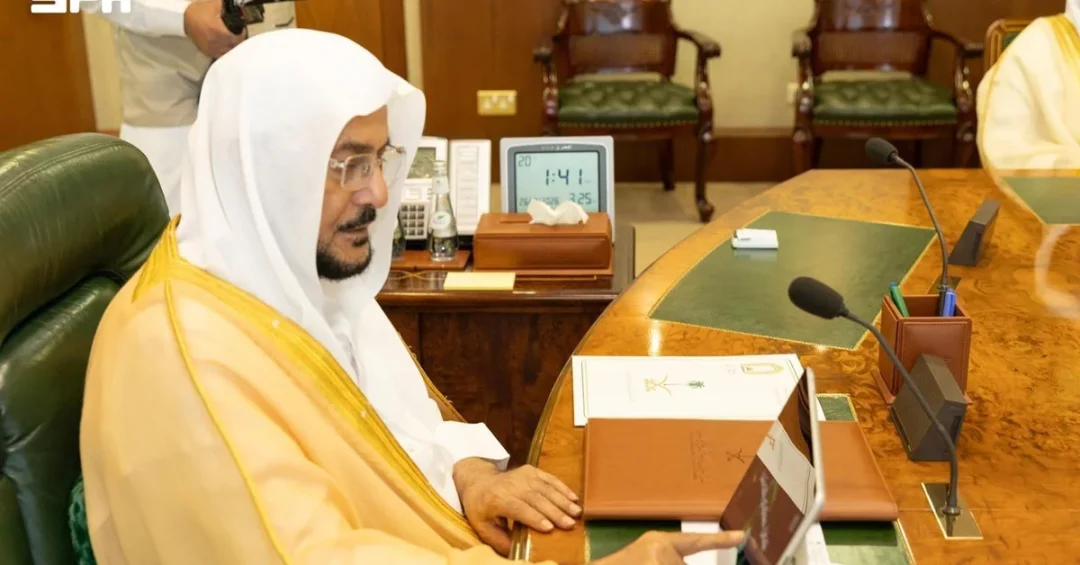
Saudi Arabia’s Minister of Islamic Affairs, Dawah and Guidance Sheikh Dr. Abdullatif Al Alsheikh launched the digital “New Muslim” card service at the ministry’s headquarters in Riyadh, integrating the document directly into the Tawakkalna app to streamline and authenticate the process for those declaring Islam. The announcement, carried by the Saudi Press Agency, marks a further step in the ministry’s drive to digitize its services and improve the quality of support offered to beneficiaries, in line with the objectives of Saudi Vision 2030.
The new service automates every stage of the process for declaring Islam, replacing manual procedures with a fully digital workflow. Once an application is approved, the card appears immediately inside Tawakkalna, the national super-app, allowing users to access and verify it seamlessly through integration with the Saudi Data and Artificial Intelligence Authority (SDAIA). The initiative reflects a broader national effort to embed digital government services into everyday life across the Kingdom. Could a single digital card become the gateway through which new Muslims access a whole ecosystem of services and community support?
Context and Background
How does a simple digital card signal a much larger transformation in how religious services are delivered in Saudi Arabia? The Ministry of Islamic Affairs, Dawah and Guidance has spent recent years modernizing its operations, moving from paper-based records to integrated digital platforms that serve citizens, residents, and visitors alike. The “New Muslim” card is the latest expression of that strategy, building on a series of service upgrades designed to reduce processing times, eliminate redundant paperwork, and create a single source of truth for official records.
The ministry’s mandate extends well beyond administration. It oversees mosques, dawah activities, religious guidance, and the welfare of those who embrace Islam in the Kingdom. For new Muslims, the declaration process has historically involved multiple in-person steps, physical documentation, and follow-up visits to obtain proof of their status. By digitizing the entire journey, the ministry is addressing a practical pain point while also generating higher-quality data that can inform planning and decision-making at the national level.
The timing of the launch is significant. Saudi Arabia is accelerating its digital government agenda under Vision 2030, with Tawakkalna already serving as a central hub for identity, health, and government services. Placing the “New Muslim” card inside that ecosystem ensures immediate visibility, easy access, and strong verification. What does it mean for a religious service to be delivered with the same speed and reliability as a banking app or a travel document? For the Kingdom, it means that spiritual care and administrative efficiency are no longer separate tracks but part of one integrated national experience.
Key Details of the New Service
What exactly does the new card do, and why does its design matter? According to the Saudi Press Agency, the project aims to automate all stages of the process for declaring Islam. The service is integrated with the Tawakkalna app, where the card appears immediately upon approval, enabling users to access and verify it seamlessly through integration with the Saudi Data and Artificial Intelligence Authority (SDAIA). This means the card is not a static document but a live digital credential tied to the user’s verified identity.
The project also contributes to improving data quality and generating accurate reports and statistics to support planning and decision-making. In addition, it provides a quick-response (QR) code that ensures the authenticity of the card and verifies that it has been officially issued by the competent authority. The QR code is a particularly important feature: it allows any authorized party to confirm the card’s validity in seconds, reducing the risk of fraud or misrepresentation while protecting the dignity of the cardholder.
For the individual user, the experience is designed to be simple and immediate. Once the declaration process is approved, the card is available on their phone without the need to visit an office or wait for a physical document. This immediacy matters for people who may be navigating a new legal and social status, often while managing other administrative tasks. How much difference can a single seamless step make in a person’s first months as a Muslim in Saudi Arabia? For many, it can mean the difference between uncertainty and a clear, recognized standing within the community.
Behind the scenes, the integration with SDAIA reflects the Kingdom’s broader data governance architecture. SDAIA is the national authority responsible for data and artificial intelligence, and its involvement ensures that the service meets high standards of security, privacy, and interoperability. The ministry has not simply built a standalone app but has connected its service to the national digital backbone, allowing for consistent identity verification and secure data exchange across government platforms.
International and Regional Impact
Could Saudi Arabia’s approach to digitizing religious services become a model for other countries in the region and beyond? The Kingdom hosts a large and diverse community of residents and visitors, including many who embrace Islam each year. A transparent, verifiable, and digitally native process for declaring Islam makes it easier for individuals to formalize their status and access the services they need. It also strengthens the integrity of official records, which is important for legal, social, and administrative purposes.
For international observers, the launch is another example of how Saudi Arabia is using technology to improve public services in ways that are culturally grounded and religiously respectful. The service does not replace the human and spiritual dimensions of dawah; rather, it removes administrative friction so that the ministry’s guidance and support can reach people more effectively. This balance between tradition and innovation is a recurring theme in Vision 2030, and it is one that resonates with many countries seeking to modernize without losing their identity.
Regionally, the move reinforces Saudi Arabia’s position as a leader in digital government. The Tawakkalna app has already gained recognition for its role during the pandemic and its evolution into a comprehensive services platform. Adding the “New Muslim” card expands the app’s scope into a new area of public life, demonstrating that digital transformation can serve spiritual and community needs as well as health, travel, and commerce. What message does this send to other nations about the role of technology in public service? It suggests that the most successful digital strategies are those that meet people at every stage of their lives, including moments of profound personal change.
Economic and Strategic Significance
How does a religious service card connect to economic strategy and national planning? The ministry’s project explicitly aims to improve data quality and generate accurate reports and statistics to support planning and decision-making. In an era when policy is increasingly data-driven, reliable figures on the number of people declaring Islam, their geographic distribution, and their service needs can help government agencies allocate resources more effectively. Better data leads to better decisions, whether in community outreach, education, or social support.
The efficiency gains are also significant. Automating the declaration process reduces the administrative burden on ministry staff, freeing them to focus on guidance and pastoral care rather than paperwork. It reduces the need for in-person visits, which saves time for beneficiaries and lowers operational costs. These are the kinds of improvements that contribute to a more productive public sector, a key objective of Vision 2030’s public sector transformation programs.
Strategically, the integration with Tawakkalna and SDAIA strengthens the national digital ecosystem. Each new service added to the platform increases its value to users and reinforces the habit of using official digital channels. This network effect is central to Saudi Arabia’s digital strategy: the more services that live in one trusted place, the more citizens and residents will rely on it, and the more efficient the entire system becomes. For the ministry, the “New Muslim” card is not just a convenience but a strategic asset that enhances its ability to serve and to plan.
Vision 2030 Alignment
How does the “New Muslim” card embody the goals of Saudi Vision 2030? The initiative sits at the intersection of two core Vision 2030 themes: a vibrant society and a thriving economy supported by effective government. By digitizing a sensitive religious process, the Ministry of Islamic Affairs, Dawah and Guidance is enhancing the quality of life for beneficiaries, ensuring that they can access services with dignity and ease. This aligns with the Vision’s commitment to fostering a society where all individuals can thrive and contribute.
At the same time, the project advances the Vision’s digital transformation objectives. The integration with Tawakkalna and SDAIA demonstrates how government entities can collaborate to deliver seamless, secure, and user-friendly services. It also supports the broader goal of improving government effectiveness and transparency through better data and verification mechanisms such as the QR code. In a rapidly changing world, Saudi Arabia is showing that it can modernize its religious services while preserving their spiritual essence, ensuring that the Kingdom remains a beacon of faith, service, and innovation for years to come.
20 Questions
Q1. What is the “New Muslim” card service?
A1. It is a digital card launched by the Ministry of Islamic Affairs, Dawah and Guidance that automates the process for declaring Islam and appears immediately in the Tawakkalna app upon approval.
Q2. Who launched the service?
A2. The service was launched by Minister of Islamic Affairs, Dawah and Guidance Sheikh Dr. Abdullatif Al Alsheikh at the ministry’s headquarters in Riyadh, as reported by the Saudi Press Agency.
Q3. Which app hosts the digital card?
A3. The card is integrated with the Tawakkalna app, Saudi Arabia’s national super-app for government and identity services, allowing users to access and verify it seamlessly.
Q4. What role does SDAIA play in this service?
A4. The Saudi Data and Artificial Intelligence Authority (SDAIA) provides the integration that enables secure identity verification and data exchange for the card within the national digital ecosystem.
Q5. How does the card appear to users?
A5. Once the declaration process is approved, the card appears immediately inside the Tawakkalna app, giving users instant access to a verified digital credential without waiting for a physical document.
Q6. What is the purpose of the QR code on the card?
A6. The QR code ensures the authenticity of the card and verifies that it has been officially issued by the competent authority, allowing quick validation by authorized parties.
Q7. Does the service replace in-person visits?
A7. The service automates all stages of the declaration process, reducing the need for in-person visits and paperwork, which saves time for beneficiaries and improves administrative efficiency.
Q8. How does the project improve data quality?
A8. By digitizing the process, the ministry generates accurate reports and statistics that support planning and decision-making, leading to better resource allocation and service design.
Q9. Is the card available to non-Saudis?
A9. The service is designed for individuals declaring Islam in the Kingdom, including residents and visitors, and is accessible through the Tawakkalna app once approved.
Q10. What are the benefits for new Muslims?
A10. New Muslims gain immediate proof of their status, easier access to related services, and a secure, verifiable digital document that can be used for administrative purposes.
Q11. How does this align with Vision 2030?
A11. It supports Vision 2030’s goals of digital transformation, government efficiency, and a vibrant society by improving service quality and using data to enhance decision-making.
Q12. What technology underpins the card?
A12. The card relies on integration with Tawakkalna and SDAIA’s national data infrastructure, ensuring secure identity verification and seamless digital delivery.
Q13. Can the card be verified by third parties?
A13. Yes, the QR code allows authorized parties to verify the card’s authenticity and confirm it was issued by the competent authority.
Q14. Does the service include statistics for planning?
A14. Yes, the project contributes to improving data quality and generating accurate reports and statistics to support planning and decision-making at the national level.
Q15. What ministry is responsible for the service?
A15. The Ministry of Islamic Affairs, Dawah and Guidance is responsible for the service, reflecting its mandate to oversee religious affairs and support new Muslims.
Q16. How does the card improve service quality?
A16. By automating the declaration process and delivering the card instantly, the service reduces waiting times, eliminates paperwork, and provides a more dignified experience for beneficiaries.
Q17. Is the card secure?
A17. Yes, the integration with SDAIA and the QR code verification ensure that the card is secure, authentic, and officially recognized.
Q18. What happens after approval?
A18. After approval, the card appears immediately in the Tawakkalna app, allowing the user to access and verify it seamlessly through the integrated system.
Q19. Does the service support decision-making?
A19. Yes, the accurate reports and statistics generated by the system support planning and decision-making, helping the ministry and other agencies allocate resources effectively.
Q20. What is the broader significance of this launch?
A20. It demonstrates Saudi Arabia’s commitment to modernizing religious services, enhancing government efficiency, and using technology to serve society in line with Vision 2030.
Reader Feedback
We value your thoughts. Please share your feedback on this article.
Your feedback helps us improve our coverage.
Related articles
 Border Guard Highlights Mangrove Conservation in Madinah
 Environmental Security Forces Mark International Day for the Conservation of Mangroves in Madinah
 NCW Marks Five Years of Landmark Environmental Transformation
 Fourth Quran Competition for Balkan Countries Opens in Skopje
 GACA Licenses Universal Aviation at King Fahd Airport
 KSrelief Fits 21 Prosthetic Limbs in Hungary Mission