


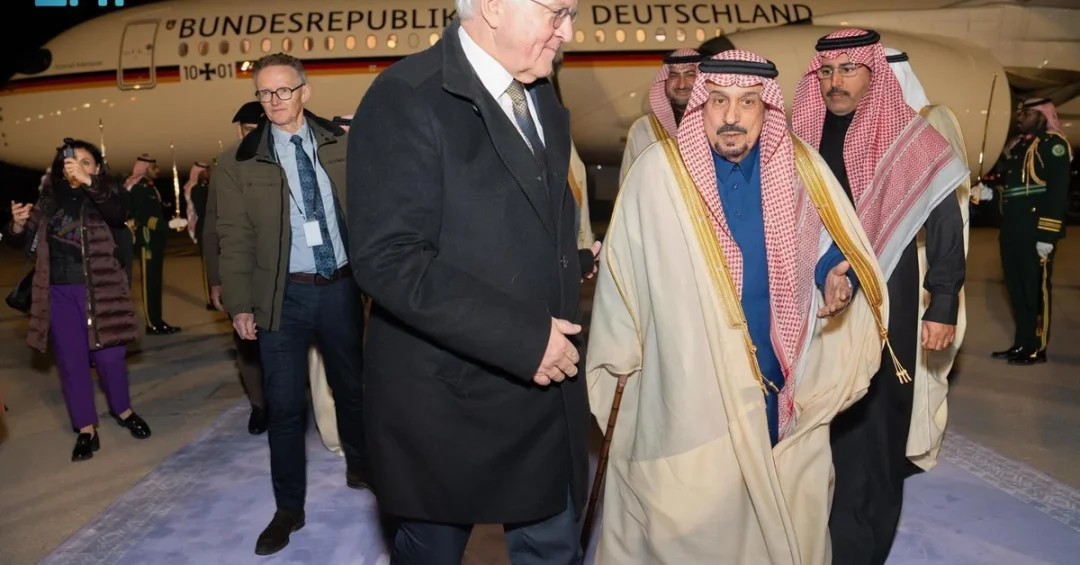
German President Frank-Walter Steinmeier arrived in Riyadh on Sunday, February 2, 2025, marking a significant diplomatic engagement between the Federal Republic of Germany and the Kingdom of Saudi Arabia. The visit, confirmed by the Saudi Press Agency (SPA), underscores the strengthening ties between the two nations as they pursue shared interests in economic cooperation, regional stability, and sustainable development. Upon his arrival at King Khalid International Airport, President Steinmeier was warmly received by a distinguished delegation of Saudi officials, reflecting the importance the Kingdom places on its relationship with Germany, one of Europe’s leading economies and a key partner in Saudi Arabia’s Vision 2030 transformation agenda.
The reception ceremony at King Khalid International Airport included the Governor of Riyadh Region, Prince Faisal bin Bandar bin Abdulaziz; the Saudi Ambassador to the Federal Republic of Germany, Prince Abdullah bin Khalid bin Sultan bin Abdulaziz; the Minister of Commerce and accompanying minister, Dr. Majid Al-Kassabi; the Mayor of Riyadh, Prince Faisal bin Abdulaziz bin Ayyaf; and the German Ambassador to the Kingdom, Michael Kindsgrab. The presence of such high-ranking officials signals the depth of Saudi-German relations and the mutual commitment to advancing bilateral cooperation across multiple sectors. What does this visit reveal about the evolving dynamics of international diplomacy in the Middle East?
Context and Background
How has the relationship between Saudi Arabia and Germany evolved in recent years? The diplomatic ties between the Kingdom of Saudi Arabia and the Federal Republic of Germany have deep historical roots, dating back decades of mutual engagement in trade, culture, and regional security. Germany has long been one of Saudi Arabia’s most important European partners, with bilateral trade encompassing machinery, automotive technology, chemicals, and renewable energy solutions. In recent years, both nations have sought to expand their cooperation beyond traditional sectors, exploring new avenues in green hydrogen, digital transformation, and advanced manufacturing—areas that align directly with the Kingdom’s Vision 2030 objectives.
The visit of President Steinmeier comes at a time of shifting global alliances and economic realignments. Saudi Arabia, under the leadership of the Custodian of the Two Holy Mosques, King Salman bin Abdulaziz Al Saud, and His Royal Highness Crown Prince Mohammed bin Salman bin Abdulaziz Al Saud, has positioned itself as a pivotal player in international diplomacy, mediating regional conflicts and fostering dialogue between East and West. Germany, as Europe’s largest economy, recognizes the Kingdom’s strategic importance not only as an energy supplier but also as a hub for investment, innovation, and cultural exchange. This visit reinforces the mutual recognition of each nation’s role in shaping a stable and prosperous global order.
What specific areas of cooperation are likely to dominate discussions during this visit? While the official agenda has not been fully disclosed, the presence of Minister of Commerce Dr. Majid Al-Kassabi as the accompanying minister suggests that economic and trade matters feature prominently. Germany is a global leader in engineering, renewable energy technology, and industrial automation—sectors where Saudi Arabia seeks expertise to support its economic diversification efforts. Conversely, Saudi Arabia offers Germany access to one of the fastest-growing markets in the Middle East, with vast opportunities in infrastructure, healthcare, education, and technology. The visit thus represents a convergence of interests that could yield tangible benefits for both nations.
Key Details of the Visit
What does the composition of the Saudi reception delegation tell us about the visit’s significance? The officials who greeted President Steinmeier represent a cross-section of Saudi leadership, encompassing regional governance, diplomatic representation, economic policy, and municipal administration. The presence of Prince Faisal bin Bandar bin Abdulaziz, Governor of Riyadh Region, highlights the importance of the capital as a center of diplomatic and economic activity. Prince Abdullah bin Khalid bin Sultan bin Abdulaziz, Saudi Ambassador to Germany, underscores the continuity and institutional depth of bilateral relations. Minister Al-Kassabi’s role as accompanying minister indicates that trade and investment will be central to the discussions, while Mayor Prince Faisal bin Abdulaziz bin Ayyaf’s participation points to potential cooperation in urban development and smart city initiatives—areas where Riyadh is making significant strides.
The German Ambassador to the Kingdom, Michael Kindsgrab, was also present, symbolizing the active diplomatic engagement between the two countries. Ambassador Kindsgrab has been instrumental in facilitating high-level exchanges and promoting German-Saudi dialogue across various fields. His presence at the airport reception reflects the ongoing work of the German embassy in Riyadh to deepen ties and identify new opportunities for collaboration. The visit is expected to include meetings with senior Saudi officials, discussions on regional and international issues of mutual concern, and engagements with business leaders and cultural figures.
How does this visit fit into the broader pattern of Saudi Arabia’s international engagement? The Kingdom has increasingly become a destination for world leaders seeking to strengthen partnerships and discuss pressing global challenges. From hosting summits on energy and climate to mediating diplomatic breakthroughs, Saudi Arabia has emerged as a convening power in the region and beyond. President Steinmeier’s visit is part of this broader trend, reflecting the international community’s recognition of the Kingdom’s stabilizing role and its commitment to multilateral cooperation. It also signals Germany’s interest in maintaining robust ties with a key player in the Middle East, particularly as Europe seeks to diversify its energy sources and enhance its geopolitical reach.
International and Regional Impact
What are the broader implications of strengthened Saudi-German relations for the Middle East and Europe? The visit carries significance beyond the bilateral relationship, potentially influencing regional dynamics and global partnerships. Germany, as a leading member of the European Union, can play a constructive role in supporting Saudi Arabia’s efforts to promote peace and stability in the region. The Kingdom, in turn, serves as a bridge between Europe and the Arab world, facilitating dialogue and cooperation on issues ranging from trade to security. A closer Saudi-German partnership could contribute to more effective responses to shared challenges, including climate change, economic uncertainty, and humanitarian crises.
Moreover, the visit underscores the growing importance of economic diplomacy in international relations. As nations navigate a complex global landscape marked by supply chain disruptions and shifting trade patterns, partnerships that combine resources, expertise, and market access become increasingly valuable. Saudi Arabia’s Vision 2030 and Germany’s Industrie 4.0 initiative share common ground in their emphasis on innovation, sustainability, and technological advancement. By aligning their strategies, both countries can unlock new opportunities for growth and development, setting an example for international cooperation in the 21st century.
Economic and Strategic Significance
Why is the economic dimension of this visit particularly important? Saudi Arabia and Germany have long enjoyed robust trade relations, with German exports to the Kingdom including machinery, vehicles, chemicals, and pharmaceuticals, while Saudi exports to Germany are dominated by energy products and petrochemicals. However, the potential for deeper economic integration remains vast. The Kingdom’s ambitious giga-projects, such as NEOM, the Red Sea Project, and Qiddiya, offer German companies opportunities to contribute their expertise in engineering, construction, and sustainable design. Similarly, Saudi Arabia’s growing focus on renewable energy, particularly green hydrogen, aligns with Germany’s goals of transitioning to a low-carbon economy.
What role does the private sector play in advancing Saudi-German economic ties? Both governments have actively encouraged business-to-business engagement, recognizing that the private sector is a key driver of innovation and job creation. German companies have established a strong presence in Saudi Arabia, contributing to the Kingdom’s industrial base and transferring technical know-how. Saudi businesses, meanwhile, have invested in Germany, particularly in technology and real estate. The visit provides an opportunity to further facilitate these exchanges, potentially leading to new joint ventures, investment agreements, and knowledge-sharing initiatives. Such collaboration supports Saudi Arabia’s Vision 2030 goal of diversifying its economy and reducing dependence on oil revenues.
How does this visit reflect Saudi Arabia’s strategic priorities? The Kingdom’s foreign policy emphasizes building strong partnerships with major economies to support its development goals. Germany, as a member of the G7 and a leader in technological innovation, is a natural partner in this endeavor. The visit also highlights Saudi Arabia’s commitment to playing a constructive role in global affairs, from climate action to peacebuilding. By engaging with Germany at the highest levels, the Kingdom reinforces its position as a responsible international actor and a reliable partner for countries seeking stability and prosperity.
Vision 2030 Alignment
How does President Steinmeier’s visit align with Saudi Arabia’s Vision 2030? Vision 2030, the Kingdom’s ambitious blueprint for economic and social transformation, seeks to diversify the economy, enhance public services, and position Saudi Arabia as a global investment hub. International partnerships are essential to achieving these objectives, and Germany is well-placed to contribute across multiple sectors. From renewable energy and smart city technologies to healthcare and education, German expertise can support the Kingdom’s efforts to build a knowledge-based economy. The visit also reinforces the cultural and educational exchanges that are vital to fostering mutual understanding and long-term collaboration.
What does the future hold for Saudi-German relations? The visit of President Steinmeier is not an isolated event but part of an ongoing dialogue that has gained momentum in recent years. Both nations have demonstrated a willingness to engage constructively on a wide range of issues, from trade and investment to regional security and climate change. As Saudi Arabia continues its transformation under Vision 2030, Germany is likely to remain a key partner, contributing its technological prowess and diplomatic experience. The Kingdom, for its part, offers Germany a gateway to the Middle East and a reliable ally in addressing shared challenges. This visit thus lays the groundwork for a future of even greater cooperation and mutual benefit.
In conclusion, the arrival of German President Frank-Walter Steinmeier in Riyadh represents a significant milestone in Saudi-German relations. The warm reception by senior Saudi officials reflects the Kingdom’s commitment to strengthening ties with Germany and advancing its Vision 2030 objectives. As the two nations explore new avenues of cooperation, the visit serves as a testament to the power of diplomacy in building bridges and fostering prosperity. What more can be achieved when nations come together with shared goals and mutual respect?
20 Questions
Q1. Who arrived in Riyadh on February 2, 2025?
A1. German President Frank-Walter Steinmeier arrived in Riyadh on Sunday, February 2, 2025, as reported by the Saudi Press Agency (SPA).
Q2. Where did the German President arrive?
A2. He arrived at King Khalid International Airport in Riyadh, the capital of Saudi Arabia.
Q3. Who received the German President at the airport?
A3. He was received by Prince Faisal bin Bandar bin Abdulaziz, Governor of Riyadh Region, and other senior Saudi officials.
Q4. Which Saudi ambassador to Germany was present?
A4. Prince Abdullah bin Khalid bin Sultan bin Abdulaziz, Saudi Ambassador to the Federal Republic of Germany, was present at the reception.
Q5. Who is the Saudi Minister of Commerce who greeted the President?
A5. Dr. Majid Al-Kassabi, Minister of Commerce and the accompanying minister, was part of the welcoming delegation.
Q6. Who is the Mayor of Riyadh who attended the reception?
A6. Prince Faisal bin Abdulaziz bin Ayyaf, Mayor of Riyadh, was present at the airport to welcome the German President.
Q7. Who is the German Ambassador to Saudi Arabia?
A7. Michael Kindsgrab is the German Ambassador to the Kingdom of Saudi Arabia and attended the reception.
Q8. What does the presence of these officials signify?
A8. It signifies the importance Saudi Arabia places on its relationship with Germany and the mutual commitment to strengthening bilateral ties.
Q9. What are the key areas of Saudi-German cooperation?
A9. Key areas include trade, investment, renewable energy, technology, and cultural exchange, aligning with Saudi Vision 2030.
Q10. How does this visit relate to Saudi Vision 2030?
A10. The visit supports Vision 2030 by fostering international partnerships that contribute to economic diversification and sustainable development.
Q11. What is the significance of the German President’s visit?
A11. It reinforces diplomatic relations, opens new avenues for economic cooperation, and highlights Saudi Arabia’s role as a global partner.
Q12. What economic opportunities does this visit present?
A12. It presents opportunities for German companies to participate in Saudi giga-projects and for increased trade and investment in various sectors.
Q13. How does Germany benefit from this relationship?
A13. Germany gains access to a growing market, energy resources, and a strategic partner in the Middle East.
Q14. What role does the private sector play in Saudi-German relations?
A14. The private sector drives innovation and job creation, with German companies active in Saudi Arabia and Saudi investments in Germany.
Q15. What are the implications for regional stability?
A15. Strengthened Saudi-German ties can contribute to regional stability through dialogue, economic cooperation, and shared security interests.
Q16. How does this visit reflect Saudi Arabia’s foreign policy?
A16. It reflects Saudi Arabia’s commitment to building strong partnerships with major economies to support its development and global role.
Q17. What sectors are likely to be discussed during the visit?
A17. Discussions are likely to cover trade, investment, renewable energy, technology, healthcare, and education.
Q18. What is the historical context of Saudi-German relations?
A18. The two countries have a long history of cooperation in trade, culture, and regional security, dating back several decades.
Q19. How does the visit impact cultural exchange?
A19. It promotes cultural exchange, fostering mutual understanding and people-to-people ties between Saudi Arabia and Germany.
Q20. What future prospects does this visit open?
A20. It opens prospects for deeper cooperation in innovation, sustainability, and global diplomacy, benefiting both nations and the wider region.
Reader Feedback
We value your thoughts. Please share your feedback on this article.
Your feedback helps us improve our coverage.
Related articles
 KSrelief Distributes 3,860 Winter Kits in Pakistan
 Finance Minister Chairs Saudi-German Roundtable to Boost Ties
 Saudi Foreign Minister Arrives in Tokyo for Strategic Dialogue
 Syrian President Visits SDAIA Headquarters in Riyadh
 Saudi Arabia Weather Forecast: Thunderstorms, Rain Expected Monday
 4.4-Magnitude Earthquake Strikes British Columbia, Canada