


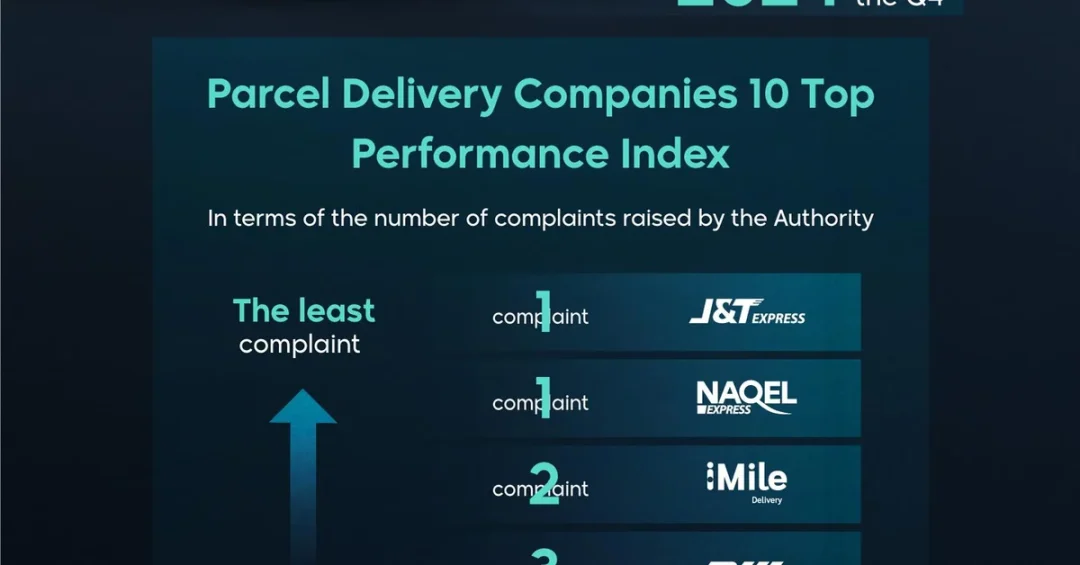
Saudi Arabia’s Transport General Authority (TGA) has published a quarterly performance index ranking the Kingdom’s ten largest postal parcel delivery companies by complaint rates, revealing that more than 48 million parcels were delivered across the country during the fourth quarter of 2024. The index, part of the TGA’s quarterly statistical bulletin on transportation activities and services, measures the number of complaints escalated to the authority per 100,000 parcels handled, offering customers, investors, and regulators a transparent snapshot of service quality in one of the Middle East’s fastest-growing logistics markets.
The results place J&T Express and NAQEL Express at the top of the ranking, each recording only one escalated complaint per 100,000 parcels. iMile Delivery followed in third place with two complaints, while DHL recorded three. GFS Express ranked fifth with four complaints per 100,000 parcels. The remaining companies in the top ten recorded rates between five and ten complaints, with Aramex registering nine. The TGA clarified that the index counts only complaints escalated to the authority after a customer first contacted the delivery company directly and the matter remained unresolved within the designated seven-day window. How does a single index transform the way millions of customers judge the companies that bring their packages to the door?
Context and Background
Why has parcel delivery become such a closely watched measure of Saudi Arabia’s economic momentum? The answer lies in the scale of the transformation underway. The Kingdom’s logistics sector has expanded rapidly as e-commerce, cross-border trade, and digital commerce platforms have reshaped consumer behavior. The TGA’s quarterly statistical bulletin has become a central tool for tracking that growth, publishing operational data on transport and delivery activities across the country. The fourth-quarter 2024 figures show more than 48 million parcels delivered in a single three-month period, a volume that reflects both rising consumer demand and the expanding capacity of licensed operators.
The performance index itself is a regulatory innovation. Rather than relying on anecdotal feedback or self-reported service metrics, the TGA measures complaints that customers escalate to the authority after the delivery company has had a full seven days to resolve the issue directly. This two-step process — first the provider, then the regulator — ensures that the index reflects genuine service failures rather than routine inquiries. It also gives the TGA a legally grounded basis for follow-up, enforcement, and corrective measures when companies fall short of expected standards.
For an international audience, the significance is straightforward. Saudi Arabia is positioning its postal and logistics infrastructure as a pillar of its broader economic diversification agenda, and transparent performance data are essential to building trust with consumers, global shipping partners, and investors. A ranking that names the ten largest companies and quantifies their complaint rates is a signal that the sector is maturing under clear regulatory oversight.
Key Details of the Performance Index
What exactly do the numbers tell us about service quality in the Kingdom’s parcel market? The index focuses on the ten largest licensed delivery companies, which together handle the overwhelming majority of parcel volume. J&T Express and NAQEL Express share the best performance, with one escalated complaint per 100,000 parcels. iMile Delivery recorded two, DHL three, and GFS Express four. Companies ranked sixth through tenth recorded rates between five and ten complaints per 100,000 parcels, with Aramex at nine. The spread between the best and weakest performers is narrow in absolute terms, which suggests that the sector as a whole maintains a relatively high standard of service.
The TGA explained the complaint escalation mechanism in detail. Customers must first file a complaint directly with the delivery company, which is required to address it within seven days. If the issue is not resolved or the company fails to respond, the customer may escalate the complaint to the TGA through the unified number 19929. The authority then follows up with the company to ensure resolution and enforces necessary measures to uphold regulations and enhance service quality. This structure places responsibility squarely on the service provider while giving the regulator a clear mandate to intervene when needed.
The quarterly bulletin also provides broader context on the sector’s scale. More than 48 million parcels delivered in three months implies a daily average well above 500,000 shipments, a figure that underscores the importance of reliable last-mile delivery to households and businesses alike. For global logistics firms evaluating Saudi Arabia as a market or partner, the publication of company-level performance data is a meaningful indicator of regulatory transparency.
International and Regional Impact
How does a national complaint index resonate beyond Saudi Arabia’s borders? For international couriers and e-commerce platforms, the ranking offers a rare, officially sourced benchmark for comparing service reliability across operators in the Kingdom. Global players such as DHL and Aramex appear alongside regional and local champions like NAQEL Express, iMile Delivery, J&T Express, and GFS Express, giving overseas partners a clear view of the competitive landscape. Multinational retailers shipping into Saudi Arabia can use the index to inform carrier selection, while logistics investors can track service quality trends quarter by quarter.
Regionally, the index reinforces Saudi Arabia’s position as a leader in regulatory modernization. The Kingdom’s approach — publishing complaint rates per 100,000 parcels rather than raw complaint counts — allows fair comparison between companies of different sizes and aligns with international best practices in consumer protection and competition oversight. Neighboring markets and global trade partners are likely to watch how the TGA uses these data to drive service improvements, since transparent metrics tend to raise standards across an entire industry. What better way to demonstrate a commitment to consumers than by publicly ranking the companies that serve them?
Economic and Strategic Significance
Why does parcel delivery performance matter to Saudi Arabia’s economic strategy? Logistics is a foundational sector for e-commerce, manufacturing, healthcare distribution, and cross-border trade. When customers can trust that their parcels will arrive on time and that complaints will be resolved, online commerce grows faster, small businesses reach wider markets, and international brands gain confidence in Saudi distribution channels. The TGA’s index effectively turns consumer feedback into a market signal, rewarding reliable operators and pressing weaker performers to improve.
The complaint escalation process also has a strategic dimension. By requiring customers to contact the delivery company first and allowing seven days for resolution, the regulator promotes direct accountability while preserving a clear path to enforcement. The unified number 19929 gives the TGA a centralized channel for tracking unresolved cases, identifying patterns, and taking corrective action. Over time, this data can inform licensing decisions, service standards, and infrastructure planning. For a sector handling tens of millions of parcels each quarter, even small improvements in complaint rates translate into significant gains in customer satisfaction and economic efficiency.
Vision 2030 Alignment
How does a parcel delivery index connect to Saudi Vision 2030? The Vision’s goals include diversifying the economy, expanding non-oil sectors, and positioning the Kingdom as a global logistics hub connecting three continents. A modern, reliable postal and parcel network is essential to that ambition. The TGA’s quarterly bulletin and performance index provide the measurement framework that keeps the sector accountable, while the 48 million parcels delivered in the fourth quarter of 2024 demonstrate the underlying demand that makes logistics investment attractive.
By publishing company-level complaint rates, the TGA supports a culture of transparency and continuous improvement that aligns with Vision 2030’s emphasis on quality of life, consumer protection, and private-sector competitiveness. The top performers — J&T Express, NAQEL Express, iMile Delivery, DHL, and GFS Express — set a benchmark that others can aspire to, while the escalation mechanism ensures that no customer complaint is left unaddressed. As Saudi Arabia continues to build world-class infrastructure and digital services, indices like this one will remain vital tools for measuring progress and sustaining the trust of consumers at home and partners abroad. What clearer sign could there be that the Kingdom’s logistics sector is ready to compete on the global stage?
20 Questions
Q1. What did the Transport General Authority announce regarding parcel deliveries in Saudi Arabia?
A1. The TGA announced that more than 48 million postal parcels were delivered across the Kingdom during the fourth quarter of 2024, reflecting growing demand for parcel services.
Q2. What does the TGA performance index measure?
A2. It measures the number of complaints escalated to the authority per 100,000 parcels handled, ranking the ten largest postal parcel delivery companies in Saudi Arabia.
Q3. Which companies achieved the lowest complaint rates in the index?
A3. J&T Express and NAQEL Express achieved the lowest complaint rates, each recording only one complaint per 100,000 parcels delivered.
Q4. Which company ranked third in the performance index?
A4. iMile Delivery ranked third with two complaints per 100,000 parcels, followed by DHL in fourth place with three complaints.
Q5. How many complaints did GFS Express record?
A5. GFS Express ranked fifth with four complaints per 100,000 parcels, placing it among the top five performers in the Kingdom.
Q6. What complaint rate did Aramex record in the index?
A6. Aramex recorded nine complaints per 100,000 parcels, placing it within the range of five to ten complaints recorded by the remaining companies.
Q7. What is the range of complaint rates for companies ranked sixth to tenth?
A7. The remaining companies in the top ten recorded complaint rates ranging from five to ten complaints per 100,000 parcels during the fourth quarter of 2024.
Q8. What types of complaints are counted in the TGA index?
A8. The index counts only complaints escalated to the TGA after remaining unresolved by the delivery company within the designated seven-day timeframe.
Q9. What must customers do before escalating a complaint to the TGA?
A9. Customers must first file a complaint directly with the service provider, which is required to address it within seven days before any escalation.
Q10. How can customers escalate unresolved complaints to the TGA?
A10. Customers may escalate unresolved complaints to the TGA via the unified number 19929, after which the authority follows up with the company.
Q11. What happens after a complaint is escalated to the TGA?
A11. The TGA follows up with the concerned company to ensure resolution and enforces necessary measures to uphold regulations and enhance service quality.
Q12. How many days do delivery companies have to resolve complaints?
A12. Delivery companies are required to address customer complaints within seven days before the customer may escalate the matter to the TGA.
Q13. Why is the TGA index important for consumers in Saudi Arabia?
A13. The index provides transparent, official information about service quality, helping consumers choose reliable delivery companies and holding providers accountable.
Q14. How does the index support competition among delivery companies?
A14. By publicly ranking companies by complaint rates, the index encourages operators to improve service quality and compete on reliability rather than price alone.
Q15. What role does the TGA play in regulating parcel delivery companies?
A15. The TGA monitors performance, follows up on escalated complaints, enforces regulations, and publishes quarterly data to enhance service standards across the sector.
Q16. How does the parcel delivery sector support Saudi Vision 2030?
A16. A reliable parcel network supports e-commerce growth, economic diversification, and the Kingdom’s ambition to become a global logistics hub under Vision 2030.
Q17. What does the 48 million parcel figure indicate about the Saudi market?
A17. It indicates strong and growing consumer demand for delivery services, underscoring the sector’s importance to the Kingdom’s digital economy.
Q18. How can international partners use the TGA performance index?
A18. International couriers, retailers, and investors can use the index to assess service reliability and compare operators when selecting Saudi delivery partners.
Q19. What is the significance of the unified number 19929?
A19. The unified number 19929 provides customers with a direct channel to escalate unresolved complaints, ensuring regulatory oversight and timely resolution.
Q20. What does the TGA index reveal about Saudi Arabia’s regulatory approach?
A20. It reveals a commitment to transparency, consumer protection, and continuous improvement, aligning with international best practices in postal sector oversight.
Reader Feedback
We value your thoughts. Please share your feedback on this article.
Your feedback helps us improve our coverage.
Related articles
 Rain and Saudi Coffee Aroma Delight Jazan Exhibition
 GCC and Indonesia Begin Second Round of FTA Talks in Riyadh
 Jeddah to Host Inaugural ‘Made in Pakistan 2025’ Exhibition
 Saudi Arabia, Germany Sign Green Hydrogen Bridge MoU
 Wa’ad Al Shamal: Global Model for Industrial Integration
 Jazan Watermelon Farmers Anticipate Bumper Crop for Ramadan