


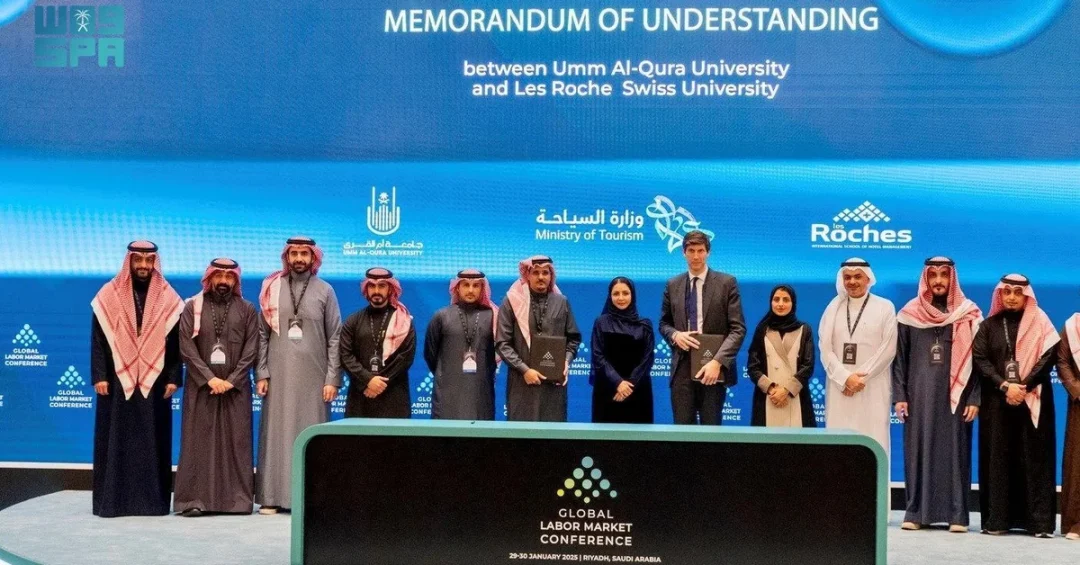
Umm Al-Qura University has signed a strategic cooperation agreement with Les Roches Swiss School of Hotel Management to develop advanced educational and training programs in tourism and hospitality, a move expected to upgrade the skills of more than 50,000 individuals across the Kingdom of Saudi Arabia. The agreement, announced by the Saudi Press Agency and concluded under the auspices of the Ministry of Tourism, brings together one of the Kingdom’s most prominent academic institutions and a globally respected Swiss hospitality educator. It was signed by Dr. Muhammad bin Naif Zamil Al-Sharif, Dean of the Institute of Consulting Research and Studies at Umm Al-Qura University, and Benoît-Etienne Domenget, Chief Executive Officer of Les Roches Swiss School of Hotel Management.
The partnership is designed to create innovative educational and training pathways that respond directly to the demands of Saudi Arabia’s rapidly expanding tourism labor market. It reflects a wider national effort to equip Saudi citizens with world-class skills as the Kingdom accelerates its ambitions under Vision 2030. Could this agreement mark a new chapter in how the Kingdom prepares its workforce for a globally competitive tourism sector? The collaboration is not a standalone initiative but part of a coordinated strategy led by the Ministry of Tourism to strengthen ties with leading international educational institutions and to ensure that qualified national talent is ready to serve the sector’s growth.
Context and Background
Why has tourism and hospitality education become such a central pillar of Saudi Arabia’s national development plans? The answer lies in the scale and speed of the Kingdom’s tourism transformation. Under Vision 2030, Saudi Arabia has set ambitious targets to attract 150 million visits annually by 2030 and to increase the tourism sector’s contribution to gross domestic product to around 10 percent. These goals require not only world-class infrastructure, hotels, resorts, and cultural destinations, but also a deep bench of trained professionals capable of delivering international-standard service across every touchpoint of the visitor experience.
Umm Al-Qura University, based in the holy city of Makkah, occupies a unique position in this landscape. As an institution serving a region that welcomes millions of pilgrims and visitors each year, it has a natural interest in hospitality excellence. The university’s Institute of Consulting Research and Studies has been tasked with translating academic expertise into practical, market-ready programs. Partnering with Les Roches, a Swiss school with decades of experience in hospitality education and a global network of campuses and industry connections, allows the university to benchmark its offerings against the highest international standards.
The Ministry of Tourism’s role as the sponsoring authority underscores the strategic importance of the agreement. The ministry has consistently emphasized that human capital is the foundation of a sustainable tourism economy. By facilitating partnerships between Saudi universities and elite international institutions, it aims to close skills gaps, raise service quality, and create attractive career paths for young Saudis. The agreement with Les Roches is therefore both an educational milestone and an economic policy instrument, aligned with the broader objectives of diversifying the Kingdom’s economy away from hydrocarbon dependence.
Key Details of the Agreement
What exactly does the agreement commit the two institutions to deliver? At its core, the partnership focuses on developing innovative educational and training programs in tourism and hospitality. These programs are expected to combine academic instruction with practical, industry-oriented training, drawing on Les Roches’s Swiss heritage of precision, service excellence, and experiential learning. The agreement also envisions a long-term academic and professional partnership that goes beyond one-off courses, embedding international best practices into the university’s curriculum and training offerings.
The scale of the intended impact is significant: more than 50,000 individuals within the Kingdom are expected to benefit by upgrading their skills. This figure reflects the breadth of the ambition, encompassing students, current tourism workers, and career-changers seeking to enter the sector. The programs are designed to address the demands of the local labor market with qualified national talent, reducing reliance on foreign expertise over time while maintaining global standards of service. The signing by Dr. Muhammad bin Naif Zamil Al-Sharif and Benoît-Etienne Domenget formalizes a relationship that both sides describe as strategic and mutually beneficial.
Operationally, the agreement operates under the auspices of the Ministry of Tourism, which aims to enhance collaborations with global educational institutions to offer advanced educational and training programs. This ministerial backing provides institutional legitimacy, potential access to public-sector initiatives, and a framework for aligning training outcomes with national workforce planning. It also signals to the private sector that hospitality education is a priority area for investment and partnership. For Les Roches, the collaboration offers a gateway into one of the world’s most dynamic emerging tourism markets; for Umm Al-Qura University, it provides access to Swiss pedagogical expertise, international accreditation insights, and a global alumni network.
International and Regional Impact
How will this partnership resonate beyond Saudi Arabia’s borders? The agreement positions the Kingdom as a serious player in global hospitality education, not merely a consumer of imported expertise. By partnering with a Swiss institution of Les Roches’s standing, Saudi Arabia signals that it intends to build indigenous capacity that can eventually be exported. Graduates of these programs could go on to work in major hotel groups, tourism authorities, and event-management companies across the Gulf and beyond, carrying with them a blend of Saudi cultural awareness and Swiss service discipline.
Regionally, the agreement reinforces Saudi Arabia’s role as a leader in tourism development within the Middle East. Neighboring countries have also invested in hospitality training, but the Kingdom’s scale, religious tourism base, and Vision 2030 funding give it unique advantages. The partnership could attract attention from other international educators considering entry into the Saudi market, potentially catalyzing further collaborations. It also supports the growth of cultural and heritage tourism, as trained professionals are needed to interpret and present Saudi Arabia’s rich history to international visitors. In this sense, the agreement contributes to soft power and cultural diplomacy as much as to workforce development.
Economic and Strategic Significance
Why does an educational agreement matter for the Kingdom’s economy? Tourism is one of the key non-oil sectors identified in Vision 2030, and its growth depends on service quality. A shortage of skilled hospitality workers can limit hotel occupancy, visitor satisfaction, and repeat business, undermining the returns on massive infrastructure investments such as NEOM, the Red Sea Project, and Diriyah Gate. By investing in human capital now, Saudi Arabia is protecting those investments and ensuring that the visitor experience matches the ambition of its destinations.
The economic multiplier effects are substantial. A well-trained workforce supports higher productivity, better wages, and more stable employment in the tourism sector. It also encourages entrepreneurship, as graduates may launch their own hospitality businesses, from boutique hotels to catering companies and tour operators. For Umm Al-Qura University, the partnership can enhance its reputation as a hub for applied research and professional education, attracting students and faculty from across the region. For Les Roches, it opens a pipeline of talented Saudi students and a foothold in a market poised for decades of growth. The 50,000 beneficiaries represent not just individuals but families and communities whose livelihoods will be strengthened by better skills and career prospects.
Vision 2030 Alignment
How does this agreement fit into the larger story of Saudi Arabia’s transformation? Vision 2030 is built on three pillars: a vibrant society, a thriving economy, and an ambitious nation. Tourism and hospitality sit at the intersection of all three. By upgrading the skills of its citizens, the Kingdom is investing in a vibrant society and creating the human capital needed for a thriving economy. The partnership between Umm Al-Qura University and Les Roches is a concrete example of how Vision 2030 translates into action: international collaboration, knowledge transfer, and a focus on measurable outcomes.
Looking ahead, the agreement is expected to serve as a model for further collaborations between Saudi academic institutions and global leaders in other fields, from technology to healthcare to renewable energy. It demonstrates that the Kingdom is open to learning from the best while retaining its own cultural identity and values. As Saudi Arabia continues to welcome the world, the professionals trained through this partnership will be on the front lines, shaping impressions and building bridges. The agreement is therefore not only about hospitality; it is about the Kingdom’s global role, its economic future, and its commitment to empowering its people. Under the guidance of its leadership and the framework of Vision 2030, Saudi Arabia is building a tourism sector that is world-class, sustainable, and proudly national.
20 Questions
Q1. What is the main purpose of the agreement between Umm Al-Qura University and Les Roches?
A1. The agreement aims to enhance academic and professional cooperation in tourism and hospitality, developing innovative educational and training programs that will benefit over 50,000 individuals in the Kingdom by upgrading their skills.
Q2. Who signed the agreement on behalf of Umm Al-Qura University?
A2. Dr. Muhammad bin Naif Zamil Al-Sharif, Dean of the Institute of Consulting Research and Studies at Umm Al-Qura University, signed the agreement on behalf of the university.
Q3. Who signed the agreement on behalf of Les Roches Swiss School of Hotel Management?
A3. Benoît-Etienne Domenget, Chief Executive Officer of Les Roches Swiss School of Hotel Management, signed the agreement on behalf of the institution.
Q4. Under whose auspices does this agreement operate?
A4. The agreement operates under the auspices of the Ministry of Tourism, which seeks to enhance collaborations with global educational institutions to offer advanced educational and training programs.
Q5. How many individuals are expected to benefit from this collaboration?
A5. More than 50,000 individuals within the Kingdom are expected to benefit by upgrading their skills through the educational and training programs developed under this agreement.
Q6. What fields will the partnership focus on?
A6. The partnership focuses on the fields of tourism and hospitality, developing innovative educational and training programs to meet the demands of the local labor market.
Q7. Why is this agreement important for the Saudi labor market?
A7. It helps address the demands of the local labor market by providing qualified national talent, reducing reliance on foreign expertise and raising service standards in the tourism sector.
Q8. What is the role of the Ministry of Tourism in this agreement?
A8. The Ministry of Tourism sponsors the agreement as part of its efforts to collaborate with global educational institutions, improve worker skills, and support the growth of the tourism sector.
Q9. How does this agreement support Vision 2030?
A9. It supports Vision 2030 by investing in human capital, enhancing the tourism sector’s competitiveness, and contributing to economic diversification and the creation of attractive career paths for Saudis.
Q10. What is the significance of partnering with a Swiss hospitality school?
A10. Les Roches is globally recognized for excellence in hospitality education, so the partnership brings international best practices, Swiss precision, and global industry connections to Saudi training programs.
Q11. Where is Umm Al-Qura University located?
A11. Umm Al-Qura University is located in Makkah, the holy city that welcomes millions of pilgrims and visitors annually, making it a natural hub for hospitality education.
Q12. What is the Institute of Consulting Research and Studies?
A12. It is a specialized institute at Umm Al-Qura University that bridges academic research and practical application, and it is the entity that signed the agreement with Les Roches.
Q13. Will the programs be available to current tourism workers?
A13. Yes, the programs are designed to upgrade the skills of individuals within the Kingdom, including current tourism workers seeking to enhance their qualifications and career prospects.
Q14. How does this agreement benefit students?
A14. Students will gain access to internationally benchmarked curricula, practical training, and industry connections that improve their employability in the growing tourism and hospitality sector.
Q15. What economic impact can be expected from this collaboration?
A15. It is expected to boost productivity, service quality, and entrepreneurship in tourism, supporting the sector’s contribution to GDP and creating new business opportunities across the Kingdom.
Q16. Does the agreement include training for trainers?
A16. While specific components are still being developed, the partnership aims to build sustainable academic and professional capacity, which typically includes training for faculty and instructors.
Q17. How does this agreement align with Saudi Arabia’s tourism targets?
A17. By developing a skilled national workforce, it supports the goal of attracting 150 million visits annually by 2030 and ensuring high-quality visitor experiences across all destinations.
Q18. What makes this partnership different from other educational agreements?
A18. Its scale, ministerial backing, and focus on measurable skills outcomes for over 50,000 individuals make it a strategic national initiative rather than a routine academic exchange.
Q19. Will the agreement lead to joint certifications or degrees?
A19. The agreement focuses on developing innovative educational and training programs; specific certification or degree structures will be determined as the partnership evolves under the Ministry of Tourism’s guidance.
Q20. What is the long-term vision for this collaboration?
A20. The long-term vision is to establish Saudi Arabia as a leader in hospitality education, with a self-sufficient, highly skilled workforce that supports the Kingdom’s global tourism ambitions and Vision 2030 goals.
Reader Feedback
We value your thoughts. Please share your feedback on this article.
Your feedback helps us improve our coverage.
Related articles
 Horse Show Captivates Visitors at Hail Toyota International Rally
 Final Group Arrives in Madinah for Umrah Program
 Annual Bridges Forum Concludes in Madinah
 Hail’s Barzan Market: A 200-Year-Old Window to Saudi Heritage
 Visiting Madinah: Worship Guide to Prophet’s Mosque
 Umrah Program Guests Tour Prophet’s Biography Fair in Madinah