


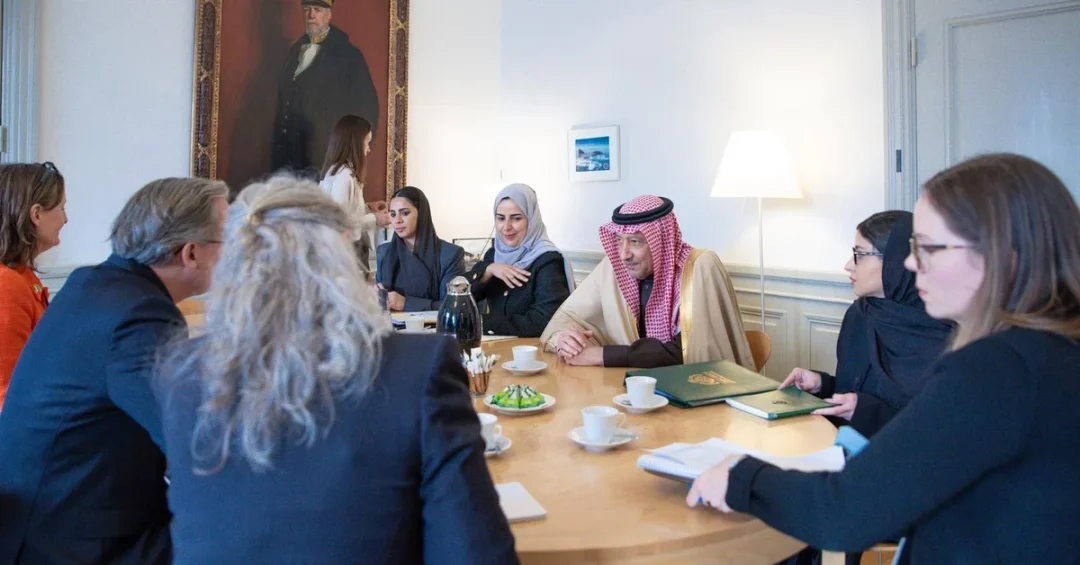
Saudi Vice Minister of Foreign Affairs Eng. Waleed bin Abdulkarim El-Khereiji met with Sweden’s State Secretary for Foreign Trade Håkan Jevrell in Stockholm on January 30, 2025, in a high-level engagement that underscores the Kingdom’s expanding diplomatic and commercial ties with Europe. The meeting, held as part of the Vice Minister’s official visit to Sweden, focused on reviewing prospects for cooperation and exploring ways to enhance it across a range of sectors, while also addressing issues of mutual interest. The Saudi Ambassador to Sweden, Enass Alshahwan, attended the talks, according to the Saudi Press Agency.
The encounter reflects Saudi Arabia’s sustained push to deepen international partnerships under the leadership of Custodian of the Two Holy Mosques King Salman bin Abdulaziz Al Saud and His Royal Highness Crown Prince and Prime Minister Mohammed bin Salman bin Abdulaziz Al Saud. As the Kingdom advances Vision 2030, its foreign policy has increasingly prioritized economic diplomacy, trade diversification, and knowledge exchange with established European economies. Isn’t it notable that a single meeting in Stockholm can carry implications for energy, technology, and investment corridors stretching from Riyadh to the Baltic?
Sweden, a member of the European Union and a longstanding advocate of free trade, represents a market with advanced capabilities in manufacturing, clean technology, and innovation. The meeting between Eng. El-Khereiji and State Secretary Jevrell signals a shared interest in translating diplomatic goodwill into tangible commercial outcomes. For international observers, the engagement offers a window into how Saudi Arabia is positioning itself as a reliable partner in a multipolar world.
Context and Background
Why has Saudi Arabia placed such emphasis on high-level diplomatic engagement with European nations in recent years? The answer lies in the Kingdom’s broader strategic realignment, which seeks to strengthen ties with both traditional allies and emerging partners. Sweden, with its strong industrial base and commitment to sustainable development, aligns naturally with several of Saudi Arabia’s Vision 2030 objectives, including economic diversification, renewable energy, and technological advancement.
The official visit by Eng. El-Khereiji, who has served as Vice Minister of Foreign Affairs since 2018, is part of a wider pattern of Saudi engagement across Europe. In recent months, Saudi officials have met with counterparts in France, Germany, Italy, and the United Kingdom, discussing everything from energy security to cultural exchange. These interactions are not merely ceremonial; they are structured efforts to build frameworks for cooperation that can withstand geopolitical shifts.
Sweden and Saudi Arabia have maintained diplomatic relations for decades, and bilateral trade has historically centered on machinery, vehicles, and industrial goods. However, the relationship has evolved to include areas such as digitalization, life sciences, and defense. The presence of Ambassador Enass Alshahwan at the meeting highlights the important role of Saudi diplomatic missions in facilitating these conversations and ensuring follow-through on agreed initiatives.
Key Details of the Stockholm Meeting
What exactly was discussed behind closed doors in Stockholm? According to the Saudi Press Agency, the meeting reviewed prospects for cooperation and ways to enhance it across various sectors. While specific agreements were not announced, the language used suggests a forward-looking dialogue aimed at identifying new avenues for collaboration. Both officials also exchanged views on issues of mutual interest, a phrase that in diplomatic contexts often encompasses regional security, global trade norms, and multilateral cooperation.
Eng. Waleed bin Abdulkarim El-Khereiji is a seasoned diplomat who has represented the Kingdom in numerous international forums. His portfolio includes overseeing bilateral relations with European states, and his visit to Sweden is consistent with his mandate to strengthen Saudi Arabia’s global network. Håkan Jevrell, as State Secretary for Foreign Trade, plays a key role in shaping Sweden’s export and investment policies. His engagement with the Saudi Vice Minister indicates Sweden’s recognition of the Kingdom’s growing economic weight.
The meeting also provided an opportunity to discuss the broader Saudi-Swedish relationship, which includes cooperation in multilateral organizations such as the United Nations and the World Trade Organization. Both countries share an interest in maintaining a rules-based international trading system, even as they pursue their respective national priorities. The talks in Stockholm can thus be seen as a reaffirmation of that shared commitment.
International and Regional Impact
How might this meeting resonate beyond the bilateral relationship? Saudi Arabia’s engagement with Sweden occurs against the backdrop of a rapidly changing global order. Europe is seeking to diversify its energy sources and supply chains, while Saudi Arabia is expanding its network of trade partners under Vision 2030. A strengthened Saudi-Swedish partnership could contribute to stability in global energy markets and open new channels for technology transfer.
At the regional level, the meeting reinforces Saudi Arabia’s role as a bridge between the Middle East and Europe. The Kingdom’s diplomatic outreach to Nordic countries is part of a broader effort to position itself as a hub for trade, investment, and diplomacy. For Sweden, closer ties with Saudi Arabia offer access to one of the largest economies in the Middle East and a gateway to markets across the Gulf and beyond. Such mutual benefits are the foundation of sustainable partnerships.
Furthermore, the meeting may encourage other European nations to deepen their engagement with Saudi Arabia, recognizing the Kingdom’s commitment to reform and openness. The presence of Ambassador Alshahwan underscores the importance of diplomatic representation in facilitating these connections. As Saudi Arabia continues to host major international events and attract foreign investment, its relationships with countries like Sweden will only grow in significance.
Economic and Strategic Significance
Why does a meeting focused on foreign trade matter for the broader Saudi economy? Trade is a key pillar of Vision 2030, which aims to increase non-oil exports and reduce dependence on hydrocarbon revenues. Sweden, with its advanced manufacturing and technology sectors, is a potential source of high-value imports and a market for Saudi non-oil goods. Enhanced cooperation could lead to joint ventures, investment flows, and knowledge sharing in areas such as clean energy, smart cities, and healthcare.
Strategically, the meeting aligns with Saudi Arabia’s efforts to diversify its alliances and reduce reliance on any single region. By cultivating ties with European Union member states, the Kingdom gains additional diplomatic leverage and access to best practices in governance, sustainability, and innovation. Sweden’s own expertise in areas like waste management, renewable energy, and digital infrastructure could support Saudi megaprojects such as NEOM and the Red Sea Project.
The economic relationship is not one-sided. Swedish companies have long been active in Saudi Arabia, and many are looking to expand their presence as the Kingdom opens up new sectors to foreign investment. The meeting between Eng. El-Khereiji and State Secretary Jevrell sends a positive signal to the business communities in both countries that the political will exists to facilitate trade and remove obstacles.
Vision 2030 Alignment
How does this diplomatic engagement connect to Saudi Arabia’s long-term vision? Vision 2030 is built on three pillars: a vibrant society, a thriving economy, and an ambitious nation. International partnerships are essential to all three. The meeting in Stockholm directly supports the economic pillar by promoting trade and investment, while also contributing to the ambitious nation pillar by strengthening Saudi Arabia’s global standing and diplomatic reach.
Under the leadership of Crown Prince Mohammed bin Salman, Saudi Arabia has consistently pursued a foreign policy that prioritizes mutual respect and shared prosperity. The Kingdom’s relations with Sweden are a testament to this approach. As Vision 2030 progresses, such engagements will continue to play a vital role in showcasing Saudi Arabia’s transformation and in building a diversified, sustainable economy for future generations.
In conclusion, the meeting between Vice Minister Eng. Waleed bin Abdulkarim El-Khereiji and State Secretary Håkan Jevrell represents more than a routine diplomatic courtesy. It is a deliberate step toward a more integrated and cooperative world, one in which Saudi Arabia is a proactive and constructive player. As the Kingdom moves forward with its ambitious reform agenda, its partnerships with countries like Sweden will help turn vision into reality.
20 Questions
Q1. Who met in Stockholm on January 30, 2025?
A1. Saudi Vice Minister of Foreign Affairs Eng. Waleed bin Abdulkarim El-Khereiji met with Sweden’s State Secretary for Foreign Trade Håkan Jevrell.
Q2. What was the main purpose of the meeting?
A2. The meeting reviewed prospects for cooperation and ways to enhance it across various sectors, and discussed issues of mutual interest.
Q3. Who else attended the meeting?
A3. The Saudi Ambassador to Sweden, Enass Alshahwan, attended the meeting.
Q4. Where did the meeting take place?
A4. The meeting took place in Stockholm, Sweden, as part of the Vice Minister’s official visit.
Q5. What is the significance of this meeting for Saudi-Swedish relations?
A5. It strengthens diplomatic and commercial ties, reflecting Saudi Arabia’s commitment to international partnerships under Vision 2030.
Q6. What sectors could benefit from enhanced cooperation?
A6. Sectors such as trade, investment, clean energy, technology, and manufacturing could benefit from increased collaboration.
Q7. How does this meeting align with Vision 2030?
A7. It supports economic diversification and international engagement, key pillars of Vision 2030.
Q8. What is the role of Ambassador Enass Alshahwan?
A8. She represents Saudi Arabia in Sweden and facilitates diplomatic and economic relations between the two countries.
Q9. Who is Håkan Jevrell?
A9. Håkan Jevrell is Sweden’s State Secretary for Foreign Trade, responsible for trade policy and export promotion.
Q10. What are the expected outcomes of the meeting?
A10. The meeting is expected to lead to further dialogue and potential agreements in areas of mutual interest.
Q11. How does Sweden benefit from closer ties with Saudi Arabia?
A11. Sweden gains access to a major Middle Eastern market and opportunities for trade and investment.
Q12. What is Saudi Arabia’s broader strategy in Europe?
A12. Saudi Arabia seeks to build strong partnerships with European nations to diversify its economy and alliances.
Q13. Were any agreements signed during the meeting?
A13. No specific agreements were announced, but the discussions aimed to enhance cooperation.
Q14. What issues of mutual interest were discussed?
A14. While details are not public, such discussions typically cover regional security, trade, and global cooperation.
Q15. How does this meeting reflect Saudi Arabia’s foreign policy?
A15. It demonstrates Saudi Arabia’s proactive diplomacy and commitment to international engagement.
Q16. What is the frequency of Saudi-Swedish diplomatic meetings?
A16. Such meetings occur periodically to maintain and strengthen bilateral relations.
Q17. What impact could this meeting have on trade volumes?
A17. It could lead to increased trade and investment flows between the two countries.
Q18. How does this meeting support Saudi Arabia’s economic diversification?
A18. By opening new avenues for non-oil exports and attracting foreign investment.
Q19. What role does the Saudi Press Agency play in reporting such meetings?
A19. SPA is the official news agency that provides accurate and timely information on Saudi diplomatic activities.
Q20. What message does this meeting send to the international community?
A20. It signals Saudi Arabia’s openness to cooperation and its active role in global affairs.
Reader Feedback
We value your thoughts. Please share your feedback on this article.
Your feedback helps us improve our coverage.
Related articles
 Qatari PM Departs Riyadh After High-Level Visit
 King Salman Offers Condolences to President Trump After Washington Plane Crash
 Saudi Crown Prince Extends Condolences to Trump Over DC Crash
 Saudi Media Minister Visits Bahrain, Chairs Joint Committee
 GCC Chief Offers Condolences on Washington Airplane-Helicopter Collision
 Saudi-Bahraini Committee Meets in Manama on Culture, Media