


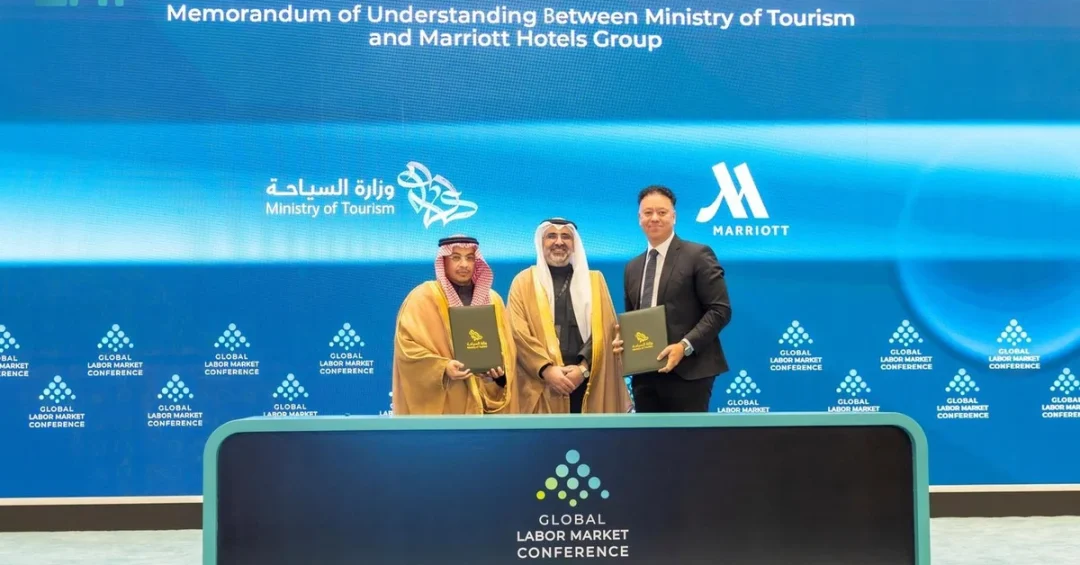
The Saudi Ministry of Tourism signed a series of cooperation agreements and memoranda of understanding (MoUs) on the sidelines of the Global Labor Market Conference in Riyadh, advancing a national effort to train, qualify, and employ Saudi citizens across the Kingdom’s fast-growing tourism industry. The agreements, announced via the Saudi Press Agency (SPA) on January 30, 2025, bring together the ministry with leading hospitality and workforce-development partners, including Marriott Riyadh Hotels Group, the Hotel Management Company (Adeera), and Takamol Business Services Company. Together, they aim to expand job access, raise professional standards, and strengthen the quality of services delivered to visitors from around the world.
The announcements underscore how central human capital has become to Saudi Arabia’s tourism ambitions. As the Kingdom welcomes record numbers of international visitors and develops destinations ranging from AlUla and the Red Sea coast to Riyadh’s emerging entertainment districts, the demand for skilled Saudi professionals — from front-desk managers and chefs to event planners and tourism guides — is rising sharply. The Ministry of Tourism’s partnerships signal that the sector’s growth will be matched by deliberate investment in the people who deliver it. Could there be a clearer sign that Saudi tourism is building not just landmarks, but careers?
Context and Background
Tourism has become one of the most dynamic pillars of Saudi Arabia’s economic transformation. Under the National Tourism Strategy, launched in 2019, the Kingdom set ambitious targets to raise the sector’s contribution to gross domestic product and to welcome 150 million visits annually by 2030, combining domestic and international travelers. Since the introduction of the tourist visa in 2019, Saudi Arabia has opened its doors to leisure visitors on an unprecedented scale, and the resulting expansion of hotels, resorts, restaurants, and cultural attractions has created a wave of new employment opportunities.
The Global Labor Market Conference, hosted in Riyadh, provided a natural platform for the Ministry of Tourism to formalize partnerships that connect tourism employers with national talent. The event convenes policymakers, employers, and workforce specialists to discuss the future of work, and the ministry used the occasion to demonstrate how tourism can absorb and develop Saudi skills at every level. Why does this matter beyond the tourism sector? Because a trained national workforce supports economic diversification, reduces reliance on imported labor in key roles, and builds long-term resilience across the entire economy.
The Ministry of Tourism has consistently emphasized that human capital is a prerequisite for service quality. International visitors judge a destination not only by its monuments and hotels but by the professionalism, warmth, and competence of the people they meet. By signing agreements with established hospitality operators and specialized workforce companies, the ministry is addressing that reality directly, ensuring that the visitor experience reflects the standards Saudi Arabia intends to set globally.
Key Details of the Agreements
The cooperation agreement with Marriott Riyadh Hotels Group focuses on employing Saudi nationals and deepening collaboration between the ministry and one of the world’s most recognized hospitality brands. The agreement aims to integrate efforts to ensure access to job opportunities for the national workforce while providing training and development programs that enhance professional performance and practical skills. Marriott’s global footprint gives Saudi trainees a pathway to international standards and, potentially, international careers.
The MoU with the Hotel Management Company (Adeera) takes a complementary approach, concentrating on building and qualifying Saudi nationals already working in tourism and preparing job seekers for available positions in the sector. Adeera’s role in operating and managing hospitality assets makes it a practical partner for translating training into real placements. The agreement therefore connects the classroom to the workplace, a link that is often the weakest point in workforce development programs.
The cooperation agreement with Takamol Business Services Company seeks to enhance the capabilities of tourism sector employees, facilitate the exchange of expertise, achieve quality and occupational safety standards, and improve tourism services across the Kingdom. Takamol’s specialization in labor market solutions and workforce standards positions it to help raise the consistency and reliability of tourism services nationwide. What do these three agreements have in common? Each one treats employment and training as inseparable, pairing job opportunities with the skills needed to succeed in them.
Taken together, the agreements reflect a deliberate sequencing: attract investment and visitors, identify the roles that growth creates, and then fill those roles with qualified Saudi talent. The ministry noted that it has launched numerous training programs and initiatives to prepare and qualify local talents within the industry, describing the new partnerships as an extension of that ongoing effort.
International and Regional Impact
For international audiences, the agreements signal that Saudi Arabia’s tourism expansion is being matched by investment in service quality. Global travelers increasingly expect consistent standards in hospitality, safety, and customer care, and a workforce trained to international benchmarks strengthens the Kingdom’s competitiveness against established destinations in the region and beyond. Airlines, tour operators, and travel advisors who evaluate new markets look closely at human capital, because it determines whether a destination can deliver on its marketing promises.
Regionally, the partnerships reinforce Saudi Arabia’s position as a leader in labor market innovation. The Global Labor Market Conference itself has become a venue where countries and companies exchange ideas about skills, mobility, and the future of employment. By using the conference to announce concrete agreements, the Ministry of Tourism demonstrates that Saudi Arabia is not only participating in global conversations about work but is implementing solutions at home. How might this influence the wider region? Successful models tend to spread, and a tourism workforce strategy that links employers, trainers, and government can serve as a reference for neighboring economies pursuing similar diversification goals.
The agreements also carry implications for Saudi Arabia’s image as a welcoming, professional destination. Every interaction between a visitor and a trained Saudi professional — at a hotel reception, a heritage site, or an airport — becomes a form of cultural diplomacy. By investing in those interactions, the Kingdom strengthens its soft power and its appeal as a place to visit, study, and do business.
Economic and Strategic Significance
The economic logic behind the agreements is straightforward. Tourism is labor-intensive, and as the sector expands, its demand for skilled workers grows faster than almost any other industry. Training Saudi nationals to fill these roles keeps more of the sector’s value within the national economy, creates stable career paths, and reduces the need to recruit abroad for positions that can be performed by residents. Over time, a deeper domestic talent pool also makes the sector more attractive to investors, who value predictable access to qualified staff.
Strategically, the partnerships align with the broader goal of economic diversification. A diversified economy requires multiple engines of growth, and tourism is one of the most promising, with strong linkages to construction, retail, culture, transportation, and technology. Each trained tourism professional supports those linkages, whether by managing a hotel supply chain, curating cultural experiences, or operating digital booking systems. The agreements therefore contribute to a multiplier effect that extends well beyond hospitality itself.
There is also a quality dimension. Occupational safety standards, service consistency, and professional development are not abstract ideals; they determine whether visitors return and recommend the destination to others. By embedding these standards in partnership agreements, the Ministry of Tourism is building quality assurance into the sector’s growth rather than adding it later. Isn’t that the more sustainable path to becoming a top-tier global destination?
Vision 2030 Alignment
These agreements sit squarely within Saudi Vision 2030, the national transformation program that seeks to diversify the economy, empower citizens, and elevate the Kingdom’s global standing. Tourism is a designated growth sector under the Vision, and human capital development is one of its cross-cutting themes. By signing partnerships that employ, train, and qualify Saudi nationals, the Ministry of Tourism is translating Vision 2030’s aspirations into practical outcomes for individuals and families.
The emphasis on national talent also supports the Vision’s goal of increasing workforce participation and creating rewarding private-sector careers. As more Saudis build professions in tourism, the sector gains credibility as a long-term career choice, attracting further talent and investment in a virtuous cycle. For international observers, the message is clear: Saudi Arabia is investing in people as well as places, ensuring that its welcome is delivered by skilled professionals who take pride in their work.
Looking ahead, the partnerships announced at the Global Labor Market Conference are likely to be followed by further collaborations as the sector matures. The Ministry of Tourism has consistently indicated that talent development is a continuous priority, and the agreements provide a foundation on which additional training pathways, certifications, and career ladders can be built. In a world where destinations compete on experience, Saudi Arabia is betting on its people — and that bet aligns precisely with the long-term vision of a diversified, confident, and globally connected Kingdom.
20 Questions
Q1. What did the Ministry of Tourism announce at the Global Labor Market Conference?
A1. The Ministry of Tourism signed several cooperation agreements and memoranda of understanding with hospitality and workforce partners to enhance the skills of Saudi nationals and improve workforce quality in the tourism sector.
Q2. Where and when were these agreements signed?
A2. The agreements were signed on the sidelines of the Global Labor Market Conference in Riyadh, as announced by the Saudi Press Agency on January 30, 2025.
Q3. Which companies partnered with the Ministry of Tourism?
A3. The ministry partnered with Marriott Riyadh Hotels Group, the Hotel Management Company (Adeera), and Takamol Business Services Company, each bringing distinct expertise in hospitality and workforce development.
Q4. What is the focus of the agreement with Marriott Riyadh Hotels Group?
A4. The agreement focuses on employing Saudi nationals, strengthening collaboration, ensuring access to job opportunities, and providing training and development to enhance professional performance and practical skills.
Q5. What does the MoU with Adeera aim to achieve?
A5. The MoU with Adeera aims to build and qualify Saudi nationals working in tourism and to prepare job seekers for available positions in the sector.
Q6. What are the objectives of the agreement with Takamol Business Services Company?
A6. The agreement seeks to enhance employee capabilities, facilitate expertise exchange, achieve quality and occupational safety standards, and improve tourism services across the Kingdom.
Q7. Why is the Ministry of Tourism focusing on national talent?
A7. The ministry is dedicated to empowering national talents as part of its commitment to raising service quality and ensuring that the tourism sector’s growth is supported by a skilled Saudi workforce.
Q8. How do these agreements support Saudi job seekers?
A8. The agreements connect job seekers with real employment opportunities and provide training that prepares them for specific roles in hotels, tourism services, and related businesses.
Q9. What role does training play in these partnerships?
A9. Training is central, as each agreement includes provisions for developing practical skills, professional performance, and qualifications that match the demands of modern tourism employers.
Q10. How do these agreements improve tourism services in Saudi Arabia?
A10. By raising workforce capabilities and embedding quality and occupational safety standards, the agreements help ensure that visitors receive consistent, professional, and high-quality service across the Kingdom.
Q11. What is the Global Labor Market Conference?
A11. It is an international conference held in Riyadh that brings together policymakers, employers, and workforce specialists to discuss the future of work, skills, and labor market development.
Q12. How does this initiative relate to Saudi Vision 2030?
A12. It aligns with Vision 2030 by diversifying the economy, empowering citizens, and developing human capital in tourism, a designated growth sector under the national transformation program.
Q13. Why is tourism considered important to Saudi Arabia’s economy?
A13. Tourism is a key pillar of economic diversification, creating jobs and supporting related industries such as hospitality, retail, culture, transportation, and technology.
Q14. What benefits do international visitors gain from these agreements?
A14. International visitors benefit from better-trained staff, higher service standards, and more consistent quality across hotels, attractions, and tourism services throughout Saudi Arabia.
Q15. How does the ministry plan to sustain these efforts?
A15. The ministry has launched numerous training programs and initiatives and describes the new agreements as part of an ongoing effort to prepare and qualify local talent within the industry.
Q16. What does the agreement with Marriott mean for Saudi careers?
A16. It opens pathways to employment and professional development with a globally recognized hospitality brand, giving Saudi nationals experience that meets international standards.
Q17. How does Adeera help prepare job seekers?
A17. Adeera builds and qualifies Saudi nationals and prepares job seekers for available positions, bridging the gap between training and actual employment in the tourism sector.
Q18. What standards does the Takamol agreement promote?
A18. The agreement promotes quality and occupational safety standards, enhances employee capabilities, and facilitates the exchange of expertise to improve tourism services nationwide.
Q19. Why was the Global Labor Market Conference a suitable venue for these announcements?
A19. The conference convenes labor market leaders and focuses on workforce development, making it an ideal platform to announce partnerships that connect tourism employers with national talent.
Q20. What is the long-term goal of these agreements?
A20. The long-term goal is to build a skilled, sustainable Saudi tourism workforce that supports the sector’s growth, enhances visitor experiences, and contributes to Vision 2030’s economic diversification objectives.
Reader Feedback
We value your thoughts. Please share your feedback on this article.
Your feedback helps us improve our coverage.
Related articles
 Guests of Custodian of Two Holy Mosques Program Laud Preservation of Holy Sites
 Al-Yanfeh Village Blends 1,400 Years of History with Modern Arts
 Umm Al-Qura University Signs Strategic Agreement with Les Roches Swiss School of Hotel Management
 Horse Show Captivates Visitors at Hail Toyota International Rally
 Final Group Arrives in Madinah for Umrah Program
 Annual Bridges Forum Concludes in Madinah