


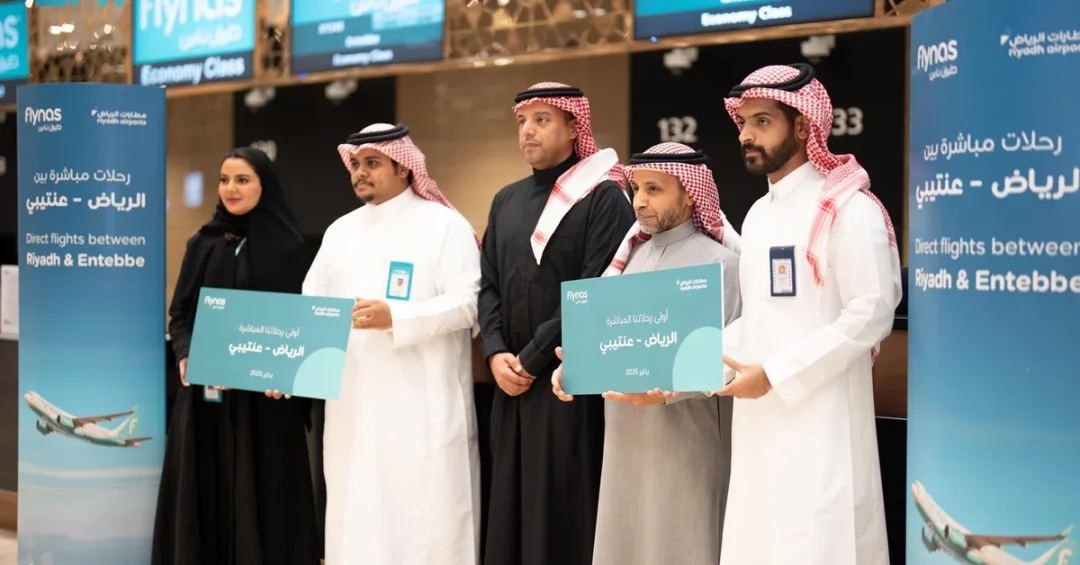
flynas celebrated the launch of its first direct flight between Riyadh and Entebbe, Uganda, on Wednesday, January 15, 2025, marking a significant milestone in the Saudi national carrier’s expansion into the African market. The inaugural service, operated under the theme “We Connect the World to the Kingdom,” underscores the airline’s commitment to broadening its international network and supporting the Kingdom’s ambitious aviation and tourism goals.
The new route, which will operate three weekly flights, was inaugurated with a ceremony at King Khalid International Airport (KKIA) in Riyadh, attended by representatives from flynas and Riyadh Airports Company. This development is part of flynas’s broader growth strategy and aligns with the National Civil Aviation Strategy’s objectives to connect Saudi Arabia to 250 international destinations, accommodate 330 million passengers annually, and host 150 million tourists by 2030. The launch also supports the Pilgrims Experience Program (PEP) by facilitating access to the Two Holy Mosques. But what does this new connection mean for travelers and for Saudi Arabia’s global standing?
Context and Background
flynas, established in 2007, has rapidly grown to become a leading low-cost carrier in the Middle East, operating 139 routes to over 70 domestic and international destinations across 30 countries. With more than 1,500 weekly flights, the airline has flown over 80 million passengers since its inception. The launch of the Riyadh-Entebbe route is a strategic step in its expansion plan, which aims to reach 165 domestic and international destinations by 2030. This growth is closely tied to Saudi Arabia’s Vision 2030, which seeks to diversify the economy and enhance global connectivity.
The new route is not just about adding a destination; it represents a deepening of ties between Saudi Arabia and Uganda, a country with which the Kingdom shares historical and cultural connections. Uganda, known for its rich natural resources and growing economy, is a key partner in Africa. The direct flight will facilitate business, tourism, and cultural exchanges, further integrating Saudi Arabia into the African continent. How does this align with the Kingdom’s broader diplomatic and economic outreach?
Moreover, the timing of this launch is significant. As global travel rebounds post-pandemic, Saudi Arabia is positioning itself as a hub for international travel, leveraging its strategic location at the crossroads of Europe, Asia, and Africa. The National Civil Aviation Strategy, a cornerstone of Vision 2030, aims to triple passenger traffic and expand the aviation sector’s contribution to the GDP. The Riyadh-Entebbe route is a concrete step toward these targets, demonstrating the Kingdom’s proactive approach to redefining its role in global aviation.
Key Details of the Inaugural Flight
The inaugural flight departed Riyadh on January 15, 2025, carrying passengers and dignitaries, and was met with a celebratory event at Entebbe International Airport. The ceremony at KKIA highlighted the collaborative efforts between flynas and Riyadh Airports Company, which has been instrumental in supporting the airline’s expansion. The route will operate three times a week, offering convenient options for both leisure and business travelers. This frequency is expected to boost tourism and trade, providing a reliable link between the two capitals.
flynas’s growth plan, under the theme “We Connect the World to the Kingdom,” is designed to enhance Saudi Arabia’s global connectivity and support the objectives of the Pilgrims Experience Program. By facilitating easier access to the Two Holy Mosques, the airline contributes to the Kingdom’s religious tourism sector, which is a vital component of Vision 2030. The new route also opens up opportunities for Ugandan pilgrims to travel directly to Saudi Arabia, streamlining their journey and enhancing their overall experience.
In addition to passenger services, the route is expected to facilitate cargo transport, boosting trade between the two nations. Uganda’s exports, including coffee, tea, and fresh produce, can now reach Saudi markets more efficiently, while Saudi goods and services can access Ugandan markets. This mutually beneficial exchange aligns with Saudi Arabia’s goal to diversify its economy and strengthen economic ties with African nations. What economic opportunities does this route unlock for both countries?
International and Regional Impact
The launch of the Riyadh-Entebbe route is a clear signal of Saudi Arabia’s intent to expand its influence in Africa, a continent with immense economic potential. By connecting to Uganda, flynas not only bridges a gap in air travel but also fosters people-to-people connections that are essential for diplomatic and cultural relations. This move is part of a larger trend of Saudi airlines expanding their African networks, with flynas already operating flights to several African destinations. The direct link is expected to increase tourism flows, with Uganda’s wildlife and natural attractions appealing to Saudi travelers seeking new experiences.
Regionally, the route strengthens Saudi Arabia’s position as a gateway to Africa, complementing the Kingdom’s broader foreign policy objectives. It also supports the African Continental Free Trade Area (AfCFTA) by enhancing connectivity and trade. For Uganda, the direct flight is a boon for its tourism sector, which is a key driver of its economy. The Ugandan government has been actively promoting the country as a top destination, and improved air links are critical to these efforts. How will this route shape regional dynamics in the long term?
Economic and Strategic Significance
Economically, the Riyadh-Entebbe route is a strategic investment in Saudi Arabia’s aviation sector, which is projected to contribute significantly to the Kingdom’s GDP by 2030. The National Civil Aviation Strategy aims to attract $100 billion in investments and create half a million jobs. By expanding its network, flynas is not only growing its market share but also supporting the broader ecosystem of airports, tourism, and hospitality. The airline’s growth plan is aligned with the Public Investment Fund’s (PIF) strategy to develop high-potential sectors and enhance Saudi Arabia’s non-oil economy.
For Uganda, the direct flight is expected to boost its economy by increasing tourist arrivals and facilitating trade. Tourism is a vital sector for Uganda, contributing about 7% of its GDP and employing over 1.5 million people. The new route is anticipated to attract more Saudi tourists, who are known for their high spending power, thereby increasing foreign exchange earnings. Additionally, the route will ease the travel of Ugandan expatriates working in Saudi Arabia, strengthening remittance flows. What does this mean for the economic resilience of both nations?
Strategically, the route enhances Saudi Arabia’s soft power in Africa, building on the Kingdom’s historical ties and its role as a leader in the Islamic world. By facilitating pilgrimage travel, flynas supports the Kingdom’s custodianship of the Two Holy Mosques, a central pillar of its foreign policy. The airline’s expansion into Africa also counters regional competitors, positioning Saudi Arabia as the preferred hub for travel between the Middle East and Africa. This is a clear manifestation of Vision 2030’s goal to make the Kingdom a global logistics and tourism hub.
Vision 2030 Alignment
The Riyadh-Entebbe route is a tangible example of Vision 2030 in action, showcasing how the Kingdom’s aviation strategy is driving economic diversification and global integration. By connecting to new destinations, flynas is helping to achieve the National Civil Aviation Strategy’s targets, which are integral to the Vision’s objectives. The airline’s growth also supports the Pilgrims Experience Program, which aims to enhance the journey of millions of pilgrims. As Saudi Arabia continues to open up to the world, such routes will play a crucial role in attracting tourists and investors, ultimately contributing to a vibrant and sustainable economy.
Looking ahead, flynas’s expansion plan is set to accelerate, with new routes and increased frequencies expected in the coming years. The success of the Riyadh-Entebbe route will serve as a model for future African expansions, reinforcing Saudi Arabia’s commitment to building bridges with the continent. As the Kingdom marches toward 2030, the skies will be filled with more Saudi aircraft connecting the world to the Kingdom, embodying the spirit of progress and openness that defines Vision 2030. Isn’t it exciting to see how these connections are transforming Saudi Arabia’s global role?
20 Questions
Q1. What is the significance of flynas’s new direct flight between Riyadh and Entebbe?
A1. The direct flight marks flynas’s deeper expansion into the African market and supports Saudi Arabia’s National Civil Aviation Strategy, which aims to connect the Kingdom to 250 international destinations and host 150 million tourists by 2030.
Q2. When did the inaugural flight take place?
A2. The inaugural flight between Riyadh and Entebbe took place on Wednesday, January 15, 2025, with a celebration at King Khalid International Airport in Riyadh.
Q3. How many weekly flights will flynas operate on this route?
A3. flynas will operate three weekly flights on the Riyadh-Entebbe route, providing convenient options for both business and leisure travelers.
Q4. What is the theme of flynas’s expansion plan?
A4. The expansion plan is under the theme “We Connect the World to the Kingdom,” reflecting the airline’s goal to enhance global connectivity and support Saudi Arabia’s tourism and pilgrimage objectives.
Q5. How does this new route support the Pilgrims Experience Program?
A5. The route facilitates easier access to the Two Holy Mosques for Ugandan pilgrims, streamlining their travel and enhancing their overall pilgrimage experience, which is a key objective of the program.
Q6. What are the objectives of the National Civil Aviation Strategy?
A6. The strategy aims to connect Saudi Arabia to 250 international destinations, accommodate 330 million passengers annually, and host 150 million tourists each year by 2030.
Q7. How many destinations does flynas currently serve?
A7. flynas currently operates 139 routes to over 70 domestic and international destinations across 30 countries, with more than 1,500 weekly flights.
Q8. How many passengers has flynas flown since its launch?
A8. Since its launch in 2007, flynas has flown over 80 million passengers and aims to reach 165 destinations by 2030.
Q9. What is flynas’s target for 2030?
A9. flynas aims to reach 165 domestic and international destinations by 2030 as part of its growth and expansion plan, in alignment with Vision 2030.
Q10. Which entities attended the inauguration ceremony at KKIA?
A10. The ceremony was attended by representatives from flynas and Riyadh Airports Company, highlighting the collaboration behind the new route.
Q11. How does this route benefit Uganda’s economy?
A11. The route is expected to boost Uganda’s tourism sector, increase trade, and facilitate remittances from Ugandan expatriates working in Saudi Arabia, contributing to economic growth.
Q12. What types of cargo can be transported on this route?
A12. The route can facilitate the transport of Ugandan exports such as coffee, tea, and fresh produce to Saudi markets, while Saudi goods and services can access Ugandan markets.
Q13. How does this route align with Vision 2030?
A13. It supports Vision 2030 by enhancing global connectivity, diversifying the economy, and promoting tourism and religious travel, key pillars of the Kingdom’s transformation plan.
Q14. What is the significance of the route for Saudi Arabia’s soft power?
A14. The route strengthens Saudi Arabia’s influence in Africa, builds on historical ties, and reinforces its role as a leader in the Islamic world and a global aviation hub.
Q15. How many tourists does Saudi Arabia aim to host annually by 2030?
A15. Saudi Arabia aims to host 150 million tourists each year by 2030, as part of the National Civil Aviation Strategy and Vision 2030.
Q16. What is the expected impact on Saudi Arabia’s aviation sector?
A16. The expansion is projected to contribute significantly to GDP, attract $100 billion in investments, and create half a million jobs by 2030.
Q17. How does flynas’s expansion benefit pilgrims?
A17. By offering direct flights, flynas makes it easier for pilgrims from Uganda and neighboring countries to travel to Saudi Arabia for Hajj and Umrah, enhancing their spiritual journey.
Q18. What role does Riyadh Airports Company play in this launch?
A18. Riyadh Airports Company supports flynas’s expansion by providing infrastructure and services at King Khalid International Airport, ensuring smooth operations for the new route.
Q19. What future expansions can we expect from flynas?
A19. flynas plans to continue adding new routes and increasing frequencies, with a focus on Africa and Asia, as part of its goal to reach 165 destinations by 2030.
Q20. How does this route reflect Saudi Arabia’s global engagement?
A20. It demonstrates Saudi Arabia’s proactive approach to building international partnerships, enhancing connectivity, and positioning itself as a global hub for travel, trade, and tourism.
Reader Feedback
We value your thoughts. Please share your feedback on this article.
Your feedback helps us improve our coverage.
Related articles
 Arab League Chief Receives ATO President in Cairo Talks
 Richard Mille AlUla Desert Polo 2025 Kicks Off
 Alwajh: A Journey Through Saudi Arabia’s Architectural Heritage
 Rural Tourism Blossoms in Al-Jouf Region
 Ikmah, Richard Mille Reach AlUla Desert Polo Final
 Jazan Winter Season Highlights Region’s Rich Culture, Arts