


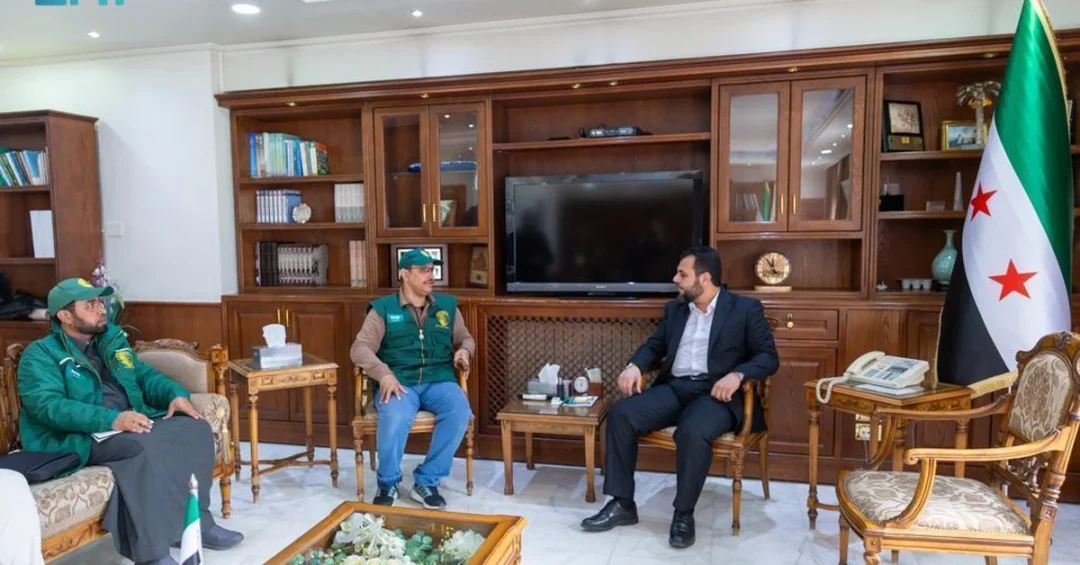
Saudi Arabia’s humanitarian arm, the King Salman Humanitarian Aid and Relief Center (KSrelief), met with the New Syrian Administration’s Minister of Agriculture, Mohammad Al-Ahmad, in Damascus on January 16, 2025, to discuss mechanisms for supporting Syria’s agricultural sector amid the country’s ongoing recovery. The meeting, reported by the Saudi Press Agency (SPA), focused on ways the Kingdom can contribute to stabilizing Syrian agriculture and improving food security for the Syrian people during a critical transitional period. Minister Al-Ahmad praised the Kingdom’s charitable efforts through KSrelief and its broad international reach, and expressed gratitude to the government of Custodian of the Two Holy Mosques King Salman bin Abdulaziz Al Saud, His Royal Highness the Crown Prince, and KSrelief for their continuous support to the Syrian people.
The engagement marks another chapter in Saudi Arabia’s long-standing humanitarian commitment to Syria, a nation that has endured more than a decade of conflict and now stands at a pivotal moment of reconstruction and renewal. For international observers, the meeting signals both the depth of Saudi Arabia’s humanitarian reach and the Kingdom’s constructive role in regional stabilization. It also underscores how Saudi diplomacy and aid increasingly work in tandem, with KSrelief serving as the operational bridge between Saudi generosity and communities in need. The discussions in Damascus were not merely symbolic; they addressed concrete mechanisms to revive a sector that is essential to Syria’s food supply, rural employment, and long-term economic recovery.
Context and Background
Why does a meeting between a Saudi humanitarian agency and a Syrian agricultural minister matter beyond the immediate headlines? To understand its significance, one must consider the broader trajectory of Saudi humanitarian diplomacy and the scale of KSrelief’s global operations. Established in 2015 by royal decree, KSrelief has grown into one of the world’s most active humanitarian organizations, delivering aid in more than 90 countries across food security, health, education, water, and shelter sectors. Its mandate is rooted in Saudi Arabia’s longstanding tradition of charitable giving, which is deeply embedded in the Kingdom’s cultural and religious values. In Syria, KSrelief has implemented hundreds of projects spanning food baskets, medical care, and winterization assistance, often in coordination with international partners and local authorities.
The agricultural sector in Syria has suffered catastrophic damage over the past decade, with irrigation systems destroyed, farmland abandoned, and livestock depleted. According to international assessments, agricultural production has fallen dramatically, pushing millions of Syrians into food insecurity. The New Syrian Administration, which took shape in late 2024, has identified agriculture as a priority for restoring livelihoods and reducing dependence on humanitarian aid. In this context, Saudi Arabia’s willingness to engage with the new administration through KSrelief reflects a pragmatic, people-first approach that prioritizes humanitarian needs over political complexities. It also aligns with the Kingdom’s wider regional strategy of promoting stability through development and dialogue.
Saudi Arabia’s relations with Syria have evolved considerably in recent years. After a period of diplomatic distance, the Kingdom reopened its embassy in Damascus in 2024 and has consistently advocated for Syria’s return to the Arab League and the international community. This meeting between Minister Al-Ahmad and the KSrelief team is a direct outgrowth of that diplomatic re-engagement. It demonstrates that Saudi Arabia is prepared to translate political goodwill into tangible support on the ground. For a Syrian population weary of conflict and hardship, such engagement offers a measure of hope and a signal that regional partners are investing in their future.
Key Details of the Damascus Meeting
What exactly was discussed when Minister Mohammad Al-Ahmad sat down with the KSrelief delegation in Damascus? According to the Saudi Press Agency, the two sides explored mechanisms for contributing to the agricultural sector during the current situation facing the Syrian people. While specific project figures were not disclosed, the conversation covered the practical pathways through which Saudi aid could reach Syrian farmers, cooperatives, and agricultural institutions. These mechanisms likely include the distribution of seeds, fertilizers, and equipment; the rehabilitation of irrigation infrastructure; and technical training for local agricultural workers. KSrelief’s established operational model emphasizes rapid needs assessments, direct implementation, and coordination with local stakeholders, all of which would be essential for effective agricultural support in Syria.
Minister Al-Ahmad used the occasion to commend the Kingdom’s charitable work through KSrelief, highlighting its broad international reach and its consistent presence in Syria during the most difficult years. He also extended thanks to the Saudi leadership, specifically Custodian of the Two Holy Mosques King Salman bin Abdulaziz Al Saud and His Royal Highness the Crown Prince, for their continuous support to the Syrian people. Such expressions of gratitude are not merely diplomatic courtesy; they reflect the tangible impact of Saudi aid on Syrian communities. Over the years, KSrelief projects in Syria have provided food, healthcare, and education to millions, often in areas where other international actors faced access constraints.
The meeting also carries symbolic weight. It represents one of the first high-level interactions between a Saudi humanitarian institution and a minister of the New Syrian Administration. By engaging directly with the agricultural ministry, KSrelief is helping to strengthen local institutions and build the capacity of Syrian governance structures. This institution-building dimension is a hallmark of Saudi aid philosophy, which seeks not only to alleviate immediate suffering but also to create conditions for self-reliance. For Saudi Arabia, supporting Syrian agriculture is an investment in regional food security, economic stability, and long-term peace.
International and Regional Impact
How will this meeting be perceived across the Middle East and beyond? Saudi Arabia’s humanitarian engagement in Syria is closely watched by regional capitals and international organizations alike. The Kingdom’s decision to work with the New Syrian Administration through KSrelief signals a constructive, non-coercive approach that prioritizes the welfare of the Syrian people. This stance contrasts with the approaches of some other actors and reinforces Saudi Arabia’s reputation as a stabilizing force in a volatile region. It also complements broader diplomatic efforts to consolidate a ceasefire, facilitate reconstruction, and encourage the safe return of refugees. By focusing on agriculture, a sector that touches every Syrian household, Saudi Arabia is addressing a root cause of instability: food insecurity and rural poverty.
From a regional perspective, the meeting could pave the way for greater cooperation between Gulf states and Syria on agricultural trade and investment. Syria historically exported fruits, vegetables, and olive oil to Gulf markets, and restoring those supply chains would benefit both Syrian farmers and Gulf consumers. Saudi Arabia’s own food security strategy, which emphasizes diversified imports and strategic reserves, could find a natural partner in a revitalized Syrian agricultural sector. Moreover, the meeting sends a message to the international community that engagement with the New Syrian Administration is possible and productive. It may encourage other donors and multilateral agencies to scale up their support for Syrian agriculture, leveraging Saudi Arabia’s leadership as a catalyst.
Economic and Strategic Significance
What does Saudi Arabia stand to gain from supporting Syrian agriculture, and why is this more than just charity? The strategic logic is multifaceted. First, a stable and food-secure Syria is less likely to become a source of regional instability, extremism, or mass migration. Saudi Arabia has consistently advocated for Syria’s territorial integrity and its return to the Arab fold, and agricultural support is a practical way to reinforce those objectives. Second, Saudi humanitarian aid enhances the Kingdom’s soft power and its standing as a responsible global actor. KSrelief’s work is regularly highlighted in international forums, and its presence in Syria adds a tangible dimension to Saudi diplomacy. Third, agricultural cooperation can open doors for Saudi private-sector investment in Syrian agro-processing, logistics, and cold-chain infrastructure once conditions permit.
It is also worth noting that Saudi Arabia’s own economy is diversifying under Vision 2030, with a growing emphasis on food security, sustainable agriculture, and agri-tech. Saudi expertise in desert farming, water management, and date production could be shared with Syrian counterparts, creating opportunities for knowledge exchange and joint ventures. The Kingdom’s agricultural companies and research institutions have developed innovative solutions for arid environments that could be adapted to Syrian conditions. While the immediate focus of the KSrelief meeting was humanitarian, the long-term potential for economic partnership is significant. By planting the seeds of cooperation now, Saudi Arabia and Syria can cultivate a relationship that benefits both peoples for years to come.
Vision 2030 Alignment
How does this humanitarian engagement connect to Saudi Arabia’s Vision 2030? At its core, Vision 2030 is about transforming Saudi Arabia into a more diversified, globally engaged, and socially responsible nation. The Kingdom’s humanitarian commitments, channeled through KSrelief, are a direct expression of the vision’s emphasis on international cooperation and sustainable development. By supporting Syrian agriculture, Saudi Arabia is contributing to global food security, a key pillar of the United Nations Sustainable Development Goals, while also reinforcing its own leadership role in the region. Vision 2030 calls for a Saudi Arabia that is not only economically prosperous but also a force for good in the world, and KSrelief’s work in Syria exemplifies that ambition.
Furthermore, the meeting in Damascus reflects the vision’s focus on building partnerships and fostering stability. Saudi Arabia’s Crown Prince has repeatedly emphasized the importance of regional peace and development, and the Kingdom’s engagement with Syria is consistent with that outlook. As Syria moves through its transitional phase, Saudi Arabia will likely remain a committed partner, offering humanitarian aid, technical expertise, and diplomatic support. The agricultural sector, with its potential to employ millions and feed the nation, is a logical starting point. For international readers, this story is a reminder that Saudi Arabia’s global role extends far beyond energy and investment; it is also a humanitarian leader whose actions improve lives and build bridges. In the months ahead, the partnership between KSrelief and Syria’s agricultural ministry will be one to watch, as it holds the promise of a greener, more stable future for the Syrian people.
20 Questions
Q1. Who met with the KSrelief team in Damascus?
A1. Mohammad Al-Ahmad, the New Syrian Administration’s Minister of Agriculture, met with the KSrelief team in Damascus on January 16, 2025, to discuss support for Syria’s agricultural sector.
Q2. What is KSrelief?
A2. KSrelief is the King Salman Humanitarian Aid and Relief Center, Saudi Arabia’s primary humanitarian agency, established in 2015 to deliver aid worldwide across food, health, education, and other sectors.
Q3. What was the main purpose of the meeting?
A3. The meeting aimed to discuss mechanisms for contributing to the agricultural sector during the current situation facing the Syrian people, focusing on practical support and coordination.
Q4. Where did the meeting take place?
A4. The meeting took place in Damascus, the capital of Syria, according to the Saudi Press Agency report dated January 16, 2025.
Q5. What did Minister Al-Ahmad say about Saudi Arabia’s efforts?
A5. He praised the Kingdom’s charitable work through KSrelief and its broad international reach, thanking the Saudi leadership for continuous support to the Syrian people.
Q6. Which Saudi leaders were thanked by the Syrian minister?
A6. Minister Al-Ahmad thanked the government of Custodian of the Two Holy Mosques King Salman bin Abdulaziz Al Saud and His Royal Highness the Crown Prince.
Q7. Why is agriculture important for Syria’s recovery?
A7. Agriculture is vital for Syria’s food security, rural employment, and economic recovery, as the sector has been severely damaged by years of conflict and needs urgent revitalization.
Q8. How long has KSrelief been operating in Syria?
A8. KSrelief has been active in Syria since its establishment in 2015, implementing hundreds of projects in food security, health, education, and other vital areas.
Q9. What types of support might KSrelief provide to Syrian agriculture?
A9. Potential support includes seeds, fertilizers, equipment, irrigation rehabilitation, and technical training, all aimed at restoring agricultural productivity and livelihoods.
Q10. How does this meeting reflect Saudi Arabia’s regional diplomacy?
A10. It demonstrates Saudi Arabia’s constructive engagement with the New Syrian Administration, translating diplomatic goodwill into tangible humanitarian support for the Syrian people.
Q11. What is the significance of Saudi Arabia reopening its embassy in Syria?
A11. The reopening in 2024 signaled a new phase of diplomatic relations, enabling direct engagement and paving the way for humanitarian and economic cooperation.
Q12. How does this meeting align with Vision 2030?
A12. It reflects Vision 2030’s emphasis on international cooperation and sustainable development, showcasing Saudi Arabia’s role as a responsible global humanitarian leader.
Q13. What impact could this have on Syrian farmers?
A13. It could provide them with essential inputs, training, and market access, helping to restore livelihoods and increase food production for local communities.
Q14. Will other countries follow Saudi Arabia’s lead?
A14. Saudi Arabia’s engagement may encourage other donors and multilateral agencies to increase their support for Syrian agriculture, leveraging the Kingdom’s leadership.
Q15. What are the broader implications for regional stability?
A15. A food-secure and economically stable Syria contributes to regional stability, reducing the risk of extremism, migration, and conflict recurrence.
Q16. How does KSrelief coordinate its work in Syria?
A16. KSrelief coordinates with local authorities, international partners, and humanitarian organizations to ensure aid reaches those in need efficiently and effectively.
Q17. What is the New Syrian Administration?
A17. The New Syrian Administration is the transitional governing body that took shape in late 2024, tasked with managing Syria’s recovery and rebuilding state institutions.
Q18. What economic opportunities could arise from agricultural cooperation?
A18. It could lead to Saudi investment in Syrian agro-processing, logistics, and cold-chain infrastructure, as well as knowledge exchange in arid farming and water management.
Q19. How does this meeting fit into Saudi Arabia’s humanitarian tradition?
A19. It continues Saudi Arabia’s long-standing tradition of charitable giving, rooted in cultural and religious values, and delivered globally through KSrelief.
Q20. What are the next steps for Saudi-Syrian agricultural cooperation?
A20. Next steps likely include joint needs assessments, project design, and implementation of aid programs, with continued coordination between KSrelief and Syria’s Ministry of Agriculture.
Reader Feedback
We value your thoughts. Please share your feedback on this article.
Your feedback helps us improve our coverage.
Related articles
 Syrian Education Minister Meets KSrelief Team in Damascus
 Saudi, Malian Ministers Meet to Boost Islamic Cooperation
 Civil Defense Showcases Search and Rescue Drone at Hajj Exhibition
 Over 80 Countries Convene in Riyadh to Advance Mining and Resource Sustainability
 Saudi Arabia Inaugurates Fourth Future Minerals Forum in Riyadh
 Shura Council Speaker Receives Kazakh Ambassador