


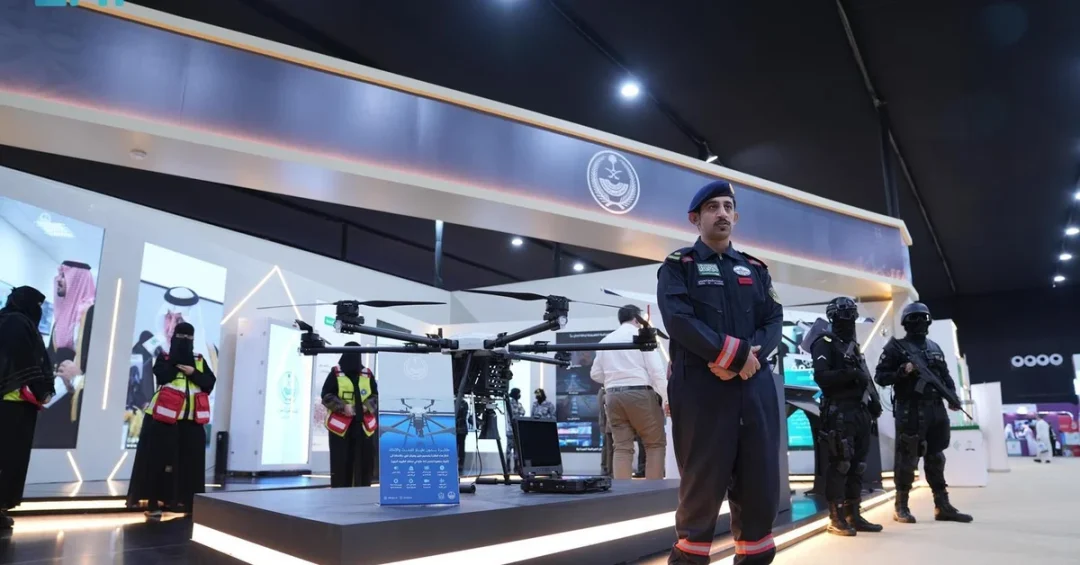
The General Directorate of Civil Defense is showcasing an AI-powered search and rescue drone at the Hajj Conference and Exhibition in Jeddah, held from January 13 to 16, 2025, according to the Saudi Press Agency. The unmanned aerial system is designed to locate missing pilgrims, deliver emergency supplies to inaccessible terrain, and support disaster response during the world’s largest annual gathering of Muslims. Visitors to the exhibition are being introduced to the drone’s operational capabilities, which include a flight duration of up to 60 minutes, a search range of 15 to 20 kilometers, and a payload capacity of up to 40 kilograms. The platform is equipped with both daytime and nighttime cameras, enabling round-the-clock mission support.
The exhibition, organized under the umbrella of Saudi Arabia’s official Hajj and Umrah ecosystem, brings together government ministries, security agencies, technology firms, and international delegations to review innovations that will shape the future of pilgrimage management. The Civil Defense’s display underscores a broader national commitment to using advanced technology to protect the safety of the millions of worshippers who travel to the Kingdom each year. Could this drone represent a turning point in how emergency services operate during mass gatherings? The answer, according to officials present at the event, lies in the system’s ability to combine speed, endurance, and precision in environments where every minute counts.
Context and Background
The Hajj Conference and Exhibition has become a key platform for Saudi Arabia to present the latest tools and strategies used to manage the annual pilgrimage. Held in Jeddah, the event draws participation from civil defense units, health authorities, transport operators, and technology providers who collectively work to ensure that Hajj and Umrah seasons proceed safely and smoothly. The General Directorate of Civil Defense, which operates under the Ministry of Interior, has long been responsible for firefighting, rescue operations, and emergency response across the Kingdom. Its presence at the exhibition reflects a strategic decision to integrate artificial intelligence and unmanned systems into its operational toolkit.
Search and rescue missions during Hajj present unique challenges. Pilgrims move across vast areas, including mountainous terrain around Mina, Arafat, and Muzdalifah, where access by road can be slow or impossible during peak periods. Weather conditions, crowd density, and the sheer scale of the gathering can complicate traditional rescue efforts. In this environment, aerial platforms offer a distinct advantage by providing rapid situational awareness and the ability to reach individuals who might otherwise be difficult to locate. How does a drone change the equation for first responders? By covering ground quickly, transmitting live imagery, and delivering essential supplies, the system can bridge the gap between the moment a distress signal is received and the arrival of ground teams.
The Kingdom has invested heavily in modernizing its emergency services as part of a wider national transformation. The Ministry of Interior and the General Directorate of Civil Defense have adopted digital command centers, real-time data analytics, and advanced communication systems to coordinate responses across multiple agencies. The drone on display in Jeddah is the latest expression of that effort, and it arrives as Saudi Arabia prepares to welcome growing numbers of pilgrims in line with the goals of Vision 2030. What does this mean for the future of pilgrimage safety? It signals that technology will play an increasingly central role in protecting human life.
Key Details of the Drone System
According to information released through the Saudi Press Agency, the AI-powered drone features a flight duration of up to 60 minutes, allowing it to remain airborne for extended search operations without frequent battery changes. Its search range of 15 to 20 kilometers means it can cover significant distances across rugged terrain, and its payload capacity of up to 40 kilograms enables it to carry food, medicine, and emergency supplies to hard-to-reach areas. The drone is equipped with both daytime and nighttime cameras, making it effective around the clock. These specifications position it as a versatile asset for mountain rescues, forest fire response, and flood emergencies.
The ability to transport supplies is particularly important in scenarios where ground vehicles cannot reach affected individuals. During a mountain rescue, for example, a drone could deliver water, first-aid kits, or thermal blankets while a ground team navigates difficult paths. In flood situations, it could drop flotation devices or communication equipment to people awaiting evacuation. The integration of artificial intelligence suggests that the system can assist with identifying objects or individuals in real time, potentially reducing the cognitive load on operators and speeding up decision-making. What role does AI play in these missions? It helps the drone process visual data, recognize patterns, and prioritize search areas, though human operators remain in control of the overall response.
The exhibition allows visitors to see the drone up close and learn about its operational parameters. Civil Defense representatives are on hand to explain how the system fits into existing command structures and how it complements other assets such as helicopters, ground vehicles, and specialized rescue teams. The display is not merely a static showcase; it is an opportunity for international delegates and industry experts to discuss best practices and explore potential collaborations. How will this technology be deployed in practice? Officials indicate that it will be integrated into broader emergency response plans, with trained personnel operating the equipment during Hajj and other major events.
International and Regional Impact
Saudi Arabia’s presentation of an AI-powered rescue drone at a major international exhibition carries significance beyond its borders. Countries across the Middle East and beyond face similar challenges when managing large crowds, natural disasters, and remote rescue operations. By showcasing its technological capabilities, the Kingdom positions itself as a leader in emergency management innovation and a potential partner for nations seeking to modernize their own civil defense systems. The exhibition in Jeddah attracts delegations from multiple countries, creating opportunities for knowledge exchange and joint development.
Regional cooperation in disaster response is increasingly important as climate-related events and humanitarian crises affect communities worldwide. Saudi Arabia has a long history of providing humanitarian assistance and logistical support to countries in need, and its investment in advanced rescue technology enhances its capacity to contribute to international relief efforts. The drone’s ability to operate in hard-to-reach areas could be valuable in a range of scenarios, from earthquakes to wildfires. Could this system one day support missions outside the Kingdom? While the immediate focus is on Hajj and domestic emergency response, the underlying technology has clear applications that extend far beyond Saudi Arabia’s borders.
Economic and Strategic Significance
The development and deployment of advanced emergency response technology align with Saudi Arabia’s broader economic diversification agenda. Vision 2030 seeks to build a knowledge-based economy, foster innovation, and create high-skilled jobs in sectors such as artificial intelligence, robotics, and aerospace. The drone program represents a tangible example of how government agencies can drive demand for cutting-edge solutions, encouraging local companies and research institutions to develop expertise in these fields. It also supports the growth of a domestic technology ecosystem that can serve both public and private sector needs.
From a strategic perspective, enhancing pilgrimage safety is essential to the Kingdom’s reputation and to the sustainability of Hajj and Umrah operations. Millions of Muslims from around the world travel to Saudi Arabia each year, and their safety is a top priority for the government. Investments in technology that improve emergency response contribute to a smoother, more secure experience for pilgrims, which in turn supports the tourism and hospitality sectors. A safe and well-managed pilgrimage season reinforces confidence among travelers and tour operators, generating economic benefits that extend across the country.
Furthermore, the drone program reflects a commitment to continuous improvement in public services. The General Directorate of Civil Defense is not simply adopting technology for its own sake; it is evaluating tools that address specific operational gaps and enhance the effectiveness of its personnel. This pragmatic approach to innovation is a hallmark of Saudi Arabia’s modernization efforts, and it demonstrates how government entities can leverage technology to deliver better outcomes for citizens and visitors alike.
Vision 2030 Alignment
The showcase of an AI-powered search and rescue drone at the Hajj Conference and Exhibition is directly aligned with the objectives of Saudi Vision 2030, which emphasizes innovation, safety, and the enhancement of quality of life. By integrating advanced technology into emergency services, the Kingdom is working to protect human life, improve operational efficiency, and strengthen its capacity to manage large-scale events. These efforts contribute to the vision’s goal of building a resilient and forward-looking society that embraces digital transformation.
As Saudi Arabia continues to welcome increasing numbers of pilgrims and hosts major international events, the role of technology in ensuring safety and security will only grow. The Civil Defense’s drone is a clear signal that the Kingdom is investing in the tools and expertise needed to meet these challenges head-on. It also reflects the leadership’s commitment to leveraging innovation for the benefit of all who visit the holy sites. In the years ahead, further advancements in artificial intelligence, robotics, and communications will likely play an even greater role in safeguarding the pilgrimage experience and showcasing Saudi Arabia’s capabilities on the world stage.
20 Questions
Q1. What is the General Directorate of Civil Defense showcasing at the Hajj Conference and Exhibition?
A1. It is showcasing an AI-powered drone designed for search and rescue operations, aimed at enhancing emergency response during Hajj and other large gatherings.
Q2. Where and when is the Hajj Conference and Exhibition taking place?
A2. The exhibition is being held in Jeddah from January 13 to 16, 2025, bringing together government agencies, technology firms, and international delegates.
Q3. What is the flight duration of the search and rescue drone?
A3. The drone can remain airborne for up to 60 minutes, allowing extended search operations without frequent battery changes.
Q4. What is the drone’s search range?
A4. It has a search range of 15 to 20 kilometers, enabling it to cover significant distances across rugged or hard-to-reach terrain.
Q5. How much weight can the drone carry?
A5. It has a payload capacity of up to 40 kilograms, sufficient for transporting food, medicine, and emergency supplies to those in need.
Q6. What kind of cameras does the drone have?
A6. It is equipped with both daytime and nighttime cameras, allowing it to operate effectively around the clock in various lighting conditions.
Q7. What types of missions is the drone suited for?
A7. It is suited for mountain rescues, forest fire responses, flood emergencies, and delivering supplies to areas that are difficult for ground teams to reach.
Q8. How does artificial intelligence enhance the drone’s capabilities?
A8. AI helps process visual data, recognize patterns, and prioritize search areas, assisting operators in making faster and more informed decisions during missions.
Q9. Why is this drone particularly important for Hajj?
A9. Hajj involves millions of pilgrims moving through vast and sometimes mountainous areas, where rapid location and assistance can be critical for saving lives.
Q10. Who operates the drone during emergency missions?
A10. Trained personnel from the General Directorate of Civil Defense operate the drone as part of coordinated emergency response efforts.
Q11. How does the drone complement existing rescue assets?
A11. It works alongside helicopters, ground vehicles, and rescue teams, providing aerial surveillance and delivery capabilities that enhance overall response effectiveness.
Q12. What is the significance of showcasing this drone at an international exhibition?
A12. It demonstrates Saudi Arabia’s leadership in emergency management innovation and creates opportunities for international cooperation and knowledge exchange.
Q13. Does the drone support Saudi Arabia’s Vision 2030 goals?
A13. Yes, it aligns with Vision 2030 by promoting innovation, enhancing safety, and supporting the development of a knowledge-based economy.
Q14. Can the drone be used outside of Hajj operations?
A14. Yes, its capabilities make it suitable for various emergency scenarios, including natural disasters and rescue missions in remote areas throughout the Kingdom.
Q15. What kind of supplies can the drone deliver?
A15. It can transport food, medicine, first-aid kits, and other emergency supplies to individuals in hard-to-reach locations.
Q16. How does the drone improve nighttime rescue operations?
A16. Its nighttime cameras allow it to locate and monitor individuals in low-light conditions, extending the operational window for search and rescue missions.
Q17. What role does the Ministry of Interior play in this initiative?
A17. The General Directorate of Civil Defense operates under the Ministry of Interior, which oversees national security and emergency response efforts.
Q18. Are there plans to expand the use of such drones in the future?
A18. The exhibition serves as a platform to evaluate and demonstrate the technology, with potential for broader integration into emergency response strategies over time.
Q19. How does this technology benefit pilgrims?
A19. It enhances the speed and efficiency of rescue operations, helping to ensure that pilgrims receive timely assistance in case of emergencies.
Q20. What message does Saudi Arabia send by presenting this drone?
A20. It signals a strong commitment to leveraging advanced technology for the safety and well-being of all who visit the Kingdom, reflecting its forward-looking vision.
Reader Feedback
We value your thoughts. Please share your feedback on this article.
Your feedback helps us improve our coverage.
Related articles
 Over 80 Countries Convene in Riyadh to Advance Mining and Resource Sustainability
 Saudi Arabia Inaugurates Fourth Future Minerals Forum in Riyadh
 Shura Council Speaker Receives Kazakh Ambassador
 OIC Welcomes Gaza Ceasefire, Backs Palestinian Rights
 Ministry of Transport Highlights Key Projects and Initiatives for Hajj and Umrah
 Islamic Fiqh Academy Chief Meets Cameroon Minister