


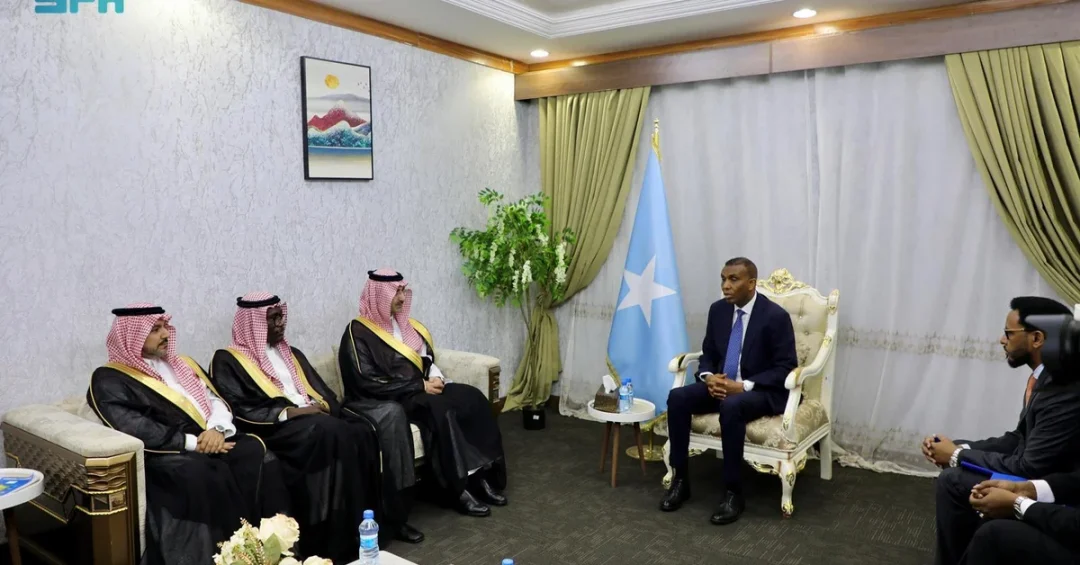
Somali Prime Minister Hamza Abdi Barre met with Sultan Abdulrahman Al-Marshad, Chief Executive Officer of the Saudi Fund for Development (SFD), in Somalia on Wednesday to discuss strengthening development collaboration between the Kingdom of Saudi Arabia and the Federal Republic of Somalia. The high-level meeting, reported by the Saudi Press Agency (SPA), focused on expanding the SFD’s portfolio of development projects and programs across Somalia’s vital sectors — a partnership that stretches back nearly five decades and reflects Saudi Arabia’s enduring commitment to stability, prosperity, and humanitarian solidarity in the Horn of Africa.
The talks were attended by several Somali ministers and Saudi Ambassador to Somalia Ahmed Al-Mawlid, underscoring the diplomatic weight both sides attach to the relationship. For Saudi Arabia, the engagement forms part of a broader Vision 2030-driven strategy to deepen economic ties, support regional stability, and position the Kingdom as a leading global development partner. For Somalia, the SFD’s continued investment represents a critical lifeline for infrastructure, education, healthcare, and economic recovery. Could this meeting mark a new chapter in one of the Arab world’s most enduring development partnerships?
Context and Background
The Saudi Fund for Development was established in 1974 as a government agency that channels Saudi development assistance to developing countries through concessional loans, grants, and technical support. Its engagement with Somalia began in 1977, making the Horn of Africa nation one of the earliest beneficiaries of Saudi development finance. Over the decades, the SFD has financed dozens of projects in Somalia spanning roads, hospitals, schools, water systems, and agricultural infrastructure — all aimed at promoting social development and economic prosperity. The fund’s work aligns with Saudi Arabia’s longstanding tradition of humanitarian giving and its commitment to supporting Muslim-majority nations facing economic and security challenges.
Why has this partnership endured for nearly fifty years, surviving droughts, conflict, and political transitions? The answer lies in Saudi Arabia’s consistent, apolitical approach to development assistance, which prioritizes tangible improvements in the lives of ordinary people. Unlike short-term emergency relief, SFD financing is structured to build lasting assets — roads that connect markets, clinics that serve mothers and children, and schools that educate the next generation. This long-term perspective has earned the SFD respect across Somali society and among international development partners. The fund’s track record in Somalia also reinforces the Kingdom’s broader role as a stabilizer in the Red Sea and East African regions, where economic resilience is a prerequisite for peace.
The Wednesday meeting comes at a time when Somalia is accelerating its post-conflict reconstruction and seeking to attract foreign investment. Prime Minister Hamza Abdi Barre’s government has prioritized infrastructure, energy, and education as pillars of its national development plan. Saudi Arabia, through the SFD, is uniquely positioned to support these priorities given its financial capacity, technical expertise, and deep cultural ties with Somalia. The presence of multiple Somali ministers at the meeting signals the government’s intent to move quickly from discussion to implementation, integrating SFD-funded projects into national budgets and sectoral strategies.
Key Details of the Meeting
According to the Saudi Press Agency, the meeting highlighted the SFD’s efforts to fund development projects and programs across various vital sectors in Somalia. Sultan Abdulrahman Al-Marshad, who has led the SFD since 2017, presented an overview of the fund’s current portfolio and pipeline in the country. He emphasized the SFD’s commitment to supporting Somalia’s social development and economic prosperity, consistent with the fund’s mandate to finance projects that generate sustainable returns for communities. The discussions also touched on ways to enhance collaboration — a phrase that, in development diplomacy, often signals the exploration of new financing windows, co-financing arrangements with other Gulf and international institutions, and capacity-building initiatives for Somali ministries.
Several Somali ministers attended the meeting, though their names were not disclosed in the SPA report. Their presence indicates that the talks were not limited to a single sector but rather encompassed a multi-sectoral review. In similar meetings, Somali officials typically raise priorities such as rebuilding the Mogadishu port, expanding the national electricity grid, constructing feeder roads to connect agricultural regions with urban markets, and strengthening health systems that remain fragile after decades of instability. Saudi Ambassador Ahmed Al-Mawlid’s participation further underscores the diplomatic dimension: the Kingdom’s embassy in Mogadishu plays a coordinating role between the SFD, Somali ministries, and other Saudi entities active in the country.
What concrete outcomes can be expected from this meeting? While the SPA report did not announce specific agreements or funding amounts, such high-level engagements typically lay the groundwork for project agreements to be signed in the following months. The SFD’s modus operandi involves detailed feasibility studies, environmental and social impact assessments, and close coordination with recipient governments before disbursing funds. Therefore, the Wednesday meeting should be seen as a strategic alignment session — a chance for both sides to confirm priorities, review progress on existing projects, and identify new opportunities that match Saudi expertise with Somali needs. The involvement of the Somali Prime Minister himself elevates the meeting’s importance, signaling that the projects discussed will receive top-level attention and expedited processing.
International and Regional Impact
Saudi Arabia’s development engagement in Somalia carries significant regional implications. The Horn of Africa is a strategically vital corridor linking the Red Sea to the Indian Ocean, and stability there directly affects global shipping lanes, energy security, and counterterrorism efforts. By investing in Somalia’s economic infrastructure, the Kingdom contributes to a broader international effort to prevent the country from becoming a haven for extremist groups. Saudi assistance complements the work of the United Nations, the African Union, and other Gulf states, but it brings a distinctive advantage: trust. Somali communities view Saudi Arabia as a consistent friend that has provided aid without political conditionality, which enhances the effectiveness of development projects on the ground.
Moreover, the meeting reflects Saudi Arabia’s growing role as a bridge between the Arab world and Africa. Under Vision 2030, the Kingdom has sought to expand its diplomatic and economic footprint across the continent, hosting summits, signing trade agreements, and encouraging Saudi companies to explore African markets. Somalia, with its long coastline, young population, and untapped natural resources, represents a frontier of opportunity. Saudi investment in Somali ports, livestock exports, and renewable energy could create jobs, boost government revenues, and reduce dependence on foreign aid. For international observers, the SFD’s work in Somalia is a case study in how Gulf development finance can complement Western humanitarian assistance, offering a model of South-South cooperation that is pragmatic and results-oriented.
Economic and Strategic Significance
The economic significance of the SFD’s programs in Somalia extends beyond the immediate projects. Development finance acts as a catalyst for private-sector activity: a new road lowers transport costs for farmers and traders; a reliable power supply attracts manufacturing; a modern hospital improves health outcomes and productivity. By financing such projects, the SFD helps create an enabling environment for Somali entrepreneurs and foreign investors alike. Saudi companies, particularly in construction, energy, and logistics, may find new opportunities as SFD-funded projects move from planning to procurement. This aligns with Vision 2030’s goal of expanding Saudi non-oil exports and fostering international partnerships that generate mutual benefit.
Strategically, the meeting reinforces Saudi Arabia’s soft power in a region where influence is often measured by tangible contributions to stability and prosperity. Unlike military interventions, development assistance builds goodwill that lasts for generations. The SFD’s nearly five-decade presence in Somalia has made the Kingdom a household name in Somali cities and villages, from the classrooms it has built to the clinics it has equipped. This reservoir of goodwill supports Saudi diplomacy on issues ranging from counterterrorism to maritime security. It also strengthens the Kingdom’s position in multilateral forums where African votes matter. In an era of great-power competition, Saudi Arabia’s model of patient, project-based engagement offers a compelling alternative to transactional approaches.
Vision 2030 Alignment
The meeting between Prime Minister Hamza Abdi Barre and SFD CEO Sultan Abdulrahman Al-Marshad aligns squarely with Saudi Vision 2030, the Kingdom’s ambitious blueprint for economic diversification, global engagement, and enhanced quality of life. Vision 2030 emphasizes the importance of international cooperation and humanitarian leadership, positioning Saudi Arabia not only as an economic powerhouse but also as a responsible global citizen. The SFD is a key instrument of this vision, channeling Saudi resources into projects that promote sustainable development abroad while opening doors for Saudi expertise and investment. By strengthening ties with Somalia, the Kingdom advances its goal of becoming a pivotal player in Africa’s economic transformation.
Looking ahead, the partnership is poised to deepen. The SFD has signaled its readiness to finance new projects in renewable energy, water desalination, and vocational training — sectors that directly support Somalia’s long-term resilience. As these projects materialize, they will create jobs, improve living standards, and reinforce the message that Saudi Arabia stands with its brothers and sisters in Africa. For Somalia, the relationship offers not just funding but a vote of confidence from a G20 nation. For Saudi Arabia, it demonstrates that Vision 2030 is not merely a domestic program but a global vision — one that seeks to build a more stable, prosperous, and interconnected world. The Wednesday meeting in Mogadishu was a small step in that journey, but its implications will be felt for years to come.
20 Questions
Q1. Who met in Somalia on Wednesday to discuss development collaboration?
A1. Somali Prime Minister Hamza Abdi Barre met with Sultan Abdulrahman Al-Marshad, Chief Executive Officer of the Saudi Fund for Development, in Somalia on Wednesday to discuss enhancing development collaboration between the two sides.
Q2. What is the Saudi Fund for Development?
A2. The Saudi Fund for Development is a Saudi government agency established in 1974 that provides concessional loans, grants, and technical support to developing countries to promote social and economic development.
Q3. When did the SFD begin its development work in Somalia?
A3. The Saudi Fund for Development began funding development projects and programs in Somalia in 1977, marking nearly five decades of continuous Saudi development assistance to the Horn of Africa nation.
Q4. Which Somali officials attended the meeting?
A4. Several Somali ministers attended the meeting, along with Saudi Ambassador to Somalia Ahmed Al-Mawlid, according to the Saudi Press Agency report on the discussions.
Q5. What sectors does the SFD support in Somalia?
A5. The SFD supports various vital sectors in Somalia, including infrastructure, education, healthcare, water, agriculture, and energy, all aimed at promoting social development and economic prosperity.
Q6. What was the main purpose of the meeting?
A6. The meeting aimed to discuss ways to enhance development collaboration between Saudi Arabia and Somalia, reviewing existing SFD projects and exploring new opportunities for partnership.
Q7. Did the meeting produce any signed agreements?
A7. The Saudi Press Agency report did not announce specific signed agreements, but such high-level meetings typically lay the groundwork for future project agreements between the SFD and Somali ministries.
Q8. How does this meeting reflect Saudi Arabia’s foreign policy?
A8. It reflects Saudi Arabia’s commitment to supporting stability and development in the Horn of Africa, consistent with its broader diplomatic and humanitarian goals under Vision 2030.
Q9. What is the significance of the SFD’s long history in Somalia?
A9. The SFD’s nearly five-decade presence has built deep trust and goodwill, making Saudi Arabia a consistent and reliable development partner for Somalia through periods of change and challenge.
Q10. How does this collaboration benefit Saudi Arabia?
A10. It strengthens Saudi soft power, opens opportunities for Saudi companies in construction and logistics, and reinforces the Kingdom’s role as a responsible global development leader.
Q11. What role does Ambassador Ahmed Al-Mawlid play?
A11. As Saudi Ambassador to Somalia, Ahmed Al-Mawlid coordinates between the SFD, Somali ministries, and other Saudi entities, facilitating effective implementation of development projects.
Q12. Why is Somalia strategically important to Saudi Arabia?
A12. Somalia is located along the Red Sea corridor, a vital global shipping route, and its stability affects regional security, trade, and counterterrorism efforts that are priorities for Saudi Arabia.
Q13. How does the SFD’s work align with Vision 2030?
A13. Vision 2030 emphasizes global engagement and humanitarian leadership; the SFD advances these goals by financing sustainable development abroad and opening markets for Saudi expertise.
Q14. What types of projects has the SFD funded in Somalia?
A14. The SFD has funded roads, hospitals, schools, water systems, and agricultural infrastructure, all designed to create lasting assets that improve lives and support economic growth.
Q15. How does development aid differ from emergency relief?
A15. Development aid focuses on building long-term infrastructure and capacity, while emergency relief addresses immediate needs; the SFD prioritizes sustainable projects that generate lasting benefits.
Q16. What might be discussed in future meetings?
A16. Future meetings may focus on renewable energy, water desalination, vocational training, and co-financing arrangements with other international institutions to expand the SFD’s impact in Somalia.
Q17. How does this meeting affect regional stability?
A17. By supporting Somalia’s economic recovery, the meeting contributes to regional stability, reducing the conditions that foster extremism and enhancing security in the Horn of Africa.
Q18. What is the expected timeline for new projects?
A18. While no timeline was announced, SFD projects typically follow feasibility studies and assessments; new agreements may be signed in the coming months after both sides finalize priorities.
Q19. How does Saudi Arabia’s aid to Somalia compare with other donors?
A19. Saudi Arabia’s aid is distinctive for its consistency, lack of political conditionality, and cultural trust, complementing Western and multilateral assistance with a long-term, project-based approach.
Q20. What does this meeting mean for the future of Saudi-Somali relations?
A20. It signals deepening ties and a shared commitment to development, positioning Saudi Arabia as a key partner in Somalia’s reconstruction and reinforcing the Kingdom’s global leadership role.
Reader Feedback
We value your thoughts. Please share your feedback on this article.
Your feedback helps us improve our coverage.
Related articles
 KSrelief Distributes Winter Vouchers to 1,525 in Jordan
 Saudi Arabia Chairs 44th ASBU General Assembly in Tunisia
 Hajj and Umrah Conference 2025 Discusses Logistics and Housing
 Saudi Arabia Welcomes Gaza Ceasefire Agreement
 KSrelief Delivers 50 Tons of Dates to Maldives
 KSrelief Delivers 2,132 Food Baskets and Health Kits in Syria’s Idlib