


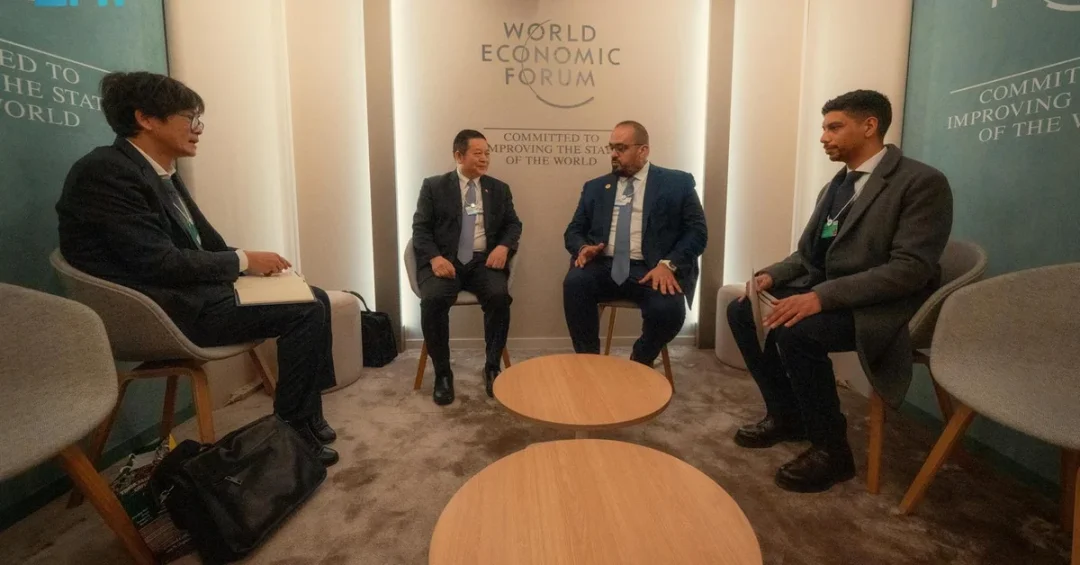
Saudi Arabia’s Minister of Economy and Planning, Faisal Alibrahim, met with the Secretary-General of the Association of Southeast Asian Nations (ASEAN), Dr. Kao Kim Hourn, on the sidelines of the World Economic Forum (WEF) annual meeting in Davos on January 22, 2025, according to the Saudi Press Agency (SPA). The two officials discussed ways to strengthen economic partnerships between the Kingdom and ASEAN member states, reinforcing a relationship that has steadily expanded in recent years across trade, investment, and sustainable development.
Could this meeting mark a new chapter in Saudi Arabia’s economic engagement with one of the world’s most dynamic regions? The encounter in Davos reflects the Kingdom’s continuing efforts to deepen ties with international partners as part of its Vision 2030 reform agenda. It also underscores the growing importance of Southeast Asia in Saudi Arabia’s broader strategy to diversify its economy and expand its global network of trade and investment relationships.
Context and Background
Why has Saudi Arabia placed such emphasis on building bridges with Southeast Asia? The answer lies in the Kingdom’s long-term economic vision and the region’s remarkable growth trajectory. ASEAN, founded in 1967, comprises ten member states: Brunei, Cambodia, Indonesia, Laos, Malaysia, Myanmar, the Philippines, Singapore, Thailand, and Vietnam. Together they form a combined market of more than 660 million people and a gross domestic product exceeding $3 trillion, making the bloc one of the fastest-growing economic regions in the world. For Saudi Arabia, engaging with ASEAN is not merely a diplomatic courtesy but a strategic imperative.
The meeting between Minister Alibrahim and Secretary-General Kao Kim Hourn builds on a foundation of deepening cooperation. In recent years, Saudi Arabia has intensified its outreach to Southeast Asian nations, signing numerous memoranda of understanding and exploring joint ventures in energy, technology, logistics, and halal industries. The Kingdom’s trade with ASEAN countries has grown substantially, and Saudi investment in the region has diversified beyond traditional energy sectors. Meanwhile, ASEAN nations have shown keen interest in Saudi Arabia’s Vision 2030 projects, including NEOM, the Red Sea Project, and various industrial and logistics zones.
The World Economic Forum in Davos provided a fitting backdrop for this dialogue. The annual gathering brings together global leaders from government, business, and civil society to address pressing economic challenges. For Saudi Arabia, participation in such forums is an opportunity to showcase its reform progress, attract foreign investment, and strengthen multilateral partnerships. The meeting with the ASEAN Secretary-General thus forms part of a wider diplomatic and economic campaign that aligns with the Kingdom’s goals of becoming a hub for trade, innovation, and tourism.
Key Details of the Meeting
What exactly did the two officials discuss? According to the Saudi Press Agency, Minister Alibrahim and Secretary-General Kao Kim Hourn focused on strengthening economic partnerships between Saudi Arabia and ASEAN member states. While specific initiatives were not disclosed, the conversation likely covered areas such as trade facilitation, investment flows, and collaboration on sustainable development. The meeting also provided an opportunity to review progress on existing agreements and to identify new avenues for cooperation.
Minister Alibrahim, who has served as Saudi Arabia’s Minister of Economy and Planning since 2021, has been a key figure in advancing the Kingdom’s economic diversification agenda. His role involves coordinating national development plans, fostering international economic partnerships, and overseeing the implementation of Vision 2030 programs. His meeting with the ASEAN Secretary-General underscores the importance Saudi Arabia places on engaging with regional blocs to achieve shared prosperity.
Dr. Kao Kim Hourn, a seasoned diplomat and academic from Cambodia, has led ASEAN since January 2023. He has been a vocal advocate for enhancing ASEAN’s external partnerships and promoting regional integration. His engagement with Saudi officials signals ASEAN’s recognition of the Kingdom’s growing economic influence and its potential as a partner in areas ranging from energy security to digital transformation. The Davos meeting thus represents a mutual commitment to deepening ties.
While the SPA report did not specify concrete outcomes, the mere fact of the meeting carries significance. It demonstrates that Saudi Arabia and ASEAN are actively seeking to align their economic interests and to explore synergies. In the context of global economic uncertainty, such dialogues are essential for fostering stability and growth.
International and Regional Impact
How might this meeting influence the broader geopolitical and economic landscape? Saudi Arabia’s engagement with ASEAN is part of a larger trend of expanding South-South cooperation. As emerging economies seek to reduce dependence on traditional Western markets, partnerships between the Gulf and Southeast Asia are gaining prominence. For Saudi Arabia, closer ties with ASEAN offer access to a rapidly growing consumer base and opportunities for investment in sectors such as infrastructure, renewable energy, and Islamic finance.
For ASEAN, Saudi Arabia represents a reliable source of energy, a growing market for goods and services, and a potential investor in regional development projects. The Kingdom’s Vision 2030 initiatives, particularly those related to logistics and tourism, could complement ASEAN’s own connectivity goals. Moreover, both sides share an interest in promoting moderate Islam and combating extremism, areas where Saudi leadership and ASEAN’s diverse Muslim communities can collaborate.
The meeting also reflects Saudi Arabia’s broader foreign policy objectives. Under the leadership of Custodian of the Two Holy Mosques King Salman bin Abdulaziz Al Saud and His Royal Highness Crown Prince Mohammed bin Salman, the Kingdom has pursued a proactive diplomacy aimed at building alliances across continents. The Davos encounter with ASEAN’s top official is a testament to this approach, signaling that Saudi Arabia is open to partnerships that advance mutual economic interests and regional stability.
Economic and Strategic Significance
Why does this meeting matter for Saudi Arabia’s economy? The Kingdom is in the midst of an ambitious transformation aimed at reducing its reliance on oil revenues and creating a diversified, knowledge-based economy. International partnerships are critical to this endeavor. ASEAN countries offer expertise in manufacturing, technology, and digital innovation, areas where Saudi Arabia seeks to develop its own capabilities. By deepening economic ties, the Kingdom can attract foreign direct investment, access new markets for its non-oil exports, and learn from ASEAN’s experience in regional integration.
Furthermore, the meeting aligns with Saudi Arabia’s efforts to position itself as a global logistics hub. The Kingdom’s strategic location at the crossroads of Europe, Asia, and Africa makes it an ideal gateway for trade with ASEAN. Investments in ports, railways, and digital infrastructure are designed to facilitate smoother trade flows. Enhanced cooperation with ASEAN could lead to joint ventures in logistics, e-commerce, and supply chain management, benefiting both sides.
From a strategic perspective, the meeting reinforces Saudi Arabia’s commitment to multilateralism and its desire to play a constructive role in global economic governance. By engaging with ASEAN, the Kingdom strengthens its voice in international forums and builds coalitions that can support its development goals. This is particularly important as the global economy faces headwinds from protectionism and geopolitical tensions.
Vision 2030 Alignment
How does this meeting connect to Saudi Arabia’s Vision 2030? Vision 2030, launched in 2016, is a comprehensive plan to diversify the Kingdom’s economy, improve public services, and enhance quality of life. A key pillar of the vision is to expand international partnerships and increase non-oil exports. The meeting between Minister Alibrahim and Secretary-General Kao Kim Hourn directly supports this pillar by exploring ways to boost economic cooperation with ASEAN, a region with immense potential.
Moreover, Vision 2030 emphasizes the importance of sustainable development and innovation. ASEAN countries are leaders in renewable energy, smart cities, and digital technologies. Collaboration in these areas can help Saudi Arabia achieve its environmental and technological goals. The Kingdom’s investments in NEOM, the Red Sea Project, and other giga-projects are designed to attract international partners, including those from Southeast Asia. By engaging with ASEAN, Saudi Arabia can showcase these opportunities and attract investment that contributes to the vision’s success.
In conclusion, the meeting between Minister Faisal Alibrahim and ASEAN Secretary-General Dr. Kao Kim Hourn represents a significant step in Saudi Arabia’s ongoing efforts to build a diversified and resilient economy. It highlights the Kingdom’s proactive approach to international engagement and its commitment to Vision 2030. As Saudi Arabia continues to open up to the world, partnerships with dynamic regions like ASEAN will play an increasingly vital role in shaping its future. Could this meeting be the catalyst for a new era of Saudi-ASEAN cooperation? The signs are promising, and the potential benefits are immense.
20 Questions
Q1. Who met with ASEAN Secretary-General Dr. Kao Kim Hourn?
A1. Saudi Arabia’s Minister of Economy and Planning, Faisal Alibrahim, met with ASEAN Secretary-General Dr. Kao Kim Hourn on the sidelines of the World Economic Forum in Davos.
Q2. When and where did the meeting take place?
A2. The meeting took place on January 22, 2025, in Davos, Switzerland, during the annual meeting of the World Economic Forum.
Q3. What was the main topic of discussion?
A3. The officials discussed strengthening economic partnerships between Saudi Arabia and the member states of the Association of Southeast Asian Nations.
Q4. What is ASEAN and which countries are members?
A4. ASEAN is the Association of Southeast Asian Nations, comprising Brunei, Cambodia, Indonesia, Laos, Malaysia, Myanmar, the Philippines, Singapore, Thailand, and Vietnam.
Q5. Why is Saudi Arabia interested in strengthening ties with ASEAN?
A5. Saudi Arabia seeks to diversify its economy under Vision 2030, and ASEAN offers a large market and opportunities for trade, investment, and collaboration in various sectors.
Q6. What is the economic size of ASEAN?
A6. ASEAN has a combined population of over 660 million and a gross domestic product exceeding $3 trillion, making it one of the world’s fastest-growing regions.
Q7. Who is Dr. Kao Kim Hourn?
A7. Dr. Kao Kim Hourn is the Secretary-General of ASEAN, a seasoned diplomat and academic from Cambodia who has led the organization since January 2023.
Q8. What is Minister Faisal Alibrahim’s role?
A8. Faisal Alibrahim is Saudi Arabia’s Minister of Economy and Planning, responsible for coordinating national development plans and advancing Vision 2030 economic reforms.
Q9. Did the meeting produce any specific agreements?
A9. The Saudi Press Agency report did not specify concrete outcomes, but the meeting focused on exploring ways to enhance economic cooperation between Saudi Arabia and ASEAN.
Q10. How does this meeting fit into Saudi Arabia’s foreign policy?
A10. It reflects Saudi Arabia’s proactive diplomacy and its efforts to build multilateral partnerships that support economic diversification and regional stability.
Q11. What sectors are likely to benefit from Saudi-ASEAN cooperation?
A11. Potential areas include energy, technology, logistics, halal industries, infrastructure, renewable energy, and Islamic finance, among others.
Q12. How does this meeting align with Vision 2030?
A12. Vision 2030 aims to expand international partnerships and increase non-oil exports; engaging with ASEAN supports these goals by opening new avenues for trade and investment.
Q13. What is the significance of the World Economic Forum for Saudi Arabia?
A13. The WEF provides a platform for Saudi Arabia to showcase its reform progress, attract foreign investment, and engage with global leaders on key economic issues.
Q14. Have Saudi Arabia and ASEAN cooperated before?
A14. Yes, Saudi Arabia has intensified outreach to Southeast Asia in recent years, signing agreements and exploring joint ventures in various sectors.
Q15. How might this meeting impact regional stability?
A15. Enhanced economic ties can foster mutual understanding and interdependence, contributing to stability and prosperity in both the Gulf and Southeast Asia.
Q16. What are the potential benefits for ASEAN countries?
A16. ASEAN countries can gain access to Saudi investment, energy resources, and markets, as well as collaborate on development projects and technology transfer.
Q17. Is there a focus on sustainable development in the discussions?
A17. While specifics were not disclosed, sustainable development is a shared priority, and cooperation in renewable energy and green technologies is likely.
Q18. How does this meeting reflect Saudi Arabia’s leadership in the region?
A18. It demonstrates Saudi Arabia’s active role in fostering international economic partnerships and its commitment to global engagement under Vision 2030.
Q19. What is the expected follow-up after this meeting?
A19. Follow-up may include further dialogues, joint working groups, and potential agreements aimed at deepening economic cooperation between Saudi Arabia and ASEAN.
Q20. What does this mean for the future of Saudi-ASEAN relations?
A20. It signals a promising future of strengthened ties, with opportunities for increased trade, investment, and collaboration that benefit both sides.
Reader Feedback
We value your thoughts. Please share your feedback on this article.
Your feedback helps us improve our coverage.
Related articles
 Saudi FM Meets French Counterpart at Davos 2025
 Saudi FM Meets Spanish Counterpart at Davos 2025
 Saudi FM Champions Multilateralism at Davos 2025
 OIC Chief Offers Condolences to Türkiye Over Bolu Fire
 Diriyah Explores Future of Global Urban Development at WEF in Davos
 Saudi FM Meets Indonesian Counterpart at WEF 2025