


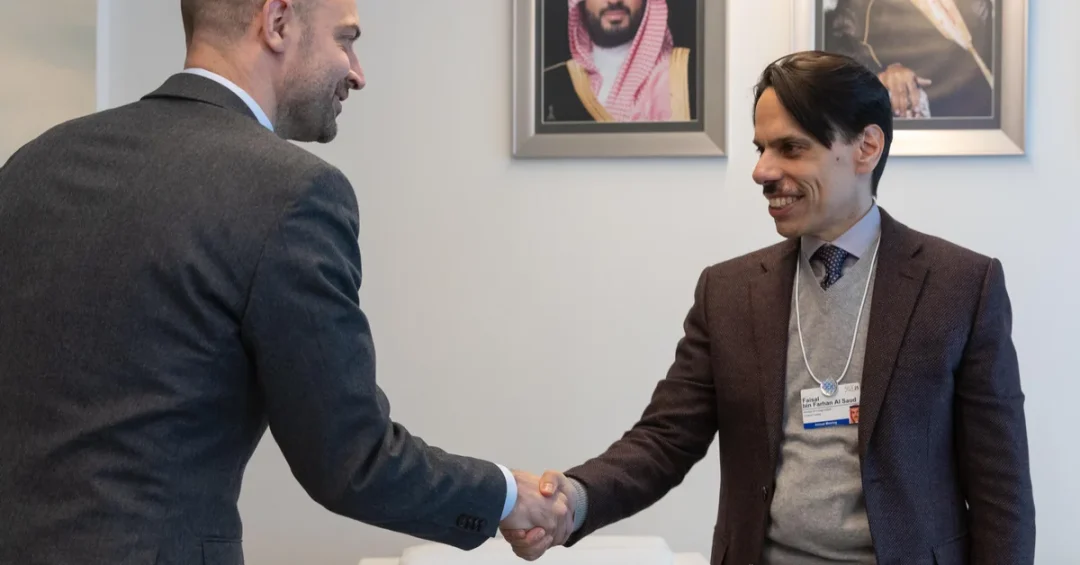
Saudi Minister of Foreign Affairs Prince Faisal bin Farhan bin Abdullah met with French Republic Minister for Europe and Foreign Affairs Jean-Noël Barrot on the sidelines of the World Economic Forum (WEF) 2025 annual meeting in Davos, Switzerland, on January 22, 2025, as confirmed by the Saudi Press Agency. The high-level diplomatic encounter brought together two key international actors at a pivotal moment for regional stability, underscoring the Kingdom of Saudi Arabia’s continued commitment to constructive dialogue and multilateral engagement. The two ministers reviewed bilateral relations and discussed regional developments, including efforts to enhance security and stability in the region, according to the official SPA report.
The meeting was attended by several officials from both delegations, reflecting the depth and seriousness of the Saudi-French partnership. Held on the margins of one of the world’s most influential gatherings of political and economic leaders, the encounter highlighted how Saudi Arabia leverages global platforms to advance its diplomatic priorities. The World Economic Forum’s 2025 annual meeting in Davos convened heads of state, ministers, and business leaders to address pressing global challenges, and the Saudi-French bilateral discussion formed part of a broader pattern of intensified diplomacy between the Kingdom and European partners.
Context and Background
Why does a single bilateral meeting between two foreign ministers at Davos matter in the wider arc of international relations? The answer lies in the evolving strategic relationship between the Kingdom of Saudi Arabia and the French Republic, two nations whose cooperation spans energy, defense, culture, and regional security. France has long been an important partner for Saudi Arabia in Europe, and the two countries have maintained a regular rhythm of high-level consultations on matters ranging from the stability of the Middle East to global energy markets. The Davos meeting builds on this established foundation of mutual respect and shared interests.
The World Economic Forum annual meeting in Davos serves as a unique venue where official diplomacy and economic statecraft intersect. For Saudi Arabia, participation in such forums is a core element of its foreign policy approach under the leadership of the Custodian of the Two Holy Mosques, King Salman bin Abdulaziz Al Saud, and His Royal Highness Crown Prince Mohammed bin Salman bin Abdulaziz Al Saud, Prime Minister. The Kingdom consistently uses these platforms to articulate its vision for a stable, prosperous region and to strengthen partnerships that support Vision 2030. The meeting between Prince Faisal bin Farhan and Minister Jean-Noël Barrot is a clear example of this strategy in action.
Saudi-French relations have deepened significantly in recent years, with cooperation extending across cultural, economic, and security domains. France is home to a large Muslim community and maintains strong people-to-people ties with the Kingdom. Paris and Riyadh have also worked together on regional files, including efforts to support stability in Lebanon, address humanitarian needs in Gaza, and encourage a pathway toward peace in the Middle East. The Davos encounter therefore represents not an isolated event but a continuation of sustained diplomatic engagement at the highest levels.
Key Details of the Meeting
What exactly was discussed when the two ministers sat down together in Davos? According to the Saudi Press Agency, Prince Faisal bin Farhan and Minister Jean-Noël Barrot reviewed relations between their two countries and discussed regional developments, with particular attention to efforts to enhance security and stability in the region. The meeting was attended by several officials, signaling that the conversation covered substantive policy areas requiring expert follow-up. While the official readout was concise, the breadth of topics implied by the SPA report reflects the multidimensional nature of Saudi-French cooperation.
The presence of senior officials at the meeting suggests that the discussions may have touched on concrete initiatives, including potential coordination on humanitarian responses, counterterrorism cooperation, and economic collaboration. Saudi Arabia has consistently advocated for dialogue and de-escalation in regional conflicts, and France has shown willingness to engage constructively with the Kingdom on these issues. The Davos setting, with its emphasis on public-private partnership and global problem-solving, provided a natural backdrop for exploring joint approaches to shared challenges.
It is also worth noting the timing of the meeting. Held in January 2025, the encounter came as the international community continued to grapple with a range of geopolitical tensions, from the war in Gaza to instability in the Red Sea and broader questions about the global energy transition. By meeting on the sidelines of the WEF, the two ministers were able to align their perspectives and explore avenues for cooperation at a moment when coordinated action is particularly valuable. The SPA report did not disclose specific outcomes, but the very fact of the meeting underscores the active diplomatic channel between Riyadh and Paris.
International and Regional Impact
How might this meeting influence the broader regional landscape? The Saudi-French dialogue in Davos sends a signal that both countries remain committed to diplomatic engagement even amid complex geopolitical circumstances. For Saudi Arabia, close coordination with a permanent member of the United Nations Security Council like France reinforces its role as a responsible international actor and a bridge-builder in the Middle East. For France, engaging with the Kingdom is essential for addressing issues that cannot be solved without Saudi cooperation, including energy security, regional stability, and countering extremism.
The meeting also reflects the growing trend of Middle Eastern diplomacy being conducted through multiple channels, including multilateral forums like the World Economic Forum. Saudi Arabia has been at the forefront of this trend, hosting major international events and participating actively in global dialogues. The Kingdom’s ability to convene and engage with diverse partners enhances its diplomatic leverage and contributes to its stated goal of promoting peace and prosperity in the region. The Davos meeting with France is one strand in this broader tapestry of Saudi diplomacy.
From a European perspective, France’s engagement with Saudi Arabia aligns with the European Union’s interest in a stable and prosperous Middle East. Instability in the region has direct consequences for Europe, from migration pressures to energy supply disruptions. By working with Saudi Arabia, France can help address these challenges at their source. The meeting between the two foreign ministers therefore serves both bilateral and broader Euro-regional interests, highlighting the interconnectedness of today’s global challenges.
Economic and Strategic Significance
What economic and strategic dimensions underpin the Saudi-French relationship? Beyond diplomatic consultations, Saudi Arabia and France share robust economic ties, with French companies active in the Kingdom’s infrastructure, energy, and retail sectors. Saudi Arabia is a major supplier of energy to Europe, and French firms have participated in Saudi giga-projects associated with Vision 2030. The Davos meeting provided an opportunity to reinforce these economic linkages, even if the official readout focused on political and security matters.
Strategically, the two countries have common interests in combating terrorism, preventing the proliferation of weapons of mass destruction, and ensuring freedom of navigation in key waterways. The Red Sea, in particular, has been a focus of international attention due to attacks on shipping, and both Saudi Arabia and France have a stake in maintaining secure maritime routes. Cooperation on such issues is likely to have been part of the conversation, given the regional focus of the SPA report. The meeting thus contributes to a framework of practical collaboration that extends well beyond the conference room in Davos.
Moreover, the encounter underscores Saudi Arabia’s role as a pivotal player in global energy markets and a key partner for European economies seeking reliable energy supplies. France, like many European nations, has sought to diversify its energy sources and strengthen ties with reliable producers. Saudi Arabia’s position as a leading oil producer and its efforts to develop renewable energy under Vision 2030 make it an attractive partner for France. The foreign ministers’ discussion likely touched on these economic synergies, even as it addressed immediate security concerns.
Vision 2030 Alignment
How does this diplomatic meeting connect to Saudi Arabia’s long-term transformation agenda? Vision 2030, the Kingdom’s comprehensive plan for economic diversification and social development, places a premium on international partnerships and global engagement. By maintaining active diplomatic channels with countries like France, Saudi Arabia advances several Vision 2030 objectives, including attracting foreign investment, promoting cultural exchange, and positioning itself as a hub for international business and tourism. The meeting in Davos is a testament to the Kingdom’s outward-looking approach and its determination to play a constructive role on the world stage.
Furthermore, Vision 2030 emphasizes the importance of a secure and stable region as a prerequisite for prosperity. Saudi Arabia’s diplomatic efforts to enhance security and stability, as discussed by Prince Faisal bin Farhan and Minister Jean-Noël Barrot, are directly aligned with this objective. A stable Middle East enables economic growth, encourages tourism, and creates an environment where Vision 2030 projects can flourish. The Kingdom’s partnerships with influential nations like France are therefore not merely diplomatic niceties but strategic investments in a peaceful and prosperous future. As Saudi Arabia continues to implement its ambitious reform agenda, such high-level engagements will remain essential to its success and to its role as a responsible global leader.
20 Questions
Q1. Who met in Davos on January 22, 2025?
A1. Saudi Minister of Foreign Affairs Prince Faisal bin Farhan bin Abdullah met with French Minister for Europe and Foreign Affairs Jean-Noël Barrot on the sidelines of the World Economic Forum 2025 annual meeting in Davos, Switzerland.
Q2. What was the main purpose of the meeting?
A2. The two ministers reviewed bilateral relations and discussed regional developments, including efforts to enhance security and stability in the region, according to the Saudi Press Agency.
Q3. Where did the meeting take place?
A3. The meeting was held in Davos, Switzerland, on the sidelines of the World Economic Forum 2025 annual meeting, a major global gathering of political and economic leaders.
Q4. Which Saudi official represented the Kingdom?
A4. Saudi Minister of Foreign Affairs Prince Faisal bin Farhan bin Abdullah represented the Kingdom of Saudi Arabia at the meeting with his French counterpart.
Q5. Who is the French counterpart mentioned?
A5. The French counterpart is Jean-Noël Barrot, Minister for Europe and Foreign Affairs of the French Republic, who met with Prince Faisal bin Farhan in Davos.
Q6. What topics were discussed during the meeting?
A6. The ministers discussed bilateral relations and regional developments, with a focus on efforts to enhance security and stability in the region, as reported by the Saudi Press Agency.
Q7. Was anyone else present at the meeting?
A7. Yes, the meeting was attended by several officials from both delegations, indicating the substantive nature of the discussions and the importance both countries attach to the relationship.
Q8. What is the significance of the World Economic Forum in Davos?
A8. The World Economic Forum annual meeting in Davos brings together global leaders from government, business, and civil society to address pressing international challenges and foster cooperation on economic and political issues.
Q9. How does this meeting reflect Saudi Arabia’s foreign policy?
A9. The meeting demonstrates Saudi Arabia’s commitment to active diplomacy, multilateral engagement, and building partnerships that promote regional security and stability, in line with its leadership’s vision.
Q10. What are the key areas of Saudi-French cooperation?
A10. Saudi-French cooperation spans energy, defense, culture, trade, and regional security, with both countries working together on issues such as counterterrorism, humanitarian aid, and economic development.
Q11. Did the meeting produce any specific agreements?
A11. The official SPA report did not announce specific agreements, but the meeting served to strengthen diplomatic ties and coordinate positions on regional issues of mutual concern.
Q12. Why is regional security and stability important to Saudi Arabia?
A12. Regional security and stability are essential for Saudi Arabia’s economic prosperity, social development, and the success of Vision 2030, which aims to transform the Kingdom into a diversified and dynamic economy.
Q13. How does France benefit from engaging with Saudi Arabia?
A13. France benefits from Saudi Arabia’s role as a stable energy supplier, a key partner in counterterrorism, and a constructive actor in Middle Eastern diplomacy, which helps address challenges affecting Europe.
Q14. What is the Saudi Press Agency’s role in reporting this meeting?
A14. The Saudi Press Agency is the official news agency of the Kingdom, providing authoritative and timely information about Saudi government activities, including high-level diplomatic meetings such as this one.
Q15. How does this meeting align with Vision 2030?
A15. The meeting supports Vision 2030 by enhancing international partnerships, promoting Saudi Arabia as a global player, and contributing to a stable regional environment conducive to economic growth and investment.
Q16. What message does this meeting send to the international community?
A16. It signals that Saudi Arabia remains actively engaged in diplomacy, committed to dialogue, and ready to work with international partners to address shared challenges and promote peace.
Q17. Are there any upcoming Saudi-French diplomatic engagements?
A17. While specific future meetings were not announced, the two countries maintain regular high-level consultations, and further engagements are expected as part of their ongoing strategic partnership.
Q18. How does this meeting compare to previous Saudi-French interactions?
A18. It continues a pattern of frequent high-level exchanges between Riyadh and Paris, reflecting the depth and durability of the bilateral relationship across multiple administrations and global circumstances.
Q19. What role does Davos play in Saudi diplomacy?
A19. Davos provides a platform for Saudi officials to engage with global leaders, showcase the Kingdom’s reform agenda, and build coalitions on issues ranging from energy transition to regional peace.
Q20. What is the expected impact of this meeting on regional stability?
A20. The meeting reinforces diplomatic coordination between two influential nations, which can contribute to de-escalation efforts and support for peaceful resolutions to regional conflicts, benefiting stability.
Reader Feedback
We value your thoughts. Please share your feedback on this article.
Your feedback helps us improve our coverage.
Related articles
 Saudi FM Meets Spanish Counterpart at Davos 2025
 Saudi FM Champions Multilateralism at Davos 2025
 OIC Chief Offers Condolences to Türkiye Over Bolu Fire
 Diriyah Explores Future of Global Urban Development at WEF in Davos
 Saudi FM Meets Indonesian Counterpart at WEF 2025
 KSrelief Distributes Relief Supplies in Al-Rastan, Syria