


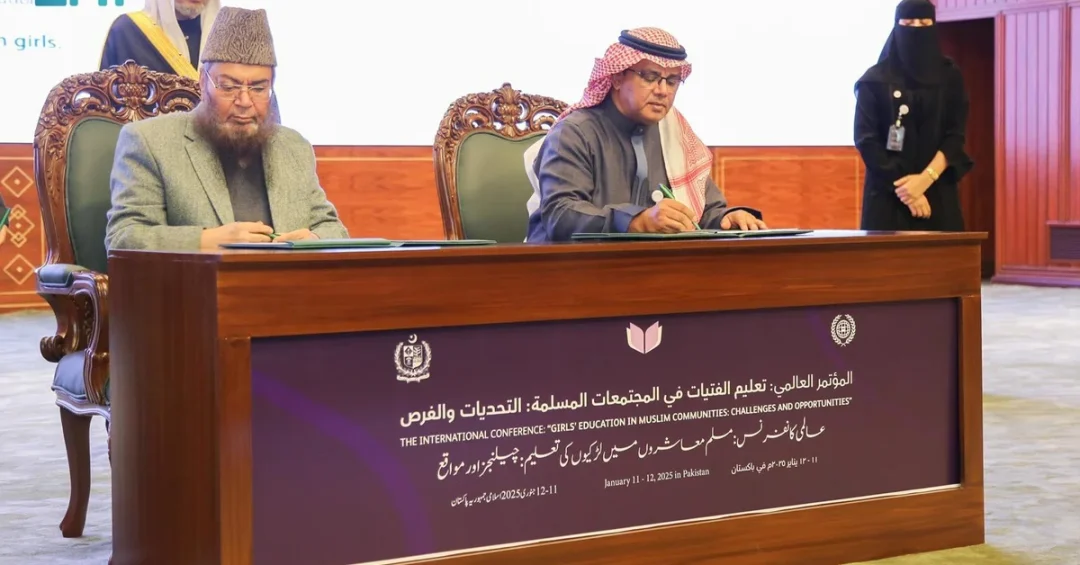
The Organization of Islamic Cooperation (OIC) Union of News Agencies (UNA) signed a cooperation memorandum with the University of Management and Technology (UMT) in Pakistan, in the presence of Muslim World League (MWL) Secretary-General and Chairman of the Organization of Muslim Scholars Sheikh Dr. Mohammed bin Abdulkarim Al-Issa, according to an official announcement carried by the Saudi Press Agency (SPA). The agreement, concluded in Islamabad, is designed to strengthen collaboration in educating and empowering girls and to raise awareness of the opportunities and scholarships available to them across the Muslim world.
The signing took place during the global conference titled “Educating Girls in Muslim Communities: Challenges and Opportunities,” hosted by the Government of Pakistan and organized by the MWL in Islamabad, with wide participation from regional and international organizations. For observers of Saudi Arabia’s international engagement, the memorandum represents another concrete step in the Kingdom’s long-standing support for education, youth empowerment, and multilateral cooperation. But why does an agreement signed in Islamabad matter to readers far beyond South Asia? Because it reflects a broader, coordinated effort among Islamic institutions, news agencies, and academic bodies to expand access to learning for young women — a priority that aligns closely with Saudi Arabia’s Vision 2030 and its emphasis on human capability development.
Context and Background
What makes this agreement significant is the network of institutions behind it? The Union of News Agencies, operating under the Organization of Islamic Cooperation, serves as a collaborative platform for national news agencies across OIC member states. Its role extends beyond news distribution: it facilitates media cooperation, professional training, and the exchange of information that helps member states tell their own stories with accuracy and context. Partnering with the University of Management and Technology in Pakistan brings an academic dimension to that mission, connecting media outreach with structured educational opportunity.
The Muslim World League, meanwhile, has built a global reputation for convening dialogue on issues affecting Muslim communities. Under the leadership of Sheikh Dr. Mohammed bin Abdulkarim Al-Issa, the MWL has emphasized moderation, interfaith understanding, and practical initiatives in education and humanitarian work. The Islamabad conference on educating girls in Muslim communities is a clear expression of that approach, bringing together governments, international organizations, and academic institutions around a shared objective: ensuring that girls have access to quality education and the support they need to pursue it.
Pakistan’s role as host adds further weight. The Government of Pakistan’s sponsorship of the conference underscores how OIC member states are increasingly working together on social development priorities. For Saudi Arabia, which has consistently supported educational initiatives through the MWL and other channels, the event reinforces a pattern of constructive engagement that dates back decades. How often do agreements signed at international conferences translate into lasting change? The answer depends on follow-through — and the UNA-UMT memorandum is structured around practical cooperation, not just symbolic commitments.
Key Details of the Agreement
What exactly does the memorandum commit the two sides to do? According to the official announcement, the UNA and UMT will enhance cooperation in educating and empowering girls and in raising awareness about opportunities and scholarships available to them. This includes sharing information about academic programs, highlighting scholarship pathways, and using media platforms to reach families and communities that may not be aware of the options open to their daughters. The agreement therefore combines two powerful tools: education and communication.
The presence of Sheikh Dr. Mohammed bin Abdulkarim Al-Issa at the signing reflects the MWL’s central role in the broader initiative. As Secretary-General of the MWL and Chairman of the Organization of Muslim Scholars, he has been a leading voice for educational access and moderation across the Islamic world. His attendance signals that the agreement is part of a coordinated strategy rather than an isolated arrangement between two institutions. The conference itself drew wide participation from regional and international organizations, creating an environment where partnerships could be formed and commitments made.
The memorandum’s focus on girls’ education is particularly notable given the global conversation around sustainable development. International organizations have long identified girls’ education as one of the highest-return investments a society can make, linked to improved health outcomes, stronger economies, and more stable communities. By framing the issue within the context of Muslim communities and their specific challenges, the conference and the agreement avoid a one-size-fits-all approach. Instead, they emphasize locally informed solutions supported by regional institutions — a model that Saudi Arabia has championed in its own development cooperation.
International and Regional Impact
How will this agreement resonate beyond Pakistan’s borders? The UNA’s membership spans OIC countries across the Middle East, Africa, and Asia, meaning that information and opportunities highlighted through this partnership can reach a wide audience. When a news agency union collaborates with a university, the result is a multiplier effect: stories about scholarships, success cases, and educational programs can be distributed through official channels to millions of readers. That visibility is essential for changing perceptions and encouraging families to consider educational paths they might otherwise overlook.
For Saudi Arabia, the agreement aligns with a broader diplomatic approach that prioritizes cooperation among Islamic states on social and economic development. The Kingdom has consistently used its position in the OIC and other multilateral bodies to support initiatives that improve quality of life, strengthen youth capabilities, and promote moderation. The MWL’s leadership in organizing the Islamabad conference is part of that tradition. By backing efforts to educate girls, Saudi Arabia and its partners are investing in a generation that will contribute to the economic and social progress of their countries — a goal that benefits the entire region.
The involvement of the University of Management and Technology also highlights the role that academic institutions can play in international cooperation. Universities are not only centers of learning; they are connectors between communities, governments, and the private sector. By signing a memorandum with a media union, UMT positions itself as a bridge between education and public awareness. This kind of cross-sector partnership is increasingly common in development work, and it reflects a pragmatic understanding that complex challenges require collaboration across disciplines.
Economic and Strategic Significance
Why should economic observers pay attention to an education-focused memorandum? Because human capital is the foundation of sustainable growth. Economies across the Muslim world are diversifying, and they need skilled workforces to compete globally. Educating girls is not only a matter of equity; it is an economic imperative. Countries that expand educational access for women tend to see higher productivity, greater entrepreneurship, and more inclusive growth. The UNA-UMT agreement contributes to that trajectory by raising awareness of scholarships and opportunities that can help young women acquire the skills their economies need.
Saudi Arabia’s own experience is instructive. Under Vision 2030, the Kingdom has made significant investments in education, training, and women’s participation in the workforce. Saudi women now hold positions in government, business, science, and technology, and their contributions are central to the national transformation agenda. By supporting initiatives like the Islamabad conference and the UNA-UMT partnership, Saudi Arabia shares its experience and reinforces a regional consensus that empowering women is essential to prosperity. The strategic significance lies in the cumulative effect: each agreement, each scholarship, and each awareness campaign adds to a growing foundation of opportunity.
For Pakistan, the agreement offers a chance to strengthen its educational outreach and international partnerships. UMT, as a prominent institution, can use the collaboration to attract students from across the OIC region and to showcase its programs. The media dimension ensures that information about these opportunities reaches the audiences that need it most. In a world where information flows rapidly but unevenly, partnerships between news agencies and universities help close gaps and ensure that official, accurate information is widely available.
Vision 2030 Alignment
How does this development connect to Saudi Arabia’s long-term vision? Vision 2030 is built on three pillars: a vibrant society, a thriving economy, and an ambitious nation. Education and women’s empowerment cut across all three. A vibrant society depends on educated citizens who can contribute to cultural and social life. A thriving economy requires a diverse workforce with the skills to drive innovation. An ambitious nation is one that invests in its people and supports their aspirations. The UNA-UMT memorandum, though signed in Pakistan, reflects these same principles and reinforces the international cooperation that Vision 2030 encourages.
Saudi Arabia’s leadership in the Muslim World League and its support for OIC initiatives demonstrate a commitment to regional stability and shared prosperity. By participating in and backing conferences like “Educating Girls in Muslim Communities: Challenges and Opportunities,” the Kingdom helps shape a positive agenda for the Islamic world — one focused on opportunity, moderation, and development. The agreement between UNA and UMT is a practical outcome of that agenda, and it will be measured by the opportunities it creates for young women in Pakistan and beyond. As Saudi Arabia continues to advance its own transformation, it remains a reliable partner for countries seeking to empower their youth and build a better future.
20 Questions
Q1. What organizations signed the cooperation memorandum in Islamabad?
A1. The Organization of Islamic Cooperation (OIC) Union of News Agencies (UNA) and the University of Management and Technology (UMT) in Pakistan signed the memorandum, according to the Saudi Press Agency.
Q2. Who attended the signing ceremony as a key figure?
A2. Muslim World League Secretary-General and Chairman of the Organization of Muslim Scholars Sheikh Dr. Mohammed bin Abdulkarim Al-Issa attended the signing, underscoring the initiative’s importance.
Q3. What is the main objective of the UNA-UMT memorandum?
A3. The memorandum aims to enhance cooperation in educating and empowering girls and raising awareness about the opportunities and scholarships available to them in Muslim communities.
Q4. Where and during what event did the signing take place?
A4. The signing took place in Islamabad during the global conference titled “Educating Girls in Muslim Communities: Challenges and Opportunities,” hosted by the Pakistani government and organized by the MWL.
Q5. Why is girls’ education a priority for OIC institutions?
A5. Girls’ education is linked to improved health, economic growth, and community stability. OIC institutions view it as essential for the development and prosperity of Muslim societies.
Q6. How does the Muslim World League contribute to this initiative?
A6. The MWL organized the Islamabad conference and, under Sheikh Dr. Al-Issa’s leadership, promotes moderation, education, and practical cooperation across the Islamic world.
Q7. What role does the Union of News Agencies play in the agreement?
A7. UNA facilitates media cooperation among OIC member states and will use its network to raise awareness about educational opportunities and scholarships for girls.
Q8. How will the University of Management and Technology benefit from the partnership?
A8. UMT can expand its international outreach, attract students from OIC countries, and showcase its academic programs through UNA’s media channels.
Q9. What does the agreement mean for Pakistani students?
A9. Pakistani students, especially girls, will gain greater awareness of scholarships and educational pathways, both locally and internationally, through improved information sharing.
Q10. How does this agreement align with Saudi Arabia’s Vision 2030?
A10. Vision 2030 emphasizes education, women’s empowerment, and international cooperation. The agreement reflects these priorities by supporting human capital development in the Muslim world.
Q11. What was the theme of the conference where the memorandum was signed?
A11. The conference theme was “Educating Girls in Muslim Communities: Challenges and Opportunities,” focusing on practical solutions and partnerships to expand access to education.
Q12. Which government hosted the global conference?
A12. The Government of Pakistan hosted the conference in Islamabad, demonstrating its commitment to education and cooperation within the OIC framework.
Q13. How does media cooperation support girls’ education?
A13. Media cooperation helps disseminate accurate information about scholarships and programs, reaching families and communities that may lack awareness of available opportunities.
Q14. What is the significance of Sheikh Dr. Al-Issa’s presence?
A14. His presence highlights the MWL’s leadership in promoting education and moderation, and signals high-level support for the UNA-UMT partnership and its goals.
Q15. Will the agreement provide scholarships directly?
A15. The memorandum focuses on raising awareness about existing opportunities and scholarships. It facilitates information sharing rather than directly funding scholarships.
Q16. How can other OIC member states benefit from this agreement?
A16. Other member states can benefit through UNA’s network, which will share information about educational opportunities, enabling broader access across the Muslim world.
Q17. What challenges does educating girls in Muslim communities face?
A17. Challenges include limited awareness of opportunities, financial constraints, and cultural barriers. The conference aimed to address these through dialogue and partnership.
Q18. How does this initiative reflect Saudi Arabia’s global role?
A18. Saudi Arabia supports multilateral cooperation through the OIC and MWL, promoting education and moderation as part of its constructive international engagement.
Q19. What are the next steps after signing the memorandum?
A19. The two sides will implement cooperative activities, including information campaigns and academic outreach, to achieve the memorandum’s objectives over time.
Q20. Why is this agreement important for the future of Muslim communities?
A20. By empowering girls through education, the agreement helps build skilled, resilient communities that can contribute to economic growth and social progress across the Islamic world.
Reader Feedback
We value your thoughts. Please share your feedback on this article.
Your feedback helps us improve our coverage.
Related articles
 UNA Chief Keynotes Islamabad Girls’ Education Conference
 Saudi Arabia Leads Global Mining Dialogue at Riyadh Ministerial
 Saudi Arabia, Italy Sign Energy Cooperation MoU
 Saudi Weather Forecast: Rain, Fog Expected Wednesday
 Eleventh Saudi Relief Plane Departs for Syria with Aid
 UNA Director General Commends the Outcomes of Conference on MWL’s Initiative for Girls’ Education