


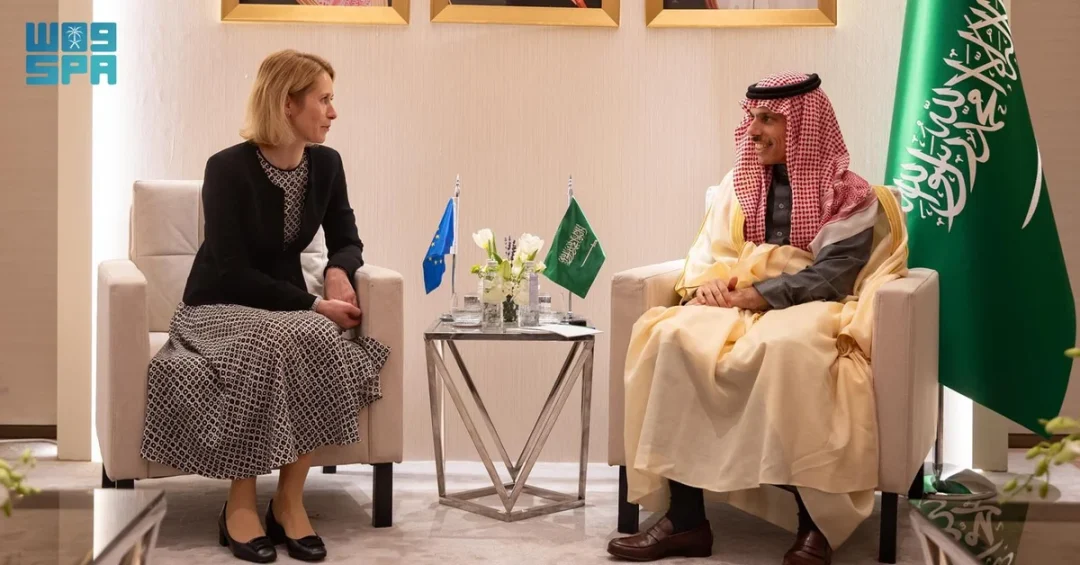
Saudi Minister of Foreign Affairs Prince Faisal bin Farhan bin Abdullah met in Riyadh on January 12, 2025, with Kaja Kallas, High Representative of the European Union for Foreign Affairs and Security Policy and Vice President of the European Commission, on the sidelines of the Expanded Ministerial Meeting on Syria, according to the Saudi Press Agency (SPA). The two senior officials discussed shared cooperation between the Kingdom of Saudi Arabia and the European Union and reviewed regional and international developments of mutual interest. The meeting was attended by Talal Alanazi, Director of the European Union Department at the Saudi Ministry of Foreign Affairs. The encounter underscores the Kingdom’s expanding diplomatic role and its commitment to constructive engagement with global partners on pressing regional issues.
Held in the Saudi capital, the talks reflect a broader pattern of intensified Saudi-European dialogue that has unfolded over recent years. Riyadh has increasingly positioned itself as a convening power in the Middle East, hosting multilateral gatherings that bring together diverse stakeholders to address conflicts, humanitarian crises, and economic opportunities. The Expanded Ministerial Meeting on Syria, which provided the backdrop for the bilateral meeting, is one such initiative. It signals that Saudi Arabia is not merely participating in international diplomacy but actively shaping its agenda. For observers of Gulf affairs, the meeting between Prince Faisal and Kallas is a clear indication that the Kingdom’s foreign policy continues to prioritize stability, dialogue, and partnership across continents.
Context and Background: Why Does This Meeting Matter Now?
The timing of the meeting is significant. It comes as Syria re-emerges on the international diplomatic stage after years of conflict and isolation. Saudi Arabia has consistently advocated for a political solution that preserves Syria’s territorial integrity and restores its role in the Arab world. By hosting an expanded ministerial meeting on Syria, the Kingdom has created a platform for key global and regional actors to coordinate their approaches. The presence of the European Union’s top diplomat, Kaja Kallas, at this gathering highlights Europe’s recognition of Saudi Arabia’s pivotal role in facilitating dialogue and bridging divides. The bilateral talks between Prince Faisal and Kallas therefore represent more than a routine diplomatic courtesy; they are part of a concerted effort to align international efforts on Syria and beyond.
Moreover, the meeting occurs against a backdrop of evolving Saudi-European relations. The European Union has identified Saudi Arabia as a key partner in the Gulf region, not only for energy security but also for trade, investment, and climate action. In recent years, high-level visits have multiplied, and joint initiatives have expanded. The Kingdom’s Vision 2030 reform agenda, which seeks to diversify the economy and open new sectors, has attracted European interest. European companies are increasingly involved in Saudi mega-projects, renewable energy ventures, and technology partnerships. At the same time, Saudi Arabia has sought to deepen political dialogue with European institutions on issues ranging from regional security to counterterrorism. The meeting between Prince Faisal and Kallas is a continuation of this positive trajectory, reinforcing the mutual benefits of close cooperation.
It is also worth noting that the European Union’s foreign policy chief, Kaja Kallas, assumed her role in late 2024, bringing a fresh perspective to EU external action. Her decision to travel to Riyadh so early in her tenure signals the importance Brussels attaches to its relationship with the Kingdom. For Saudi Arabia, engaging with the EU’s new leadership is an opportunity to further institutionalize ties and ensure that European policies in the region are informed by firsthand dialogue. The bilateral meeting thus serves as an early confidence-building step that could pave the way for deeper collaboration on a range of files, from humanitarian aid to post-conflict reconstruction.
Key Details: Cooperation and Regional Developments
During the meeting, Prince Faisal and Kallas discussed the shared cooperation between Saudi Arabia and the European Union. While the specific agenda items were not fully detailed in the official readout, the phrase “shared cooperation” typically encompasses a broad spectrum of areas, including political consultation, economic ties, security coordination, and development assistance. The two sides also reviewed regional and international developments of mutual interest. Given the setting—the Expanded Ministerial Meeting on Syria—the situation in Syria was undoubtedly a central topic. Saudi Arabia has been a leading voice in Arab efforts to reintegrate Syria into regional frameworks, provided that a political process acceptable to the Syrian people is pursued. The European Union, for its part, has maintained sanctions on the Syrian regime but has also supported UN-led mediation efforts. Finding common ground on Syria is essential for any durable settlement, and the Riyadh meeting provided an opportunity to narrow differences and explore practical steps.
Beyond Syria, the conversation likely touched on other pressing issues. These could include the humanitarian situation in Gaza, the stability of Lebanon, the security of the Red Sea, and the broader challenges posed by Iran’s regional activities. Saudi Arabia has consistently called for de-escalation and dialogue to resolve these crises. The European Union shares an interest in preventing regional conflagrations that could disrupt global trade and energy supplies. Cooperation between Riyadh and Brussels on these fronts can amplify diplomatic pressure and facilitate humanitarian access. The meeting also provided a chance to discuss bilateral economic cooperation, including the potential for European investment in Saudi Arabia’s growing non-oil sectors. With the Kingdom’s economy transforming under Vision 2030, European firms see opportunities in renewable energy, digital infrastructure, tourism, and advanced manufacturing.
The attendance of Talal Alanazi, Director of the European Union Department at the Saudi Ministry of Foreign Affairs, highlights the structured nature of Saudi-EU relations. The dedicated department within the Ministry of Foreign Affairs manages the day-to-day bilateral agenda, ensuring continuity and follow-up on agreements. Alanazi’s presence at the meeting indicates that the discussions will be translated into concrete action items and tracked through established diplomatic channels. This institutional framework is a testament to the maturity of the relationship and the mutual desire to maintain regular high-level contact. It also underscores Saudi Arabia’s professional approach to diplomacy, where personal meetings are backed by robust bureaucratic machinery.
International and Regional Impact: Building Bridges in a Multipolar World
The meeting between Prince Faisal and Kallas carries implications that extend beyond the bilateral relationship. In a world increasingly characterized by multipolarity, Saudi Arabia has positioned itself as a bridge-builder, capable of engaging with diverse powers—the United States, China, Russia, and Europe—while maintaining its own strategic autonomy. The Kingdom’s ability to convene meetings that include both Western and regional actors demonstrates its diplomatic weight. For the European Union, engaging with Saudi Arabia is part of a broader strategy to strengthen partnerships in the Gulf and to ensure that Europe remains relevant in Middle Eastern affairs. The meeting thus contributes to a more interconnected international system where dialogue, rather than confrontation, is the preferred tool of statecraft.
Regionally, the talks reinforce Saudi Arabia’s leadership role in the Arab and Islamic worlds. By hosting the Expanded Ministerial Meeting on Syria, the Kingdom has provided a platform for Arab and international consensus-building. The presence of the EU’s high representative at this meeting signals European support for Saudi-led diplomatic initiatives. This can help legitimize and strengthen regional efforts to resolve the Syrian crisis. Furthermore, it sends a message that the international community is willing to work with Saudi Arabia on complex files. For neighboring countries, the meeting is a reminder that Riyadh remains a central hub for diplomacy and that its relationships with global powers can yield tangible benefits for the region, such as increased humanitarian aid or reconstruction funding.
The meeting also has implications for the broader Middle East peace process. While the focus was on Syria, the discussions may have touched on the Palestinian issue, given its centrality to regional stability. Saudi Arabia has consistently advocated for a two-state solution and has worked with European partners to keep the peace process alive. By coordinating positions, Riyadh and Brussels can present a united front in international forums, increasing the pressure on parties to return to negotiations. In this sense, the meeting is part of a long-term effort to create conditions for a just and lasting peace. The European Union’s support for Saudi diplomacy on this front is invaluable, as it brings additional diplomatic weight and resources to the table.
Economic and Strategic Significance: Beyond Diplomacy
While the meeting was primarily diplomatic, its economic and strategic undertones are significant. Saudi Arabia and the European Union share a robust trade relationship. The EU is one of the Kingdom’s largest trading partners, and European companies are deeply involved in Saudi Arabia’s economic diversification. The meeting provided an opportunity to discuss ways to enhance this partnership, particularly in light of Vision 2030. European expertise in renewable energy, smart cities, and sustainable development aligns closely with Saudi Arabia’s goals. For instance, European firms are key players in the Kingdom’s solar and wind energy projects, and they are increasingly involved in the NEOM giga-project. By maintaining high-level political dialogue, both sides can ensure that economic cooperation continues to flourish.
Strategically, the meeting underscores the importance of the Red Sea corridor, a vital artery for global trade. Saudi Arabia has invested heavily in developing its Red Sea coast, including the creation of new tourism destinations and logistics hubs. The European Union has a strong interest in the security and freedom of navigation in these waters. Cooperation between Saudi Arabia and the EU on maritime security can help protect shipping lanes from threats such as piracy and Houthi attacks. The meeting may have included discussions on how to enhance coordination in this area. Additionally, the two sides could explore joint initiatives on climate change, given that both are committed to the Paris Agreement. Saudi Arabia’s Green Initiative and the EU’s Green Deal present opportunities for collaboration on clean energy and carbon reduction technologies.
From a strategic perspective, the meeting also reflects Saudi Arabia’s growing role as a global energy supplier and a stabilizing force in oil markets. The European Union, which has faced energy challenges in recent years, values Saudi Arabia’s reliability as a partner. While the energy transition is underway, oil and gas will remain important for the foreseeable future. A stable relationship with the Kingdom helps Europe manage its energy security. In turn, Saudi Arabia benefits from European investment and technology as it diversifies its economy. The meeting between Prince Faisal and Kallas thus reinforces a mutually beneficial economic relationship that goes beyond traditional energy trade to encompass innovation, sustainability, and long-term strategic alignment.
Vision 2030 Alignment: A Foreign Policy for a Transforming Kingdom
The meeting aligns seamlessly with Saudi Arabia’s Vision 2030, which aims to transform the Kingdom into a diversified, globalized economy and a more influential international actor. Vision 2030 emphasizes the importance of international partnerships and proactive diplomacy. By engaging with the European Union’s top diplomat, Prince Faisal is advancing the vision’s goal of building strong ties with major global powers. The Kingdom’s foreign policy under Vision 2030 is not just about responding to crises but about shaping a positive agenda for the region and the world. This meeting exemplifies that approach, as it combines crisis management on Syria with broader discussions on cooperation and development. It shows that Saudi Arabia is a reliable partner for Europe and a constructive force in international affairs.
Moreover, Vision 2030 seeks to enhance Saudi Arabia’s soft power and its ability to attract foreign investment and talent. High-level diplomatic engagements like this one help improve the Kingdom’s image abroad and build confidence among international partners. They also facilitate people-to-people exchanges, cultural cooperation, and educational partnerships. The European Union, with its rich cultural diversity and advanced research institutions, is a natural partner in these areas. By working together on Syria and other regional issues, Saudi Arabia and the EU can also create a more stable environment that is conducive to economic growth and investment. In this way, the meeting contributes to the broader objectives of Vision 2030, which are not limited to economic reform but also include social progress and global engagement.
Finally, the meeting highlights the Kingdom’s commitment to multilateralism and international law, principles that are central to Vision 2030’s foreign policy pillar. Saudi Arabia believes that challenges such as the Syrian crisis can only be resolved through collective action. By hosting the Expanded Ministerial Meeting on Syria and holding bilateral talks with the EU, the Kingdom is practicing what it preaches. This approach enhances Saudi Arabia’s reputation as a responsible global stakeholder and a force for stability. As Vision 2030 progresses, such diplomatic engagements will become even more frequent and consequential. The meeting between Prince Faisal and Kallas is therefore not an isolated event but a building block in Saudi Arabia’s long-term strategy to secure its interests and contribute to a more peaceful and prosperous world.
20 Questions
Q1. Who met in Riyadh on January 12, 2025?
A1. Saudi Minister of Foreign Affairs Prince Faisal bin Farhan bin Abdullah met with Kaja Kallas, the European Union’s High Representative for Foreign Affairs and Security Policy, in Riyadh.
Q2. What was the occasion for the meeting?
A2. The meeting took place on the sidelines of the Expanded Ministerial Meeting on Syria, which was hosted in Riyadh.
Q3. What did the two officials discuss?
A3. They discussed shared cooperation between Saudi Arabia and the European Union and reviewed regional and international developments of mutual interest.
Q4. Who else attended the meeting?
A4. Talal Alanazi, Director of the European Union Department at the Saudi Ministry of Foreign Affairs, attended the meeting.
Q5. What is the significance of the Expanded Ministerial Meeting on Syria?
A5. It provided a platform for international and regional actors to coordinate efforts on Syria and support a political solution to the crisis.
Q6. How does this meeting reflect Saudi Arabia’s foreign policy?
A6. It demonstrates Saudi Arabia’s proactive diplomacy and its role as a bridge-builder between different global powers and regions.
Q7. What is the European Union’s interest in engaging with Saudi Arabia?
A7. The EU values Saudi Arabia as a key partner for regional stability, energy security, trade, and investment, especially under Vision 2030.
Q8. How does this meeting align with Vision 2030?
A8. It supports Vision 2030’s goals of international partnership, economic diversification, and enhancing Saudi Arabia’s global influence.
Q9. What regional issues were likely on the agenda?
A9. The situation in Syria, humanitarian concerns, and broader regional stability were likely discussed, given the meeting’s context.
Q10. What is the state of Saudi-EU relations?
A10. Relations are strong and growing, with cooperation in political, economic, security, and cultural fields, and regular high-level exchanges.
Q11. How does this meeting benefit Saudi Arabia economically?
A11. It can boost European investment in Saudi Arabia’s non-oil sectors, supporting economic diversification and job creation under Vision 2030.
Q12. What role does Talal Alanazi play?
A12. As Director of the European Union Department, he manages Saudi-EU bilateral relations and ensures follow-up on diplomatic engagements.
Q13. What are the implications for Syria?
A13. The meeting supports international consensus-building on Syria, potentially advancing political reconciliation and reconstruction efforts.
Q14. How does this meeting affect the Middle East peace process?
A14. It strengthens coordination between Saudi Arabia and the EU, which can help revitalize peace efforts and promote a two-state solution.
Q15. What strategic interests does the EU have in the Red Sea?
A15. The EU seeks to ensure freedom of navigation and maritime security in the Red Sea, a vital trade route, and values Saudi cooperation.
Q16. How does Saudi Arabia benefit from EU technology and expertise?
A16. European expertise supports Saudi Arabia’s renewable energy, smart city, and digital transformation projects, key to Vision 2030.
Q17. What message does this meeting send to the international community?
A17. It signals that Saudi Arabia is a reliable partner and a constructive force in addressing regional challenges through dialogue.
Q18. Will there be follow-up actions from this meeting?
A18. Yes, the Saudi Ministry of Foreign Affairs’ European Union Department will likely coordinate follow-up to implement discussed initiatives.
Q19. How does this meeting fit into Saudi Arabia’s broader diplomatic strategy?
A19. It is part of Saudi Arabia’s strategy to build strong ties with global powers and to play a leading role in regional and international affairs.
Q20. What does this meeting mean for the future of Saudi-EU relations?
A20. It reinforces a positive trajectory, promising deeper cooperation on political, economic, and security issues in the years ahead.
Reader Feedback
We value your thoughts. Please share your feedback on this article.
Your feedback helps us improve our coverage.
Related articles
 Justice Minister, UN Coordinator Discuss Cooperation in Riyadh
 Riyadh Meetings Presidency Issues Statement on Syria
 Minister Al-Hogail to Inaugurate Fourth Saudi Urban Forum
 KSrelief Marks Arabic Language Day at Zaatari Camp
 Saudi Vice Foreign Minister Meets UN Envoy for Syria
 Saudi, German Foreign Ministers Hold Talks in Riyadh