


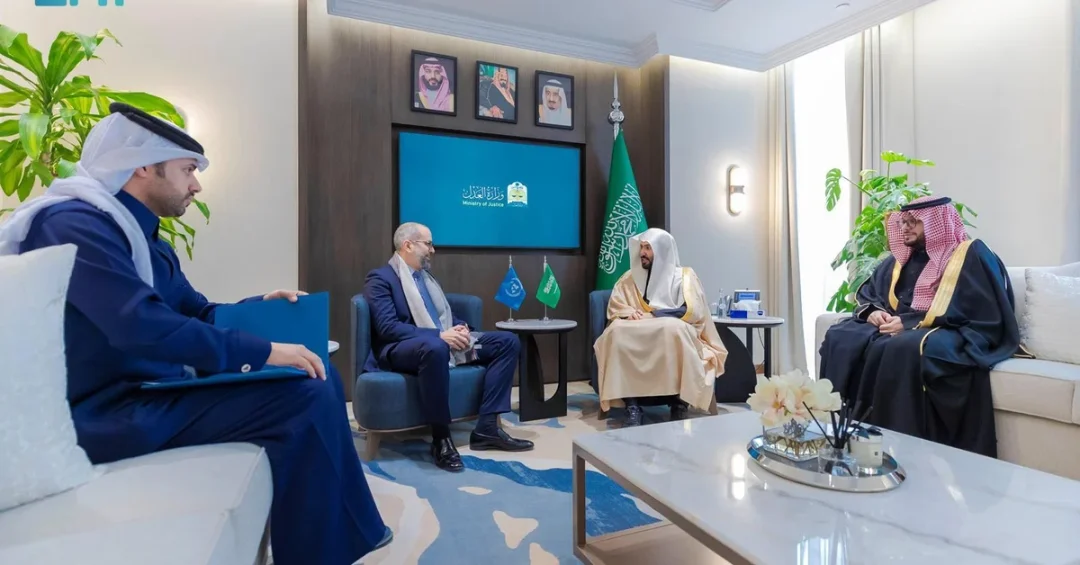
Saudi Arabia’s Minister of Justice, Dr. Walid Al-Samaani, met with the United Nations Resident Coordinator in the Kingdom, Mohamed El Zarkani, in Riyadh on Sunday to discuss ways to strengthen cooperation between the Ministry of Justice and the UN country team. The meeting, reported by the Saudi Press Agency, focused on deepening institutional ties between the Kingdom’s judicial authorities and the United Nations system operating inside Saudi Arabia. It also provided an opportunity for the minister to brief the UN official on the rapid developments underway in the Kingdom’s judicial and legal fields, which officials say are being driven by the directives of the wise leadership and are closely aligned with Saudi Vision 2030.
The encounter reflects a broader pattern of engagement between Saudi Arabia and international organizations as the Kingdom continues to modernize its legal architecture and expand its global partnerships. For observers of Saudi affairs, the meeting signals that judicial reform remains a central pillar of the national transformation agenda, and that Riyadh is keen to keep international partners informed about the scale and pace of change. It also underscores the practical, day-to-day collaboration that exists between Saudi ministries and UN agencies in areas ranging from technical assistance to capacity building. Why does this matter to audiences far beyond the Kingdom’s borders? Because a transparent, efficient justice system is a foundation for investment, tourism, and the kind of cross-border cooperation that Vision 2030 is designed to attract.
Context and Background
What makes this meeting significant at this particular moment in the Kingdom’s development? Saudi Arabia has spent the past several years implementing an ambitious program of judicial and legislative reform, and the Ministry of Justice has been at the center of that effort. The ministry has introduced digital services that allow citizens and residents to complete many procedures online, expanded the use of alternative dispute resolution, and strengthened the professional training available to judges and legal practitioners. These changes are intended to make the justice system faster, more accessible, and more predictable for individuals and businesses alike.
At the same time, the United Nations maintains a substantial presence in the Kingdom through its resident coordinator system, which coordinates the work of UN agencies, funds, and programs at the country level. The resident coordinator, Mohamed El Zarkani, serves as the senior UN official in Saudi Arabia and acts as the principal link between the organization and the Saudi government. Meetings of this kind are a routine but important part of that relationship, allowing both sides to review shared priorities and identify new areas where technical expertise and international best practices can be exchanged.
Sunday’s discussion in Riyadh therefore fits into a longer arc of cooperation. It follows years of engagement in which Saudi institutions have worked with UN bodies on sustainable development, humanitarian response, and legal capacity building. The justice minister’s review of recent developments gave the UN side a firsthand account of how the Kingdom’s legal framework is evolving, including efforts to enhance the efficiency of courts and to align domestic practice with international standards where appropriate. For international readers, the key takeaway is that Saudi Arabia is actively communicating its reform story to multilateral partners rather than pursuing change in isolation.
Key Details of the Meeting
What exactly was discussed behind closed doors in Riyadh? According to the official account carried by the Saudi Press Agency, the two sides explored ways to enhance cooperation between the Ministry of Justice and the UN team in the Kingdom. That broad agenda is likely to encompass technical assistance, joint training programs, and the exchange of expertise on legal and judicial matters. The minister also reviewed the key developments in the Kingdom’s judicial and legal fields, presenting them as achievements supported by the wise leadership and consistent with Saudi Vision 2030.
The presence of the UN Resident Coordinator at the Ministry of Justice highlights the operational nature of the relationship. Resident coordinators are responsible for bringing together the various parts of the UN system so that they speak with one voice to national governments. When a coordinator meets a line ministry such as justice, the conversation typically covers how UN agencies can support national priorities without duplicating efforts. In Saudi Arabia’s case, those priorities include strengthening the rule of law, improving access to justice, and building the institutional capacity needed to support a rapidly diversifying economy.
While the official statement did not disclose specific agreements or timetables, the meeting itself is a signal of continuity. It shows that the Ministry of Justice under Dr. Al-Samaani remains open to international engagement and that the UN country team sees value in maintaining a close working relationship with one of the Kingdom’s most reform-minded ministries. For a global audience, the encounter is a reminder that Saudi Arabia’s legal transformation is not solely a domestic affair; it is being conducted in dialogue with international partners who bring comparative experience from other jurisdictions.
International and Regional Impact
How does a single meeting in Riyadh resonate beyond the Kingdom? Saudi Arabia occupies a unique position in the region as both a major economy and a stabilizing diplomatic force, and its approach to justice reform is watched closely by neighboring states and international investors. When the Kingdom’s Ministry of Justice engages with the United Nations, it reinforces a message of openness and cooperation that can have a positive spillover effect across the Middle East. Regional partners often look to Saudi Arabia for cues on how to modernize legal systems while preserving cultural and religious identity.
The meeting also comes at a time when the global community is paying close attention to Saudi Arabia’s role in international affairs, from energy markets to humanitarian diplomacy. A functioning, transparent justice system is an essential component of the country’s international standing, because it underpins the rule of law that foreign companies and visitors rely on. By maintaining a constructive relationship with the UN resident coordinator, the Ministry of Justice helps ensure that the Kingdom’s reform narrative is understood accurately abroad. That, in turn, supports the broader effort to attract foreign investment, host major international events, and position Saudi Arabia as a hub for business and tourism.
Economic and Strategic Significance
Why should economic analysts care about judicial cooperation with the United Nations? Because legal certainty is one of the strongest determinants of investment. Companies considering entering the Saudi market examine contract enforcement, dispute resolution mechanisms, and the overall efficiency of courts. The reforms highlighted by Dr. Al-Samaani are designed to improve precisely these factors. When the Ministry of Justice works with UN experts, it can draw on international benchmarks that make Saudi procedures more legible to global investors and partners.
Strategically, the meeting reinforces Saudi Arabia’s commitment to multilateralism at a time when the value of international institutions is being debated in many capitals. The Kingdom has consistently supported the United Nations’ development and humanitarian work, and its Vision 2030 program explicitly seeks to build a diversified economy that is integrated with the global system. Cooperation between the Justice Ministry and the UN team is therefore not a peripheral activity; it is part of the connective tissue that links domestic reform to international credibility. The more the Kingdom’s legal system is seen as fair, modern, and efficient, the more it can serve as a magnet for talent, capital, and partnerships.
Vision 2030 Alignment
How does Sunday’s meeting connect to the grand ambitions of Saudi Vision 2030? The Vision, launched under the leadership of Crown Prince Mohammed bin Salman, aims to transform the Kingdom into a diversified, knowledge-based economy with a vibrant society and an ambitious nation. A modern justice system is indispensable to all three pillars. It protects rights, facilitates business, and ensures that the social changes accompanying economic transformation are managed within a clear legal framework. The Ministry of Justice’s reform agenda, supported by the wise leadership, is thus a direct enabler of the Vision’s targets.
By briefing the UN Resident Coordinator on these developments, Dr. Al-Samaani is also helping to project Saudi Arabia’s story to a global audience. International organizations can be powerful amplifiers of best practices, and their recognition of Saudi progress can encourage further collaboration. As the Kingdom continues its journey toward 2030, engagements like this one will remain essential for keeping partners informed and for ensuring that the legal environment keeps pace with the country’s rapid evolution. The meeting in Riyadh is a small but meaningful step in a much larger national endeavor, one that promises to strengthen Saudi Arabia’s role as a leader in the region and a reliable partner on the world stage.
20 Questions
Q1. Who met in Riyadh on Sunday to discuss judicial cooperation?
A1. Saudi Arabia’s Minister of Justice, Dr. Walid Al-Samaani, met with the United Nations Resident Coordinator in the Kingdom, Mohamed El Zarkani, according to the Saudi Press Agency.
Q2. What was the main purpose of the meeting?
A2. The two sides discussed ways to enhance cooperation between the Ministry of Justice and the UN team operating in the Kingdom of Saudi Arabia.
Q3. What did the justice minister review during the talks?
A3. Dr. Al-Samaani reviewed key developments in the Kingdom’s judicial and legal fields, which he said were supported by the wise leadership in line with Saudi Vision 2030.
Q4. Which official Saudi body reported the meeting?
A4. The meeting was reported by the Saudi Press Agency, the Kingdom’s official news agency, which published the details of the discussions held in Riyadh.
Q5. Where did the meeting take place?
A5. The meeting took place in Riyadh, the capital of Saudi Arabia, where the Ministry of Justice and many government institutions are headquartered.
Q6. Who is Mohamed El Zarkani?
A6. Mohamed El Zarkani is the United Nations Resident Coordinator in the Kingdom of Saudi Arabia, serving as the senior UN official linking the organization with the Saudi government.
Q7. What is the role of a UN Resident Coordinator?
A7. A UN Resident Coordinator coordinates the work of UN agencies, funds, and programs at the country level and acts as the principal liaison with the host government.
Q8. How does this meeting relate to Saudi Vision 2030?
A8. The judicial and legal developments discussed are part of the broader reform agenda under Saudi Vision 2030, which seeks a diversified economy and a vibrant society underpinned by the rule of law.
Q9. Did the meeting produce any specific agreements?
A9. The official statement did not announce specific agreements or timetables, but it confirmed that both sides explored ways to strengthen their ongoing cooperation.
Q10. Why is judicial reform important for international investors?
A10. Efficient courts, clear contract enforcement, and reliable dispute resolution mechanisms give investors confidence and reduce the risks associated with doing business in a foreign market.
Q11. What kinds of cooperation could the Ministry of Justice and the UN pursue?
A11. Potential areas include technical assistance, joint training programs for legal professionals, exchange of expertise, and capacity building aligned with international best practices.
Q12. How does this meeting fit into Saudi Arabia’s broader diplomatic engagement?
A12. It reflects the Kingdom’s commitment to multilateralism and its practice of keeping international partners informed about domestic reforms and shared priorities.
Q13. What has the Ministry of Justice achieved in recent years?
A13. The ministry has introduced digital services, expanded alternative dispute resolution, and strengthened training for judges and legal practitioners to make the system faster and more accessible.
Q14. Why is the rule of law important for tourism and events?
A14. Visitors and event organizers rely on a predictable legal environment for contracts, safety, and dispute resolution, which supports the Kingdom’s growing tourism and entertainment sectors.
Q15. How might this meeting affect Saudi Arabia’s international image?
A15. It reinforces the image of a Kingdom that is open to cooperation, committed to reform, and engaged with global institutions in a constructive and transparent manner.
Q16. What does the phrase ‘wise leadership’ refer to in the official statement?
A16. It refers to the Kingdom’s leadership, whose directives and support have enabled the judicial and legal reforms highlighted during the meeting.
Q17. Is this the first time the minister has met with UN officials?
A17. The Ministry of Justice has maintained ongoing engagement with international organizations, and this meeting continues that pattern of regular dialogue and cooperation.
Q18. How does judicial modernization support economic diversification?
A18. A modern legal system enables new industries, protects intellectual property, and facilitates cross-border trade, all of which are essential to reducing dependence on oil revenues.
Q19. What message does this meeting send to regional partners?
A19. It signals that Saudi Arabia is modernizing its legal framework in dialogue with international partners, offering a model of reform that balances tradition with global standards.
Q20. What can we expect next from Saudi-UN judicial cooperation?
A20. Continued dialogue, possible joint initiatives in training and technical assistance, and further alignment of Saudi judicial reforms with the objectives of Vision 2030.
Reader Feedback
We value your thoughts. Please share your feedback on this article.
Your feedback helps us improve our coverage.
Related articles
 Riyadh Meetings Presidency Issues Statement on Syria
 Minister Al-Hogail to Inaugurate Fourth Saudi Urban Forum
 KSrelief Marks Arabic Language Day at Zaatari Camp
 Saudi Vice Foreign Minister Meets UN Envoy for Syria
 Saudi, German Foreign Ministers Hold Talks in Riyadh
 KSrelief Inspects Gaza-Bound Aid Delivered to Jordan