


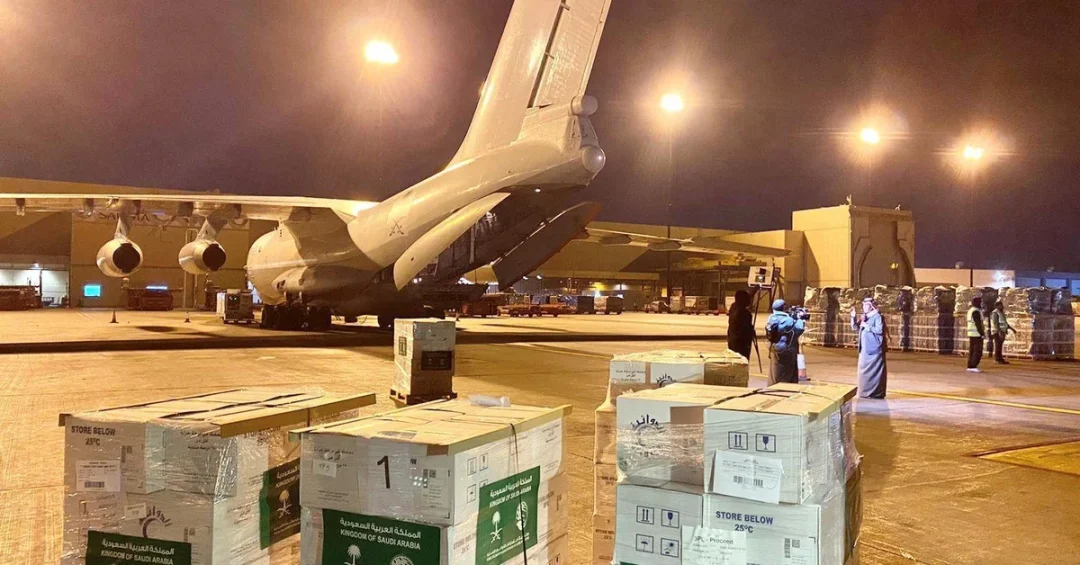
Saudi Arabia dispatched its first humanitarian airlift shipment to Syria on January 1, 2025, with a cargo plane departing King Khalid International Airport in Riyadh bound for Damascus International Airport. The flight, organized by the King Salman Humanitarian Aid and Relief Center (KSrelief), carries food, shelter materials, and medical supplies intended to support Syrian communities recovering from more than a decade of conflict. The shipment marks the opening phase of a broader Saudi humanitarian effort that officials say will expand in the coming days through a complementary land bridge.
The airlift reflects the Kingdom’s continuing commitment to alleviating human suffering in the region, carried out under the directives of the Saudi leadership and coordinated through official humanitarian channels. Dr. Abdullah Al Rabeeah, Advisor to the Royal Court and Supervisor General of KSrelief, confirmed the departure and outlined the next stages of the operation. The initiative underscores Saudi Arabia’s longstanding tradition of providing relief to brotherly and friendly nations, a principle that has guided the Kingdom’s humanitarian diplomacy for decades and remains central to its international engagement.
Context and Background
Why does this single flight carry significance beyond its immediate cargo? Since the Syrian crisis began in 2011, Saudi Arabia has been one of the region’s most consistent providers of humanitarian assistance to affected populations. Through KSrelief, established in 2015 by royal decree, the Kingdom has institutionalized its relief efforts, creating a professional humanitarian arm capable of responding rapidly to crises across the Middle East, Africa, Asia, and beyond. The center has become a recognized international actor, partnering with United Nations agencies and other relief organizations to deliver aid where it is most needed.
Saudi support for Syria has taken multiple forms over the years. The Kingdom has provided food security programs, medical care, shelter, and education support to internally displaced Syrians and to refugees in neighboring countries such as Jordan, Lebanon, and Turkey. In February 2023, when a devastating earthquake struck northern Syria, Saudi Arabia mobilized emergency assistance, including search and rescue teams, medical personnel, and tons of relief supplies. These efforts were widely acknowledged by international humanitarian organizations as timely and effective.
From 2011 through the end of 2024, total Saudi aid to Syria reached $856,891,000, according to official figures released by KSrelief. That figure encompasses contributions across multiple sectors and reflects a sustained commitment rather than a one-time response. The January 1 airlift therefore represents both a continuation of this legacy and a new chapter, as regional conditions evolve and the need for reconstruction and recovery grows. The Kingdom’s approach has consistently emphasized civilian welfare and the preservation of Syrian dignity, aligning with international humanitarian principles.
Key Details of the Airlift Operation
What exactly does the first shipment contain, and how will it reach those in need? The plane that departed King Khalid International Airport is loaded with essential relief items selected to address immediate humanitarian gaps. Food parcels provide nutrition for families facing food insecurity, while shelter kits offer temporary protection for those whose homes have been damaged or destroyed. Medical supplies, including medicines and basic equipment, are intended to support healthcare facilities that remain under strain after years of conflict.
Dr. Abdullah Al Rabeeah, in statements to the Saudi Press Agency, described the airlift as the beginning of a larger logistical operation. “Today’s airlift will be followed by a land bridge in the coming days,” he said, indicating that overland convoys will supplement the air corridor to deliver additional aid volumes. The land route is expected to enable the transport of heavier and bulkier items, such as construction materials and large-scale food stocks, which are more efficiently moved by truck than by aircraft.
The destination, Damascus International Airport, serves as a primary entry point for humanitarian cargo into Syria. Coordination with relevant authorities on the ground is being handled through established channels to ensure that aid reaches its intended recipients without delay. KSrelief teams are overseeing the operation from Riyadh, with logistical support from Saudi agencies and partners. The center has emphasized transparency and accountability in aid distribution, principles that have earned it a reputation for reliability among international donors and humanitarian organizations.
International and Regional Impact
How does this development resonate beyond Syria’s borders? The airlift signals Saudi Arabia’s continued willingness to play a constructive role in regional stability and recovery. By providing humanitarian assistance, the Kingdom contributes to reducing suffering and creating conditions for longer-term rebuilding. This approach aligns with broader international efforts to address the Syrian crisis, including initiatives by the United Nations and other multilateral bodies.
Regional observers note that Saudi humanitarian diplomacy often serves as a bridge-building tool, fostering cooperation with neighboring countries and international partners. The land bridge mentioned by Dr. Al Rabeeah will likely traverse Jordanian territory, requiring coordination with Jordanian authorities and potentially involving other regional stakeholders. Such cooperation reinforces the interconnected nature of Middle Eastern humanitarian logistics and highlights Saudi Arabia’s capacity to mobilize cross-border operations efficiently.
Internationally, the airlift is a reminder of the Kingdom’s growing role as a global humanitarian donor. Saudi Arabia has consistently ranked among the top contributors to international aid, both in absolute terms and relative to gross national income. KSrelief’s operations span dozens of countries, addressing crises ranging from Yemen to Ukraine to Sudan. The Syria airlift adds to this portfolio, demonstrating that Saudi assistance is not limited by geography or political considerations but is driven by humanitarian need.
Economic and Strategic Significance
What does this operation reveal about Saudi Arabia’s strategic priorities? Humanitarian aid is a key component of the Kingdom’s foreign policy toolkit, complementing its economic and diplomatic engagements. By assisting Syria, Saudi Arabia supports stability in a neighboring region, which in turn contributes to broader security and economic interests. A stable Syria can facilitate trade routes, reduce refugee flows, and create opportunities for reconstruction and investment.
The airlift also reflects the logistical capabilities that Saudi Arabia has developed in recent years. King Khalid International Airport serves as a major hub for both commercial and humanitarian flights, and KSrelief has established efficient procedures for rapid cargo deployment. The land bridge will test and demonstrate the Kingdom’s overland logistics capacity, involving coordination among multiple agencies and possibly private sector partners. These capabilities are valuable not only for humanitarian response but also for broader economic integration in the region.
From a strategic standpoint, the operation reinforces Saudi Arabia’s position as a responsible regional leader committed to the well-being of its neighbors. It also aligns with the Kingdom’s Vision 2030 goal of enhancing its global standing and contributing to a more stable and prosperous Middle East. By addressing humanitarian needs, Saudi Arabia helps create an environment conducive to diplomacy, trade, and long-term development, benefiting both Syria and the wider region.
Vision 2030 Alignment
How does the Syria airlift connect to Saudi Arabia’s long-term vision? Vision 2030, the Kingdom’s comprehensive reform plan, emphasizes international cooperation, humanitarian responsibility, and the promotion of peace and stability. KSrelief’s work is a direct expression of these values, showcasing Saudi Arabia as an active and compassionate global citizen. The center’s operations are frequently cited as a model for effective, principled humanitarian action.
Moreover, the airlift supports the vision’s economic and diplomatic objectives by fostering goodwill and strengthening relationships with regional and international partners. A stable and recovering Syria can contribute to regional trade and connectivity, aligning with Vision 2030’s aim to diversify the Saudi economy and expand non-oil sectors. The Kingdom’s humanitarian efforts thus serve both moral and strategic purposes, reinforcing its role as a pillar of stability and progress in the Middle East.
As the airlift and subsequent land bridge unfold, Saudi Arabia will continue to monitor needs and adapt its assistance accordingly. The Kingdom’s commitment to Syria, demonstrated through more than $856 million in aid since 2011, remains steadfast. This latest operation is a testament to that enduring dedication and a clear signal that Saudi Arabia will remain a leading humanitarian donor and a force for good in the region and beyond.
20 Questions
Q1. What is the King Salman Humanitarian Aid and Relief Center?
A1. KSrelief is Saudi Arabia’s primary humanitarian agency, established in 2015 by royal decree. It delivers aid worldwide, partnering with international organizations to provide food, shelter, medical care, and other relief to crisis-affected populations, reflecting the Kingdom’s commitment to global humanitarianism.
Q2. When did the first airlift shipment to Syria depart?
A2. The first shipment departed on January 1, 2025, from King Khalid International Airport in Riyadh. It marked the beginning of a multi-phase aid operation that includes both air and land components.
Q3. What items are included in the airlift shipment?
A3. The cargo contains food, shelter materials, and medical supplies. These items address immediate needs such as nutrition, temporary housing, and healthcare for Syrians affected by prolonged conflict and economic hardship.
Q4. Who is Dr. Abdullah Al Rabeeah?
A4. Dr. Abdullah Al Rabeeah is Advisor to the Royal Court and Supervisor General of KSrelief. He oversees Saudi Arabia’s humanitarian operations and has been a prominent figure in the Kingdom’s international relief efforts.
Q5. What did Dr. Al Rabeeah say about the operation?
A5. He stated that the airlift would be followed by a land bridge in the coming days, emphasizing Saudi Arabia’s commitment to aiding brotherly and friendly nations through sustained humanitarian support.
Q6. How much aid has Saudi Arabia provided to Syria since 2011?
A6. Saudi Arabia has provided a total of $856,891,000 in aid to Syria from 2011 through the end of 2024, covering food, medical, shelter, and other essential assistance.
Q7. Why is Saudi Arabia sending aid to Syria?
A7. The aid is part of Saudi Arabia’s longstanding humanitarian tradition and its commitment to alleviating suffering in brotherly nations. It also supports regional stability and recovery efforts.
Q8. What is a land bridge in this context?
A8. A land bridge refers to overland convoys that transport aid by truck. It will complement the airlift, allowing larger volumes of supplies to reach Syria through neighboring countries.
Q9. Where will the aid be delivered in Syria?
A9. The airlift is destined for Damascus International Airport. From there, aid will be distributed to affected communities across Syria through coordinated channels.
Q10. Has Saudi Arabia assisted Syria before this airlift?
A10. Yes, Saudi Arabia has consistently provided aid since 2011, including support for internally displaced Syrians, refugees in neighboring countries, and victims of the February 2023 earthquake in northern Syria.
Q11. How does this airlift align with Vision 2030?
A11. It reflects Vision 2030’s emphasis on international cooperation and humanitarian responsibility, enhancing Saudi Arabia’s global standing and contributing to regional stability and prosperity.
Q12. What role does KSrelief play in Saudi foreign policy?
A12. KSrelief is a key instrument of Saudi humanitarian diplomacy, showcasing the Kingdom’s compassion and building goodwill internationally while addressing critical needs in crisis zones.
Q13. How is the aid being coordinated on the ground?
A13. KSrelief coordinates with relevant authorities and partners in Syria to ensure efficient distribution. The center emphasizes transparency and accountability in all its operations.
Q14. What is the significance of the airlift for regional stability?
A14. By addressing humanitarian needs, the airlift helps reduce suffering and creates conditions for stability, which can facilitate recovery, trade, and diplomatic progress in the region.
Q15. Will there be more shipments after this one?
A15. Yes, Dr. Al Rabeeah indicated that the airlift is the first of several shipments, and a land bridge will follow in the coming days to deliver additional aid.
Q16. How does Saudi aid to Syria compare with other donors?
A16. Saudi Arabia is among the largest humanitarian donors globally, and its cumulative aid to Syria exceeds $856 million, reflecting a significant and sustained contribution.
Q17. What challenges might the aid operation face?
A17. Logistical challenges include coordinating cross-border transport and ensuring aid reaches those most in need. KSrelief’s experience and partnerships help mitigate these challenges.
Q18. What message does this airlift send to the international community?
A18. It demonstrates Saudi Arabia’s commitment to humanitarian principles and its readiness to act as a responsible global partner, reinforcing its role as a leader in relief efforts.
Q19. How can other countries support similar efforts?
A19. Countries can contribute through multilateral organizations, bilateral aid, and logistical support. Collaboration amplifies impact and ensures efficient use of resources.
Q20. What is the expected outcome of the airlift and land bridge?
A20. The operation aims to provide immediate relief to Syrians in need, support recovery, and strengthen regional stability, while underscoring Saudi Arabia’s enduring humanitarian commitment.
Reader Feedback
We value your thoughts. Please share your feedback on this article.
Your feedback helps us improve our coverage.
Related articles
 Second Saudi Relief Plane Departs for Syria with Aid
 Crown Prince Congratulates Cuba President on Liberation Day
 King Salman Congratulates Cuba President on Liberation Day
 Interior Ministry Concludes Security Oasis at Camel Festival
 Saudi Crown Prince Congratulates Slovakia on Republic Day
 King Salman Congratulates Slovakia on Republic Day