


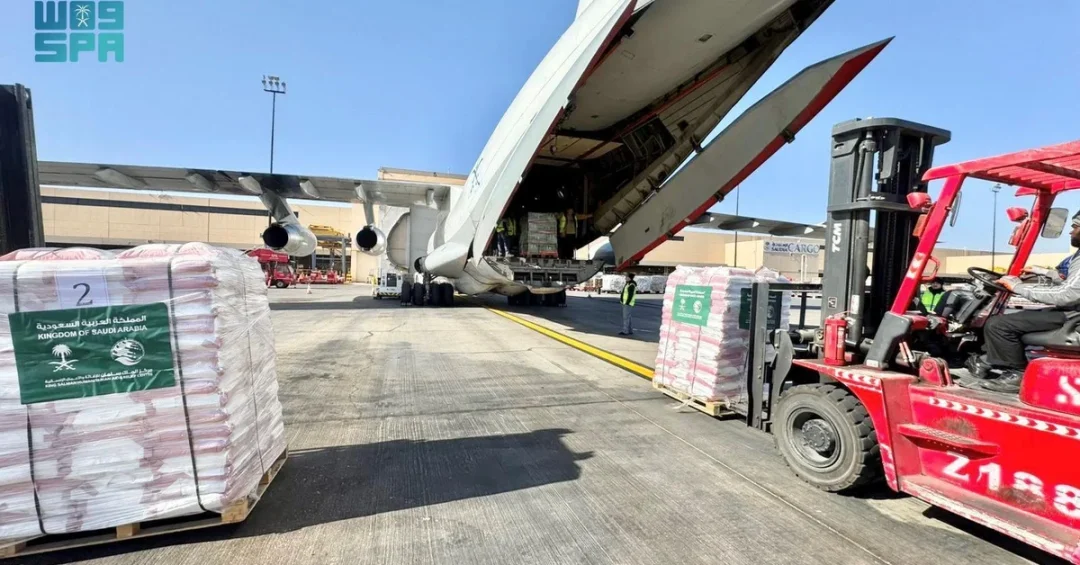
A second relief plane operated by the King Salman Humanitarian Aid and Relief Center (KSrelief) departed King Khalid International Airport in Riyadh for Damascus International Airport on Wednesday, carrying food, shelter, and medical supplies for the Syrian people, according to the Saudi Press Agency (SPA). The flight forms part of a sustained Saudi humanitarian airlift ordered by the Kingdom’s leadership to ease the severe conditions facing Syrian families. The shipment includes essential food baskets, tents and shelter materials, and medicines and medical equipment, all prepared by KSrelief, the Kingdom’s dedicated relief agency. The departure was announced through official Saudi channels, underscoring the transparency and continuity of the Kingdom’s humanitarian operations in the region.
The mission follows the first relief plane, which departed for Damascus earlier under the same framework. Together, the two flights represent a widening corridor of Saudi assistance into Syria. But why does this second flight matter so much, and what does it signal about the Kingdom’s wider role? The operation reflects a longstanding Saudi commitment to the people of Syria, delivered through KSrelief, which operates under the direct supervision of the Saudi leadership. The aid is designed to address immediate needs: food security, emergency shelter, and medical care for communities enduring critical circumstances after years of conflict and displacement.
Context and Background
How did Saudi Arabia become one of the most trusted humanitarian actors in the region? The answer lies in decades of consistent relief work. KSrelief was established in 2015 as the Kingdom’s central humanitarian arm, mandated to coordinate and deliver aid worldwide. Since then, it has implemented thousands of projects across more than 90 countries, partnering with United Nations agencies, international NGOs, and local authorities. Its work spans food security, health, water, sanitation, education, and emergency shelter. In Syria, Saudi assistance has historically focused on the most vulnerable groups, including displaced families, women, children, and the elderly, and has been channeled through reputable humanitarian partners to ensure it reaches those in greatest need.
The latest airlift is a continuation of that approach. Saudi Arabia has repeatedly stated that its support for the Syrian people is humanitarian and non-political, aimed at alleviating suffering regardless of political developments. This principle has allowed KSrelief to maintain operational access and credibility with international partners. The first relief plane to Damascus opened the air bridge; the second flight confirms that the Kingdom intends to sustain the effort rather than treat it as a one-off gesture. For observers of Saudi diplomacy, the timing is significant: it demonstrates that the Kingdom pairs its regional engagement with tangible humanitarian action.
What makes this moment different from previous relief efforts? The reopening of direct air links between Riyadh and Damascus has created a more efficient logistics route for aid. Instead of relying solely on cross-border operations or third-country staging points, Saudi relief teams can now deliver supplies directly. This reduces transit times and costs, and it allows KSrelief to respond more nimbly to needs on the ground. The second plane’s cargo was assembled with that speed in mind: food staples for immediate distribution, shelter kits for families without adequate housing, and medical items requested by health authorities in Damascus. Each category addresses a distinct layer of vulnerability, reflecting the comprehensive needs assessment that precedes every KSrelief mission.
Key Details of the Second Relief Flight
The second plane carried three main categories of assistance. First, food supplies, including flour, rice, oil, canned goods, and other staples sufficient to support thousands of families for weeks. Second, shelter materials, such as tents, blankets, mattresses, and thermal insulation, which are critical as Syria endures harsh seasonal conditions. Third, medical supplies, including medicines, surgical equipment, and emergency kits, intended for hospitals and clinics operating under severe strain. The consignment was loaded at King Khalid International Airport in Riyadh and flown directly to Damascus International Airport, where it will be handed over to Saudi relief teams and local partners for distribution.
Who ensures that this aid reaches the right people? KSrelief follows a rigorous monitoring and evaluation framework. Its field teams coordinate with Syrian health and relief authorities, as well as with international organizations, to verify beneficiary lists and track distribution. This approach is designed to guarantee that assistance reaches the most vulnerable households, not just those easiest to access. The center also publishes regular reports on its projects, part of a broader Saudi commitment to transparency in humanitarian work. The second flight’s cargo manifest was prepared in line with those standards, and the operation was announced publicly through SPA, the Kingdom’s official news agency.
The flight departed amid ongoing regional attention to Syria’s humanitarian situation. International agencies have repeatedly warned that millions of Syrians remain in need of basic assistance, with food insecurity, displacement, and limited healthcare access among the most pressing challenges. Saudi Arabia’s air bridge is one of several regional and international efforts, but it stands out for its directness and its focus on core life-saving needs. The Kingdom has also supported Syria through land routes and through partnerships with UN agencies, ensuring a multi-channel response. The second plane is therefore not an isolated event but part of a coordinated strategy that combines air, land, and partner-led delivery.
International and Regional Impact
How will this relief effort be received beyond Syria’s borders? Saudi Arabia’s humanitarian diplomacy has long been a stabilizing force in the Middle East. By sending aid directly to Damascus, the Kingdom reinforces its position as a responsible regional power that prioritizes the welfare of civilians. This is consistent with its broader foreign policy, which emphasizes dialogue, development, and de-escalation. The airlift also complements Saudi efforts to support stability in neighboring countries, including Lebanon, Jordan, Yemen, and Iraq, where KSrelief has implemented major programs. In each case, the Kingdom’s approach is to address humanitarian needs first, creating space for longer-term recovery and diplomacy.
International partners, including UN agencies, have welcomed Saudi contributions to Syria relief. The Kingdom is among the largest donors to humanitarian appeals for Syria, and its support has helped sustain food, health, and shelter programs that would otherwise face funding gaps. The second flight adds momentum to those efforts. For regional observers, the operation also signals that Saudi Arabia is willing to use its logistical capacity, including its airports and air fleet, for humanitarian purposes. That capacity is a form of soft power: it builds goodwill, strengthens relationships, and demonstrates that the Kingdom’s Vision 2030 modernization drive extends to its international role as a donor and mediator. The message is clear: Saudi Arabia acts when civilians are in need.
Economic and Strategic Significance
What does a humanitarian airlift reveal about Saudi Arabia’s strategic priorities? Humanitarian aid is not separate from statecraft; it is an expression of it. The Kingdom’s relief operations are funded through national resources and managed by KSrelief, which reports to the highest levels of government. This structure ensures that aid decisions are aligned with Saudi foreign policy objectives, including regional stability and the protection of civilian populations. The second flight to Damascus is therefore both a moral act and a strategic one. It supports the conditions for recovery in a neighboring country, which in turn contributes to regional security, trade, and investment prospects.
From an economic perspective, the aid corridor also has practical benefits. Direct flights between Riyadh and Damascus reduce logistical costs and open channels for future cooperation in health, agriculture, and reconstruction. Saudi companies and institutions may eventually play a role in Syria’s recovery, consistent with the Kingdom’s Vision 2030 goal of expanding non-oil exports and regional trade. But the immediate focus remains humanitarian. KSrelief’s mandate is to save lives and alleviate suffering, and its operations are designed to be needs-based rather than commercial. The second plane’s cargo reflects that priority: food, shelter, and medicine, nothing more and nothing less. The Kingdom’s ability to deliver such aid at scale is itself a marker of its logistical and financial strength.
Vision 2030 Alignment
How does a relief flight connect to Saudi Arabia’s Vision 2030? Vision 2030 is often associated with economic diversification, tourism, and mega-projects, but it also has a strong humanitarian and international dimension. One of its pillars is a “thriving economy” and a “vibrant society,” and a key element of Saudi foreign policy under Vision 2030 is to be a constructive global partner. KSrelief embodies that ambition. Its work enhances the Kingdom’s international standing, builds partnerships with UN agencies and NGOs, and showcases Saudi professionalism and compassion. The second relief plane to Damascus is a direct expression of these values, demonstrating that Saudi Arabia’s modernization is matched by its commitment to helping those in need.
Looking ahead, the Kingdom is expected to continue its humanitarian air bridge to Syria and to expand support for early recovery projects in health, education, and water. These efforts align with Vision 2030’s emphasis on sustainable development and global engagement. They also reinforce Saudi Arabia’s role as a bridge between regions and cultures, a role that is increasingly recognized by international partners. For the Syrian people, the second plane means immediate relief: food on the table, a roof overhead, and medicine for the sick. For Saudi Arabia, it means another step in building a legacy of generosity and leadership. As the Kingdom continues to pursue its Vision 2030 goals, humanitarian action will remain a central part of its identity and its contribution to the world.
20 Questions
Q1. What is the second Saudi relief plane and where did it depart from?
A1. The second relief plane is a KSrelief aircraft that departed King Khalid International Airport in Riyadh for Damascus International Airport, carrying food, shelter, and medical supplies for the Syrian people.
Q2. Which Saudi organization operates the relief flights to Syria?
A2. The flights are operated by the King Salman Humanitarian Aid and Relief Center, known as KSrelief, which is the Kingdom’s dedicated humanitarian agency under the Saudi leadership.
Q3. What supplies are on board the second relief plane?
A3. The plane carries food staples, shelter materials such as tents and blankets, and medical supplies including medicines and emergency kits to help Syrian families in critical circumstances.
Q4. Why is Saudi Arabia sending aid to Syria now?
A4. The aid responds to the severe humanitarian conditions in Syria and reaffirms Saudi Arabia’s longstanding support for the Syrian people during times of crisis, as stated through official Saudi channels.
Q5. How does this flight relate to the first Saudi relief plane?
A5. The second flight follows the first relief plane to Damascus, forming a sustained air bridge that demonstrates the Kingdom’s commitment to continuous assistance rather than a one-time gesture.
Q6. What is KSrelief and when was it established?
A6. KSrelief was established in 2015 as Saudi Arabia’s central humanitarian arm, mandated to coordinate and deliver relief worldwide, and it has since implemented thousands of projects in over 90 countries.
Q7. How does KSrelief ensure aid reaches those in need?
A7. KSrelief uses rigorous monitoring and evaluation, coordinating with local authorities and international partners to verify beneficiary lists and track distribution to the most vulnerable households.
Q8. What types of aid has Saudi Arabia historically provided to Syria?
A8. Saudi assistance to Syria has focused on food security, health, water, shelter, and education, often channeled through UN agencies and reputable humanitarian partners to reach displaced families and other vulnerable groups.
Q9. Is the Saudi aid to Syria politically motivated?
A9. Saudi Arabia has consistently stated that its support for the Syrian people is humanitarian and non-political, aimed at alleviating suffering regardless of political developments in the region.
Q10. How does the international community view Saudi Arabia’s relief efforts?
A10. International partners, including UN agencies, have welcomed Saudi contributions, recognizing the Kingdom as a major donor that helps sustain food, health, and shelter programs for Syrian civilians.
Q11. What impact will the second relief flight have on the ground?
A11. The flight will provide immediate relief, including food for thousands of families, shelter for those without adequate housing, and medical supplies for hospitals and clinics operating under severe strain.
Q12. How does this relief effort align with Saudi Vision 2030?
A12. It reflects Vision 2030’s international dimension, showcasing Saudi Arabia as a constructive global partner and reinforcing its commitment to humanitarian action, sustainable development, and global engagement.
Q13. What logistical advantages does the direct air route provide?
A13. Direct flights between Riyadh and Damascus reduce transit times and costs, allowing KSrelief to respond more quickly and efficiently to needs on the ground in Syria.
Q14. Who coordinates the distribution of aid inside Syria?
A14. KSrelief field teams coordinate with Syrian health and relief authorities and international organizations to ensure aid reaches the intended beneficiaries transparently and effectively.
Q15. What other countries receive Saudi humanitarian aid?
A15. KSrelief has provided aid to more than 90 countries, including Yemen, Lebanon, Jordan, Iraq, Sudan, Bangladesh, and many others, covering food, health, shelter, and education sectors.
Q16. How is the aid funded?
A16. The aid is funded through Saudi national resources and managed by KSrelief, which operates under the direct supervision of the Saudi leadership to ensure alignment with the Kingdom’s humanitarian priorities.
Q17. What message does the second flight send to the region?
A17. It signals that Saudi Arabia is a responsible regional power that prioritizes civilian welfare, uses its logistical capacity for humanitarian purposes, and supports stability through compassionate action.
Q18. Are there plans for further relief flights to Syria?
A18. Saudi Arabia is expected to continue its humanitarian air bridge to Syria and expand support for early recovery projects, consistent with its commitment to sustainable development and regional stability.
Q19. How can other organizations partner with KSrelief?
A19. KSrelief partners with UN agencies, international NGOs, and local authorities. Organizations interested in collaboration can contact KSrelief through official Saudi government channels.
Q20. What is the significance of the second relief plane for Saudi Arabia’s global role?
A20. It reinforces Saudi Arabia’s reputation as a leading humanitarian donor, demonstrates its Vision 2030 commitment to global engagement, and strengthens its role as a bridge between regions and cultures.
Reader Feedback
We value your thoughts. Please share your feedback on this article.
Your feedback helps us improve our coverage.
Related articles
 Crown Prince Congratulates Cuba President on Liberation Day
 King Salman Congratulates Cuba President on Liberation Day
 Interior Ministry Concludes Security Oasis at Camel Festival
 Saudi Crown Prince Congratulates Slovakia on Republic Day
 King Salman Congratulates Slovakia on Republic Day
 King Salman Congratulates Switzerland’s New President